RCD Maintenance Checklist for Safety
Residual Current Devices (RCDs) are vital for protecting against electrical shocks and fires, but they can fail without regular maintenance. Here's what you need to know:
- Why it matters: Electrical incidents cause over 300 deaths and 4,000 injuries annually in U.S. workplaces.
- Key tasks: Test RCDs monthly using the built-in button and professionally every three months. Inspect for damage, loose connections, or water ingress.
- Testing standards: RCDs must trip within 300ms at their rated current and 40ms at five times their rated current.
- Safety steps: Use proper PPE, follow Lockout/Tagout (LOTO) procedures, and comply with OSHA standards.
- Record-keeping: Document test dates, results, and maintenance actions to ensure compliance and reliability.
Regular checks and timely replacements keep RCDs reliable, ensuring your safety system works when it’s needed most.
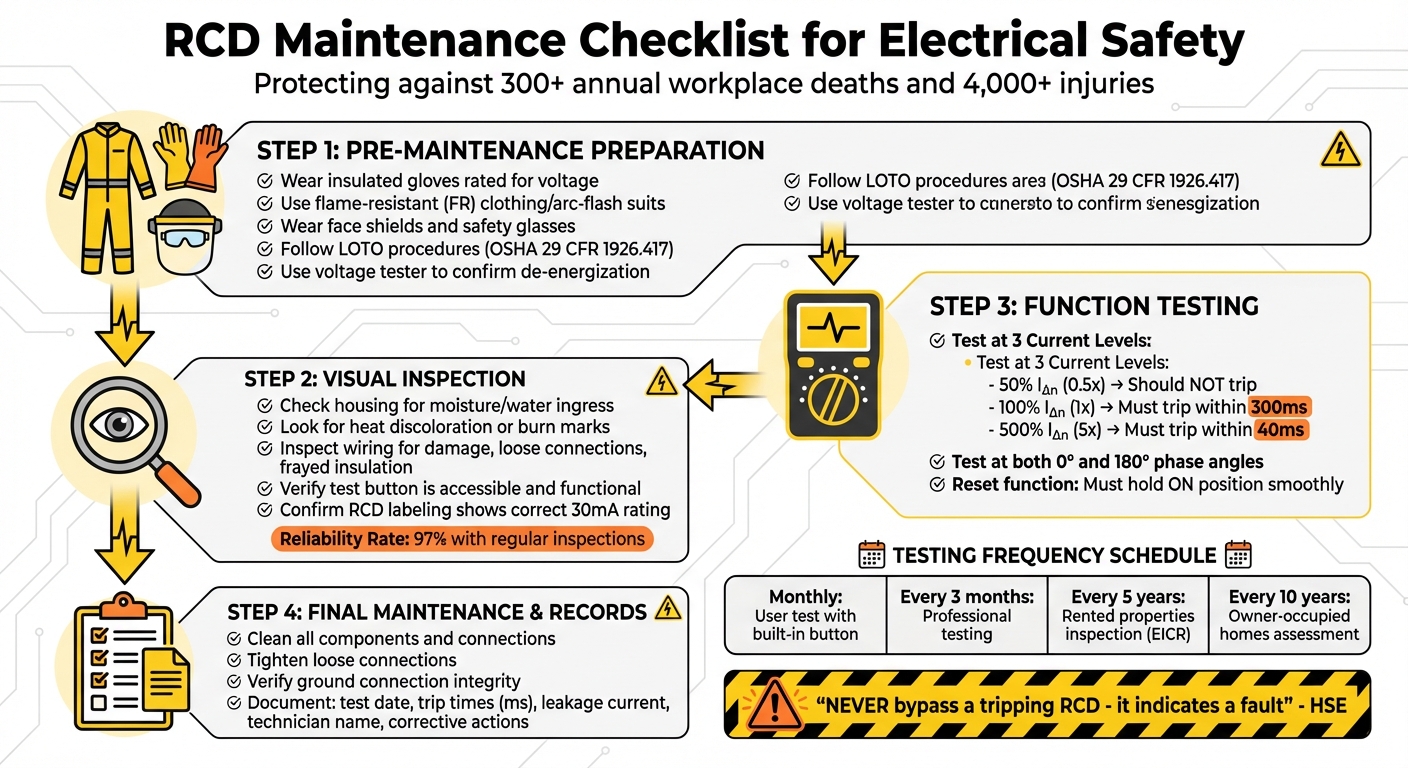
RCD Maintenance Checklist: 4-Step Safety Testing Process
Guide to completing an RCD test and how to complete the test sheet
Pre-Maintenance Preparation Steps
Before starting any RCD work, it's essential to prepare thoroughly. RCD testing is considered "live testing", meaning the circuit stays energized during the process. This introduces specific risks that demand careful safety measures and the right equipment.
Required Personal Protective Equipment
To protect against electrical hazards, always wear the appropriate personal protective equipment (PPE). This includes:
- Insulated gloves rated for the voltage you'll be working with.
- Flame-resistant (FR) clothing or arc-flash suits to shield against thermal energy.
- Face shields and safety glasses to guard against arc blast debris and intense light.
Inspect your PPE before each use to ensure it's in good condition. Additionally, use double-insulated or grounded hand tools specifically designed for electrical work.
An arc flash risk assessment should also be performed, ensuring that all labels meet current safety standards. Make sure everyone involved is trained in the testing procedures and understands how to properly use, care for, and recognize the limitations of their protective gear. Once you're equipped and ready, proceed to isolate the power supply.
Power Supply Isolation Procedures
Even though RCD testing involves live circuits, Lockout/Tagout (LOTO) procedures are essential for any preliminary or isolation work. According to OSHA standard 29 CFR 1926.417, all circuits must be de-energized and tagged at every energization point. Use a voltage tester to confirm that circuits are de-energized before beginning any work that doesn't require live power. This dual approach - LOTO for isolation tasks and controlled energization for testing - minimizes the risk of accidental voltage exposure.
Local Electrical Code Requirements
After addressing personal safety, ensure that all procedures comply with local electrical codes. In the U.S., maintenance work must align with OSHA construction standards 29 CFR 1926.404 (Wiring Design and Protection) and 29 CFR 1926.417 (Lockout and Tagging of Circuits). These regulations specify that testing should be conducted by a competent person or a licensed electrician, depending on the test's complexity.
Keep detailed records of the testing process, including the date, results (e.g., pass/fail, trip time), and the name of the tester. It's also important to review state and local regulations, as testing frequency and requirements may vary.
These safety steps lay the groundwork for the visual inspections and functional testing covered in later sections.
Visual Inspection Procedures
Once the preparation is complete, take a close look at the RCD to check for any signs of physical damage, installation errors, or other visible issues. Regular visual inspections play a key role in keeping the RCD's reliability at an impressive 97% level. This step lays the groundwork for the more detailed functional testing that follows.
Housing and Connection Inspection
Start by examining the housing for any signs of moisture or water ingress - common culprits behind unexpected RCD trips. If you spot water on electrical components, immediately turn the affected circuit fuse to the "off" position to isolate and de-energize it. Also, be on the lookout for heat discoloration or burn marks, which might indicate overheating or internal electrical issues. Check that the control lever moves freely and operates as expected: UP for reset/active, and DOWN for off.
Next, inspect the wiring and cable connections carefully. Look for any mechanical damage, punctures, loose connections, or frayed insulation, paying special attention to the outgoing terminals. Ensure the test button, often marked with a "T" or "Test" symbol, is accessible, intact, and moves without getting stuck or broken.
Labeling and Access Verification
Check that the RCD is clearly labeled - whether it's marked as an RCD, RCCB, or RCBO - and verify that its rating plate shows the correct residual operating current, typically 30mA for domestic installations. Additionally, ensure that circuit labels or pictograms on fuses and MCBs are easy to read and not faded or unclear.
"Compliance isn't just about ticking boxes - it's about protecting people from potential electrical hazards." - TIS Electrics Team
Make sure the consumer unit flap opens smoothly, allowing clear access to the RCD switches. Keep in mind that some insurance claims may be denied if an electrical incident occurs and there's no proof that the RCD was accessible and properly maintained. If you identify a faulty RCD during your inspection, immediately mark it as "faulty" and remove it from use to prevent any accidental operation.
RCD Function Testing
After completing a visual inspection, the next step is to confirm the operational reliability of the Residual Current Device (RCD).
Start by ensuring the circuit is energized, but disconnect any loads and sensitive equipment to prevent potential damage during testing.
Connect the tester leads to the Line, Neutral, and Earth terminals on the load side of the RCD. Perform tests at three current levels: 50% (0.5 IΔn), 100% (IΔn), and 500% (5 IΔn) of the RCD’s rated tripping current. Each test should be conducted at both 0° and 180° phase angles to verify the RCD's response to both halves of the AC waveform. For convenience, modern testers like the Megger 1553 can automatically run the entire test sequence. You’ll just need to reset the RCD after each trip.
Trip Current and Time Testing
To meet compliance standards, a 30mA RCD must trip within 300ms at its rated current (100% IΔn) and within 40ms at 500% of the rated current (5 IΔn, equivalent to 150mA for a 30mA device). At the 50% test level, the RCD should not trip. If it does, this might indicate standing leakage current in the circuit or an overly sensitive device. Use a ramp test to pinpoint the exact leakage threshold and diagnose potential nuisance tripping. Ensure that test current is applied for no more than 2 seconds.
| Test Current Level | Expected Result (BS EN 61008 / 61009) | Expected Result (BS 4293) |
|---|---|---|
| 50% IΔn (0.5x) | No Trip | No Trip |
| 100% IΔn (1x) | < 300ms | < 200ms |
| 500% IΔn (5x) | < 40ms | < 40ms |
Reset Function Verification
After each trip, manually reset the RCD. The reset mechanism should remain in the ON position without reverting to the tripped or OFF state. Power should restore seamlessly to the connected circuits, and the switch should operate smoothly without sticking or requiring excessive force. If the RCD fails to reset, turn off all downstream circuit breakers. If the RCD then resets and holds, the issue is likely due to a persistent circuit fault rather than a mechanical problem with the RCD.
Test Data Recording
Accurate documentation of test results is crucial. Record the trip times (in milliseconds) for each current level and phase angle. Note the leakage current at which the RCD trips during ramp testing, the RCD type, and its rated residual operating current (commonly 30mA for domestic installations). Verify that the results align with BS 7671 or other applicable standards. Additionally, confirm the functionality of the integral "Test" button to ensure the mechanical components of the device are in proper working order.
This thorough documentation not only certifies the circuit as safe and compliant but also provides a detailed safety log for future reference before moving on to the final maintenance steps.
sbb-itb-501186b
Final Maintenance Steps and Record Keeping
After completing function tests, it's time to wrap up with a thorough physical maintenance check and proper documentation.
Start by visually inspecting the RCD and nearby terminals for any signs of thermal stress, such as discoloration, carbon buildup, or overheating. Look closely for frayed or exposed wires that might pose safety risks. Also, double-check that all wiring is securely seated in the RCD terminals to avoid future issues.
Connection Cleaning and Tightening
Dust and debris can lead to overheating, so clean all RCD components and the surrounding panel carefully. Once cleaned, inspect all electrical connections to ensure they’re securely fastened. Even connections that pass digital tests can fail under physical inspection, so hands-on verification is essential. If you find any loose connections, tighten or re-terminate them immediately.
"Whether it's checking wiring connections... or visually inspecting the RCD for any signs of wear and tear, being on-site gives you a level of thoroughness that remote testing can't always match." - TIS Electrics Team
Ground Connection Verification
Reconfirm that the grounding remains intact and meets compliance standards, as verified during earlier function tests. The ground path should enable the RCD to trip within 300ms at 100% of its rated current and within 40ms at 500% of its rated current. Perform Earth Fault Loop Impedance and protective conductor continuity tests to ensure the ground path complies with code requirements. During this process, inspect the earth terminals for any physical damage or loose connections.
Maintenance Record Updates
Once all physical maintenance tasks are completed, update your records to reflect the current status. This step is just as critical as the testing itself. Your records should include:
- The test date, technician's name, and the next scheduled inspection date.
- Specific measurements like trip times (in milliseconds) and leakage current from ramp tests.
- Details of any corrective actions, such as repairs, replacements, or connection adjustments.
- Notes on physical maintenance tasks like cleaning and tightening.
- Confirmation that all RCDs and circuit breakers are clearly labeled.
"Detailed records of maintenance activities support compliance with safety regulations and are useful during inspections and audits." - TRADESAFE
Keeping precise and comprehensive records not only ensures compliance with safety standards but also simplifies future inspections and audits. Proper documentation is a cornerstone of effective maintenance.
RCD Maintenance and Replacement Schedules
Once you've confirmed that your RCD is functioning properly, it's crucial to stick to a regular testing schedule and follow appropriate replacement procedures.
Testing Frequency Guidelines
The frequency of RCD testing depends on the type of installation and its usage. For owner-occupied homes, a full electrical assessment is recommended every 10 years, while rented properties require inspections every 5 years. These inspections typically result in an Electrical Installation Condition Report (EICR).
In addition to these professional checks, perform the monthly in-circuit test as previously outlined. Industry standards also suggest having a professional test RCDs every three months.
Certain installations in the U.S. require even more frequent checks. For example:
- Caravans should be inspected every 3 years.
- Swimming pools require annual testing.
- High-risk environments like construction sites and heavy industrial settings need daily user checks and monthly combined inspections for 230V mains equipment.
- Light industrial environments typically call for formal visual inspections every 6 months, with combined testing performed every 6 to 12 months.
Response to Failed Tests
If an RCD fails a test or refuses to reset, stop using the circuit immediately and contact a qualified electrician. Avoid attempting any repairs yourself, as a malfunctioning RCD can present serious risks of electric shock or fire.
Before assuming the RCD is faulty, unplug all appliances connected to the circuit. If the RCD resets after this step, the issue may stem from one of the appliances rather than the device itself. However, if the RCD still doesn’t reset, replacement is necessary. Replace the RCD if you notice:
- A damaged or cracked cover
- Burn marks
- Frequent unexplained tripping
"Faulty RCDs should not be used and either removed for use or labeled as faulty." – Health and Safety Executive (HSE)
Older RCDs, such as those in fuse boxes with wooden backs or cast-iron switches, do not meet modern safety standards. These should be replaced, even if they pass testing. Additionally, if a periodic inspection results in an "unsatisfactory" rating, immediate corrective action is required to address potential shock or fire hazards.
Regular testing and timely replacement are essential to maintaining a safe electrical system.
Conclusion
An RCD maintenance checklist is a crucial safeguard against electrical hazards, which account for over 300 deaths and 4,000 injuries in U.S. workplaces every year. By adhering to proper testing protocols, keeping detailed records, and promptly replacing faulty devices, you establish a dependable safety system capable of meeting the critical 300-millisecond trip threshold.
Combining regular professional testing with routine user checks ensures these devices are always prepared to disconnect power instantly during a fault. One key rule to remember: never bypass a tripping RCD. As the Health and Safety Executive warns:
"An RCD is a valuable safety device, never bypass it; if the RCD trips, it is a sign there is a fault."
The reliability of your safety system also hinges on the quality of your tools. Opt for high-quality replacement components and professional-grade testing equipment. Trusted brands like Megger and Kewtech deliver the precise measurements needed to verify trip times at 50%, 100%, and 500% of the rated current - accuracy far beyond what push-button tests can achieve. Whether you're seeking budget-friendly options or advanced tools, specialized equipment ensures both safety and compliance.
For certified RCDs, professional testing gear, and power distribution components, platforms like Electrical Trader offer everything you need to maintain compliance with OSHA and NFPA 70E standards. Their selection supports maintenance programs designed to keep electrical systems safe and reliable.
Ultimately, thorough testing, careful record-keeping, and top-tier components are the backbone of reliable RCD performance. By committing to consistent maintenance and responding immediately to failed tests, you not only meet regulatory requirements but also ensure confidence in your electrical safety measures.
FAQs
How often should RCDs be tested, and who should perform the tests?
Residual Current Devices (RCDs) need to be tested at least twice a year to confirm they're working as intended. To do this, simply press the test button on the device. This action mimics a fault, ensuring the RCD trips and functions properly.
Although homeowners can handle this basic test themselves, it's important to schedule regular, more detailed inspections with a licensed electrician. These professional checks ensure the system remains safe and meets electrical safety standards.
How can I tell if an RCD needs to be replaced?
If your Residual Current Device (RCD) is acting up, it might be time for a replacement. Here are some signs to watch out for:
- The device doesn’t trip as it should during routine testing.
- It trips often without any clear reason (also known as nuisance tripping).
- It fails to protect reliably, such as not disconnecting the circuit during a fault.
Safety comes first, so don’t ignore these warning signs. If you’re uncertain about the condition of your RCD, it’s best to have a qualified electrician inspect it and determine if a replacement is needed.
Why should RCD maintenance and test results be documented?
Keeping a detailed record of RCD maintenance and test results is crucial for ensuring the device operates as intended and safeguarding electrical systems. These records not only confirm compliance with safety standards and regulations but also serve as essential documentation during inspections or audits.
Thorough documentation allows you to monitor performance trends, spot potential problems early, and create a safer environment for both individuals and equipment.