

Fire Suppression Systems for UPS Rooms
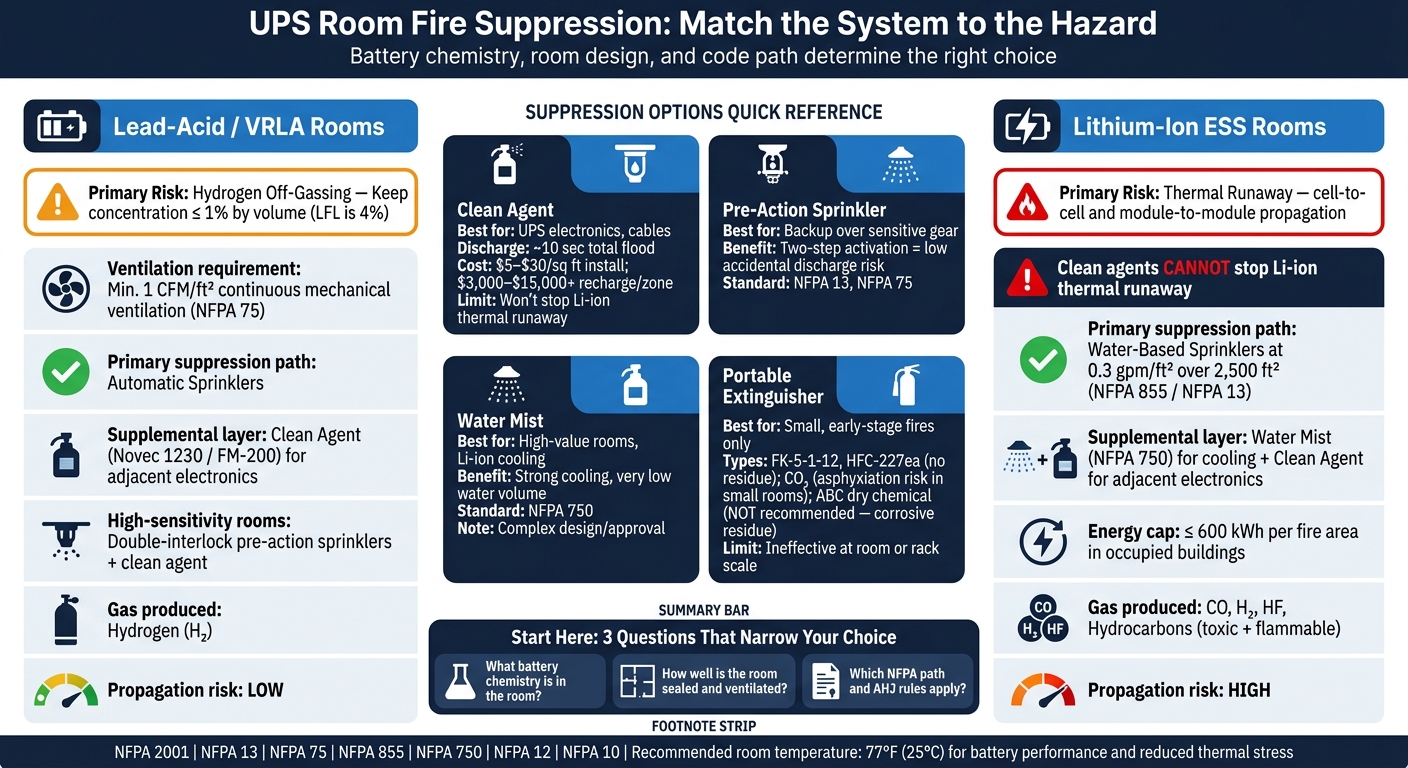
If you protect a UPS room the wrong way, the fire system can damage the equipment as much as the fire. In most cases, the right setup depends on battery type, room conditions, and code rules. For lead-acid/VRLA, the focus is often hydrogen control, room sealing, clean agent coverage, and sprinkler backup. For lithium-ion, the baseline is different: water-based cooling and control are usually required because clean agents do not stop thermal runaway.
Here’s the short version:
- Clean agent works well for small fires in UPS electronics and cables
- Pre-action sprinklers help limit accidental water release over gear
- Water mist can fit rooms where cooling matters and water volume must stay low
- Portable extinguishers only help with small, early-stage fires
- Lithium-ion rooms need water-based protection, not clean agent alone
- Lead-acid rooms need ventilation to keep hydrogen at or below about 1%
- Many UPS and battery rooms are kept near 77°F (25°C) for battery life and lower heat stress
- Clean-agent systems often cost about $5 to $30 per sq. ft., with recharge after discharge sometimes reaching $3,000 to $15,000+ per zone
UPS Room Fire Suppression Systems: Battery Type vs. Protection Method
Data Center Fire Protection Module 11A | Electrical, UPS, Batteries & ESS Safety
sbb-itb-501186b
Quick comparison
| Option | Best fit | Main upside | Main limit |
|---|---|---|---|
| Clean agent | UPS modules, cables, power electronics | No residue, safe for electronics | Needs room integrity; won’t stop Li-ion thermal runaway |
| Pre-action sprinkler | Backup for UPS rooms, battery rooms | Cuts accidental water discharge risk | Still uses water if fire grows |
| Water mist | High-value rooms needing cooling with less water | Strong cooling with lower water use | Design and approval can be more involved |
| Portable extinguisher | Small fires caught early | Fast first response | Not enough for room-scale battery events |
If I were choosing a system, I’d start with three questions: What battery chemistry is in the room? How well is the room sealed and ventilated? Which NFPA path and AHJ rules apply? Those answers usually narrow the choice fast.
UPS Room Fire Risks and the Conditions That Shape System Design
Once the hazards are on the table, the room itself becomes the next big variable. UPS rooms squeeze several ignition sources into a small footprint. Electrical faults in UPS modules, overloaded or overheated power cables, rectifier and charger failures, and battery faults can all start a fire. In a packed room, that fire can move fast. Battery chemistry, ventilation, and detection all shape the suppression choice.
Lead-Acid vs. Lithium-Ion Battery Fire Behavior
Lead-acid and lithium-ion rooms need different controls because they fail in different ways.
Lead-acid systems, including valve-regulated lead-acid (VRLA) strings, release hydrogen during charging. Hydrogen has a lower flammability limit of about 4% by volume in air, and codes usually cap room concentration at about 1% to keep a safety buffer in place. If ventilation is poor and an ignition source is present, the room can shift from a battery space to an explosion risk.
Lithium-ion systems are a different animal. During thermal runaway, a lithium-ion cell throws off intense heat, releases internal oxygen, and gives off flammable and toxic gases, including carbon monoxide, hydrogen, and hydrogen fluoride. That event can spread from cell to cell and then from module to module. Clean agents may knock down visible flame, but they do not stop lithium-ion thermal runaway. These rooms need cooling and off-gas control.
| Factor | Lead-Acid | Lithium-Ion |
|---|---|---|
| Primary hazard | Hydrogen off-gassing, explosion risk | Thermal runaway, toxic/flammable off-gas |
| Gas produced | Hydrogen | CO, H₂, HF, hydrocarbons |
| Propagation risk | Low | High (cell-to-cell, module-to-module) |
| Key design response | Ventilation, ignition control | Cooling, gas detection, water-based suppression |
Layout, Ventilation, Temperature, and Detection Factors
Room layout affects how heat, smoke, and gases move, and whether the suppression agent can get where it needs to go. Sealed penetrations and compartmentation help keep clean agents in the room. Open plenums and unsealed penetrations do the opposite and can cut system performance.
Ventilation plays two separate roles, and mixing them up can cause problems. In normal operation, it removes hydrogen from lead-acid rooms. NFPA 75 requires either continuous mechanical ventilation of at least 1 CFM/ft² of floor area or a design that keeps hydrogen at or below 1% by volume during worst-case simultaneous boost charging. FM Global Data Sheet 5-28 also stresses hydrogen control.
During an incident, ventilation has to work in step with alarm and suppression release. If it runs at the wrong time, it can spread smoke or thin out the agent concentration. Put simply: exhaust and suppression need the right sequence so ventilation doesn't work against the fire system.
Temperature control also matters for fire risk. Multiple engineering and manufacturer sources recommend keeping UPS and battery rooms at 77°F (25°C) for battery performance and service life. A room that runs hot ages batteries faster, adds electrical stress, and pushes lithium-ion systems closer to thermal instability. Hot spots near battery strings or power electronics aren't just a maintenance issue. They're an early warning sign.
Detection should be layered, not one-dimensional. Use smoke, heat, hydrogen, and off-gas sensors tied to alarm, HVAC shutdown, and suppression release. Those signals help determine whether the room needs clean agent, pre-action sprinkler, or water mist protection.
These conditions decide whether clean agent, pre-action sprinkler, or water mist protection fits the room.
Fire Suppression Options for UPS Rooms
The right suppression setup for a UPS room depends on three things: battery chemistry, room integrity, and the code path for the space. In practice, that usually points you toward clean agent, pre-action, water mist, or portable extinguishers.
Clean Agent Systems for Electronic Equipment Areas
Clean agents are often the first line of response in UPS rooms and other electronic equipment spaces. They discharge fast, leave no residue, and don't conduct electricity. In U.S. facilities, the two main agents are FK-5-1-12 (Novec 1230) and HFC-227ea (FM-200). Both are used in total-flooding systems under NFPA 2001.
FK-5-1-12 is a fluorinated ketone that puts out fire mostly through heat absorption. It has a low toxicity profile, which makes it suitable for occupied UPS rooms. Typical system designs use about 4% to 6% by volume, with total-flood discharge in roughly 10 seconds.
HFC-227ea works through a mix of heat absorption and chemical flame inhibition. But it has a much higher global warming potential, and that has brought more regulatory pressure. As a result, many facilities are moving toward FK-5-1-12 and similar fluoroketones while HFC agents face tighter review.
Both agents are a good fit for incipient fires in UPS modules, cable trays, and power electronics. That said, there's an important limit here: clean agents may knock down visible flame, but they do not stop lithium-ion thermal runaway. They also depend on room integrity and ventilation shutdown to work as intended.
Clean agent handles the first hit. Water-based protection steps in when cooling and containment matter more.
| Clean Agent | Primary Mechanism | UPS Room Fit | Discharge Consideration | Residue | Key Limitation |
|---|---|---|---|---|---|
| FK-5-1-12 (Novec 1230) | Heat absorption | Strong for electronics and VRLA rooms | About 10-second total flood; room integrity required | None | Does not stop Li-ion thermal runaway propagation |
| HFC-227ea (FM-200) | Heat absorption + chemical flame inhibition | Strong for electronics; declining use | About 10-second total flood; room integrity required | None | Higher GWP; regulatory pressure increasing |
Pre-Action Sprinklers, Water Mist, and Layered Water-Based Protection
Pre-action sprinklers are the standard water-based backup in many UPS rooms. NFPA 13 and NFPA 75 often call for water-based backup along with clean agent protection.
These systems keep the piping dry during normal conditions. Water enters the pipe only after a detection signal opens the pre-action valve, and then a sprinkler head still has to activate before any water is released. That two-step sequence is why pre-action systems are favored over wet-pipe systems above sensitive UPS gear. If a sprinkler head gets damaged by accident, you get an air pressure drop and an alarm - not an immediate dump of water over your equipment.
For lithium-ion battery rooms, the code gets even more direct. NFPA 855 requires sprinkler protection per NFPA 13, which makes water-based backup the expected baseline in those spaces.
Water mist systems work a little differently. They use ultra-fine droplets to cool the fire area hard while using much less water than standard sprinklers. That's a big deal in rooms packed with costly electrical equipment. They're also especially relevant for lithium-ion battery hazards, where cooling the cells and nearby structure is key to slowing propagation.
The tradeoff is design complexity. Water mist systems must comply with NFPA 750 and usually need manufacturer-specific testing for the exact hazard involved. So while they can be a strong fit, they aren't as plug-and-play as standard sprinkler systems.
| System | Primary Protection Role | Water Exposure Risk | Li-Ion Thermal Runaway Response | Key Standard |
|---|---|---|---|---|
| Clean agent (FK-5-1-12 / HFC-227ea) | First response; incipient fire suppression | None | Insufficient alone | NFPA 2001 |
| Pre-action sprinkler | Water-based backup; escalating events | Low (two-step activation) | Effective for cooling and control | NFPA 13, NFPA 75, NFPA 855 |
| Water mist | Cooling-focused; Li-ion and high-value equipment | Very low (fine droplets) | Strong cooling; slows propagation | NFPA 750 |
Hand-held extinguishers belong at the bottom of this stack. They help with small, early-stage events. That's about it.
Portable Extinguishers and Their Realistic Limits
Portable extinguishers do have a place in UPS rooms, but the role is narrow. They're meant for small, localized fires caught early. A hand-held FK-5-1-12 or HFC-227ea unit can help with a single UPS power module failure or a minor cable fault if someone catches it fast enough. A 10 lb CO₂ extinguisher has short discharge time and limited reach, which sharply limits its use in a fast-moving UPS fire.
Once a fire moves beyond that stage, portable units run out of road. No hand-held extinguisher can handle a multi-rack battery fire or a thermal runaway event that is already spreading.
CO₂ also comes with a serious life-safety issue. In a small or poorly ventilated room, it can create an asphyxiation hazard. NFPA 12 sets strict safety procedures for its use in enclosed spaces. And while ABC dry chemical extinguishers work on many fire classes, they leave corrosive residue behind. In a UPS room, that residue can damage sensitive electronics, which makes ABC a poor choice in most cases.
| Extinguisher Type | Typical UPS Room Use | Benefits | Drawbacks | Relevant Standard |
|---|---|---|---|---|
| Clean agent (FK-5-1-12 / HFC-227ea) | Small UPS module or cable fires | No residue; non-conductive; good for electronics | Limited capacity; ineffective at cabinet or room scale | NFPA 10 |
| CO₂ | Small electrical fires | No residue; non-conductive | Asphyxiation risk; short range and discharge time | NFPA 10, NFPA 12 |
| ABC dry chemical | General fire use; not recommended for UPS rooms | Wide fire class coverage | Corrosive residue damages electronics; cleanup required | NFPA 10 |
Extinguishers are a supplement, not the plan. After this, the key task is checking the NFPA path and the AHJ requirements for the system you're planning to use.
U.S. Codes, Standards, and Compliance Checkpoints
Before you specify a system, pin down which standards apply and how the AHJ reads them. After you know the suppression method, the next move is checking the code path before you buy equipment. In most U.S. UPS rooms, that usually means NFPA 75, NFPA 13, and NFPA 855.
NFPA 75, NFPA 13, and NFPA 855 in UPS and Battery Rooms
NFPA 75 applies to UPS rooms in IT and telecom spaces. It often points teams toward clean-agent protection with water-based backup.
NFPA 13 covers sprinkler protection. Its electrical-room omission exception is narrow. The room must be dedicated to electrical equipment, use only dry-type or listed liquid-type equipment, be enclosed by 2-hour fire-rated construction, and contain no combustible storage. Mixed-use UPS rooms usually do not qualify.
Lithium-ion rooms follow a separate code path. NFPA 855 applies to lithium-ion ESS rooms. It limits energy to about 600 kWh per fire area in occupied buildings, requires 3 ft separation unless UL 9540A supports less, and calls for sprinkler density of 0.3 gpm/ft² over 2,500 ft², along with barriers, ventilation, and gas detection.
The AHJ decides which standard takes the lead and how any conflicts are handled. Getting that input early - before equipment purchase - can save you from an expensive redesign.
Documentation, Listings, and Approval Points to Verify
At this stage, compliance is less about picking hardware and more about getting the submittal right. Approval depends on a complete package, and missing core items can slow review.
The table below shows the usual link between room type, likely code references, expected suppression path, and the main approval items.
| Room Type | Primary Standards | Expected Suppression Path | Key Approval Items |
|---|---|---|---|
| UPS room in IT/data center area | NFPA 75, NFPA 2001, NFPA 13 | Clean agent protection coordinated with sprinkler backup | UL-listed agent system components; above- and below-floor coverage; sequence of operations |
| UPS room with lead-acid batteries | NFPA 13; NFPA 75 if part of an ITE area | Sprinklers per NFPA 13 | Room classification; fire separation; sprinkler omission conditions verified |
| UPS room with lithium-ion ESS | NFPA 855, NFPA 13, NFPA 75 | Water-based protection per NFPA 13 at 0.3 gpm/ft²; clean agent supplemental | UL 9540 listing; UL 9540A test report; hazard mitigation analysis; energy cap compliance |
Submit a sequence-of-operations matrix that shows detection, alarm, HVAC shutdown, damper closure, agent release, and ESS shutdown.
For rooms with large battery systems, NFPA 855 may also call for a hazard mitigation analysis. This is a documented review of thermal runaway scenarios, gas release events, and occupant evacuation conditions. The AHJ may ask for these analyses when reviewing alternative layouts or suppression densities that still meet NFPA 855's minimum safety goals. Large battery banks often need this analysis for approval.
How to Select a Fire Suppression System for a UPS Room
A Step-by-Step Selection Process for Buyers and Facility Teams
Once you’ve nailed down the hazard and the code path, the next step is simple in theory: match the system to the room and its limits.
Start with the battery setup. Look at the chemistry first, then the total stored energy. Before any vendor review, document the manufacturer, model, nominal voltage, amp-hour rating, and total kWh across all strings.
From there, turn to the room itself. Check wall and ceiling ratings, ceiling height, raised floors, HVAC airflow, and any openings to nearby spaces. That part matters more than many teams expect. A room with leaks can weaken clean-agent hold time fast, which can rule out one option and push you toward another. In practice, those details often narrow the field to clean agent, pre-action, or water mist.
It also helps to lock in the governing code path early and review it with the AHJ before you make a final equipment choice. That can save time, change orders, and a lot of back-and-forth later.
Cost needs a long view too. Don’t stop at install price. Lifecycle cost is where the picture gets more honest:
- Upfront clean-agent systems often run $5–$30 per square foot
- Annual testing can add $800–$8,000
- A post-discharge recharge can add $3,000–$15,000+ per zone
It’s also smart to leave room in the budget for future battery changes. If lithium-ion cabinets get added later, the space may need a full suppression re-analysis.
Sourcing UPS Room Electrical Equipment and Upgrade Components
Procurement usually comes right after the protection decision. If the suppression upgrade also includes breakers, transformers, or distribution gear, Electrical Trader can help source those electrical components in one place.
Conclusion: Match the Suppression Method to the Battery Hazard, Room Design, and Code Path
Battery chemistry and stored energy set the starting point. After that, room layout, detection, code path, and budget shape the final system.
Clean agents do a good job protecting sensitive electronics, but they cannot stop lithium-ion thermal runaway once it propagates. For lithium-ion rooms, water-based protection is the baseline. Lead-acid and VRLA rooms give teams more options, but they still need a clear code path and AHJ sign-off.
Early detection, proper room separation, and a documented basis-of-design are what make a system easier to approve and insure. The table below gives a quick view of likely system paths by battery type and room sensitivity.
| Battery Type | Room Sensitivity | Primary Suppression | Supplemental Layer |
|---|---|---|---|
| Lead-acid / VRLA | Low to moderate | Automatic sprinklers | Clean agent for adjacent electronics |
| Lead-acid / VRLA | High (IT-adjacent) | Clean agent (FM-200, Novec 1230, inert gas) | Double-interlock pre-action sprinklers |
| Lithium-ion ESS | Any | Water-based (sprinklers at 0.3 gpm/ft²) | Clean agent for adjacent electronics |
| Mixed chemistry | High | Water-based primary; clean agent for electronics areas | Layered detection (aspirating smoke plus gas/thermal runaway detection) |
FAQs
Do I need clean agent or water-based protection?
It depends on your fire safety needs and the battery chemistry in use.
Clean agent systems, such as Novec 1230 or FM-200, are often installed in UPS rooms because they help protect sensitive electronic equipment. That said, they may not deliver enough cooling to deal with battery thermal runaway.
NFPA 855 requires automatic water-based sprinkler systems for indoor battery installations. Because of that, many facilities use both: clean agent systems for equipment protection and water-based systems for fire suppression.
Can clean agent stop a lithium-ion battery fire?
Often, no. Clean agent systems can fall short because they don't provide the cooling needed to control thermal runaway.
Agents like Novec 1230 may help only if they discharge early, before cell venting gets worse. But in practice, clean agents on their own haven't stopped cascading thermal runaway.
That's why water-based suppression is often the better choice. It helps cool the cells and limit fire spread.
What codes apply to a UPS room fire system?
UPS room fire systems usually need to line up with NFPA 70 for electrical safety, NFPA 75 for spaces that house electronic equipment, NFPA 855 for battery-based systems, and UL 1778 for UPS equipment safety.
Final approval, along with any site-specific rules, usually comes from the local Authority Having Jurisdiction (AHJ).