

Explosion-Proof Fans: Features and Benefits
Explosion-proof fans are designed for hazardous environments where flammable gases, vapors, or dust pose a risk. Unlike standard fans, they prevent sparks, overheating, and ignition, making them essential for industries like oil refineries, chemical plants, and grain facilities. Here’s a quick overview of their key features:
- Materials: Non-sparking metals (aluminum, stainless steel) and flameproof housings.
- Safety Features: Thermal monitoring, static control, and IP55–IP65 ratings for dust and water protection.
- Certifications: ATEX, IECEx, and NEC compliance for hazardous zones (0/20, 1/21, 2/22).
- Applications: Paint booths (50–100 ACH), battery rooms (6–10 ACH), and more.
Standard fans, by contrast, lack these safety measures and are suited for non-hazardous spaces like offices or warehouses. Explosion-proof fans are pricier, starting at $513 and reaching over $19,000 for industrial models, but they ensure safety in dangerous settings. Choose based on your environment's risk level and compliance needs.
1. Explosion-Proof Fans
Materials and Construction
Explosion-proof fans are built using materials that minimize the risk of sparks, which could ignite hazardous atmospheres. Metals like aluminum alloy and brass are commonly used because they don't produce sparks when struck or rubbed. In environments where corrosion is a concern, manufacturers often turn to stainless steel (AISI 304) or advanced composites like ZAmid ATEX for added durability and safety.
The fan housing is tailored to withstand specific environmental challenges. For low-corrosion areas, heavy-gauge sheet steel coated with epoxy or polyester powder is sufficient. In more aggressive chemical environments, conductive plastics such as polyethylene (PE-EL) or polypropylene (PP-EL) are preferred. Motors are housed in flameproof enclosures (Ex d) to contain internal sparks or heat, while encapsulated electronics add another layer of safety. Shaft seals are also crucial, as they block flammable fumes from entering the motor. To ensure protection against dust and water, these fans are rated between IP55 and IP65. Together, these design elements ensure the fan operates safely, even in hazardous conditions.
Operational Safety
Safety is a top priority for explosion-proof fans, which incorporate features like thermal monitoring and static control. Built-in PTC thermistors monitor motor temperature, automatically shutting down the fan if it exceeds a critical threshold - typically around 130°C. To prevent static buildup, the fans are equipped with dedicated bonding and grounding systems.
Temperature classifications (ranging from T1 to T6) ensure that surface temperatures remain within safe limits. For instance, a T4 rating restricts surface temperatures to a maximum of 275°F (135°C). High-performance models can move up to 200,000 m³/hr (117,720 CFM) of air and operate under pressures of up to 150 mBar (2.18 psi).
Protection Mechanisms
Explosion-proof fans use multiple protective measures to ensure safety in hazardous environments. Flameproof enclosures (Ex d) are designed to contain any internal explosions, preventing flames or sparks from escaping into the surrounding atmosphere. Increased safety designs (Ex e) further reduce the chances of sparks, arcs, or excessive heat during normal operation.
These fans also meet AMCA spark resistance standards, which classify designs into three types:
- Type A: All airstream components are made from nonferrous materials.
- Type B: Features a spark-resistant impeller and a nonferrous rubbing ring at the shaft entry.
- Type C: Ensures that moving ferrous parts cannot come into contact.
These construction standards align with zone classifications for hazardous environments: Zone 0/20 for constant risks, Zone 1/21 for occasional risks, and Zone 2/22 for rare risks.
Applications
Explosion-proof fans are indispensable in industries where flammable substances are present. They are widely used in oil and gas refineries, chemical plants, grain silos, paint booths, battery charging rooms, and pharmaceutical production facilities. These fans maintain high Air Changes per Hour (ACH) to dilute combustible concentrations effectively. For example:
- Paint booths typically require 50–100 ACH.
- Solvent mixing rooms need 20–30 ACH.
- Battery charging rooms operate with 6–10 ACH.
Prices for these fans vary based on size and capacity. Smaller 8-inch models are priced around $513, while industrial 12-inch units cost approximately $4,482. Larger, heavy-duty fans can reach prices close to $14,741. Many modern designs are also certified for use in hydrogen-rich environments (Group IIC or IIB+H2), which demand even stricter tolerances due to hydrogen's high volatility.
2. Standard Ventilation Systems
Materials and Construction
Standard ventilation systems are built using materials like powder-coated steel, aluminum, and stainless steel. These materials are chosen for their durability and ease of maintenance, prioritizing cost-efficiency over spark prevention. The fans in these systems use conventional materials that don't inherently guard against sparks. Motors are typically Totally Enclosed Fan Cooled (TEFC) or open designs, but they lack flameproof ratings. The housing is designed for general air circulation, humidity control, and thermal management. Its purpose is to prevent issues like mold growth or equipment overheating, rather than containing potential internal explosions.
Let's dive into how these design choices impact safety during operation.
Operational Safety
Unlike explosion-proof systems, standard ventilation systems rely on dilution ventilation and basic overload protection to manage safety. Dilution ventilation works by allowing contaminants to mix into the air, reducing their concentration to levels below the Permissible Exposure Limit. However, these systems are not suitable for environments with explosive gases or dust. Standard fans can create sparks, static discharge, or hot surfaces, leading to ignition risks in hazardous atmospheres. In contrast, explosion-proof systems include features like thermistor relays and temperature class ratings (T1-T6). Standard fans, on the other hand, typically offer only thermal overload protection to support continuous operation.
Protection Mechanisms
Standard fans are equipped with basic thermal overload protection and sealed motors, which help safeguard the equipment and extend motor lifespan. However, they lack advanced features designed to prevent sparks or ignition. For example, while explosion-proof fans eliminate static discharge risks through bonding and grounding, standard systems may still generate static during use.
In terms of ingress protection, these systems generally achieve IP55 ratings, which protect against dust and water jets. Some specialized models can reach IP65 ratings for enhanced protection.
Applications
The limitations of standard systems define their safe applications. These systems are ideal for warehouses, commercial kitchens, offices, and general assembly lines where flammable atmospheres are not a concern. They are effective for tasks like temperature control, humidity management, odor elimination, and handling low-toxicity vapors. However, poor or inadequate ventilation is linked to about 50% of indoor air quality issues in non-industrial workplaces.
What Makes A Fan Explosion Proof
sbb-itb-501186b
Pros and Cons
Explosion-Proof vs Standard Fans: Key Differences and Specifications
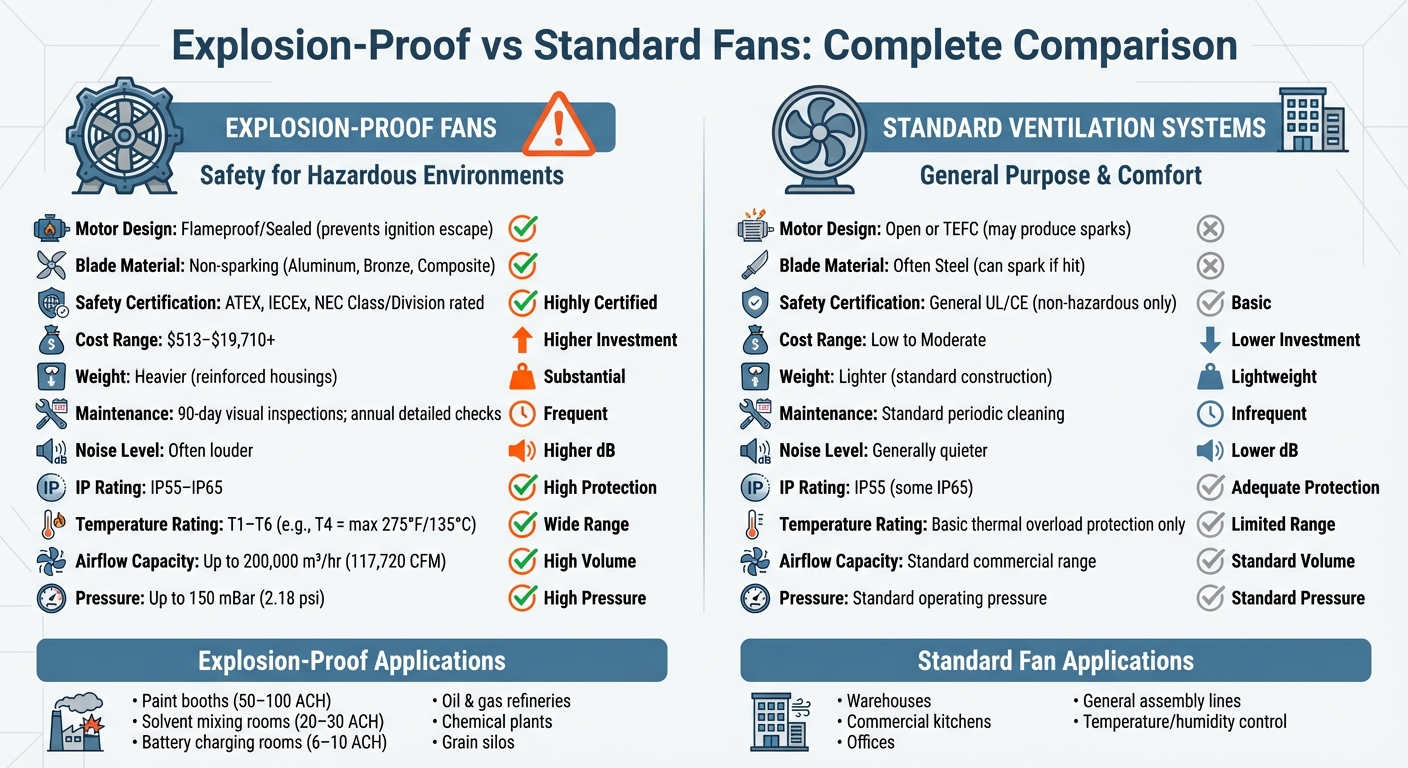
Deciding between explosion-proof fans and standard ventilation systems means weighing their advantages and drawbacks. Explosion-proof fans are engineered for safety in hazardous environments. They are built to contain internal explosions, use materials that minimize spark risks, and comply with stringent safety standards like ATEX, IECEx, and NEC Class/Division ratings. On the downside, they come with a hefty price tag - ranging from $513 for smaller 8-inch models to over $19,710 for industrial units. These fans are also heavier due to reinforced housings, consume more energy, and tend to be noisier than standard fans. Maintenance is another challenge, requiring visual inspections every 90 days and detailed annual checks of seals and bearings.
Standard ventilation systems, on the other hand, shine in areas like cost, weight, and quiet operation. They are well-suited for spaces like warehouses, offices, and commercial kitchens where flammable atmospheres aren’t a concern. These systems effectively manage temperature and humidity but are unsuitable for hazardous areas. Their open or TEFC motors can generate sparks, ferrous blades may spark on impact, and static discharge isn’t actively controlled. Additionally, they lack the safety certifications needed for use in dangerous environments.
| Feature | Explosion-Proof Fans | Standard Ventilation Systems |
|---|---|---|
| Motor Design | Flameproof/Sealed; prevents ignition escape | Open or TEFC; may produce sparks |
| Blade Material | Non-sparking (Aluminum, Bronze, Composite) | Often Steel; can spark if hit |
| Safety Certification | ATEX, IECEx, NEC Class/Division rated | General UL/CE (non-hazardous only) |
| Cost Range | $513–$19,710+ | Low to Moderate |
| Weight | Heavier (reinforced housings) | Lighter (standard construction) |
| Maintenance | 90-day visual; annual detailed | Standard periodic cleaning |
| Noise Level | Often louder | Generally quieter |
The performance gap between the two is clear. Explosion-proof fans, often made from stainless steel or FRP, can handle high static pressure and exposure to corrosive chemicals but require extensive grounding and bonding. Standard fans, designed for clean air environments, lack the durability for harsh conditions and only need basic grounding. Each type serves its purpose, but the environment and safety requirements should guide your choice.
Conclusion
When choosing between explosion-proof and standard fans, the environment dictates the decision. Facilities dealing with flammable gases (Class I), combustible dusts (Class II), or ignitable fibers (Class III) must use explosion-proof equipment - it’s a safety requirement, not an option. On the other hand, standard fans work well in clean, non-hazardous spaces like offices, warehouses, or commercial kitchens where volatile materials aren’t a concern.
Start by identifying the type of hazardous area: is it continuous (Division 1/Zone 1) or occasional (Division 2/Zone 2)?. Then, ensure the fan’s certification - whether ATEX, IECEx, or NEC Class/Division - matches the specific zone. This ensures compliance with environmental safety standards. Don’t overlook airflow calculations: CFM = (Room Volume × ACH) ÷ 60. For example, a paint booth might require 50–100 air changes per hour, while a battery charging room may only need 6–10 ACH.
Material selection is another key factor. Stainless steel works well in corrosive settings, aluminum is ideal for general non-sparking needs, and composites suit corrosive atmospheres. Additionally, check the fan’s T-rating to ensure it stays below the ignition temperature of the substances in your facility. For instance, a T4 rating ensures the surface temperature won’t exceed 275°F (135°C).
FAQs
What safety certifications should explosion-proof fans have?
Explosion-proof fans are designed to meet stringent safety standards, ensuring they can function safely in environments where hazards like flammable gases or dust are present. Key certifications include UL (Underwriters Laboratories) for use in the United States, ATEX for compliance within the European Union, and IECEx, which is recognized globally. These certifications guarantee that the fans have been thoroughly tested to avoid sparks, overheating, or other dangers that could lead to ignition.
When choosing an explosion-proof fan, it's crucial to confirm that it carries the appropriate certification for your specific application and region. This not only safeguards the environment but also ensures adherence to local safety regulations.
What makes explosion-proof fans safe for hazardous environments?
Explosion-proof fans are built to function safely in environments where flammable gases, vapors, or dust are present. They accomplish this by incorporating sturdy materials and tightly sealed enclosures that prevent sparks or heat from escaping, which could otherwise ignite the surrounding atmosphere. On top of that, their electrical components, such as motors, are specially designed and rated to reduce the chances of sparking or overheating.
These fans are also designed to contain any internal explosions, preventing them from spreading to the external environment. This feature makes them a critical safety measure in industries like chemical processing, oil and gas, and manufacturing, where hazardous conditions are part of daily operations.
What industries require explosion-proof fans?
Explosion-proof fans play a critical role in industries where flammable gases, vapors, dust, or fibers could lead to dangerous explosions. Industries like oil and gas, petrochemicals, chemical manufacturing, mining, pharmaceuticals, and food processing rely on these fans to ensure safety in high-risk environments. Proper ventilation in such settings is not just a preference - it's a necessity to eliminate ignition risks.
These fans are specifically designed to prevent sparks, excessive heat, or internal explosions from igniting hazardous substances. By doing so, they help facilities meet strict safety standards like NEC, ATEX, and IECEx. Beyond compliance, explosion-proof fans safeguard employees, equipment, and infrastructure, all while ensuring effective ventilation in potentially volatile areas.