

Emergency Repairs: High Voltage Safety Tips
When high voltage equipment fails, safety should always come first. Rushing repairs can lead to serious injuries or fatalities. Here’s what you need to know:
- High Voltage Defined: Anything above 600 volts is classified as high voltage and requires strict safety measures.
- Key Hazards: Energized equipment, backfeeds, arc flashes, and residual charges can pose lethal risks.
- Safety Steps: Always de-energize systems, use proper protective equipment (PPE), maintain minimum approach distances, and test voltage before starting work.
- Environmental Risks: Storms and damaged lines add complexity - treat all downed lines as energized until verified safe.
- Preparation Matters: Regular training, clear communication, and maintaining spare parts can reduce risks during emergencies.
Prioritize safety by following structured procedures, equipping workers with the right tools, and ensuring all hazards are assessed before repairs begin. Every decision made in the first moments of an emergency impacts the outcome.
How Are High Voltage Power Lines Maintained and Repaired?
sbb-itb-501186b
Common High Voltage Hazards in Emergency Repairs
Emergency repair sites are unpredictable, with hazards that can appear and change quickly. This makes identifying and addressing them a critical task.
Hazard Identification Challenges
Some hazards are not immediately visible. Energized components may appear de-energized, and high-capacitance systems can retain dangerous levels of energy even after being powered down. Additionally, nearby energized lines can create induced voltages, adding unexpected risks.
Misjudging whether a component is live - or assuming a line is dead without proper testing - can lead to violations of minimum approach distances (MAD) and the use of incorrect personal protective equipment (PPE). This increases the likelihood of electrocution. Before starting work, always assess all voltages and equipment conditions using a properly rated voltage detection device. Conduct a job briefing to cover potential hazards, work procedures, energy controls, and PPE requirements:
"Existing characteristics and conditions of electric lines and equipment that are related to the safety of the work to be performed shall be determined before work on or near the lines or equipment is started." - 29 CFR 1910.269(a)(15)
Single-line diagrams are crucial for identifying all potential energy sources, including backfeed risks from portable generators or circuit ties that could re-energize lines thought to be safe.
On top of equipment hazards, environmental conditions often add another layer of danger.
Outdoor Hazards: Downed Lines and Damaged Equipment
Storm recovery scenarios bring unique challenges. Common threats include downed power lines, leaning poles, and damaged transformers or insulators. These dangers are often compounded by unknown chemicals or gas leaks near electrical equipment.
Treat all downed or damaged lines as energized until qualified personnel complete the 6-step de-energization and grounding procedure. This includes testing with a voltage detection device and applying protective grounds. OSHA also mandates that lines must be treated as energized unless all de-energization steps under 1910.269(m) are followed.
Step potential - the voltage gradient near downed lines - poses another risk, as it can cause shocks without direct contact. To minimize this danger, establish clearly marked safety zones using brightly colored tape placed at waist height. This helps protect both workers and the public. Additionally, any accessible switching devices must be disabled while open to prevent accidental re-energization.
The table below summarizes some of the most common outdoor hazards and their safety measures:
| Hazard | Quick Identification | Key Safety Control |
|---|---|---|
| Downed Lines | Sparks near conductors; visual inspection | Mark safety zones, ground equipment, coordinate with utilities |
| Backfeed | Voltage testing; portable generators | Use transfer switches; follow grounding procedures |
| Damaged Equipment | Humming sounds; broken insulators; leaks | Inspect visually; use insulated tools |
| Arc Flash | Burning smell; thermal imaging for hot spots | Wear arc-rated clothing (CAT 4); use face shields |
| Stored Energy | Single-line diagrams; voltage testers | Perform de-energization, LOTO, and re-grounding |
Electrical arcs are especially dangerous during storm recovery. These arcs can reach temperatures of 35,000°F - hotter than the surface of the sun - and their pressure waves can cause severe injuries even from a distance. As the StormWatt Team explains:
"Think of electrical arcs during storm recovery as hidden thunderstorms in a calm sky. Just like sudden lightning can strike unseen, these hazards lurk silently, ready to surprise you." - StormWatt Team
To further enhance safety, OSHA requires at least two employees to be present when working on lines energized above 600 volts. This ensures immediate CPR assistance if a shock occurs. At fixed locations like substations, staffing must be adequate to reach a victim within 4 minutes. Always work in pairs when handling high-voltage repairs.
Key Safety Controls for High Voltage Emergency Work
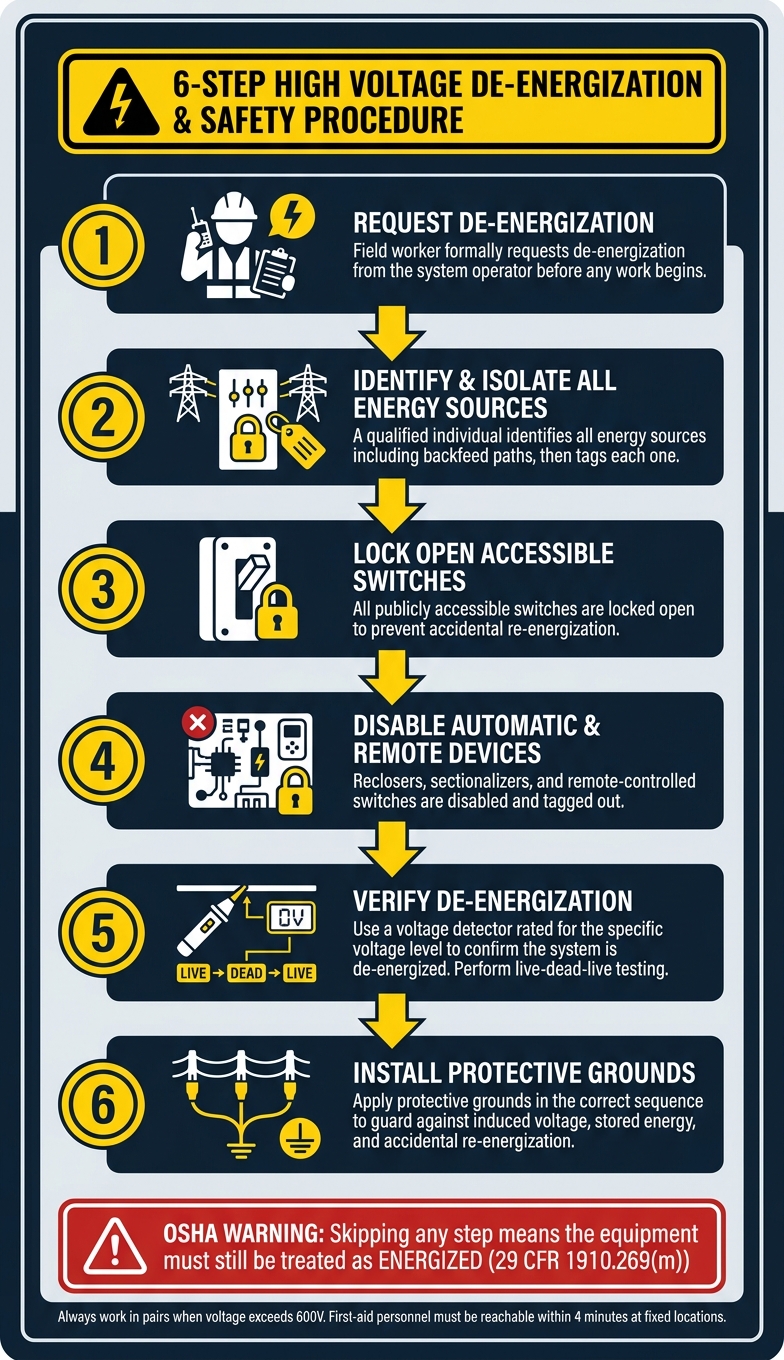
6-Step High Voltage De-Energization & Safety Procedure
Understanding the risks is just the beginning. The real challenge lies in implementing the right safety measures before any equipment is handled.
De-Energization, Lockout/Tagout, and Voltage Testing
De-energizing high voltage equipment follows a precise six-step process. First, the field worker formally requests de-energization from the system operator. Next, a qualified individual identifies and isolates all energy sources, including potential backfeed paths, and tags them. Publicly accessible switches are locked open. Automatic devices such as reclosers and sectionalizers are disabled and tagged, while remote-controlled switches are switched to local control. Verification of de-energization is then performed using a voltage detector rated for the specific voltage level. The final step involves installing protective grounds in the correct sequence.
"Any line, circuit, or equipment that has been shut down can only be worked on as deenergized if all of the 1910.269(m) requirements are met; if all are not met, then the work must be done as if the line, circuit, or equipment is still energized." - Occupational Safety and Health Administration
Skipping even one step in this process means the equipment must still be treated as if it’s energized. For tagout devices, OSHA mandates that they must be non-reusable, attachable by hand, and able to withstand a minimum unlocking strength of 50 pounds. As OSHA clarifies, "tags are essentially warning devices affixed to energy isolating devices and do not provide the physical restraint on those devices that is provided by a lock". This makes it essential to use locks alongside tags whenever possible.
Once the equipment is confirmed de-energized and secured, the next step is selecting the right PPE and maintaining safe working distances.
PPE Selection and Safe Working Distances
For emergency repairs, choosing proper PPE and maintaining safe distances is just as critical as de-energizing the equipment. The process starts with identifying the type of exposure. A qualified worker must determine whether the hazard is phase-to-ground or phase-to-phase. If the Minimum Approach Distance (MAD) could be breached, either by the worker or a conductive object they’re handling, insulating equipment must be rated for phase-to-phase exposure. For rubber insulating equipment, the maximum use voltage tops out at 36 kV.
| Voltage Range (Phase to Phase) | Minimum Approach Distance |
|---|---|
| 300V and less | Avoid contact |
| Over 300V, not over 750V | 1 ft. 0 in. |
| Over 750V, not over 2kV | 1 ft. 6 in. |
| Over 2kV, not over 15kV | 2 ft. 0 in. |
| Over 15kV, not over 37kV | 3 ft. 0 in. |
| Over 37kV, not over 87.5kV | 3 ft. 6 in. |
| Over 87.5kV, not over 121kV | 4 ft. 0 in. |
| Over 121kV, not over 140kV | 4 ft. 6 in. |
Workers must also eliminate or cover any conductive jewelry and clothing, such as rings, watches, necklaces, and metalized aprons, before approaching energized equipment. Use ladders with nonconductive siderails, and always test equipment rated for circuits over 600 volts for proper functioning both before and after use.
Working Safely in Adverse Conditions
When conditions are less than ideal, extra precautions are necessary. Adverse weather significantly increases risks. OSHA is clear on this:
"Thunderstorms in the vicinity, high winds, snow storms, and ice storms are examples of adverse weather conditions that make live-line barehand work too hazardous to perform safely." - OSHA
If high winds risk pushing conductors below the MAD, work must stop unless insulating guards are applied to energized lines or exposed equipment. Workers should also position themselves to ensure that a slip or shock won’t bring them into contact with uninsulated parts at a different potential. For worksites located above 3,000 feet, MAD values must be adjusted using an altitude correction factor. For example, at elevations between 4,921 and 5,905 feet, a factor of 1.08 applies. Nonconductive measuring tools should always be available to confirm distances when visibility is poor or footing is unstable.
Safe Practices During High Voltage Emergency Repairs
When handling high voltage repairs, following a strict sequence of safety procedures is critical. Cutting corners, even under pressure, can turn a fixable issue into a deadly situation.
Securing the Scene
The first step after a high voltage failure is to control access to the area. Clear nonessential personnel and ensure everyone remaining is equipped with proper personal protective equipment (PPE). Publicly accessible switching devices, such as pole-mounted handles, should be locked open or have their handles removed to prevent accidental re-energization.
Before starting any work, the person in charge must conduct a thorough job briefing. This briefing should cover potential hazards, the steps involved, and PPE requirements.
For field operations involving equipment energized at 50 volts or more, at least two trained first-aid providers must be present. In fixed locations like substations, first-aid personnel should be able to reach an exposed worker within 4 minutes.
Once the scene is secured, the next step is verifying that the equipment is safe to handle.
Rapid Assessment and Isolation
Controlling the scene doesn’t automatically make the equipment safe. Verification of isolation is mandatory. As JINPOWER explains, "De-energized is a status. Safe to touch is a protected condition."
A qualified individual must identify all potential energy sources, including backfeeds from generators, cogenerators, or load-side sources, which could re-energize equipment even after the primary power source has been disconnected. Open all switches, disconnectors, jumpers, and taps, and ensure they are tagged and rendered inoperable. Disable automatic and remote-controlled devices to prevent unintended operation during repairs.
After isolating the equipment, use a voltage detector to confirm it is de-energized. Then, install protective grounds. Grounding safeguards workers by creating a fault current path that trips protective devices, shielding against induced voltage, stored energy, or accidental re-energization. Protective grounds should only be removed after all workers are confirmed clear and repairs are complete.
Temporary Repairs and Equipment Replacement
Once isolation and grounding are complete, repair work can begin. For temporary fixes, ensure all components are properly rated for the system’s voltage and fault current levels. Never use parts that are undersized or unrated, even when time is tight.
In cases of major failures requiring replacement, the decision between repair and replacement often hinges on time. Emergency transformer suppliers can typically ship stock units within 24 to 48 hours, whereas a factory rebuild may take 2 to 6 months. For facilities where downtime costs thousands of dollars per hour, a replacement unit delivered in two days is often the most practical solution.
Before re-energizing any replaced equipment, it must pass critical tests such as insulation resistance (megger), turns ratio (TTR), and winding resistance tests.
Finding properly rated replacement equipment quickly can be a major challenge during emergencies. Companies like Electrical Trader offer a broad inventory of new and used high voltage components, including breakers, transformers, and power distribution equipment, helping to minimize delays when time is of the essence.
Organizational Steps to Reduce Emergency Repair Risks
Handling high voltage emergencies without preparation can lead to costly mistakes and severe safety hazards. Organizations that prioritize proactive measures are better equipped to manage these situations effectively.
Training and Qualified Personnel
High voltage work is not for just anyone - it requires properly trained and qualified personnel. According to OSHA and NFPA guidelines, a "qualified person" must have the skills and knowledge to operate, install, and repair high voltage equipment, recognize electrical hazards, and take the right precautions.
Training programs should include critical topics like minimum approach distances (MAD), choosing the right PPE, using insulated tools, and emergency response techniques such as pole-top and manhole rescues. Proficiency in CPR and first aid is also essential.
"The degree of training shall be determined by the risk to the employee for the hazard involved." - 29 CFR 1910.269
This isn’t a one-and-done process. NFPA 70E standards are updated every three years, making regular retraining a must. OSHA also mandates retraining for tasks performed less than once a year. For high-risk tasks - like those involving incident energy above 40 cal/cm² - this level of preparation is non-negotiable.
Preventive Maintenance and Spare Parts Inventory
Proper training is just one piece of the puzzle. Preventive maintenance plays an equally important role in reducing risks during emergency repairs. With over 400 arc flash incidents reported annually in the U.S. - each costing an average of $1.5 million due to injuries, downtime, and equipment replacement - having a maintenance plan is critical.
A tiered maintenance schedule can help keep equipment in top shape:
- Monthly: Visual inspections of panels
- Quarterly: Thermal scans of transformers and motor control centers
- Annually: Breaker trip testing and insulation resistance checks
- Every five years: Comprehensive arc flash risk assessment updates
"The two most common electrical safety failures in facility management are both documentation failures, not equipment failures... NFPA 70E compliance is not about doing the right things. It is about being able to prove it in a retrievable format when someone asks." - Jim Phillips, PE, CESCP, NFPA 70E Technical Committee Member
For inventory, it’s essential to maintain a "quick-ship" data sheet for critical assets. This should include details like kVA rating, primary and secondary voltage, impedance percentage, and physical dimensions. Having this information readily available can significantly reduce delays when replacements are needed.
Clear Procedures and Communication Protocols
During high voltage emergencies, clear communication and structured procedures are non-negotiable. Ambiguity can lead to serious mistakes. One person should always be in charge of clearance for the entire crew. If multiple crews are involved, they must either coordinate under a single lead or use separate but synchronized tagging systems.
Every job - even routine ones - requires a formal pre-work briefing. If conditions change during the task, an updated briefing is mandatory. When contractors are involved, the host employer must inform them of any site-specific hazards, and contractors, in turn, must report any new risks they identify.
Once repairs are complete, implement a "soak period" to monitor the equipment during its initial operation. Watch for any unusual sounds, vibrations, or temperature changes before resuming full production. Follow this with a post-incident review to refine procedures and address any shortcomings exposed during the emergency.
Conclusion: Key Takeaways for High Voltage Emergency Repairs
High voltage emergency repairs require precision and careful planning. The difference between a controlled repair and a disastrous outcome often comes down to the early decisions made and the level of preparation in place.
To ensure safety, always perform live-dead-live testing, fully de-energize the system, establish proper grounding, wear the correct PPE, and conduct a detailed crew briefing - updating it as conditions evolve. As JINPOWER aptly states: "De-energized is a status. Safe to touch is a protected condition." From cutting the power to securing the right equipment, every step is critical.
Having accurate information about your equipment beforehand can significantly reduce response times. Knowing the specifications of your critical assets allows for quicker decisions when replacements are needed. Resources like Electrical Trader offer a variety of high-voltage components, such as transformers and breakers, ensuring you can source replacements promptly. This readiness underscores the importance of proactive planning.
Organizations that excel in handling high voltage emergencies are those that prepare long before an issue arises. Regular training, clear communication protocols, documented maintenance schedules, and pre-positioned spare parts are all essential elements. Following these practices helps ensure both safety and uninterrupted operations.
Every safe repair begins with the decisions made well before the emergency occurs.
FAQs
How do I confirm equipment is truly de-energized?
To ensure equipment is safely de-energized, follow these critical steps:
- Isolate, Lock Out, and Tag: Follow established procedures to isolate the equipment and apply lockout/tagout devices to prevent accidental re-energization.
- Verification by a Qualified Person: A trained and qualified individual must confirm that the equipment cannot restart.
- Test for Voltage: Use a properly rated voltage detector to check for any remaining voltage.
Always perform a live-dead-live test to confirm your voltage detector is functioning correctly. Until all these steps are completed and protective grounds are in place, treat the equipment as if it is still energized. Safety first!
What should I do if I see a downed power line?
Always treat a downed power line as if it’s live and hazardous, even if it looks inactive. Call 911 right away to report the situation. Keep a safe distance - at least 30 feet from distribution lines and 100 feet from transmission lines. Never attempt to touch, move, or drive over a fallen line. If a power line lands on your vehicle, stay inside until emergency responders confirm it’s safe to leave. Your safety depends on it.
When should a repair become a full equipment replacement?
If your electrical equipment is nearing the end of its 20–30-year service life, it might be time to consider a replacement. Signs like overheating, strange noises, frequent tripping, or repair costs exceeding 50% of the replacement value are clear indicators. Replacement is also necessary if you can’t find manufacturer-approved parts, the equipment fails to comply with updated safety codes like NFPA 70E, or if your power demands surpass the system's capacity or reliability.