

High-Voltage Withstand Testing Equipment Guide
High-voltage withstand testing, or the hipot test, ensures electrical insulation can handle voltages higher than normal operating levels. This test is crucial for identifying insulation flaws that could lead to shocks, short circuits, or failures in equipment like transformers, cables, and consumer electronics. Here's what you need to know:
- Key Parameters: Voltage levels (500 V to 800 kV), test duration (1-60 seconds), and insulation properties.
- Equipment: Hipot testers, ground bond testers, DC generators, and test leads ensure accurate testing and safety.
- Safety Measures: Use interlock systems, automatic discharge circuits, and personal protective equipment (PPE) to prevent hazards.
- Advanced Tools: Automated systems and remote monitoring improve efficiency and precision, offering features like programmable controls and data logging.
Testing ensures compliance with standards (e.g., UL, IEC) and helps prevent electrical hazards. Proper tools and training are essential for accurate and safe operations.
DC Hipot | "How-To" Video
sbb-itb-501186b
Key Testing Parameters You Need to Know
Understanding high-voltage testing parameters is crucial for selecting the right equipment and ensuring safety compliance. Key factors like voltage level, test duration, and insulation properties play a major role in detecting potential failures.
Voltage Levels and Their Applications
Voltage applications set the stage for defining testing parameters.
Dielectric testing typically uses voltages between 500 V and 30 kV, depending on the rated voltage of the device and applicable safety standards. For utility-grade equipment, such as AC high-voltage circuit breakers, testing spans a much wider range - from 4.76 kV to 800 kV. High-voltage circuit breakers generally fall under testing protocols for equipment with rated maximum voltages exceeding 1,000 V AC.
Selecting the appropriate voltage range depends on the application. Consumer electronics and general electrical products typically fall within the 500 V to 30 kV range, adhering to standards like UL, IEC, and CE. Medical devices follow IEC 60601 requirements, while electric vehicles must comply with ISO 6469 specifications.
| Application / Equipment Type | Relevant Standard | Typical Voltage Range |
|---|---|---|
| General Electrical/Consumer Products | UL, IEC, CE | 500 V to 30 kV |
| Information Technology Equipment | UL 60950 | Standard-specific |
| Medical Electrical Equipment | IEC 60601 | Defined safety levels |
| Electric Vehicles (EV) | ISO 6469 | Specific EV safety specs |
| Laboratory & Measurement Equipment | IEC 61010 | Defined safety levels |
| AC High-Voltage Circuit Breakers | IEEE C37.09 | 4.76 kV to 800 kV |
Test Duration and Safety Standards
The duration of the test is just as important as the voltage applied. A controlled ramp-up time helps avoid sudden voltage spikes, while a sufficient dwell time - when the voltage is held at its peak - is critical for spotting insulation flaws. If the dwell time is too short, defects might go undetected, leading to safety risks.
"Incorrect test voltage or dwell time... could leave insulation weaknesses undetected and compromise safety." - Vitrek
International standards like UL 60950 for IT equipment and IEC 60601 for medical devices outline specific test durations to ensure safe performance under real-world conditions. For DC testing, it’s essential to account for the time needed to charge the insulation’s capacitance. Always use an auto-discharge feature or manually discharge the device afterward to eliminate any hazardous residual voltage.
These timing considerations are critical for selecting the right equipment and ensuring reliable test results.
Insulation Resistance and Dielectric Strength
Insulation resistance gauges how well insulation prevents current leakage, while dielectric strength measures the highest voltage an insulator can handle before breaking down. These metrics are vital for identifying potential issues in transformers, switchgear, and cables, helping to maintain equipment performance and extend its lifespan.
Advanced tools are needed for accurate testing. Very Low Frequency (VLF) testing - operating at 0.1 Hz or lower - is ideal for high-capacitance loads like solid dielectric cables, transformers, and motors. This method uses smaller, more portable equipment compared to standard 50/60 Hz testers. For on-site transformer and bushing evaluations, fully automatic instruments can precisely measure dielectric loss (tg) and capacitance (Cx). Modern hipot testers offer high-resolution leakage current measurements down to picoamps, making it easier to detect even the smallest insulation defects.
Required High-Voltage Testing Equipment
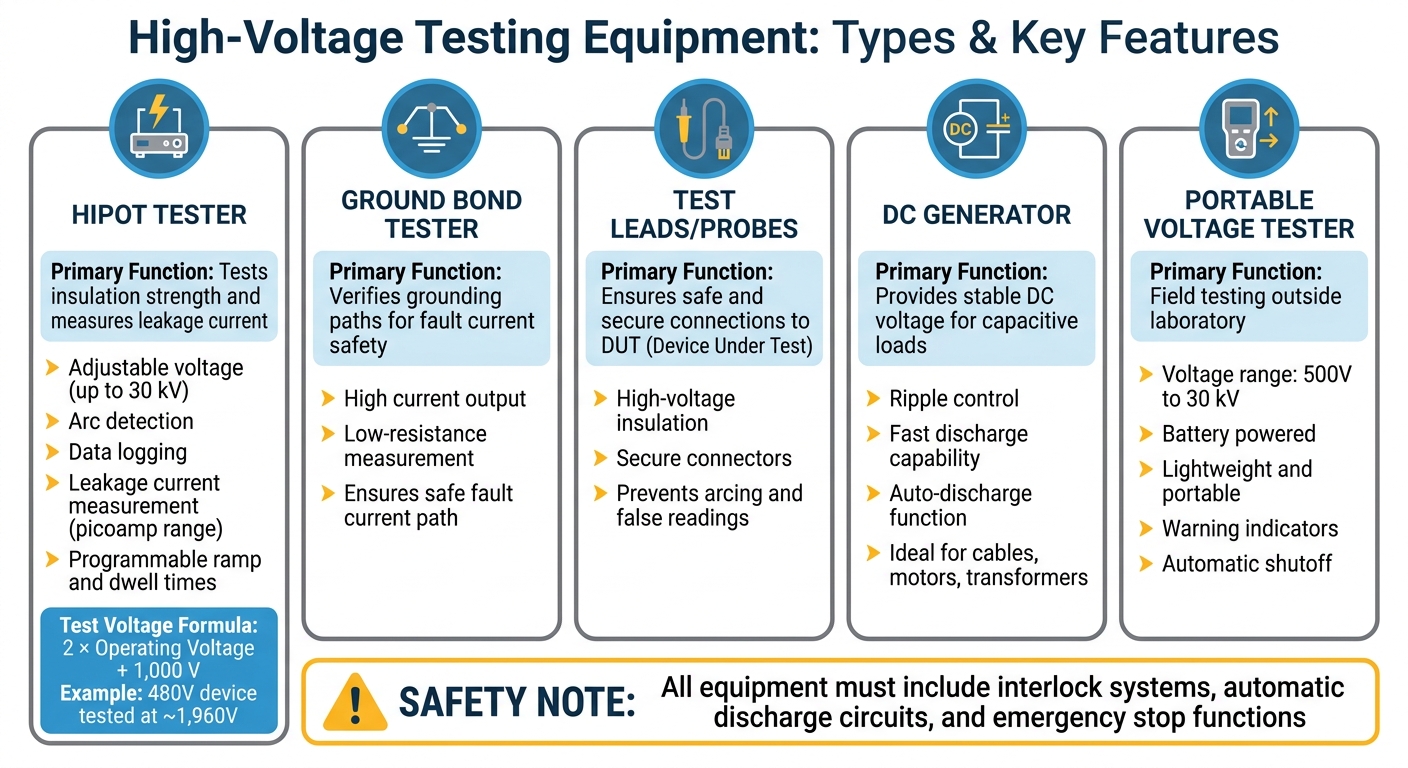
High-Voltage Testing Equipment Types and Applications Comparison Chart
When it comes to high-voltage testing, having the right tools is essential for accurate and safe operations. These tools are designed to apply voltage, ensure proper grounding, and measure leakage current effectively.
Here’s a closer look at the key equipment used in high-voltage testing:
Hipot testers (short for high potential testers) are the cornerstone of high-voltage testing. They apply high voltage between a product’s live components and grounded parts to check for insulation breakdown by measuring leakage current. Modern hipot testers often include adjustable voltage settings (up to 30 kV), arc detection, and data logging for tracking test results over time. For example, the standard test voltage formula - 2 × Operating Voltage + 1,000 V - means a 480-V device is tested at around 1,960 V. Advanced models can measure leakage currents in the picoamp range. Look for features like programmable ramp and dwell times, safety interlocks, and automated discharge for added functionality.
Secure connections are just as critical as voltage application. Test leads and probes play a key role in ensuring safe and reliable connections. High-quality leads with proper insulation prevent breakdowns and ensure accurate readings. On the flip side, poor-quality or worn connections can result in arcing, false readings, or even dangerous exposure to high voltage.
A proper grounding path is another must-have. Ground bond accessories - such as testers, clamps, and cables - ensure that all conductive paths can safely carry fault currents to ground before testing begins. This step is vital for protecting both the equipment and the operator. High-quality ground bond testers typically offer high current output and precise low-resistance measurements.
For testing capacitive loads like long cables or motors, DC high-voltage generators are the go-to option. Unlike AC testing, DC testing eliminates the capacitive leakage current, making it easier to measure true resistive leakage. Features like auto-discharge help remove residual voltage safely after testing.
When testing needs to happen outside the lab, portable voltage testers are indispensable. These compact devices are easy to transport and ideal for fieldwork. When choosing a portable tester, consider factors like voltage range (typically 500 V to 30 kV), battery life, weight, and safety features such as warning indicators and automatic shutoff.
| Equipment Type | Primary Function | Key Features to Look For |
|---|---|---|
| Hipot Tester | Tests insulation strength and measures leakage current. | Adjustable voltage (up to 30 kV), arc detection, data logging |
| Ground Bond Tester | Verifies grounding paths for fault current safety. | High current output, low-resistance measurement |
| Test Leads/Probes | Ensures safe and secure connections to DUT. | High-voltage insulation, secure connectors |
| DC Generator | Provides stable DC voltage for capacitive loads. | Ripple control, fast discharge capability |
Each piece of equipment plays a specific role in ensuring safe and efficient high-voltage testing, whether in a lab or out in the field.
Safety Considerations for High-Voltage Testing
When working with high-voltage testing, safety isn't just important - it's critical. Even a current as low as 0.1 A for just 2 seconds can be lethal, and currents above 75 mA may lead to ventricular fibrillation. That's why strict safety protocols are essential to protect both operators and equipment.
Built-in Safety Features in Testing Equipment
Modern testing equipment is designed with safety in mind. For example, interlock systems prevent voltage from being applied until all safety barriers are in place. Emergency stop buttons and remote start switches - whether foot or hand-operated - allow operators to maintain a safe distance from live circuits.
Another critical feature is automatic discharge circuits, which safely drain residual energy from capacitors and the device under test once the procedure is complete. This is especially important since capacitors can hold dangerous charges even after being de-energized. Additionally, real-time leakage current monitoring automatically shuts down the system if current levels exceed safe limits, reducing the risk of insulation failure or injury.
Visual and audible alerts, such as high-voltage indicator lights and alarms, ensure everyone nearby is aware when equipment is active. Advanced tools like smart probes (e.g., Vitrek SmartProbes) come with built-in calibration data to streamline setup and minimize errors. Isolation transformers are another key feature, ensuring separation between high-voltage circuits and low-voltage control systems.
These built-in safeguards work hand-in-hand with personal safety practices, which are equally important.
Personal Protective Equipment (PPE) Guidelines
Before starting any high-voltage test, remove all conductive jewelry and use rubber mats on floors and work surfaces. According to the IEC 61010 standard, any voltage above 30V is considered hazardous.
Follow the "one-hand rule" - keep one hand in your pocket to avoid creating a current path through your chest. Electrical engineer Edvard Csanyi offers this timeless advice:
"Treat all electrical devices as if they are live or energized. You never know".
When checking for overheating, use the back of your hand. This ensures that, if a shock occurs, muscle contractions will pull your hand away from the conductor rather than causing it to grip.
Safe Testing Environment Setup
Creating a safe workspace is just as important as using the right equipment. Always set up grounded barriers around the test area, as capacitive coupling can cause arcing over distances of 3 to 4 feet. The Vitrek 4700 Operator's Manual emphasizes:
"The user should not put any part of their body in proximity to the connections while high voltages are present (at least 1 inch per kV is recommended)".
Before beginning any test, verify that all equipment and enclosures are properly grounded. Post clear safety signs and use high-voltage warning lights to alert others when testing is underway. Avoid conducting tests in environments with contaminants, high humidity, or condensation, as these conditions can compromise insulation. Lastly, always assume capacitors are charged until proven otherwise. Use a grounding stick to discharge any remaining energy before handling components.
Automation and Advanced Testing Solutions
Manual high-voltage testing can be time-consuming and prone to human error. Automated test systems solve these problems by using programmable controls to handle tasks like voltage ramp-up, current limits, and data recording. These systems allow users to set test voltages ranging from 100 to 5,000 V AC, current limits from 0.1 to 100 mA, and durations anywhere between 0.1 seconds and 99 minutes.
Automated Test Systems
Automation integrates smoothly with existing safety protocols, simplifying the entire testing process. Advanced systems, such as the Vitrek V7X and 95X Series, leverage QT Insite automation software to seamlessly incorporate high-voltage testing into production workflows. These testers can measure leakage current down to picoamps and include arc detection to catch insulation failures during high-speed testing. Another example, the ETL ATS400 HG-AC System, combines AC high-voltage testing (100–5,000 V), ground bond testing (up to 25 A), and functional testing into a single, efficient unit. It even supports remote control via PC and offers programmable test times, enabling fully automated testing sequences.
In high-volume environments, high-voltage switch matrices are invaluable. These systems automate testing across multiple device points without requiring manual lead changes, significantly improving throughput. Additionally, programmable ramp and dwell functions ensure a gradual voltage increase, helping to avoid damaging transient spikes while maintaining consistent stress levels across all devices being tested.
Remote Monitoring and Data Logging
The benefits of automation extend beyond efficiency to include improved safety and data management. Remote monitoring has transformed how operators handle testing workflows. For example, systems like the ETL ATS400 allow centralized control of test parameters and sequences from a PC, enabling a single operator to manage multiple test stations at once.
Data logging further enhances the advantages of automation. Advanced systems automatically capture test results and waveforms, creating secure, tamper-proof records of leakage values and compliance data. These records align with global standards such as UL, IEC, and ISO 17025. By eliminating the need for manual note-taking, these systems speed up the creation of compliance reports and certificates, improving traceability - a critical factor for quality assurance and regulatory audits.
Conclusion and Key Takeaways
Choosing the right high-voltage testing equipment is about more than just meeting technical requirements - it’s about safeguarding lives and ensuring the reliability of power systems. Devices like transformers, switchgear, and power cables demand precise compliance, as highlighted by Five Star HV: "High voltage testing equipment plays a crucial role in ensuring the safety and reliability of power transmission and distribution systems".
Today’s advanced testers, with features like picoamp leakage resolution, can identify even the smallest insulation weaknesses. This is critical for meeting standards such as UL 60950, IEC 60601, and ISO 17025. Vitrek underscores the risks, noting that "any failure in insulation can lead to dangerous consequences like shocks, fires, or even complete product breakdowns". These points align with earlier discussions about automation and rigorous safety practices. To maintain safety, ensure proper grounding, test the functionality of safety interlocks, and always use personal protective equipment. Regular calibration is equally important to avoid inaccurate measurements and unsafe products while supporting thorough quality control.
Investing in reliable testing equipment and comprehensive operator training leads to consistent results, compliance with regulations, and the prevention of electrical failures. Whether conducting lab tests or field assessments, selecting the right equipment - be it AC or DC, portable or stationary - is essential for accuracy and safety.
If you’re looking for high-quality equipment that meets these demanding standards, check out advanced high-voltage testing tools available at Electrical Trader.
FAQs
Should I use AC, DC, or VLF for my hipot test?
The decision to use AC, DC, or VLF testing hinges on the application and the type of insulation involved.
- AC testing is widely used for general cable insulation. It applies higher test voltages to verify safety margins effectively.
- DC testing is straightforward and excels at pinpointing specific defects in the insulation.
- VLF testing (very low-frequency AC) works best for long cables and large systems. It reduces partial discharges and minimizes stress on the equipment during testing.
Your choice should align with the specific requirements of your equipment and testing objectives.
How do I choose the right test voltage and dwell time?
When performing dielectric withstand tests, it's important to choose a test voltage that aligns with the insulation strength of the equipment and complies with relevant safety standards. Typically, this voltage is higher than the equipment's normal operating level to ensure the insulation can handle stress beyond everyday conditions.
For the dwell time, consult standards such as IEEE or IEC. These guidelines outline how long the voltage should be applied - long enough to evaluate the insulation's performance effectively, but not so long that it risks causing undue stress or damage to the equipment.
What safety steps should I take before touching the DUT after a test?
Before handling the Device Under Test (DUT) after a high-voltage test, make sure it has been fully discharged and is no longer holding any charge. Always follow established safety protocols, including using proper grounding and discharge techniques. Confirm that the DUT is physically grounded and that all safety barriers are securely in place. To prevent the risk of electric shock, never touch the DUT immediately after testing without first verifying it is safe.