

Ultimate Guide to Voltage Equipment Aging Tests
Voltage equipment aging tests simulate years of wear and tear in a short time by applying higher-than-normal voltage and temperature. This process identifies potential failures in insulation, stator coils, and high-voltage cables before they occur in critical systems. For instance, a 13.8 kV coil may undergo 30 kV stress for 400 hours at 212°F to mimic long-term usage. These tests follow strict standards, like IEEE 1043 and 1553, ensuring reliable results across manufacturers.
Key Insights:
- Purpose: Detect insulation weaknesses and manufacturing flaws early.
- Methods: Thermal cycling, electrical overstress, burn-in testing, and voltage endurance tests.
- Standards: IEEE 1407-2021 guides testing for cables up to 46 kV.
- Maintenance: Continuous monitoring tools like Partial Discharge (PD) and Dissolved Gas Analysis (DGA) help track equipment health.
- Best Practices: Isolate stress factors, control environmental conditions, and follow statistical sampling protocols.
Aging tests are essential for preventing failures, extending equipment life, and ensuring reliability in industrial environments.
Understanding Medium Voltage Cable Aging: Preventing Power Failures
sbb-itb-501186b
Industry Standards and Guidelines
Voltage equipment aging tests are built on standardized frameworks to ensure consistent and reliable results across various laboratories and manufacturers. These standards cover everything from how test equipment should be set up to how data should be interpreted. This consistency allows for objective comparisons of cable performance and helps identify potential issues early. Below, we’ll take a closer look at some of the key standards and regulations shaping these tests.
IEEE Standards
The IEEE 1407-2021 standard lays out guidelines for accelerated aging tests of extruded electric power cables rated between 5 kV and 46 kV. Released on February 3, 2022, this updated standard extends the previous 35 kV limit set in the 2007 version. The testing involves water-filled tanks designed to mimic the environmental stress that can degrade cable insulation over time. This approach helps engineers predict how materials will perform after years of use in the field.
Under IEEE 1407-2021, manufacturers can choose between two main testing methods: time-to-failure tests or fixed-time aging followed by diagnostic evaluations like step AC breakdown tests. The IEEE Power and Energy Society's Insulated Conductors Committee (PE/IC) oversees and updates these guidelines. Their work ensures detailed instructions on test equipment, specimen selection, control methods, and data analysis, making it easier to achieve consistent results across different laboratories. This level of standardization reduces the risks of inconsistent testing.
U.S. Regulatory Compliance Requirements
In the U.S., compliance regulations build upon IEEE protocols to enforce strict safety and reliability standards for voltage equipment. The technical details outlined in IEEE 1407-2021 serve as the foundation for these compliance checks, providing uniform methodologies for test control and measurement techniques. Regulatory bodies rely on these standardized approaches to evaluate performance, ensuring that equipment meets the necessary reliability benchmarks before being deployed in critical environments like industrial facilities or power distribution networks.
Common Aging Test Methods
Selecting the right aging test method is all about understanding the specific stresses voltage equipment will encounter in real-world conditions. Each method focuses on different types of failure mechanisms - whether it’s thermomechanical fatigue in solder joints or insulation breakdown in high-voltage cables. These tests are essential for predicting long-term performance with greater accuracy.
Thermal Cycling Tests
Thermal cycling replicates the heating and cooling cycles that equipment experiences during operation. This method is particularly effective at targeting thermomechanical fatigue, a leading cause of failure in high-power semiconductors and solder joints. Researchers Lakshmi Gopireddy, Leon Tolbert, and Burak Ozpineci explain:
"The main failures in high power semiconductors are caused by thermomechanical fatigue. Power cycling and temperature cycling are the two most common thermal acceleration tests used in assessing reliability."
Thermal cycling tests provide valuable insights into the long-term reliability of equipment designed for continuous use - sometimes exceeding 100,000 hours, or roughly 20 years. They are commonly used to evaluate printed circuit board assemblies, mechanical interfaces, and cables, where problems like delamination or cracked solder joints are most likely to occur.
Next, let’s look at test methods that focus on electrical stress to uncover hidden defects in insulation and semiconductors.
Electrical Overstress and High Potential Field Tests
While temperature changes reveal some vulnerabilities, electrical stress testing goes a step further by exposing weaknesses that might not show up under normal operating conditions. Electrical overstress tests apply voltages or currents beyond the equipment’s rated limits, helping to identify fault mechanisms such as insulation breakdowns, dielectric losses, or hidden defects in semiconductor junctions .
As Shenzhen Chuangxin Online Testing Technology Co., Ltd. notes:
"Potential defects in semiconductors can be detected by aging testing. Potential defects become prominent when the device applies voltage stress and heating and begins to operate."
Many early failures in semiconductor devices stem from production flaws or material defects. These issues often surface under the combined effects of voltage stress and heat.
Burn-In and Hold-Time Testing
Burn-in testing, also known as Highly Accelerated Stress Screening (HASS), is another key method. It’s designed to catch early-life failures - often called "infant mortality" failures - before the equipment ever reaches the end-user. During burn-in testing, equipment is subjected to elevated temperatures (typically between 140°F and 185°F) for durations ranging from less than an hour to several days.
Failures during burn-in tests often occur when devices are repeatedly power-cycled under thermal stress. This process usually involves cycling devices 15 to 20 times before leaving them powered on for the remainder of the test. The method is particularly effective at identifying weak components, poor solder joints, fabrication defects, and assembly issues. Products like switching power supplies (400W to 2,000W), DC-to-DC converters, and power semiconductors are among the equipment that benefits the most from burn-in testing.
Monitoring and Predictive Maintenance Techniques
Once aging tests are complete, continuous monitoring of equipment condition becomes essential. Real-time monitoring and predictive maintenance tools are invaluable for identifying early signs of wear before they evolve into serious problems. These methods track key parameters during testing and throughout the equipment’s operational life, helping determine the best time for maintenance or replacement. Together, they work alongside accelerated aging tests to provide real-time insights into equipment health.
In-Situ Measurements
In-situ measurements allow for non-intrusive monitoring of equipment. For example, Partial Discharge (PD) monitoring uses tools like acoustic emission, UHF, and optical sensors to detect insulation issues and internal arcing without interrupting operations. In oil-immersed equipment, Dissolved Gas Analysis (DGA) is a trusted method for identifying early-stage faults by analyzing gases produced under thermal or electrical stress.
Real-time tracking of winding temperatures through temperature probes or infrared thermography helps evaluate how heat is distributed under load. Additionally, Dielectric Dissipation Factor (DDF) measurements, conducted via capacitance taps, provide insights into bushing conditions and insulation moisture levels. For oil systems, a Power Factor above 1.0% at 77°F signals a need for immediate action, such as oil replacement or reclamation. If the Power Factor exceeds 2%, the oil is beyond salvage, and equipment failure is imminent.
These immediate diagnostics feed into broader condition monitoring systems, which analyze complex data to support predictive maintenance.
Condition Monitoring Tools
Predictive maintenance tools combine multiple diagnostics to estimate the remaining useful life of equipment. Techniques like Dielectric Response Analysis, which includes the Return Voltage Method (RVM) and Polarization Depolarization Current (PDC) analysis, evaluate oil and paper insulation separately by measuring charging and discharging currents. For instance, RVM studies have shown that a moisture content of 3.5% in paper insulation is the upper limit before significant degradation begins.
Advanced computational methods, such as Artificial Neural Networks (ANN), fuzzy logic, and Support Vector Machines (SVM), are now used to process complex diagnostic data into a single Health Index (HI) score. Researchers Md Mominul Islam, Gareth Lee, and Sujeewa Nilendra Hettiwatte emphasize this trend:
"To accurately assess the remaining life and failure probability, methods now correlate routine and diagnostic test results."
Combining diagnostic techniques enhances reliability. For example, pairing RVM with frequency dielectric spectroscopy ensures accurate moisture content analysis, while correlating DGA results with Frequency Response Analysis (FRA) detects both chemical and mechanical issues. The move toward condition-based maintenance - where decisions are based on real-time equipment conditions rather than fixed schedules - is helping utilities extend the lifespan of aging assets and minimize unexpected outages.
Testing Best Practices
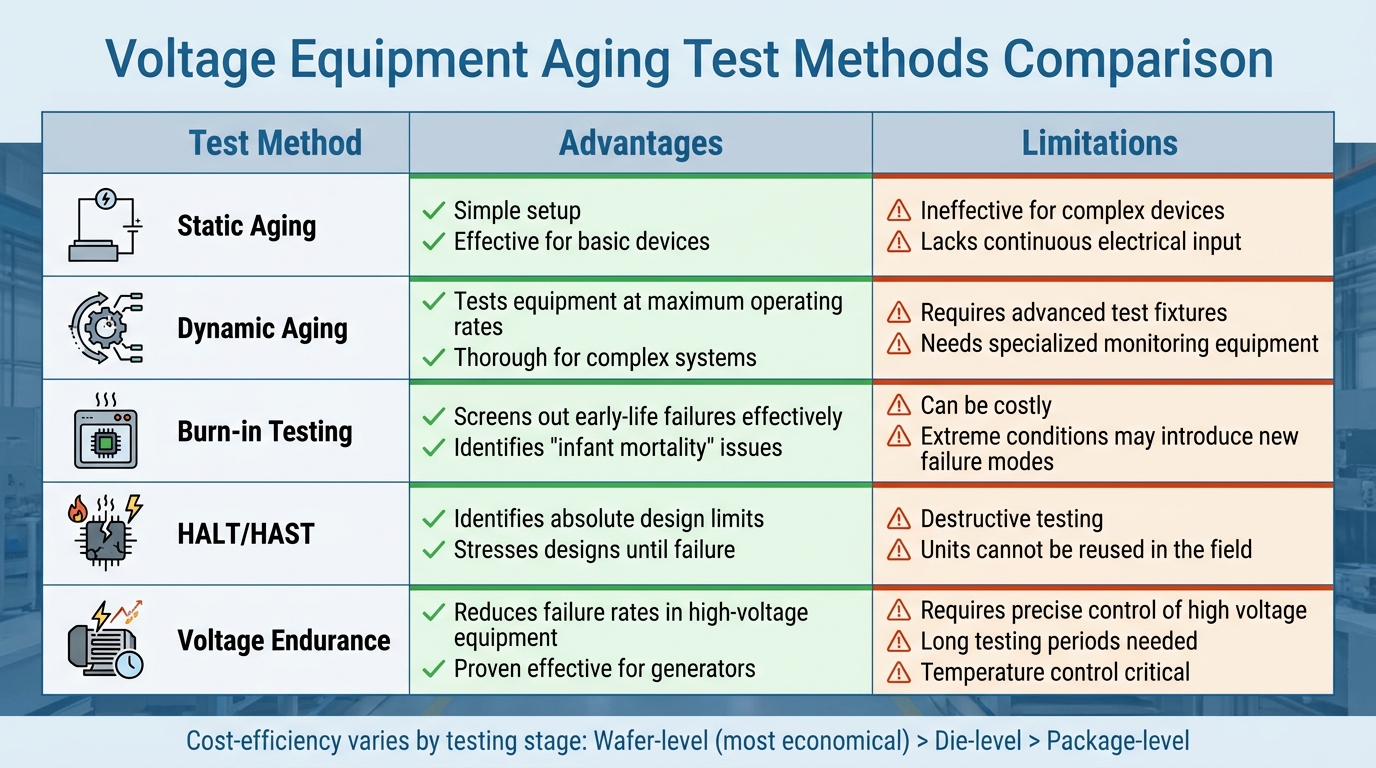
Comparison of Voltage Equipment Aging Test Methods: Advantages and Limitations
Aging tests that mimic over 100,000 hours (roughly 20 years) of operation under controlled conditions are essential for gathering reliable data. These insights help guide maintenance strategies and prevent costly equipment failures.
Isolating Stress Factors
To identify failure causes, it's crucial to isolate stress factors. These typically fall into four categories: electrical, dielectric, mechanical, and thermal. Testing each factor independently can reveal whether failures stem from insulation breakdown, mechanical fatigue, or heat-related degradation.
That said, real-world conditions often involve multiple stress factors interacting. As Nadine Lahoud and her team explain:
"The resulting model presents an original relationship between the logarithm of the insulation life span and that of electrically applied stress and an exponential form of the temperature".
Since insulation life is influenced by both electrical stress and temperature, the Design of Experiments (DoE) method is often used to model these interactions effectively, reducing the number of test iterations required.
For instance, standard stator coil tests apply voltage at 3.76 times the normal level under a constant 212°F. This ensures failures are linked to electrical stress rather than temperature shifts. After testing, techniques like dissection and microscopic analysis can pinpoint whether the failure was due to assembly errors, manufacturing flaws, or specific component issues. Even simple diagnostics, like "tap tests" that involve tapping a coil with a metal object to detect hollow sounds (a sign of delamination), can uncover issues that electrical tests might miss.
Once stress factors are isolated, refining test conditions further enhances the reliability of the results.
Optimizing Test Conditions
Precise environmental controls are essential. Active temperature management ensures electrical stress data remains accurate. Many equipment owners turn to independent third-party labs for voltage endurance testing to avoid bias and benefit from specialized expertise.
Following industry standards like IEEE 1043 and IEEE 1553-2002 is also critical. Proper statistical sampling - testing at least four bars or two coils, but no more than 1% of the total winding - ensures representative results. If less than 26% of specimens fail between 51% and 100% of the minimum time-to-failure, additional specimens must be tested to meet acceptance criteria.
For a complete picture of equipment health, endurance tests should be paired with methods like partial discharge monitoring, dissipation factor measurements, insulation resistance checks, and surface resistivity tests. Hugh Zhu from Generator Solutions highlights the importance of this approach:
"Voltage endurance testing has been the most popular accelerated aging test to check the quality of coils/bars for over 30 years".
Comparing Test Methods
Different test methods are suited to specific failure modes, depending on the equipment type and testing goals. Here's a breakdown of commonly used approaches:
| Test Method | Advantages | Limitations |
|---|---|---|
| Static Aging | Simple setup; effective for basic devices | Ineffective for complex devices due to lack of continuous electrical input |
| Dynamic Aging | Tests equipment at maximum operating rates; thorough for complex systems | Requires advanced test fixtures and monitoring equipment |
| Burn-in Testing | Screens out early-life ("infant mortality") failures effectively | Can be costly; extreme conditions may occasionally introduce new failure modes |
| HALT/HAST | Identifies absolute design limits by stressing designs until failure | Destructive testing means units cannot be reused in the field |
| Voltage Endurance | Reduces failure rates in high-voltage equipment like generators | Requires precise control of high voltage and temperature over long periods |
The stage of testing also affects cost-efficiency. Wafer-level testing is the most economical, die-level testing cuts packaging costs, while package-level testing - though traditional - can become expensive if failures occur late in the process. Increasingly, early-stage testing is preferred to identify "known qualified" components before committing to packaging.
Conclusion
Aging tests play a critical role in ensuring the reliability of voltage equipment. By simulating years of operational stress in a condensed timeframe, these tests uncover defects and insulation vulnerabilities before the equipment is deployed in the field. This proactive method not only prevents costly failures but also helps extend the lifespan of critical assets. It ties into the broader discussion of effective testing methods and maintenance strategies.
The results are clear. As Hugh Zhu highlights, rigorous aging tests significantly reduce insulation failure rates over time.
To achieve consistent quality, professionals should incorporate standards like IEEE 1043 and IEEE 1553-2002 into procurement specifications. Alongside aging tests, diagnostic tools - such as partial discharge monitoring, dissipation factor measurements, and even tap tests - offer a more comprehensive understanding of equipment health. When failures occur during testing, conducting forensic analyses can uncover root causes and guide improvements in manufacturing processes.
FAQs
How do I choose the right aging test for my equipment?
When choosing an aging test, focus on your equipment's specific failure mechanisms and the conditions it operates under. Pay attention to stress factors like electrical overstress or thermal cycling, and pick a test that mirrors these real-world scenarios.
For example, voltage endurance tests are ideal for assessing insulation performance under high voltage. These tests often follow established standards, such as IEEE1043, ensuring consistency and reliability. Similarly, accelerated aging systems allow you to simulate failure mechanisms in a controlled setting, offering valuable insights into how your equipment performs under stress.
What makes an accelerated aging test result trustworthy?
A reliable accelerated aging test result follows established standards like IEEE 1043 and IEEE 1553-2002. These standards ensure that test parameters, conditions, and acceptance criteria are applied consistently to replicate aging processes accurately. By adhering to these guidelines, the likelihood of failures is reduced, and overall reliability is improved.
Which monitoring tests should I run after aging tests?
After completing aging tests, it's time to conduct monitoring tests to check electrical, thermal, and insulation integrity. One widely used method is the voltage endurance test, where insulation is subjected to higher-than-normal voltage stresses (for example, 30 kV for 400 hours) to confirm its reliability. Beyond this, it's important to assess electrical performance, thermal stability, and resistance to thermal shock. These evaluations help confirm that the equipment can endure operational stresses over time without breaking down.