Footwear Standards for Power Distribution Safety
Safety footwear is a critical layer of protection for workers in power distribution, shielding against electrical hazards and static discharge. Here's what you need to know:
- Electrical Hazard (EH) footwear: Protects against accidental contact with live circuits up to 600V AC. Tested to withstand 18,000 volts at 60 hertz for one minute with minimal current leakage. Must remain dry and undamaged to function effectively.
- Static Dissipative (SD) footwear: Safely discharges static electricity to protect sensitive electronics and prevent sparks. Not suitable for live electrical work.
- Conductive footwear: Designed for explosive environments, quickly releases static but lacks EH protection.
Key Standards:
- ASTM F2413: Sets performance benchmarks for impact, compression, and electrical protection.
- OSHA 1910.136: Requires employers to provide protective footwear based on workplace hazard assessments.
Quick Tip: Always inspect boots for damage and ensure they match the hazards of your job. EH-rated boots are essential for power distribution tasks but should complement other safety measures like insulated gloves and lockout/tagout procedures.
Fit Tip What's the Difference Between EH, SD and CD Safety Footwear?
sbb-itb-501186b
ASTM F2413 Standards for Protective Footwear
ASTM F2413 sets the benchmark for protective footwear in the U.S., outlining performance standards to guard against various workplace hazards. As the ANSI Blog explains:
"ASTM F2413-24 provides minimum guidelines for the performance of footwear to provide protection against numerous workplace dangers that may result in injury".
The latest version, ASTM F2413-24, is complemented by ASTM F2412-24, which specifies the test methods used to evaluate protective footwear.
Performance Requirements Under ASTM F2413
Protective boots must meet strict testing standards. For impact resistance, they must endure a 50 lb weight dropping with 75 foot-pounds of force onto the toe cap, while maintaining a clearance of 0.500 inches for men and 0.468 inches for women. Additionally, they must resist compression forces of up to 2,500 lbs while preserving the same clearance.
Footwear can also achieve additional certifications, such as:
- Electrical Hazard (EH) Protection: Ensures the boots meet the 18,000-volt standard, providing extra safety in environments where electrical risks are present.
- Puncture Resistance (PR): Requires soles to withstand at least 270 pounds of nail force.
To confirm compliance, workers can check the internal label inside the footwear. This label typically includes the ASTM standard version, gender-specific ratings (I/C), and any additional protections like EH or PR. As MooseLog aptly states:
"Either your boots are certified, or you're leaving your safety strategy up to chance".
These requirements ensure the boots are ready to handle the demands of hazardous environments.
Use in Power Distribution Environments
For power distribution tasks, EH-rated boots are critical. These boots incorporate nonconductive materials in their shanks, outsoles, and heels to prevent electrical currents from completing a circuit. Composite toe caps made from materials like Kevlar, fiberglass, or carbon fiber are often chosen for their insulating properties.
However, EH-rated footwear is not meant to replace other safety measures. As Rocky Boots explains:
"The ASTM standard for electrical hazard protection is that the boots must be capable of withstanding 18,000 volts at 60 hertz for one minute with no current flow to the foot".
While these boots provide a layer of protection against accidental contact with electrical hazards, they are designed to complement, not replace, a comprehensive safety strategy.
Electrical Hazard (EH) Footwear Standards
Voltage Protection and Testing Parameters
According to ASTM F2412 testing, EH-rated footwear must endure 18,000 volts at 60 hertz for one minute, with current leakage staying below 1.0 mA.
That said, these boots have clear limitations. The Health and Safety Executive (HSE) clarifies:
"Footwear tested to this (the EH) Standard is NOT SUITABLE for live electrical working. These may be suitable for use in environments where there is potential for accidental exposure to alternating current (AC) voltages not exceeding 600V AC".
EH protection can be compromised by moisture or physical damage, such as cuts or punctures, which create paths for electrical current. HSE further warns:
"EH footwear will not offer protection from electric shock if the outer sole has been penetrated by a nail or other sharp objects and therefore should not be marked with claims of perforation resistance".
To maintain safety, workers should inspect their boot soles daily for any signs of damage that could reduce electrical resistance. The "EH" marking on the internal label confirms compliance with ASTM F2413 (safety toe) or ASTM F2892 (soft toe) standards.
These restrictions underscore the need for proper care and inspection before using EH-rated footwear in any electrical work.
Power Distribution Work Applications
Due to these technical constraints, proper maintenance and correct usage of EH footwear are critical in real-world power distribution settings. These boots are designed to provide secondary protection against accidental contact with energized circuits. As Robert Petersen, Senior Product Manager at Tingley, explains:
"EH-rated footwear is intended as a secondary source of protection against incidentally stepping on live electrical wires. This protection is severely deteriorated with excessive wear on the outsoles and/or when worn in wet environments".
Maintaining the boots in good condition is essential for ensuring their protective capabilities. EH footwear works by increasing electrical resistance between the worker’s body and the ground, reducing the likelihood of the body completing a conductive circuit. However, this secondary layer of protection complements - not replaces - primary safety measures like insulated gloves, lockout/tagout procedures, and proper work protocols.
For areas with step-potential risks, such as those near underground lines or downed high-voltage wires, dielectric (DI) footwear can provide better protection than standard EH boots. When working near power distribution equipment rated at 600V AC or less, EH boots can offer adequate secondary protection if they are kept dry and free from damage.
Static Dissipative (SD) and Conductive (Cd) Footwear: Differences and Uses
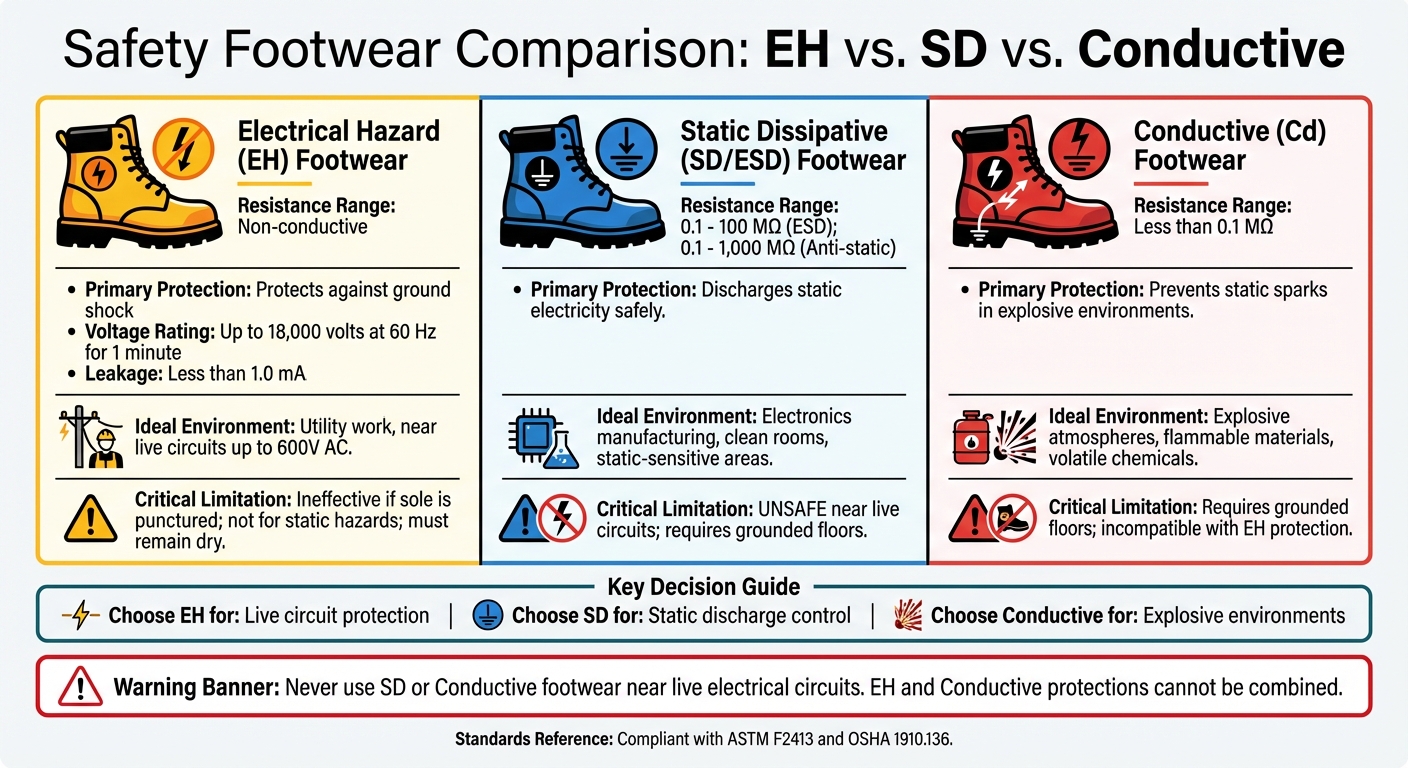
EH vs SD vs Conductive Footwear: Safety Standards Comparison Chart
Safety footwear isn't just about protecting against electrical hazards (EH-rated boots). Some designs are specifically made to manage static discharge, offering protection in environments where static electricity can pose risks.
Static Dissipative (SD) Footwear Specifications
Unlike EH-rated boots, SD footwear helps discharge static electricity by connecting the wearer to the ground. This prevents damage to sensitive equipment and reduces the risk of static sparks.
SD footwear operates within a specific resistance range to safely discharge static while limiting electrical flow. The most precise version, Electrostatic Dissipative (ESD) footwear, has a resistance range of 0.1 to 100 megaohms (MΩ), as defined by BS EN IEC 61340-4-3:2018. Standard anti-static footwear, on the other hand, has a broader range of 0.1 to 1,000 MΩ.
These shoes are essential in industries like electronics manufacturing, clean rooms, and environments prone to explosion risks due to static sparks. However, there’s an important distinction to keep in mind:
"EH-rated boots insulate you from the ground to protect against shock from live currents, while SD footwear connects you to the ground to safely discharge static electricity and prevent sparks".
This means SD footwear should never be used for protection against live electrical circuits, as it allows electricity to flow through the body.
Conductive (Cd) Footwear for Explosive Environments
Conductive footwear is designed for environments with a high risk of explosions, such as those with flammable gases, dust, or volatile chemicals. These boots ensure static electricity is discharged quickly by providing a low-resistance path, preventing the buildup of charges that could ignite dangerous materials.
A key difference here is that conductive footwear cannot be combined with electrical hazard (EH) protection. Workers exposed to both static and electrical hazards must either switch footwear between tasks or use specialized dual-rated boots while understanding the limitations of each type. For conductive or SD footwear to work effectively, the wearer must be on properly grounded floors.
Choosing the right footwear is especially critical in industries like power distribution, where both electrical and static hazards may be present.
EH vs. SD vs. Cd Footwear Comparison
The table below highlights the differences between EH, SD, and conductive footwear:
| Footwear Type | Resistance Range | Primary Protection | Ideal Environment | Critical Limitation |
|---|---|---|---|---|
| Electrical Hazard (EH) | Non-conductive | Protects against ground shock | Utility work, near live circuits up to 600V AC | Ineffective if sole is punctured; not for static hazards |
| Static Dissipative (SD/ESD) | 0.1 - 100 MΩ | Discharges static electricity | Electronics manufacturing, clean rooms | Unsafe near live circuits |
| Conductive | Less than 0.1 MΩ | Prevents static sparks | Explosive atmospheres, flammable materials | Requires grounded floors; incompatible with EH |
The type of footwear you choose depends on the primary hazard. If the risk involves contact with live circuits, EH-rated boots are the way to go. For environments where static discharge could damage equipment or ignite a fire, SD or conductive footwear is essential. In power distribution, where workers often handle sensitive electronics, SD footwear is often the best choice - provided that proper safety measures, like lockout/tagout, are in place to control electrical hazards.
OSHA and ASTM Standards Compliance
OSHA regulations and ASTM standards work hand-in-hand to ensure safety in power distribution environments. OSHA lays out the legal requirements, while ASTM defines the technical specifications for protective footwear. Together, they address the specific risks workers face, particularly those related to electrical hazards.
OSHA 1910.136 Foot Protection Requirements
OSHA regulation 29 CFR 1910.136 mandates that employers provide protective footwear for workers in areas with electrical hazards. This includes dangers like electric shock and static discharge. Before selecting safety footwear, employers must complete a hazard assessment as outlined in 29 CFR 1910.132(d). This assessment must document the workplace evaluated, the person responsible for the evaluation, the date, and the specific hazards identified, such as exposure to live circuits or the risk of falling objects.
"The true purpose of OSHA 1910.136 is not simply to require safety shoes, but to compel employers to first conduct a thorough hazard assessment and then provide footwear that specifically protects against the identified risks of the job." (Tech Team, 3515)
Employers are required to provide this protective footwear at no cost to employees. While workers may cover the cost of basic safety-toe boots for personal use, specialized equipment like EH-rated or puncture-resistant footwear must be employer-funded. The results of the hazard assessment directly determine which ASTM-certified footwear ratings - such as EH (Electrical Hazard), SD (Static Dissipative), or Cd (Conductive) - are necessary for specific tasks. This ensures that the technical benchmarks set by ASTM align with OSHA's legal framework.
How ASTM F2412 and F2413 Standards Support Compliance
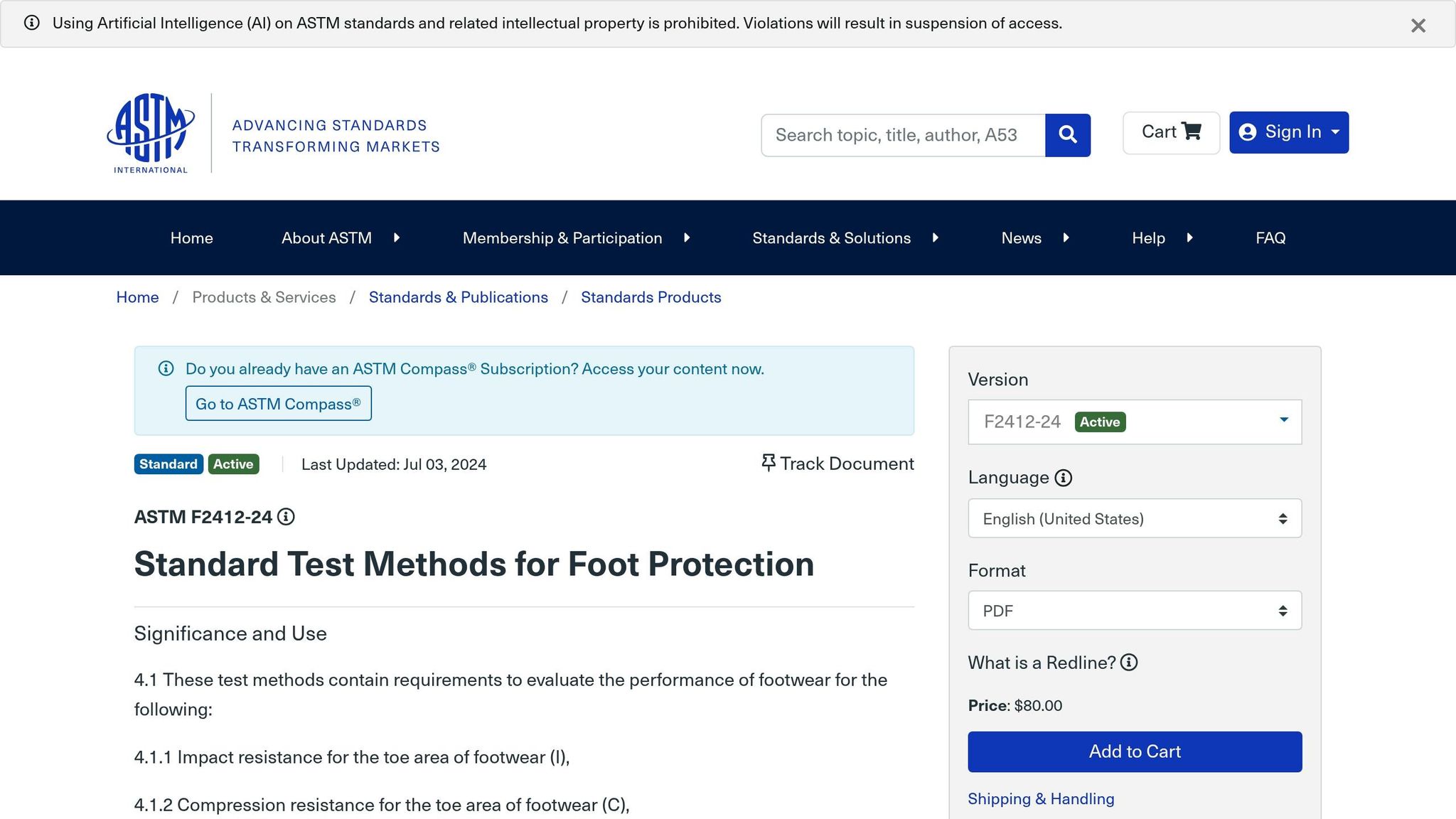
ASTM standards build on OSHA's requirements by defining the technical details for protective footwear. OSHA incorporates these standards by reference, so any footwear meeting ASTM F2412 and F2413 standards (2005 or newer) automatically complies with OSHA regulations. ASTM F2413 outlines the performance criteria for footwear, including impact resistance, compression strength, and electrical protection, while ASTM F2412 specifies the testing methods used to verify these features.
For power distribution work, footwear must display the appropriate ASTM markings. For example, boots labeled "EH" provide electrical hazard protection, while "SD" indicates static dissipative properties. This labeling ensures that the footwear matches the hazards identified during the employer's assessment.
The stakes for compliance are high. OSHA reports that 74 fatalities and 444 serious injuries occur annually in the electric power generation, transmission, and distribution sectors. Proper adherence to OSHA and ASTM standards could prevent nearly 80% of these incidents, significantly reducing workplace injuries and fatalities. Many foot injuries stem from objects weighing about 65 pounds falling from less than four feet.
When selecting protective footwear, always check that the label includes ASTM F2413 certification and the specific ratings needed for your work environment. A "safety toe" alone does not guarantee electrical protection.
Conclusion
Footwear Classifications and Standards Summary
The three main types of safety footwear serve different purposes in power distribution settings. Electrical Hazard (EH) rated footwear is designed to insulate and protect wearers from completing an electrical circuit during unintended contact with live wires. According to ASTM F2413 standards, EH footwear can withstand up to 18,000 volts at 60 hertz for one minute with less than 1.0 mA of leakage. However, these boots are only tested for accidental exposure to voltages under 600V AC and should never be used for live electrical work.
On the other hand, Static Dissipative (SD) and ESD footwear help safely discharge static electricity to the ground. While anti-static footwear operates within a resistance range of 0.1–1,000 MΩ, ESD footwear is tested to a stricter range of 0.1–100 MΩ. This controlled discharge prevents static buildup that could harm sensitive electronics or ignite flammable materials.
Understanding these distinctions is key to ensuring safety in the workplace.
How to Select Safety Footwear for Power Distribution Work
To choose the right footwear for power distribution tasks, start by identifying the specific hazards present. For accidental contact with live circuits, EH-rated boots are the go-to option. However, if the primary concern is static discharge - such as in electronics manufacturing or explosive environments - SD or ESD-rated footwear is more appropriate. Always check for ASTM markings on the footwear, such as F2413 for safety toe or F2892 for soft toe designs.
Regular inspection is equally important. Check for any cuts, punctures, or embedded objects in the soles, as these can compromise the footwear's protective capabilities. Keep in mind that EH-rated boots lose their insulating properties when wet, so moisture can significantly reduce their effectiveness. Additionally, EH footwear should never be relied upon as the sole means of protection - it is meant to complement other PPE like insulated gloves and adherence to lockout/tagout protocols.
For highly specialized tasks, such as high-voltage electrical installations or working on electric vehicles, standard EH boots are not enough. These situations demand dielectric or specially insulated footwear designed specifically for live high-voltage environments.
FAQs
How do I choose between EH, SD, and conductive footwear for work?
Selecting the right footwear is all about addressing the specific risks in your workplace. Here's a quick breakdown:
- EH (Electrical Hazard): These have non-conductive soles designed to shield against electrical shocks, up to 600V AC. Perfect for electricians or anyone working around live wires.
- SD (Static Dissipative): Ideal for environments where static buildup could cause sparks, such as areas with flammable materials or sensitive electronics.
- Conductive: These shoes disperse static electricity immediately, making them a must in spaces with flammable gases or powders.
Choose footwear that aligns with the hazards you face on the job.
How often should EH boots be tested or replaced?
Electrical hazard (EH) boots typically need to be tested or replaced every year. To tackle wear and tear, many utility companies mark the boots with a date and replace them annually. Regular testing is crucial to meet safety standards and ensure these boots continue to provide the necessary protection in power distribution settings.
What ASTM markings should I look for on the boot label?
When choosing safety boots, look for ASTM markings like ASTM F2413-18 or labels that say ASTM compliant. These markings confirm the boots meet established safety standards, including protection against electrical hazards. Always examine the label carefully to ensure the footwear aligns with the necessary safety requirements.