

NFPA 70 NEC: Hazardous Location Equipment Guide
Electrical safety in hazardous locations is critical. NFPA 70, also known as the National Electrical Code (NEC), sets the standards for safe electrical installations in environments where flammable gases, vapors, or dust could ignite. Compliance isn’t optional - it’s required by law.
Here’s what you need to know:
- Hazardous Classifications: Locations are categorized into Classes (I, II, III), Divisions (1 or 2), or Zones (0, 1, 2) based on the materials present and their ignition risks.
- Equipment Standards: Explosionproof, dust-ignitionproof, and intrinsically safe designs are essential for preventing ignition. Equipment must also have proper markings for Class, Division/Zone, Group, and Temperature Code (T-code).
- Wiring and Sealing: Only approved conduits and seals can prevent flammable substances from traveling through electrical systems.
- OSHA and NFPA 497/499: These standards work alongside NEC to define boundaries and ensure compliance.
- Common Violations: Issues like missing conduit seals, T-code mismatches, and improper bonding are frequent but avoidable.
NEC article 500 hazardous locations explained: defining the division system
sbb-itb-501186b
Hazardous Location Classifications and Standards
NEC Hazardous Location Classifications: Classes, Divisions & Zones Explained
Understanding NEC classifications is a critical step toward compliance. Proper hazard classification ensures adherence to NEC standards and directly impacts equipment selection and installation practices, which will be discussed in later sections.
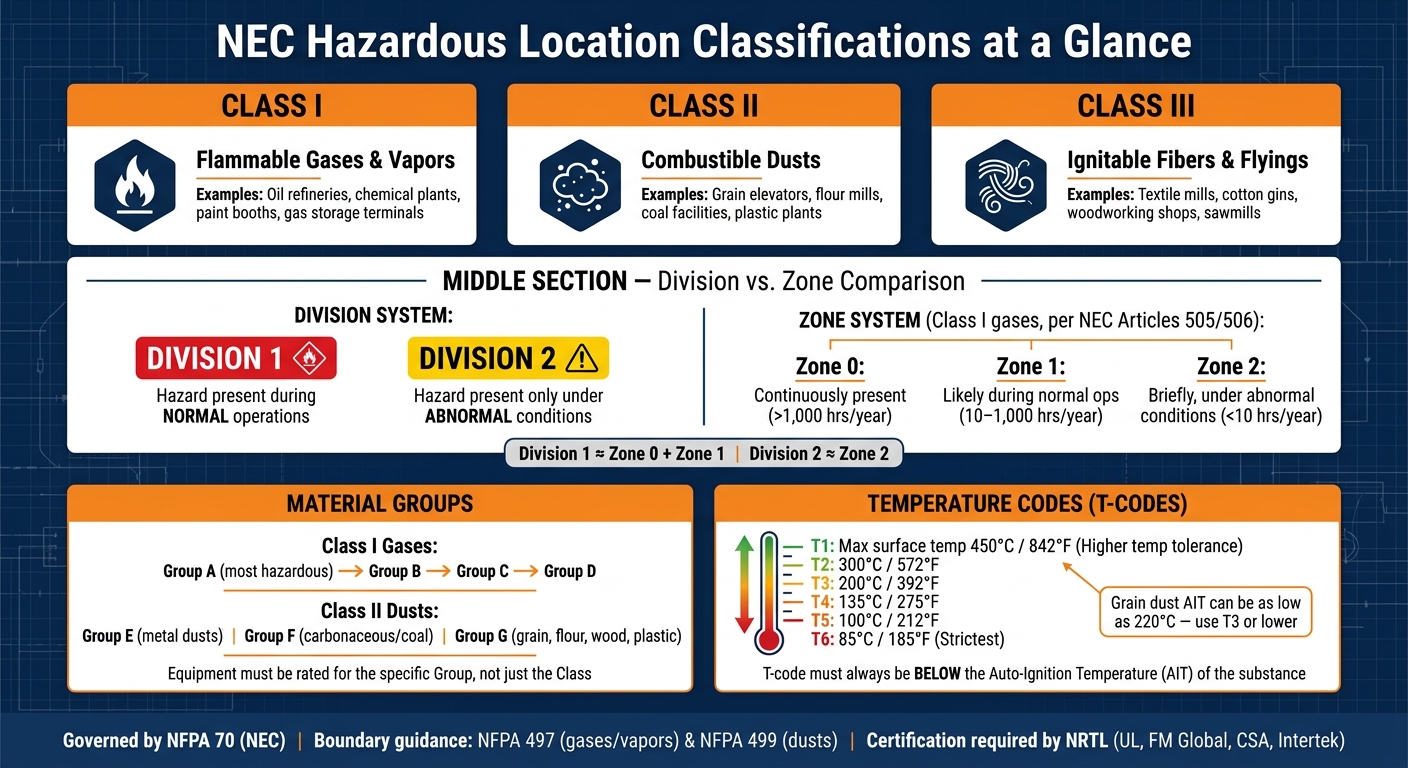
NEC Classes, Divisions, and Zones Explained
The NEC categorizes hazardous locations into three Classes based on the type of hazardous material present. These classifications determine the required equipment ratings and installation methods to maintain safety.
- Class I: Areas with flammable gases, vapors, or vapors from combustible liquids that can form explosive mixtures.
- Class II: Locations where combustible dust is present.
- Class III: Areas containing easily ignitable fibers or flyings - materials that may not be suspended in high enough concentrations to ignite but still pose a fire risk.
In addition to Classes, the NEC uses Divisions to describe the frequency of the hazard. Division 1 indicates that the hazardous substance is present during normal operations, such as routine activities or regular leaks. Division 2, on the other hand, means the hazard exists only under abnormal conditions, like equipment failure or accidental ruptures.
Alternatively, NEC Articles 505 and 506 allow for a Zone system, which aligns with international IEC standards. For Class I gas hazards:
- Zone 0: Ignitable concentrations are present continuously (over 1,000 hours per year).
- Zone 1: Likely during normal operations (10–1,000 hours per year).
- Zone 2: Present only briefly during abnormal conditions (less than 10 hours per year).
A Class I, Division 1 area is roughly equivalent to Zones 0 and 1 combined, while Division 2 aligns with Zone 2.
Each Class further categorizes materials into Groups based on their ignition properties. For instance:
- Class I gases: Group A (most hazardous) to Group D.
- Class II dusts: Group E (metal dusts), F (carbonaceous dusts like coal), and G (grain, flour, wood, and plastic dusts).
Equipment must be rated for the specific Group in the area, not just the Class.
Additionally, equipment is assigned a Temperature Code (T-code), which ranges from T1 (maximum surface temperature of 450°C/842°F) to T6 (maximum 85°C/185°F). The T-code must always be lower than the auto-ignition temperature (AIT) of the substance in the area. This detail is easy to overlook but critical to ensuring safety.
The following examples highlight how these classifications are applied in industrial settings.
Industrial Examples of Hazardous Location Classes
The NEC classification system directly maps to various industrial environments across the United States.
| NEC Class | Material Type | Typical U.S. Industrial Settings |
|---|---|---|
| Class I | Flammable gases or vapors | Oil refineries, chemical plants, gas storage terminals, paint booths |
| Class II | Combustible dusts | Grain elevators, flour mills, coal facilities, plastic plants |
| Class III | Ignitable fibers or flyings | Textile mills, cotton gins, woodworking shops, sawmills |
For example, consider a grain elevator in the Midwest. The handling and transfer of grain generate fine combustible dust (Class II, Group G) that can accumulate on surfaces and become airborne. Areas near bucket elevators and conveyor transfer points are typically classified as Division 1, as dust is present under normal conditions. In contrast, storage areas farther from active handling may be classified as Division 2.
In an oil refinery, the classification shifts to Class I. Pump rooms, loading racks, and areas around pressure relief valves are often Division 1 zones due to the presence of flammable vapors during routine operations. Outdoor processing areas with sufficient ventilation, where vapor release would occur only during equipment failure, are usually classified as Division 2.
"Hazardous (classified) locations, if properly treated, are not necessarily any more dangerous to work in than other areas or locations." - NFPA 70, National Electrical Code Handbook
Role of NFPA 497 and NFPA 499 in Classification
While the NEC defines classification criteria, NFPA 497 and NFPA 499 provide detailed guidelines for defining hazardous area boundaries.
- NFPA 497: Focuses on flammable liquids, gases, and vapors in chemical process areas. It outlines how far Division 1 or Division 2 boundaries extend from potential release points, such as pump seals, valves, or tank vents. It also assigns chemical Groups (A, B, C, or D) based on ignition sensitivity.
- NFPA 499: Covers combustible dusts, providing boundary distances and Group classifications (E, F, or G) for Class II environments. It includes auto-ignition temperature data for specific dust types. For instance, some grain dusts have an AIT as low as 220°C (428°F), influencing the T-code requirements for equipment in those areas.
In practice, these standards are used to create classified area drawings, which detail the dimensions of Division 1 and Division 2 zones around hazard sources. These drawings are essential for permit applications and inspections, and they must be updated whenever process changes occur, such as introducing new chemicals or modifying ventilation systems.
Key NEC Requirements for Hazardous Location Equipment
The NEC provides detailed guidelines for designing, labeling, and wiring equipment used in hazardous locations. These rules ensure safety and reliability in environments where flammable gases, vapors, or dust may pose risks.
Equipment Design: Explosionproof, Dust-Ignitionproof, and Intrinsically Safe
The NEC outlines several protection methods tailored to specific hazards and location classifications.
- Explosionproof enclosures (for Class I locations) don’t stop internal explosions but are designed to contain them. These enclosures withstand internal ignition pressures and cool escaping gases through engineered flame paths, preventing ignition in the surrounding atmosphere. Maintaining the enclosure’s structural integrity is critical for its performance.
- Dust-ignitionproof equipment (for Class II locations) prevents dust from entering and ensures internal heat or sparks cannot ignite external dust.
- Intrinsically safe systems limit electrical and thermal energy to levels that can’t ignite hazardous atmospheres, even under fault conditions. This makes them ideal for sensors and instrumentation across all classes and zones.
Each method minimizes risks under fault conditions, ensuring hazards remain controlled.
| Protection Technique | Primary Location | Design Strategy |
|---|---|---|
| Explosionproof | Class I, Div 1 & 2 | Containment and cooling of internal explosions |
| Dust-Ignitionproof | Class II, Div 1 & 2 | Exclusion of dust; containment of internal heat |
| Intrinsically Safe | All Classes/Zones | Energy limitation to prevent ignition |
| Purged/Pressurized | Any Hazardous Location | Positive pressure with clean air to exclude hazards |
| Nonincendive | Division 2 only | Prevention of ignition during normal operation |
These methods form the foundation for safe equipment operation and proper marking.
Marking and Certification Standards
To comply with NEC requirements, hazardous location equipment must display permanent, visible markings. These labels identify the Class, Division or Zone, Group, and Temperature Code (T-code) and confirm the equipment has been tested and certified by a Nationally Recognized Testing Laboratory (NRTL) like UL, FM Global, CSA Group, or Intertek (ETL).
- The T-code specifies the maximum surface temperature the equipment can reach during operation, assuming a standard ambient temperature of 40°C (104°F). It’s essential to ensure the T-code is below the hazard’s auto-ignition temperature (AIT).
- Manufacturer self-certification is not sufficient unless explicitly approved by the Authority Having Jurisdiction (AHJ). Always verify the NRTL mark on the equipment label before installation.
Wiring Methods and Sealing Requirements
Proper wiring and sealing are critical in hazardous locations. Only Rigid Metal Conduit (RMC) and Intermediate Metal Conduit (IMC) are approved for use in all classified areas.
-
Threaded conduit connections must engage at least five full threads and be wrench-tight. This ensures that any internal explosion is safely cooled as gases escape through the threads. NEC consultant Mike Holt explains:
"This thread requirement ensures that if an explosion occurs within a raceway or enclosure, the expanding gas will sufficiently cool as it dissipates through the threads. This prevents hot flaming gases from igniting the surrounding atmosphere of a hazardous (classified) location."
- Conduit seals (sealoffs) are required at specific points to prevent flammable gases or vapors from traveling through the conduit system. These seals also block pressure piling, where explosive forces move through connected piping.
Unused enclosure openings should be closed with approved metal plugs. Additionally, bonding jumpers must be used instead of standard locknut-bushing connections to maintain electrical continuity and prevent static sparks.
Equipment Selection and Compliance in Industrial Facilities
Steps to Determine Area Classification
Start by collecting essential documents like process descriptions, P&IDs, equipment layouts, and safety procedures. These will help you identify all flammable and combustible materials in the facility. Be sure to note the auto-ignition temperature (AIT) and flash point for each substance.
A common pitfall is assigning a single classification to an entire facility. OSHA Standard 1910.307(a) emphasizes:
"Each room, section or area shall be considered individually in determining its classification."
Over-classification can unnecessarily inflate equipment costs, while under-classification poses serious safety hazards. To avoid this, pinpoint potential release sources like control valves, pump seals, drains, vents, and sampling points. Assign the appropriate Class, Group, and Division or Zone to each area. Use physical markers, such as walls or floors, to clearly define classified zones, simplifying both installation and inspections.
Ram K. Saini, PE, Senior Principal Engineer, warns:
"Failure to determine the EAC for the facility and such equipment in a timely fashion can result in unsafe installations, rework, confusion, delays, and cost overruns."
Document all findings in a hazardous location design basis document and electrical area classification (EAC) drawings. OSHA mandates that hazardous locations classified under the Class and Division system after August 13, 2007, must be thoroughly documented.
Once the area classification is finalized, you can move on to selecting equipment that complies with NEC standards.
How to Select NEC-Compliant Equipment
When choosing equipment, match it to the area's Class, Division, and Group based on NEC marking standards. Ensure every device has an NRTL label and a T-code rating that is lower than the hazardous atmosphere's AIT. Always cross-check the chemical manufacturer's Safety Data Sheet (SDS) with the NFPA 497 tables to confirm the correct Group and AIT. Avoid relying solely on a chemical's common name.
For Division 2 areas, make sure motors, lighting fixtures, and arcing devices meet Division 2 specifications. If you're sourcing replacement or secondary components, platforms like Electrical Trader can be helpful. However, verify that all items carry the proper NRTL certification and markings before installation.
Finally, ensure that wiring and sealing methods adhere to NEC standards as previously outlined.
Installation, Inspection, and Maintenance Best Practices
Selecting the right equipment is just the start - proper installation and consistent maintenance are equally critical. Submit classified area drawings to the Authority Having Jurisdiction (AHJ) during the permitting phase, before any equipment is installed. This step ensures early detection of rating mismatches, avoiding expensive rework.
Keep classified area drawings updated whenever there are process changes, such as swapping chemicals, altering ventilation, or relocating equipment. Each change requires a review of the drawings.
During inspections, pay close attention to threaded conduit connections, enclosure seals, and the condition of equipment markings. Missing or damaged labels can make it impossible to verify compliance during audits. A multidisciplinary team - including experts in process operations, HVAC, chemical handling, fire protection, and maintenance - should handle both the initial classification and ongoing reviews to ensure thorough oversight.
Common Compliance Challenges and Solutions
Maintaining compliance with NEC equipment standards and proper installation practices isn't just about meeting regulations - it's about ensuring safety and reliability. Spotting and addressing common violations is a key part of this process.
Common Compliance Violations to Watch For
Even when facilities follow best practices, certain errors crop up repeatedly during inspections. These aren't obscure issues but rather straightforward mistakes that can often be avoided with careful review.
Conduit seal issues top the list of common violations. Seal-offs must be installed no more than 18 inches from each conduit entry and filled to a depth matching the conduit’s trade size. Inspectors frequently encounter seals that are either missing entirely or positioned too far from enclosures.
T‑code mismatches are another frequent problem, especially in Class II, Group G environments (e.g., grain dust) where auto‑ignition temperatures can be as low as 220°C (428°F). Equipment with a T‑code exceeding this temperature creates a serious safety hazard. NEC Article 500.8(C) provides detailed guidance on this.
Incorrect Group ratings are a quieter but equally serious issue. For instance, equipment rated for Group D (propane) cannot safely operate in a Group C (ethylene) environment because ethylene’s Maximum Experimental Safe Gap (MESG) is smaller, increasing the risk of flame propagation. Always ensure the nameplate Group matches the chemicals present.
Bonding failures are another widespread concern. NEC Article 250.100 explicitly requires bonding jumpers or other approved methods in hazardous locations. It states:
"Locknut-bushing or double-locknut types of connection do not meet the requirements for bonding."
How to Prevent Violations Before They Occur
Preventing these issues requires a combination of thorough documentation, ongoing training, and disciplined system checks. Here’s how you can stay ahead:
- Keep classified area drawings up to date. Any process change - whether it’s introducing new chemicals, altering ventilation, or relocating equipment - can shift zone classifications and render existing ratings invalid. Treat these drawings as living documents that evolve with your facility.
- Stick to one manufacturer per explosion‑proof assembly. Mixing components from different manufacturers can lead to mismatched threading tolerances or sealing surfaces, compromising the enclosure’s integrity.
- Avoid mixing Division and Zone systems. NEC Articles 505 and 506 explicitly prohibit overlapping these classification systems within the same area.
- Verify PVC‑coated fittings. Ensure these fittings have passed post-coating tests, as unvalidated coatings can block critical flame‑path gaps needed to cool escaping gases.
- Preserve equipment markings. Labels indicating Class, Group, T‑code, and NRTL certification must remain visible after installation. Painted-over or damaged labels make compliance checks impossible during inspections.
Comparison Table: Common Violations and NEC References
| Common Violation | NEC Reference | Recommended Solution |
|---|---|---|
| Missing or improper conduit seals | Article 501.15 | Install seal‑offs within 18" of enclosures; fill compound to conduit trade size depth |
| Improper bonding (locknut only) | Article 250.100 | Use approved bonding jumpers; standard locknuts are not permitted |
| T‑code mismatch | Article 500.8(C) | Verify equipment T‑code is below the auto‑ignition temperature of the specific gas or dust present |
| Wrong Group rating | Article 500.8 | Match nameplate Group (A–G) to the actual chemical using SDS and NFPA 497/499 tables |
| Mixing Division/Zone systems | Articles 505 / 506 | Review site drawings; do not overlap classification systems in the same area |
| Obstructed flame path | Article 500.2 | Inspect joints for paint, debris, or unvalidated PVC coatings that block gas cooling gaps |
| Non‑threaded conduit in Class I, Div 1 | Article 501.10(A) | Use threaded RMC or IMC with at least five full threads engaged and wrench‑tight |
Conclusion: Ensuring NEC Compliance for Hazardous Locations
Staying aligned with NEC standards for classification, equipment selection, and wiring methods requires more than just initial compliance - it demands consistent effort and vigilance. Each component, from proper area classification to the careful selection and installation of equipment, plays a critical role in maintaining safety and operational integrity. When even one of these elements is neglected, the risks can escalate quickly.
As NEC consultant Mike Holt emphasizes, safety decisions should always prioritize risk reduction over cost:
"In those situations, risk mitigation must always trump cost mitigation. After all, reducing the risk of fire or explosion is why hazardous location rules exist."
This risk-first approach underscores the importance of maintaining thorough and accurate documentation.
Keep records up to date, including flammable materials lists, EAC drawings, and design basis documents. These documents are essential for making informed decisions, especially as conditions and requirements evolve.
Achieving compliance is a collaborative effort. The process of classification and equipment selection should involve a multidisciplinary team, including engineers, operators, and maintenance personnel. By following established protocols and fostering teamwork, facilities can strengthen every step - from classification to installation. Pairing this with regular training, strict lockout/tagout (LOTO) procedures, and a culture that respects equipment markings and documentation ensures that your facility not only meets NEC standards but also prioritizes the safety of everyone involved.
FAQs
Who determines hazardous location classification (AHJ or engineer)?
Hazardous location classification is usually established by the authority having jurisdiction (AHJ) rather than the engineer. The AHJ ensures that all hazardous environments meet NEC standards and regulations.
How do I choose the correct T-code for my gas or dust?
To choose the correct T-code for a hazardous location, start by identifying the type of hazard present - whether it's flammable gas, combustible dust, or ignitable fibers. Next, determine the Class of the hazard: Class I is for gases and vapors, Class II is for dusts, and Class III is for fibers. Then, assess the Division: Division 1 indicates a frequent hazard, while Division 2 applies to occasional hazards. Always consult NEC classifications to ensure your selection meets safety and compliance standards for your specific setting.
When do I need conduit seals, and where do they go?
Conduit seals are essential when conduit enters explosionproof enclosures containing equipment that could produce arcs or reach temperatures capable of ignition. These seals need to be installed within 18 inches of the enclosure and must adhere to specific rules regarding the size of the conduit and the type of fittings used. For precise details, always consult the relevant standards.