Class I, II, III Hazardous Locations Explained
In hazardous work environments, understanding Class I, II, and III locations is critical for safety. These classifications, outlined by the National Electrical Code (NEC), help identify risks tied to flammable gases, combustible dust, or ignitable fibers. Here's a quick breakdown:
-
Class I: Involves flammable gases or vapors (e.g., methane, propane). Divided into:
- Division 1: Hazard present during normal operations.
- Division 2: Hazard occurs only in abnormal conditions.
-
Class II: Deals with combustible dusts (e.g., grain, coal). Divided into:
- Division 1: Dust is airborne during regular operations.
- Division 2: Dust accumulates but is not typically airborne.
- Class III: Focuses on ignitable fibers or flyings (e.g., cotton, sawdust). Divisions are based on whether materials are processed (Division 1) or stored (Division 2).
Proper classification ensures the right equipment is used, preventing ignition and meeting NEC safety standards. Misclassification can lead to unnecessary costs or increased risks. Always verify equipment markings for compliance with Class, Division, and Group requirements.
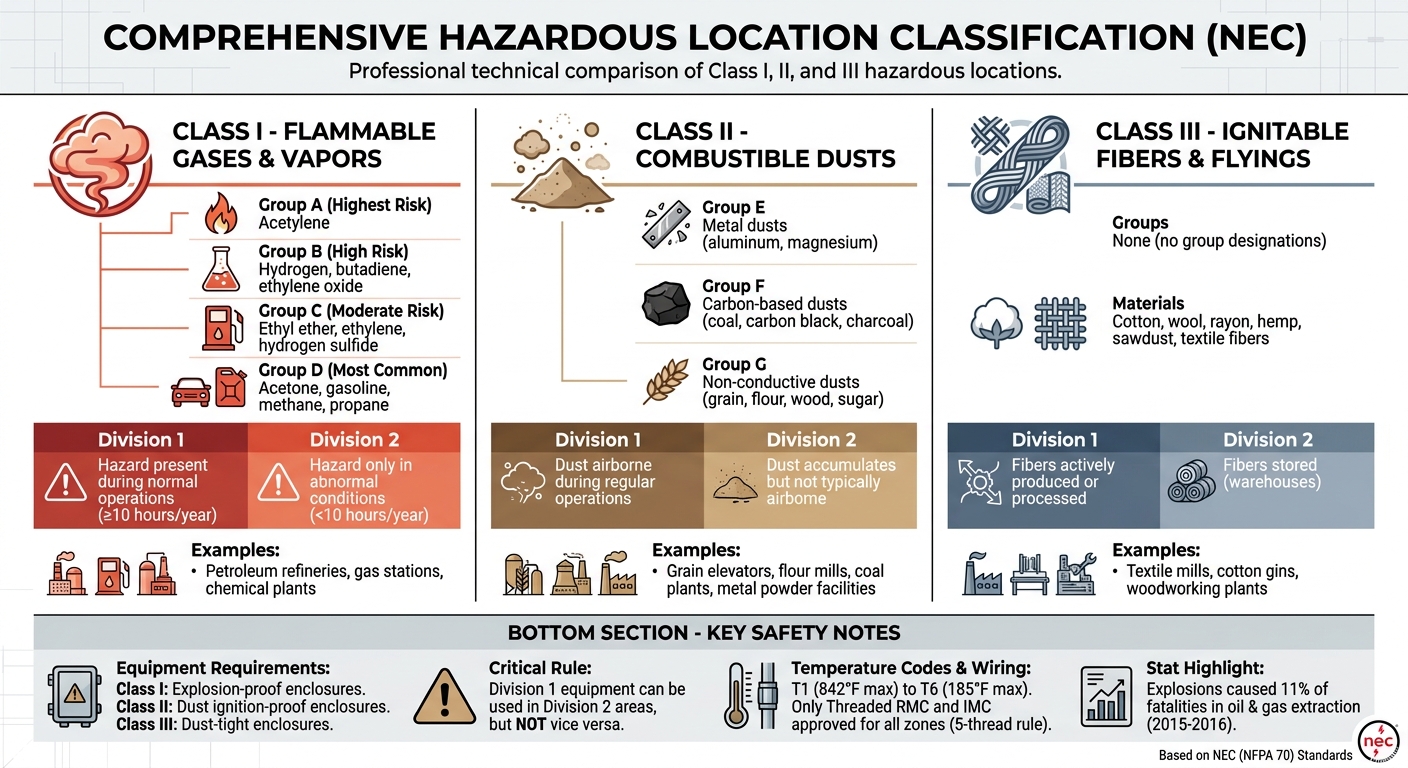
NEC Hazardous Location Classifications: Class I, II, and III Comparison Chart
Class I Locations: Flammable Gases and Vapors
What Are Class I Locations?
Class I locations are areas where flammable gases or vapors have the potential to create explosive atmospheres. These environments are typically found in places where volatile substances are handled, stored, or processed - examples include petroleum refineries and chemical plants. To better understand the hazards, gases and vapors in Class I locations are grouped into Groups A, B, C, and D based on their explosive properties. This classification is determined using the Maximum Experimental Safe Gap (MESG) and the Minimum Igniting Current (MIC) ratio (compared to methane).
| Group | Categorization Criteria | Common Substance Examples | Risk Level |
|---|---|---|---|
| Group A | Atmosphere containing acetylene | Acetylene | Highest Risk |
| Group B | MESG ≤ 0.45 mm or MIC ratio ≤ 0.40 | Hydrogen, butadiene, ethylene oxide, propylene oxide, acrolein | High Risk |
| Group C | 0.45 mm < MESG ≤ 0.75 mm or 0.40 < MIC ratio < 0.80 | Ethyl ether, ethylene, acetaldehyde, cyclopropane, hydrogen sulfide | Moderate Risk |
| Group D | MESG > 0.75 mm or MIC ratio > 0.80 | Acetone, ammonia, benzene, butane, ethanol, gasoline, methane, propane | Most Common |
To further refine the risk assessment, Class I locations are divided into Division 1 and Division 2, based on the likelihood and frequency of hazardous concentrations being present.
Division 1 vs Division 2
The Division classification indicates when hazardous concentrations of flammable gases or vapors are expected to be present:
- Division 1: These areas have flammable gases or vapors present during normal operations or when releases happen frequently. For example, the inside of a gasoline tank or an open spray booth would fall under Division 1.
- Division 2: These zones are less hazardous, as ignitable concentrations are unlikely during normal operations. They typically occur only due to abnormal conditions, such as equipment failure or a system breakdown. Division 2 areas often surround Division 1 zones, acting as a buffer. However, classifying an entire facility as Division 2 without first identifying Division 1 sources is generally incorrect.
The time factor also plays a role: Division 1 applies when hazardous materials are present for 10 or more hours per year, while Division 2 applies when they are present for less than 10 hours. Equipment used in these areas must be rated for the specific Class, Division, and Gas Group. Protection methods include explosion-proof enclosures, intrinsically safe circuits, and purged or pressurized systems. Misclassifying an area can lead to equipment costs that are 3 to 10 times higher than necessary.
Common Class I Location Examples
Examples of Class I locations help illustrate how these classifications apply in real-world settings:
- Petroleum refineries: Division 1 areas are found inside process vessels and tank interiors, while surrounding Division 2 zones are located near pump seals, valve bonnets, and tank vents.
- Gasoline storage and dispensing facilities: From bulk terminals to retail gas stations, both divisions are present. Vapor recovery systems and underground tank areas require careful classification.
- Chemical processing plants: Facilities handling Group B substances like hydrogen or ethylene oxide need stringent equipment protections due to the high ignitability of these gases.
- Open spray booths: These are another common example of Class I locations, where flammable vapors can accumulate.
Each of these examples highlights the importance of proper classification and equipment selection to ensure safety in hazardous environments.
sbb-itb-501186b
NEC Code 500 Hazardous Classified Locations Explained
Class II Locations: Combustible Dusts
Class II locations focus on the risks posed by combustible dusts, distinguishing them from the flammable gases and vapors addressed in Class I.
What Are Class II Locations?
These areas are defined by the presence of combustible dusts that, when airborne, can form explosive mixtures. Unlike gases or vapors, dust particles ignite under specific conditions. To ensure safety, equipment in these locations must have dust ignition-proof enclosures. These enclosures are designed to keep dust out and maintain surface temperatures below ignition levels.
Understanding Groups E, F, and G
Class II locations are divided into three groups based on the type of dust present:
- Group E: Includes metal dusts, such as aluminum and magnesium. These are hazardous due to their conductive and abrasive properties.
- Group F: Covers carbon-based dusts like coal, carbon black, charcoal, and coke. These materials contain more than 8% entrapped volatiles or are otherwise sensitized to create explosion risks.
- Group G: Includes non-conductive dusts such as grain, flour, starch, sugar, wood, and plastics.
Class II areas are further categorized into Division 1 and Division 2. Division 1 refers to locations where ignitable dust concentrations are present during regular operations or maintenance. Division 2 applies to areas where dust is not typically airborne but could become hazardous under abnormal conditions, such as equipment malfunctions or accidental leaks. Importantly, equipment rated for Division 1 can be used in Division 2 zones of the same class and group, but the reverse is not permitted.
Common Class II Location Examples
Examples of Class II locations include grain elevators and flour mills, where Group G dusts are present during processing and storage. Coal-fired power plants, which handle carbon-based dusts, and facilities producing metal powders, where metal dusts are a concern, also fall under this classification. Proper classification of these areas is critical, as it determines whether a zone is Division 1 or Division 2 and influences the choice of compliant electrical equipment to ensure safe operations.
Next, we’ll explore Class III locations and the hazards associated with ignitable fibers.
Class III Locations: Ignitable Fibers and Flyings
Class III locations are defined by the presence of materials like cotton, wool, rayon, hemp, jute, Spanish moss, and sawdust - substances that are easily ignitable. While these materials generally don’t suspend in the air in amounts that could create explosive mixtures, they pose a fire risk if they accumulate on heat-producing equipment. Electrical devices in these areas must be dust-tight to prevent fibers from reaching ignition sources.
Division 1 vs. Division 2
Class III locations are categorized into Division 1 and Division 2, depending on how the ignitable fibers or flyings are handled:
- Division 1: This applies to areas where fibers or combustible flyings are actively produced or processed. Examples include textile manufacturing floors, cotton ginning facilities, and woodworking plants where materials are cut, shaped, or otherwise manipulated.
- Division 2: This classification covers areas where these materials are stored rather than processed, such as warehouses holding baled cotton, flax, or hemp.
Equipment designed for Division 1 is suitable for use in Division 2 areas, but the reverse is not true. This distinction ensures safety and aligns with the NEC's guidelines for hazardous locations.
Common Class III Location Examples
Recognizing Class III locations is key to managing risks effectively. Typical examples include:
- Textile mills where fibers like cotton and wool are processed.
- Cotton gins and cotton seed mills involved in raw cotton handling.
- Woodworking plants generating sawdust or flyings during operations like cutting or shaping.
- Flax processing facilities.
In these environments, strict housekeeping is critical. Fibers and flyings must not be allowed to accumulate on heat-producing components, such as motors or lighting fixtures, as this could lead to ignition. Equipment approved for Class II, Division 2 locations is often acceptable for Class III environments without requiring additional markings.
Comparing Divisions and Groups Across All Classes
Division 1 vs Division 2: What You Need to Know
The difference between Division 1 and Division 2 applies consistently across all three hazardous location classes, though the specific materials involved vary. In Division 1, hazardous substances are present as part of normal operations. By contrast, Division 2 areas only face hazards under abnormal conditions, such as equipment malfunctions, accidental leaks, or maintenance-related issues.
In Division 1, hazards are constant, so equipment must be designed to either contain explosions or limit energy to prevent ignition. According to OSHA 1910.307(c): "Equipment, wiring methods, and installations of equipment in hazardous (classified) locations shall be intrinsically safe, approved for the hazardous (classified) location, or safe for the hazardous (classified) location". For Division 2, where hazards appear unexpectedly, equipment must prevent ignition during those abnormal conditions. One key takeaway: equipment rated for Division 1 is always acceptable for Division 2 areas, but the reverse is not true.
Classes and Groups Comparison Table
The table below offers a clear summary of how classifications differ across Classes I, II, and III, helping guide equipment selection for hazardous areas. These distinctions are critical for ensuring safety and compliance with regulatory standards.
Class I locations use Groups A through D to classify flammable gases and vapors based on characteristics like the Maximum Experimental Safe Gap (MESG) and Minimum Igniting Current (MIC) ratio. Class II locations rely on Groups E, F, and G to categorize combustible dusts, considering factors like conductivity, abrasiveness, and particle size. For Class III, there are no group designations - equipment simply needs to be dust-tight to block fibers from entering.
| Class | Hazard Type | Groups | Typical Materials | Division 1 Example | Division 2 Example |
|---|---|---|---|---|---|
| Class I | Gases & Vapors | A, B, C, D | Acetylene (A), Hydrogen (B), Ethylene (C), Propane/Gasoline (D) | Near venting systems | Near storage tanks (only during leaks) |
| Class II | Combustible Dusts | E, F, G | Metal Dust (E), Coal/Carbon Black (F), Flour/Grain/Wood (G) | Dust suspended in air during operations | Dust accumulation, not normally airborne |
| Class III | Fibers & Flyings | None | Cotton lint, Flax, Sawdust, Textile fibers | Textile manufacturing floors | Fiber storage warehouses |
Group classifications ensure that equipment can manage explosion pressures and ignition risks effectively. For instance, Group B addresses gases containing more than 30% hydrogen, while Group F focuses on carbonaceous dusts with over 8% total entrapped volatiles.
NEC Compliance and Equipment Selection
Understanding Equipment Markings and Standards
Following NEC standards for marked equipment is crucial to ensure compatibility with the hazard classifications mentioned earlier. Equipment installed in hazardous locations must include specific markings that clearly indicate its approved use. OSHA specifies: "Equipment shall be marked to show the class, group, and operating temperature or temperature range, based on operation in a 40-degree C ambient, for which it is approved". These markings verify the equipment's safety for installation in such environments.
Temperature codes (T-codes) are used to classify equipment surface temperatures. They range from T1 to T6, with T1 allowing surface temperatures up to 842°F and T6 limiting them to 185°F. It's essential to match the equipment's T-code with the ignition temperature of the hazardous material present.
Wiring methods are another critical aspect. Only Threaded Rigid Metal Conduit (RMC) and Intermediate Metal Conduit (IMC) are approved for all hazardous zones. When installing these conduits, the 5-thread rule must be followed: NPT tapered threads must engage at least five full threads when tightened with a wrench. This ensures proper containment of explosions and cooling of escaping gases. Standard locknut-bushing connections are not acceptable, so bonding jumpers or other approved bonding methods must be used instead.
Protection techniques vary depending on the hazard type. For Class I locations, explosionproof enclosures (Type 7) are required to contain internal explosions. Class II areas need dust-ignitionproof equipment, while Class III locations permit dust-tight enclosures. In environments with multiple hazards, intrinsically safe equipment is often the go-to choice, as it limits electrical energy to levels that cannot ignite hazardous materials.
Next, let's explore how to find equipment that meets these strict standards.
Where to Source Compliant Equipment
Finding NEC-compliant equipment is easier when you know what certifications to look for. All equipment should meet UL 1203 standards for explosive atmospheres or combustible dust environments. Before purchasing, verify the certifications through UL's online database or check manufacturer-provided certificates. Markings should include the UL logo, file number, catalog number, area classification, electrical ratings, and T-code.
One reliable source for such equipment is Electrical Trader (https://electricaltrader.com). This marketplace offers a range of compliant electrical equipment, including RMC, IMC, specialized enclosures, circuit breakers, and transformers designed for hazardous locations. Both new and used equipment meeting safety standards are available.
When sourcing components, it's best to procure from a single manufacturer to reduce risks related to threading or sealing inconsistencies. If you opt for PVC-coated fittings, ensure the manufacturer has conducted post-coating tests to confirm that the coating does not block flame paths or compromise ground continuity. Lastly, remember that for hazardous locations established after August 13, 2007, proper documentation must be accessible to those authorized to design, install, or inspect the electrical equipment.
Conclusion
Understanding hazardous locations is essential for ensuring safety in environments with potential ignition risks. Class I refers to areas with flammable gases like gasoline or methane, Class II involves combustible dusts such as grain or coal, and Class III covers ignitable fibers like cotton lint or sawdust.
The Division system adds further detail to these classifications. Division 1 applies to situations where hazards are present during normal operations and have a high likelihood of ignition. Division 2, on the other hand, describes areas where hazards are unlikely under normal conditions but may arise during equipment failures or leaks. Between 2015 and 2016, explosions were responsible for about 11% of fatalities in the oil and gas extraction industry, underscoring the importance of proper classification and equipment selection. These classifications form the backbone of the NEC standards, which are critical for ensuring equipment safety.
NEC compliance isn't just a recommendation - it's a legal requirement designed to protect both lives and property. Electrical equipment must be clearly marked with its Class, Group, and temperature rating. For hazardous locations identified after August 13, 2007, OSHA requires that detailed documentation, including area classification drawings and equipment specifications, be available to authorized personnel.
When sourcing equipment, certifications and temperature ratings are non-negotiable. For example, Electrical Trader (https://electricaltrader.com) provides compliant components such as threaded conduits, enclosures, breakers, and transformers. Always ensure that the surface temperature rating of the equipment aligns with the ignition temperature of substances in your environment. For example, a T6-rated device has a maximum surface temperature of 185°F, while a T1-rated device can reach up to 842°F. Coupled with regular housekeeping and thorough risk assessments, these precautions lay the groundwork for a solid safety system.
Matching the right equipment to the hazard classification and maintaining accurate documentation not only ensures regulatory compliance but also strengthens operational safety and reliability.
FAQs
How do I tell if my area is Division 1 or Division 2?
To figure out if your area falls under Division 1 or Division 2, consider the presence of hazardous substances such as flammable gases, vapors, or dust:
- Division 1: These substances are present during normal operations.
- Division 2: These substances are only present during unusual situations, like equipment malfunctions or maintenance work.
What does the Group (A–G) on equipment markings mean?
The Group (A–G) markings on equipment serve an important purpose: they specify the ignition group classification. This tells you which types of gases, vapors, or dust the equipment can safely handle, based on how easily these substances can ignite. These markings help confirm the equipment is appropriate for use in hazardous environments where such materials might be present.
How do I choose the right T-code for my hazardous location?
To choose the right T-code for a hazardous location, start by identifying the exact type of hazard present - whether it's flammable gases, vapors, dust, or fibers - and assess how likely it is to be present. The classifications, such as those outlined by NEC Classes and Divisions, depend on these factors. You'll also need to figure out if the hazard is present during regular operations or only under abnormal conditions. To stay compliant and ensure safety, refer to NEC standards along with any applicable local regulations.