

AI Predictive Maintenance for Transformers
AI-driven predictive maintenance is transforming how transformers are monitored and maintained. By leveraging real-time sensor data and advanced AI models, utilities can predict potential transformer failures, reduce unexpected outages by up to 40%, and extend asset lifespans by 20–40%. Traditional maintenance methods - reactive and preventive - are being replaced by condition-based approaches, which focus on actual equipment health rather than fixed schedules.
Key takeaways:
- Why it matters: Transformers are critical to the power grid, and failures result in costly downtime and disruptions.
- How it works: AI analyzes data from sensors (e.g., dissolved gas analysis, temperature, vibration) to detect faults early and estimate remaining useful life.
- Proven results: Utilities like PG&E and Duke Energy report significant cost savings and improved grid reliability using AI systems.
- Challenges: High setup costs, data quality issues, and cybersecurity risks remain barriers to adoption.
AI-powered systems are also paving the way for digital twins and hybrid models, enabling real-time monitoring and precise fault detection. For utilities, retrofitting existing transformers with AI-ready sensors or procuring new AI-compatible transformers can maximize these benefits. This shift is not just about improving maintenance efficiency but also ensuring long-term grid resilience.
Smart Transformers: Maintenance Strategies and AI. Ep 8.
sbb-itb-501186b
Key Data and Sensors Supporting AI Models
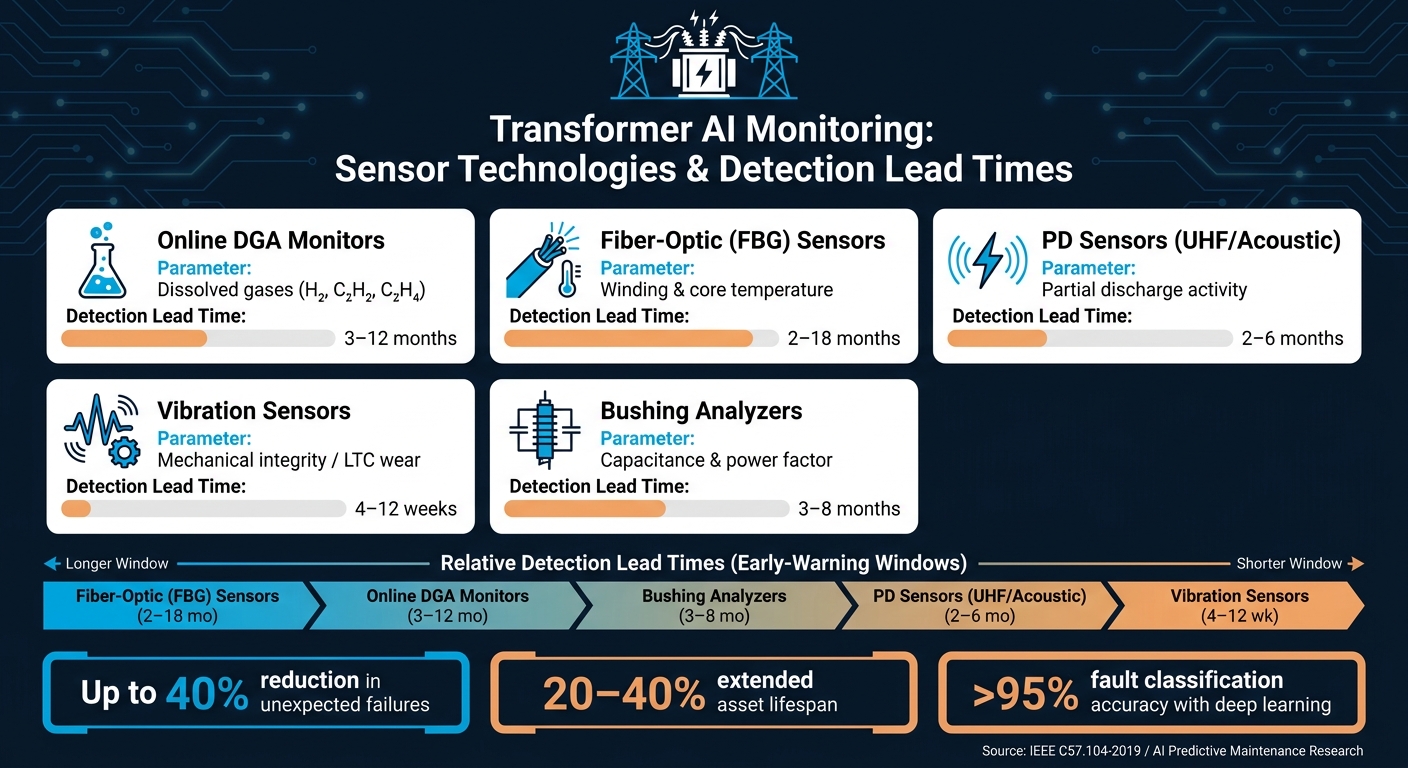
AI Predictive Maintenance for Transformers: Sensor Technologies & Detection Lead Times
Types of Data Used in Transformer Monitoring
Transformer AI relies on a wide range of data sources - spanning chemical, electrical, thermal, and mechanical measurements - to build a comprehensive picture of transformer health. Each type of data offers distinct insights into potential issues.
Take Dissolved Gas Analysis (DGA), for instance. This method provides a chemical breakdown of gases like hydrogen (H₂), methane (CH₄), acetylene (C₂H₂), and carbon monoxide (CO) that accumulate in transformer oil when faults such as overheating or arcing occur. By combining DGA results with electrical and thermal data, AI can pinpoint faults with greater accuracy.
Beyond DGA, electrical parameters such as terminal current and voltage, along with Frequency Response Analysis (FRA), help detect issues like winding deformations. Magnetic flux data, gathered through search coils, is another valuable input for identifying turn-to-turn faults. To round out the analysis, data from vibration sensors, thermal imaging, and partial discharge (PD) sensors is integrated, especially in hybrid models that merge multiple data streams into a single, actionable health score.
Together, these diverse data sources fuel AI systems capable of identifying potential failures well in advance.
Sensor Technologies in Use
Transformers are monitored using an array of sensor technologies that deliver critical, real-time data. Here's a quick overview:
| Sensor Technology | Parameter Monitored | Detection Lead Time |
|---|---|---|
| Online DGA Monitors | Dissolved gases (H₂, C₂H₂, C₂H₄) | 3–12 months |
| Fiber-Optic (FBG) Sensors | Winding & core temperature | 2–18 months |
| PD Sensors (UHF/Acoustic) | Partial discharge activity | 2–6 months |
| Vibration Sensors | Mechanical integrity / LTC wear | 4–12 weeks |
| Bushing Analyzers | Capacitance & power factor | 3–8 months |
Fiber Bragg Grating (FBG) sensors are particularly useful in high-voltage environments because they resist electromagnetic interference. Meanwhile, PD sensors - whether using UHF or acoustic methods - can detect insulation breakdown months before it leads to failure, providing maintenance teams with ample time to act. IoT-enabled smart meters and wireless sensor networks (WSNs) further enhance monitoring by tracking load patterns and voltage stability. This additional layer of data allows AI to link thermal stress to actual usage cycles.
By continuously capturing data, these sensors help AI establish reliable baselines, which significantly reduce false positives compared to manual testing done at intervals.
Challenges in Data Quality and Integration
Despite the advanced technology, integrating diverse data streams isn't without its hurdles. The most pressing issue is data heterogeneity - DGA readings, acoustic signals, and thermal images all come in different formats, making it technically challenging to combine them.
Another challenge is label scarcity. Since catastrophic transformer failures are rare, there isn't enough real-world fault data to train AI models effectively. To address this, researchers often rely on synthetic data or lab-generated results, though these may not fully capture the complexity of real-world conditions. Methods like Principal Component Analysis (PCA), k-means clustering, and feature selection are commonly used to simplify data and improve performance when datasets are limited.
Signal distortions caused by grid noise and harmonic distortion (especially 3rd, 5th, and 7th orders) can also lead to false alarms. AI systems must be designed to filter out such noise, adhering to standards like IEEE 519-2014. For older transformers, the lack of healthy baseline data presents another obstacle, particularly for methods like FRA that rely on comparative analysis.
"The ΔV-I locus method can detect faults with severity as low as 5%, though it requires baseline data from healthy conditions for comparative analysis." - Scientific Reports
Lastly, as monitoring systems increasingly adopt IoT and cloud-edge architectures, cybersecurity becomes a critical concern. Protecting data streams from external threats is essential to maintaining the integrity of these systems.
AI Methods and Techniques for Transformer Maintenance
With integrated sensor data as the foundation, advanced AI techniques are now enabling more precise fault detection and better predictions for transformer lifespan.
Anomaly Detection and Fault Classification
AI models process sensor data to identify faults efficiently. Machine learning algorithms such as Random Forest (RF) and Support Vector Machines (SVM) are highly effective for structured diagnostic data. Meanwhile, deep learning models like Convolutional Neural Networks (CNNs) and Long Short-Term Memory (LSTM) networks excel at identifying complex, time-dependent fault patterns. These models have achieved fault classification accuracies exceeding 95%, a notable leap compared to older methods.
One practical example is the Transformer Fault Diagnosis Intelligent System (TFDIS). This system, developed using 386 DGA samples from Egypt's Holding Company for Electricity's Chemical Laboratory, integrates four diagnostic techniques - Code Tree 2020, Modified IEC, Modified Rogers' Ratio, and Neural Pattern Recognition. By combining these methods, TFDIS reached 89.12% accuracy, outperforming standalone Neural Pattern Recognition, which achieved 86.01%.
For insulation aging, Random Forest classifiers analyze chemical markers like 2-Furfuraldehyde (2-FAL) in transformer oil. These classifiers categorize insulation conditions into four stages - Fresh, Lightly Aged, Moderately Aged, and Worstly Aged - with a 92.5% accuracy rate and an F1-score of 0.924.
Remaining Useful Life (RUL) Estimation
While fault detection is essential, estimating the remaining lifespan of a transformer is even more critical. Remaining Useful Life (RUL) estimation helps maintenance teams shift from reactive repairs to proactive strategies.
AI models analyze degradation patterns in historical data to estimate RUL. A key metric here is the Degree of Polymerization (DP) of insulating paper - values below 200 indicate the insulation is nearing the end of its life. Since sampling insulation paper is invasive, AI models use 2-FAL concentration in transformer oil as a non-invasive proxy. A Random Forest Regressor trained on this data achieved an R² score of 0.894, enabling accurate DP estimation without disrupting operations.
For more complex degradation signals, hybrid deep learning models provide even greater accuracy. For instance, the SSA-CEEMDAN-Transformer-BiGRU model combines signal decomposition, self-attention mechanisms, and bidirectional gated recurrent units. This model achieved an impressive R² of 0.9721 and a Mean Squared Error (MSE) of just 0.031 in predicting degradation trends. The CEEMDAN signal decomposition step is particularly important as it filters out short-term noise, leaving only the long-term aging trends for analysis.
These advanced approaches are transforming how transformer health is monitored and predicted.
Hybrid Models and Digital Twins
Hybrid models blend AI with physics-based reasoning to deliver a more complete picture of transformer health. For example, combining Artificial Neural Networks (ANNs) with SVMs allows cross-validation, reducing the risk of misdiagnosis by addressing the blind spots of individual methods.
Digital twins represent an even more advanced approach. These virtual replicas of physical transformers update in real time as sensor data flows in, enabling engineers to detect issues like overheating or oil leaks without halting operations. In January 2025, researchers from Xinjiang University and TBEA Co., Ltd. demonstrated this with their DETR+X model, which converts one-dimensional DGA data into three-dimensional feature images. This system achieved 100% classification accuracy on DGA feature maps for state recognition tasks, outperforming models like Faster R-CNN and YOLOv8.
"Applying digital twin technology to the monitoring and maintenance of transformer equipment can effectively meet the multidimensional control demands for remote real-time monitoring, virtual-real mapping, and virtual control of reality." - Xuedong Zhang, School of Intelligent Manufacturing Modern Industry, Xinjiang University
Looking ahead, researchers are exploring ways to fine-tune Large Language Models (LLMs) like Llava-7b. These models could interpret visual outputs from digital twin systems and generate plain-language maintenance recommendations, effectively offering field engineers an AI-powered consultant.
Benefits and Challenges of AI in Transformer Maintenance
Documented Benefits in Utility and Industrial Applications
AI-based predictive maintenance has proven to reduce unexpected transformer failures by as much as 40% when compared to traditional time-based maintenance practices. This approach shifts the focus from routine, scheduled check-ups to repairs triggered by actual signs of deterioration, making maintenance efforts more efficient.
Utility companies are already reaping the rewards of AI implementation. For example, in January 2025, Pacific Gas & Electric (PG&E) revealed that machine learning models analyzing both historical and real-time sensor data helped cut unplanned downtime by 30%. Similarly, Duke Energy has developed a grid sensor network that processes over 85 billion data points annually, enabling precise maintenance scheduling and preventing catastrophic failures. Another utility in the Southern U.S. deployed more than 400 AI models across 67 generation units, achieving $60 million in annual savings and reducing carbon emissions by 1.6 million tons.
AI also extends the lifespan of essential assets. Predictive maintenance programs have been shown to increase the service life of critical utility components by 20–40%. This has a direct impact on procurement schedules and long-term capital planning for transformer fleets, offering both financial and operational advantages.
Challenges in Implementation
Despite these impressive benefits, several hurdles stand in the way of widespread adoption. High upfront costs are a major barrier, especially when retrofitting older transformers with the necessary sensors and communication hardware. Many legacy systems lack modern communication protocols like MQTT or OPC-UA, requiring utilities to invest in IoT gateways or customized integrations to bridge the gap.
Another challenge is the quality of data. Transformer fleets often produce noisy, inconsistent, or incomplete datasets, making it difficult to train accurate AI models. Additionally, model drift - where an AI model's accuracy declines over time due to changing conditions - requires ongoing updates and recalibration. Cybersecurity is another pressing concern, as the increasing number of connected sensors expands the potential attack surface for malicious breaches. As of early 2026, only 27% of transformer maintenance teams had fully adopted predictive maintenance, although two-thirds planned to implement it by the end of the year.
Resistance to change within maintenance teams is another obstacle. Experienced technicians may be skeptical about AI tools, questioning their reliability or fearing job displacement. Engaging these teams early in the process - by involving them in setting alert thresholds and designing systems - can help build trust and encourage adoption.
Addressing these challenges is essential for the development of next-generation AI solutions.
Future Trends and Research Directions
To tackle these implementation challenges, new AI advancements are focusing on improving usability and scalability. Explainable AI (XAI) tools, such as SHAP (SHapley Additive exPlanations), are becoming more popular as they help operators understand the specific factors that triggered an anomaly alert. This transparency allows maintenance teams to move beyond "black-box" warnings and respond more effectively.
"AI-powered predictive maintenance... addresses the downsides of raising a large number of unnecessary alarms, ensuring that the control room operators can focus on the key concerns when operating a unit." - Nimit Patel, AI/ML Leader, QuantumBlack (McKinsey & Company)
Another promising development is federated learning, which enables AI models to train on data from multiple utilities or plant sites without requiring raw data to be shared. This approach addresses privacy and data ownership concerns. When combined with cloud-edge computing architectures - where data processing happens locally at substations before being sent to the cloud - these innovations could make AI-based maintenance systems viable even for remote or resource-limited grid locations. These advancements are also influencing the design of new transformers, with a growing emphasis on sensor compatibility and edge-computing readiness.
How Research Findings Affect Transformer Procurement
Specifications for New Transformers
To make the most of AI predictive maintenance, new transformers need specific sensors and communication capabilities. Research is reshaping transformer specifications, aligning hardware with the requirements of AI-driven monitoring systems.
When drafting procurement specs, include built-in DGA monitoring for real-time tracking of gases like hydrogen, methane, and ethylene. For critical assets, specify Fiber Bragg Grating (FBG) sensors in the transformer core to provide real-time data on vibration and temperature. Additionally, opt for designs featuring non-invasive 2-FAL sensors, which allow insulation health checks without requiring system shutdowns.
Ensure new transformers support standardized IoT protocols for seamless data integration. These features are essential for achieving diagnostic accuracies as high as 97.3%. If replacing transformers isn't feasible, legacy systems can also be retrofitted with similar AI-ready sensors to boost reliability.
Retrofitting Existing Transformer Fleets
Replacing an entire transformer fleet isn't always practical. Instead, retrofitting older transformers with AI-compatible monitoring hardware can extend their lifespans and improve performance. Research indicates that AI-driven monitoring can increase transformer lifecycles by 15–20% and cut downtime by over 50%.
Start by retrofitting high-risk assets - those whose failure would cause the greatest operational or financial disruption. This approach helps validate the return on investment (ROI) and builds expertise before scaling retrofits across the fleet.
Retrofit kits should include IoT sensors to monitor partial discharge, oil temperature, moisture levels, and load patterns. For older transformers that lack modern communication protocols, IoT gateways using secure standards like MQTT or OPC-UA can bridge the gap. For insulation health, 2-FAL monitoring kits offer a non-invasive way to gather the data needed for AI to estimate remaining useful life.
| Insulation State | DP Range | 2-FAL (ppm) | Recommended Action |
|---|---|---|---|
| Fresh | 700–1,200 | 0–0.1 | Routine monitoring |
| Lightly Aged | 450–700 | 0.1–1 | Baseline AI data collection |
| Moderately Aged | 250–450 | 1–10 | Source retrofit sensor kits |
| Worstly Aged | < 250 | > 10 | Plan for replacement/procurement |
(Source: IEEE C57.104-2019 standard data as cited in)
Documenting the results of pilot programs can help secure internal buy-in and regulatory approval for wider implementation.
Sourcing Transformers and Components
Procurement strategies should align with the savings AI-driven systems can deliver over a transformer's lifecycle. Finding transformers and components that meet AI-readiness standards can be tricky, especially when balancing cost and technical needs. Platforms like Electrical Trader simplify this process by offering a marketplace for both new and used transformers, including 3-phase and substation units, as well as components for predictive maintenance upgrades.
For retrofitting projects, the platform also provides IoT-compatible sensor modules, such as ESP32-based monitoring units, alongside transformers.
"The move to condition-based maintenance has transformed the utility industry by reducing operational costs by up to 40%, improving equipment efficiency, preventing service interruptions, and extending the asset lifecycle." - Dataforest
When purchasing transformers - whether new or used - consider the total lifecycle cost, not just the upfront price. A transformer that comes AI-ready with pre-installed sensors and communication modules might cost more initially but eliminates costly integration later. It also ensures your operation is prepared to harness the full benefits of AI-driven maintenance.
Conclusion
Recent studies highlight how AI is reshaping transformer maintenance by shifting from traditional time-based schedules to real-time, condition-based approaches. Advanced deep learning models, like convolutional neural networks (CNNs) and long short-term memory (LSTM) networks, have demonstrated fault classification accuracies surpassing 95%. Additionally, AI-powered systems have been shown to reduce unexpected transformer failures by as much as 40%.
Transformers play a critical role in the power grid and represent some of its most expensive assets. When they fail unexpectedly, the consequences can be severe: costly repairs, service outages, regulatory complications, and lengthy replacement timelines. AI-based maintenance strategies provide a proactive way to address these challenges effectively.
"Integrating AI and IoT in transformer maintenance enhances fault detection, failure prediction, asset lifecycle optimization, and grid resilience." - Md. Nuruzzaman et al.
New technologies like digital twins, multimodal data fusion, and LLM-based decision-making tools are further pushing the boundaries of what's possible in this field. For instance, improved DETR+X models have achieved 100% classification accuracy for DGA feature maps, showcasing the potential of these advancements. These breakthroughs are setting the stage for immediate implementation in transformer maintenance practices.
FAQs
What data do I need to start AI predictive maintenance on transformers?
To kick off AI-driven predictive maintenance for transformers, you'll need a mix of sensor data and historical insights. Key sensor data includes thermal imaging, vibration readings, dissolved gas analysis (DGA), partial discharge (PD) metrics, and real-time condition monitoring. On top of that, having access to past maintenance records and operational parameters is crucial for making accurate predictions and analyses.
How do I choose which transformers to retrofit first?
When deciding which transformers to retrofit first, it's smart to focus on those showing early signs of potential failure. AI-powered predictive maintenance tools can provide invaluable insights by analyzing data such as sensor readings, thermal imaging, dissolved gas concentrations, and partial discharge activity.
Pay close attention to transformers flagged by these systems for unusual patterns. For example, abnormal temperature spikes, vibration levels, or gas concentrations are clear indicators of underlying issues. Addressing these flagged units promptly can help prevent costly outages and significantly extend their operational lifespan.
How can we secure transformer IoT sensor data from cyberattacks?
To keep transformer IoT sensor data safe from cyberattacks, it's essential to put strong cybersecurity measures in place. Start with encryption to protect the data as it moves or is stored. Use secure authentication protocols to ensure only authorized individuals or devices can access the system. Additionally, implement network segmentation to separate sensitive systems from other parts of the network. Together, these steps help maintain the integrity and confidentiality of the data.