Transformer Monitoring: Online vs Offline Methods
Transformer monitoring ensures power transformers operate reliably by identifying potential issues early, such as insulation wear or mechanical faults. Two main approaches exist:
- Online Monitoring: Tracks real-time data while transformers are energized. Ideal for detecting fast-developing faults and minimizing downtime. Technologies include dissolved gas analysis (DGA), fiber optic sensors, and partial discharge detection.
- Offline Monitoring: Involves periodic testing while the transformer is offline. Offers detailed diagnostics through lab analysis of oil samples and tests like Frequency Response Analysis (FRA).
Key Differences:
- Online Monitoring: Continuous, immediate fault detection, higher upfront cost, minimal downtime.
- Offline Monitoring: Periodic, detailed analysis, lower initial cost, requires outages.
Quick Comparison:
| Factor | Online Monitoring | Offline Monitoring |
|---|---|---|
| Operational State | Energized (on-load) | De-energized (out-of-service) |
| Data Frequency | Continuous / Real-time | Periodic / Scheduled |
| Fault Detection Speed | Immediate | Delayed |
| Initial Cost | Higher | Lower |
| Downtime | Minimal | High |
A hybrid approach combines both methods for optimal reliability, using online monitoring for real-time alerts and offline methods for in-depth diagnostics. This strategy helps balance cost, efficiency, and fault detection accuracy.
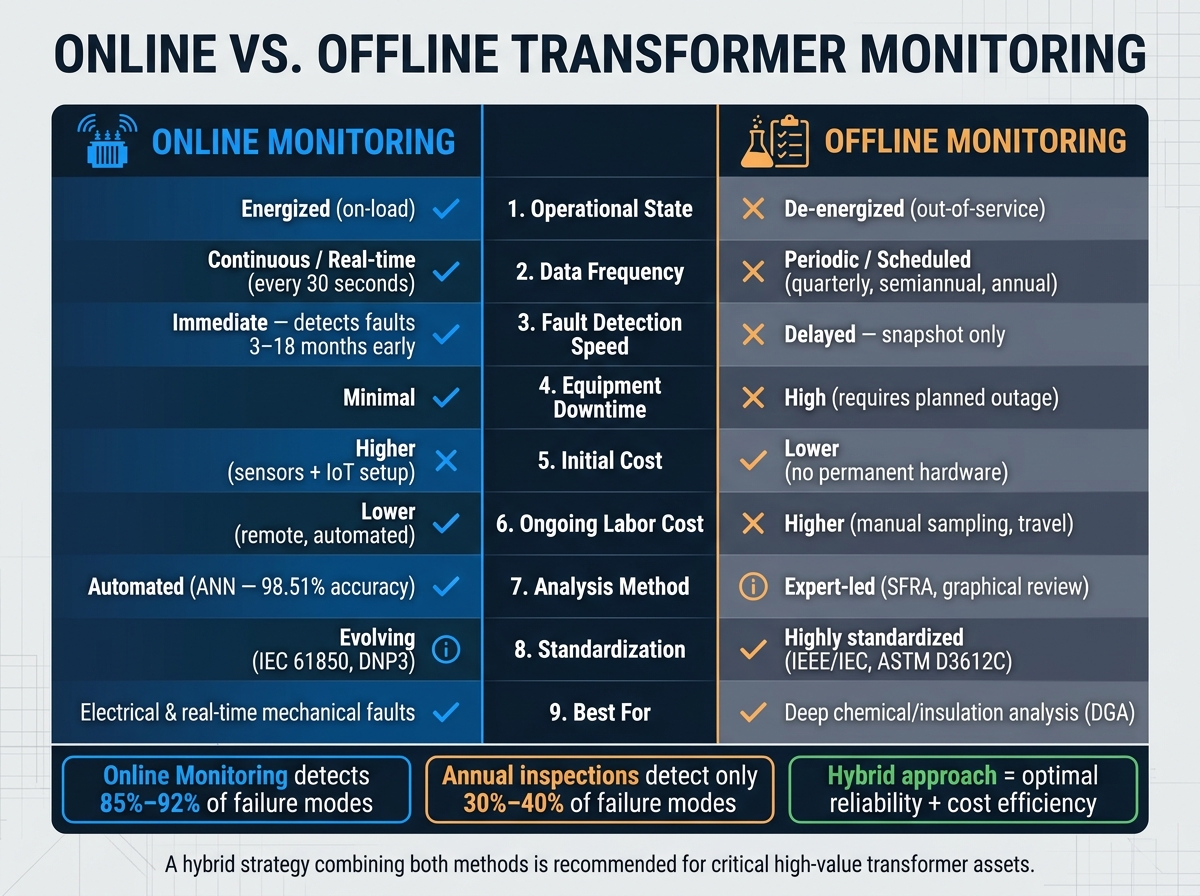
Online vs Offline Transformer Monitoring: Key Differences at a Glance
Online Transformer Monitoring
How Online Monitoring Works
Online monitoring keeps a constant eye on transformers while they remain energized. Sensors gather data every 30 seconds and send it directly to SCADA or asset management systems in real time. This setup provides a steady stream of updates about the transformer's condition, making it possible to spot subtle issues that annual inspections might miss entirely.
Multiple technologies work together to address various failure scenarios. Dissolved Gas Analysis (DGA) sensors, for instance, track up to eight fault gases like hydrogen, acetylene, and carbon monoxide using techniques such as gas chromatography or photo-acoustic spectroscopy. Fiber optic sensors embedded within the transformer tank measure winding hot-spot temperatures directly. These sensors are immune to electromagnetic interference, so they don’t require recalibration over time. For insulation issues in their early stages, UHF/HFCT sensors detect partial discharges (100 MHz to 3 GHz), providing warnings before gases even form.
| Technology | What It Monitors | Why It Matters |
|---|---|---|
| Online DGA | Fault gases (H₂, C₂H₂, CO, etc.) | Detects active arcing and thermal faults early |
| Fiber Optic Sensors | Winding hot-spot temperature | Helps estimate insulation aging and remaining lifespan |
| UHF/HFCT Sensors | Partial discharge | Identifies dielectric breakdown before gas formation |
| Voltage Tap Sensors | Bushing capacitance and tan delta | Averts explosive bushing failures |
| Motor Current Analysis | On-load tap changer (OLTC) drive | Detects mechanical binding and contact coking |
These technologies not only provide in-depth diagnostics but also highlight the strengths of continuous monitoring.
Advantages of Online Monitoring
The real-time data these sensors deliver offers major operational benefits. For example, online systems can detect problems 3 to 18 months before a failure happens. While annual inspections typically identify only 30% to 40% of potential failure modes, continuous monitoring can catch 85% to 92% of these issues well in advance. This proactive approach can prevent costly outages, which might otherwise last hours or even days.
Safety is another key advantage. As Emily Newton, Editor-in-Chief of Revolutionized, explains:
"Disaster prevention hinges almost entirely on early responses - and that requires real-time warnings, which only online monitoring tools provide."
Remote access further enhances safety and efficiency. Teams can monitor equipment from computers or mobile devices, minimizing travel, labor costs, and exposure to high-voltage environments. These benefits stand in contrast to offline methods, which will be discussed later.
However, online monitoring does come with its own set of challenges.
Limitations of Online Monitoring
Installing sensors on existing transformers typically requires a high-voltage shutdown, which introduces downtime and risks.
"A shutdown also represents a risk in itself, as it may provoke certain types of failures, when the transformer is switched off and on again." - Oktogrid
Once installed, the sheer volume of data can overwhelm teams. Without proper filtering, critical warnings may get buried in the noise, leading to alarm fatigue. Interpreting complex outputs, such as Duval Triangle coordinates or phase-resolved partial discharge patterns, requires specialized expertise, which is becoming harder to find. Additionally, integrating new sensors into older SCADA systems can be a time-consuming and resource-intensive process, especially when dealing with compatibility issues across protocols like IEC 61850, DNP3, or Modbus.
The upfront costs are another consideration. A fleet-wide rollout demands careful planning and significant investment. For this reason, many organizations opt for a phased approach, starting with their most critical assets.
sbb-itb-501186b
Offline Transformer Monitoring
How Offline Monitoring Works
Offline monitoring involves periodic oil sampling paired with detailed lab analysis, typically conducted on a quarterly, semiannual, or annual basis. During this process, a technician collects an oil sample without interrupting the transformer's operation. The sample is then sent to a laboratory, where it undergoes Dissolved Gas Analysis (DGA) - a key test that detects eight critical fault gases: hydrogen, nitrogen, carbon monoxide, carbon dioxide, methane, ethane, ethylene, and acetylene. Additional tests evaluate factors like interfacial tension, power factor, breakdown voltage, acidity, and oil color to provide a comprehensive understanding of the oil's condition.
To ensure accuracy, technicians flush several liters of insulating liquid through the sampling pipe and store the sample in glass containers. This prevents water contamination and hydrogen loss, which could compromise results.
These lab findings form the basis for further diagnostics, helping utilities make informed and cost-effective maintenance decisions.
Advantages of Offline Monitoring
Offline monitoring offers several benefits, especially for smaller substation transformers. One of its biggest strengths is its affordability, requiring much less initial investment compared to continuous online systems. Lab analysis also ensures a high level of diagnostic precision and repeatability. If a test result raises concerns, the same sample can be retested for confirmation. Standardized testing methods, such as ASTM D3612C and IEC 60567, further reinforce the reliability of results.
Even with advancements in online DGA tools, laboratory analysis has remained the gold standard for accuracy since its introduction in the 1960s.
"DGA of transformer oil is the single best indicator of the overall condition of the transformer and is carried out without taking it out of service." - Your Electrical Guide
Another major advantage of offline testing is its impact on extending a transformer's lifespan. While transformers are typically designed to last about 25 years, consistent oil testing and proper maintenance can help these critical assets operate for 40 years or more.
Limitations of Offline Monitoring
Despite its benefits, offline monitoring has its limitations. One major drawback is that it provides only a snapshot of the transformer's condition at the time of testing, rather than a continuous trend. This means it might not detect rapidly developing faults, which can escalate within days or weeks.
Additionally, some offline tests, like Frequency Response Analysis (FRA), require taking the transformer completely out of service. This can pose logistical challenges, as scheduling outages may not always be feasible. As highlighted in Scientific Reports:
"Frequency Response Analysis (FRA) is categorized as an offline method, posing significant challenges due to strict operational constraints, as utilities often cannot guarantee adequate outage availability." - Scientific Reports
Interpreting offline test results also requires skilled professionals. Unlike automated systems, offline analysis involves manually interpreting complex graphs and identifying fault patterns, which can add to the time and cost of diagnostics.
Why should you implement DGA Monitoring on power transformers? #electrical #utilities
Online vs. Offline Monitoring: Key Differences
When comparing online and offline monitoring, the standout difference lies in how data is collected. Online monitoring continuously gathers data from transformers while they’re energized, whereas offline monitoring captures periodic snapshots during maintenance or after a fault occurs.
This timing difference significantly impacts factors like cost, labor, fault detection speed, and data analysis methods. Online systems lean heavily on automated tools, such as Artificial Neural Networks (ANN), which can classify faults with an impressive 98.51% accuracy. Offline monitoring, on the other hand, requires expert input. Technicians manually interpret frequency spectra and use graphical comparisons, following well-established protocols like Sweep Frequency Response Analysis (SFRA). These protocols ensure consistency and reliable results. Online systems, though faster, can face hurdles such as signal interference and noise from the grid.
Cost is another major factor. Online monitoring demands a higher upfront investment due to the need for sensors and IoT infrastructure. However, as Emily Newton, Editor-in-Chief of Revolutionized, notes:
"Proactive offline monitoring can also prevent these high costs, but manual checks are a more expensive process."
Choosing between these methods depends on the specific needs of the transformer. Factors like the criticality of the equipment, budget, and operational requirements all play a role. To simplify, here’s a quick comparison:
Comparison Table: Online vs. Offline Monitoring
| Factor | Online Monitoring | Offline Monitoring |
|---|---|---|
| Operational State | Energized (on-load) | De-energized (out-of-service) |
| Data Frequency | Continuous / Real-time | Periodic / Scheduled |
| Fault Detection Speed | Immediate | Delayed |
| Equipment Downtime | Minimal | High (requires outage) |
| Initial Cost | Higher (sensors, IoT setup) | Lower (no permanent hardware) |
| Ongoing Labor Cost | Lower (remote, automated) | Higher (manual sampling, travel) |
| Analysis Method | Automated (ANN, locus diagrams) | Expert-led (SFRA, graphical review) |
| Standardization | Evolving | Highly standardized (IEEE/IEC) |
| Best Fault Detection | Electrical & real-time mechanical faults | Deep chemical/insulation analysis (DGA) |
| Invasiveness | Often non-invasive | May require direct connection |
Ultimately, there’s no one-size-fits-all solution. Each method has strengths and limitations, making the choice highly dependent on the transformer’s specific operational and financial considerations.
Choosing the Right Monitoring Method
There's no one-size-fits-all solution here. The right choice depends on how critical the transformer is, how much downtime can be tolerated, and the budget you're working with.
When to Use Online Monitoring
Online monitoring is ideal for transformers where failure could lead to major costs or safety risks. Think about transformers that are key to grid stability, manufacturing lines, or data centers. The upfront expense of sensors and IoT infrastructure is justified when an unplanned outage could cause significant financial or operational damage. As Emily Newton, Editor-in-Chief of Revolutionized, explains:
"Online monitoring entails initial disruption and cost, but its benefits quickly outweigh these investments."
For critical transformers, quarterly infrared (IR) thermography is a smart move. This noninvasive test identifies hot spots, loose connections, and cooling problems without requiring a shutdown. It's particularly important if the transformer shows a temperature difference exceeding 18°F (about 10°C) above the surrounding environment. Transformers exposed to harsh conditions - like dust, moisture, or corrosive substances - need even more frequent checks because they degrade faster.
On the other hand, if a transformer can handle occasional downtime, offline monitoring may be a more practical and cost-effective option.
When to Use Offline Monitoring
Offline monitoring works well for situations where periodic outages are acceptable, and continuous monitoring isn't in the budget. For less critical dry-type transformers, annual tests like Insulation Resistance (Megger), Winding Resistance, and Excitation Current can establish a solid performance baseline. Additionally, Turns Ratio (TTR) testing every two years is useful for spotting shorted turns, especially in low-voltage windings where surge testing might not be as effective.
However, not all offline tests are risk-free. For instance, DC Hi-pot testing can accelerate insulation wear, even if the transformer passes the test. To reduce this risk, NETA guidelines suggest limiting DC overpotential tests to 100% of the factory RMS test voltage for one minute. This type of testing should only be used sparingly and when other signs hint at a potential problem.
| Scenario | Recommended Approach |
|---|---|
| Critical transformer with high downtime risk | Online monitoring (at least quarterly IR thermography) |
| Harsh operating environment (dust, moisture, corrosion) | Increased online monitoring frequency |
| Non-critical asset with flexible outage scheduling | Annual offline basics (Megger, Winding Resistance, Excitation Current) |
| Low-voltage windings, shorted turn detection | Offline Turns Ratio (TTR) testing biennially |
| Budget limited | Offline routine testing; supplement with online IR as feasible |
Combining Online and Offline Monitoring
Building a Hybrid Monitoring Strategy
Offline testing gives you detailed snapshots of a transformer's condition, while online monitoring keeps tabs on real-time changes. Together, they create a more complete picture. This combination ensures that any early warning signs detected online can lead to deeper offline investigations, leveraging the strengths of both methods while addressing their individual weaknesses.
Start by using offline test data as a baseline for your online monitoring. Online sensors can then continuously track for deviations from this baseline. For example, if dissolved gas levels begin to rise, the online system flags the issue early, allowing a lab sample to confirm the problem before deciding whether to take the transformer offline for maintenance.
A hybrid strategy also means prioritizing your transformer fleet based on criticality. High-priority units, like generator step-up (GSU) transformers or heavily loaded transmission units, benefit from continuous online monitoring with tools like partial discharge sensors, fiber optic hot-spot monitors, and real-time dissolved gas analysis (DGA). Meanwhile, lower-risk distribution transformers can be monitored with periodic offline sampling, activating mobile online monitors only if offline results suggest potential issues.
Benefits of Using Both Methods Together
By combining offline and online techniques, you can significantly improve reliability. Continuous multi-parameter monitoring can detect 85% to 92% of failure modes weeks or even months before a breakdown, compared to just 30% to 40% detection rates with annual inspections alone.
One major advantage is bridging the gap in fault detection. Promwad explains:
"A transformer developing an active arcing fault between annual oil samples may not show elevated gas concentrations in the sample taken at the beginning of the interval. By the time the next sample is taken twelve months later, the fault may have escalated... to a critical condition."
Online monitoring also helps cut down on unnecessary preventive maintenance. When continuous data shows a transformer is stable, you can extend the time between offline tests, reducing labor costs without compromising safety. However, the key to success lies in integrating online alerts directly into your maintenance workflow. Many hybrid programs fail not because of the technology, but because alerts are ignored or disconnected from the work order system, leaving critical warnings unaddressed.
JP Picard, CEO and Co-Founder of Factory AI, highlights the value of online monitoring:
"For critical assets, online monitoring will help a lot. We've found for sites that have a medium to high hourly cost of downtime, it's a no-brainer to install continuous monitoring on key pieces of equipment, even if they are part of an offline program already."
This combined strategy also supports Transformer Health Indexing, which brings together data like DGA readings, partial discharge activity, thermal history, and oil quality into a single score. This score helps prioritize maintenance across your entire fleet, offering a level of visibility and optimization that neither method could achieve on its own.
Conclusion
When it comes to transformer monitoring, a one-size-fits-all approach simply doesn’t cut it. Offline inspections can identify about 30%–40% of potential failure modes, but continuous online monitoring significantly boosts detection rates to 85%–92%. Even better, online systems can flag issues 3 to 18 months before a failure occurs. With aging transformers and increasing grid demands, choosing the right monitoring strategy is more important than ever. Combining online and offline methods creates a well-rounded defense, as highlighted in the hybrid strategy discussed earlier.
"Periodic inspection is no longer an adequate risk management strategy for critical assets whose failure consequences have grown with the grid's load and complexity."
Key Takeaways
- Offline monitoring works well for less critical distribution transformers. Periodic sampling and lab analysis provide enough detail for diagnostics without breaking the bank.
- Online monitoring is essential for high-priority assets, such as those that are heavily loaded, aging, or located in remote areas. Real-time data can help prevent costly failures.
- A hybrid approach blends offline and online methods. Offline data can serve as a baseline, while online sensors track changes over time. This combination is especially effective when alerts integrate directly with your work order system.
- Transformer Health Indexing simplifies maintenance planning by combining key metrics - like DGA readings, partial discharge data, and oil quality - into a single, actionable score.
Ultimately, the best monitoring strategy depends on your specific assets, your tolerance for risk, and the costs associated with downtime. If you’re in the market for transformers or related electrical equipment, Electrical Trader offers a variety of new and used transformers, along with power distribution components, to help meet your operational needs.
FAQs
Which transformers need online monitoring most?
Transformers that play a crucial role in the power grid, like generator step-up transformers and large transmission transformers, require online monitoring the most. These transformers are essential for maintaining grid stability, and their failure can cause major disruptions. Online monitoring systems are invaluable for spotting early signs of trouble, reducing the risk of breakdowns, and keeping these high-cost, critical assets running smoothly.
What online sensors should I start with first?
To maintain transformer health, begin with sensors that track essential parameters like temperature, load, and oil quality. These metrics are vital for understanding the condition of your transformer and form the backbone of most online monitoring systems.
- Dissolved gas analysis sensors: These monitor oil quality and can detect signs of insulation aging, a common issue in transformers.
- Temperature sensors: Help spot overheating, which could lead to equipment failure if left unchecked.
- Load sensors: Provide insights into operational stress and can flag potential problems early.
By prioritizing these sensors, you're setting up a strong base for real-time monitoring and predictive maintenance. This approach ensures you can address issues before they escalate.
How do I build a cost-effective hybrid monitoring plan?
To design a budget-friendly hybrid transformer monitoring plan, blend online and offline techniques to get the best of both worlds. Online monitoring delivers real-time data, helping identify potential issues early. Meanwhile, offline tests, such as oil analysis and insulation assessments, serve to confirm and refine those findings. By combining insights from both approaches, you can prioritize maintenance tasks, manage expenses effectively, and maintain system reliability. Make sure to review and adjust the plan regularly, taking into account operational insights and changes in transformer conditions.