Ultimate Guide to Supplier Relationship Management
Supplier Relationship Management (SRM) is about creating stronger partnerships with suppliers to achieve long-term value, especially in industries like electrical equipment procurement. Instead of focusing solely on cost, SRM emphasizes collaboration to manage risks, improve quality, and drive mutual success. Key takeaways include:
- Segment Suppliers: Use tools like the Kraljic Matrix to categorize suppliers into Strategic, Leverage, Bottleneck, and Transactional groups, tailoring management approaches accordingly.
- Set Clear Metrics: Track supplier performance with KPIs like delivery reliability, quality, and responsiveness using scorecards.
- Enhance Communication: Build two-way feedback loops, centralize communication, and collaborate on product development for better outcomes.
- Manage Risks: Reduce supply chain disruptions through dual-sourcing, risk assessments, and maintaining buffer stock.
- Promote Improvement: Recognize top-performing suppliers, involve them early in projects, and encourage innovation.
For electrical equipment buyers, where transformer prices have risen 150% since 2020, SRM is critical to navigating challenges like supply shortages and volatile pricing. Tools like online marketplaces simplify sourcing and negotiation, offering features like technical filtering, seller communication, and auctions to ensure efficiency and cost-effectiveness. By treating suppliers as partners and leveraging structured SRM practices, businesses can strengthen supply chains and drive better results.
8 Supplier Relationship Management Tactics for Procurement Success
sbb-itb-501186b
Building Strong Supplier Relationships
Kraljic Matrix for Supplier Segmentation in Electrical Equipment Procurement
Segmenting Suppliers by Business Needs
Not all suppliers play the same role in your business. Some are absolutely essential, while others are easier to replace. For industries like electrical equipment procurement, this means identifying suppliers who provide critical components - like transformers or specialized breakers - and distinguishing them from those supplying more standard items, like office supplies or basic wiring. This kind of segmentation is key to managing costs effectively.
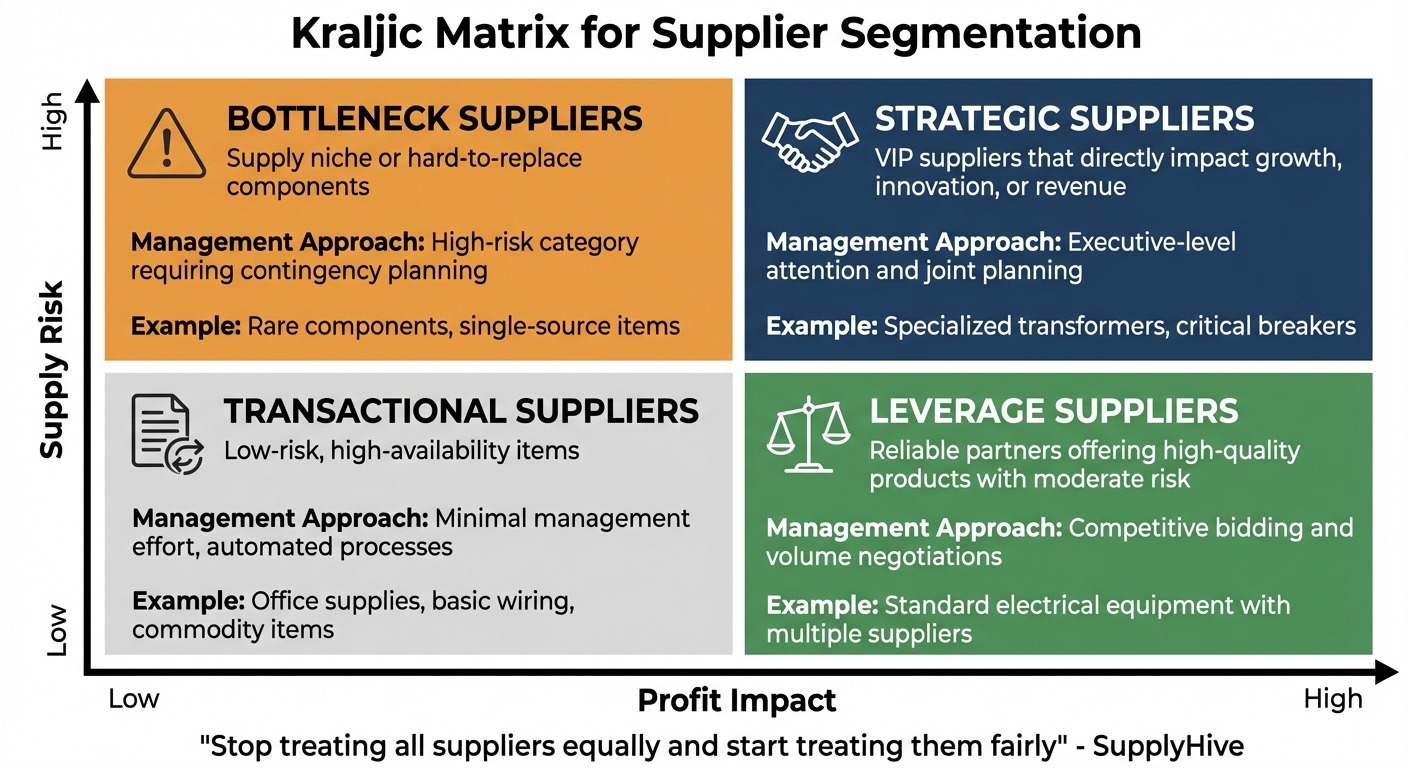
A helpful tool for this process is the Kraljic Matrix, which organizes suppliers into four categories: Strategic, Leverage, Bottleneck, and Non-critical. Here’s a quick breakdown:
- Strategic suppliers: These are your VIPs. They directly impact your growth, innovation, or revenue, so they need executive-level attention and joint planning.
- Leverage suppliers: Reliable partners that offer high-quality products with moderate risk to profitability.
- Transactional suppliers: These provide low-risk, high-availability items and require minimal management effort.
- Bottleneck suppliers: They supply niche or hard-to-replace components, making them a high-risk category if disruptions occur.
As SupplyHive wisely advises:
"Stop treating all suppliers equally and start treating them fairly".
Once you’ve segmented your suppliers, tailor your approach to fit their role. For example, automate processes like invoicing for transactional suppliers, while ensuring regular executive meetings with strategic partners. This method helps reduce supply chain risks and cost issues, especially in electrical equipment procurement. It also sets the stage for clear performance metrics.
Setting Clear KPIs and Metrics
To evaluate suppliers effectively, rely on objective data rather than subjective opinions. Focus on four core performance areas: Delivery, Quality, Responsiveness, and Cost. A weighted scorecard could look like this:
- 40%: On-time delivery
- 25%: Quality
- 20%: Lead time
- 15%: Responsiveness
For components critical to production, like transformers, prioritize delivery reliability even more heavily.
Use simple formulas to track performance. For example:
- On-Time Delivery = (on-time deliveries ÷ total deliveries) × 100
- Defect Rate = (defective units ÷ total units delivered) × 100
- Order Accuracy = (correct orders ÷ total orders) × 100
- Lead Time = delivery date - order placement date.
Review supplier performance monthly for critical partners, quarterly for strategic ones, and annually for less frequent evaluations. Integrating scorecards with your ERP or purchasing systems ensures real-time data tracking and reduces manual errors.
As Logan Price from Tradogram puts it:
"KPIs are the foundation of successful supplier management. KPI metrics help to track and evaluate supplier performance on a regular basis and ensure quality partnerships in the long run".
These data-driven metrics are essential for building resilient supplier relationships in the electrical equipment industry.
Improving Communication and Collaboration
While KPIs provide the numbers, communication transforms those insights into action. Surprisingly, only 13% of businesses have formal supplier management programs that cover their entire supply base, and nearly half of procurement leaders cite poor systems for collaboration as a major obstacle. So, how do you bridge the gap?
Start by creating two-way feedback loops. Ask suppliers to evaluate your performance through reverse appraisals to uncover friction points and improve partnerships.
Take inspiration from the County of San Diego, which switched to the Ivalua platform to manage procurement across 48 departments. This shift from manual processes to a unified Supplier Relationship Management (SRM) model improved community engagement and enabled data-driven evaluations.
Centralizing communication is another game-changer. Use a dedicated portal to streamline feedback, onboarding, and performance tracking. Assign Supplier Relationship Managers to maintain consistent contact and oversee key alliances. Regular site visits to supplier facilities can also deepen your understanding of their operations and show your commitment.
Go beyond basic transactions by collaborating on product development or sharing insights about cost-effective materials and emerging technologies. Negotiating win-win payment terms, like early payment discounts (e.g., "2/10 net 30"), can improve supplier cash flow while saving you money. Hosting annual awards to honor top-performing suppliers in areas like innovation or security is another way to strengthen ties.
Managing Risk and Monitoring Performance
Identifying and Reducing Supply Chain Risks
In 2025, an alarming 72% of businesses faced major supply chain disruptions caused by underperforming suppliers. For industries like electrical equipment procurement, where a single transformer failure can bring production to a standstill, this statistic highlights a critical vulnerability.
One significant concern is concentration risk - relying on a single supplier for critical components. This creates a potential single point of failure. A practical strategy to address this is dual-sourcing with a 70/30 volume split, which can reduce risks by 60% to 80%. This approach keeps your main supplier engaged while ensuring a backup supplier is prepared to step in if needed.
To better assess supplier risks, create a Risk Assessment Matrix. This tool plots suppliers based on two factors: the likelihood of disruption (considering financial stability, location, and political conditions) and the potential business impact (such as revenue loss or downtime costs). Suppliers in the "high probability, high impact" category require immediate action, whether that means finding alternative sources, building safety stock, or negotiating stricter performance contracts.
Real-world examples underscore the importance of risk management. In 2025, Asahi's logistics partner suffered a ransomware attack, halting production. This event highlights why 87% of procurement professionals now prioritize supplier risk management.
Assessing financial stability is also crucial. Credit reports, which cost between $50 and $200 each, can reveal early warning signs like delayed payments or credit downgrades. Ignoring supplier data can be costly - businesses lose an estimated $15 million annually due to poor supplier information. And supply chain disruptions? They can slash up to 62% of a company's profits. For situations where dual-sourcing isn't an option, such as components from a sole global manufacturer, maintaining buffer stock is essential for handling short-term disruptions.
Using Scorecards to Track Supplier Performance
Once you've mitigated risks, it's important to keep a close eye on supplier performance. Scorecards are an effective way to do this, offering objective insights into how well suppliers are meeting expectations. As SourceDay explains:
"Supplier performance problems rarely appear all at once. They show up in small gaps: a delivery that slips a few days, a price that changes after a purchase order is issued, or a supplier commitment that was never clearly confirmed".
To make scorecards effective, focus on 5 to 7 key criteria. Assign weights to these criteria based on your operational priorities. For example, in electrical equipment procurement, where production uptime is critical, you might allocate 30% to Quality, 25% to Delivery, 20% to Price, 10% to Responsiveness, 10% to Financial Stability, and 5% to Capacity.
Use a straightforward 1-5 scoring system, where 5 represents "Excellent" (top 10% of vendors) and 1 signals "Unacceptable", prompting an immediate search for a replacement. Automating data collection through your ERP system - for metrics like purchase order delivery dates, quality rejections, and communication logs - can cut data entry errors by up to 90%.
Adjust your review frequency based on supplier importance. Critical suppliers might need monthly reviews, while strategic partners can be reviewed quarterly during Quarterly Business Reviews. Standard vendors may only require annual evaluations. Sharing scorecard results with suppliers fosters transparency, sets clear expectations, and creates a foundation for improvement discussions. For key suppliers scoring below 3.0 on a 5.0 scale, implement formal improvement plans with specific goals and timelines.
Combining risk management with consistent performance monitoring ensures stronger, more reliable supplier relationships in the electrical equipment procurement space.
Promoting Continuous Improvement and Innovation
Strengthening supplier relationships through ongoing improvement and fresh ideas supports the broader strategic framework discussed earlier.
Supporting Supplier Innovation Programs
Building strong supplier relationships goes far beyond negotiating prices and delivery schedules. Early Supplier Involvement (ESI) brings electrical component manufacturers into the project planning process from the very beginning. This approach leverages their technical expertise to streamline design cycles and resolve potential issues before they escalate into costly problems. It’s also a catalyst for smarter product designs.
For instance, when designing a new power distribution system, involving a transformer supplier early can help optimize performance while keeping costs in check. Collaboration between Procurement, Engineering, and Operations teams ensures that technical requirements are precise and costs remain under control.
The numbers speak for themselves: over 60% of Chief Procurement Officers identify supplier collaboration as the strategy that delivers the most value to their organizations. Yet, nearly 60% of companies still face annual supply chain disruptions costing millions, often due to limited supplier visibility. Strategic suppliers who understand your long-term goals can offer proactive solutions, such as cost-effective material alternatives or technologies that improve system reliability.
Doug Roginson, Head of Supplier Relationship Management at JPMorganChase, underscores the importance of addressing operational gaps to enable innovation:
"We can't pragmatically talk about business development and innovation if we have lingering issues that aren't being successfully addressed and remediated".
This highlights the role of performance evaluations, such as scorecards, in building trust. Once trust is established, suppliers are more likely to share groundbreaking ideas. This kind of engagement sets the stage for recognizing and rewarding the most innovative contributors.
Recognizing and Rewarding Top Suppliers
Acknowledging top-performing suppliers is a natural extension of collaborative innovation. Programs like JPMorganChase's "Gold Supplier Program" formalize this recognition, offering tangible benefits to standout partners. As Roginson explains:
"Suppliers want insight, access and opportunities - the goal of the Gold Supplier Program is to deliver on those wishes".
Top-tier suppliers enjoy perks like dedicated communication channels, early access to new projects, and direct connections to executive leadership.
This recognition isn’t just symbolic - it drives measurable business outcomes. Valued suppliers are more inclined to invest in research and development and share innovations that align with your goals. In industries like electrical equipment, where transformer costs have surged by 150% since 2020, these collaborative efforts can help offset rising expenses.
Performance-based contract renewals also serve as a strong motivator. Offering extended terms or minimum order guarantees to high-performing suppliers gives them the financial stability to expand capacity or develop new technologies tailored to your needs. As Roginson puts it:
"to get beyond negotiating rates, service levels and delivery schedules and work toward market-making, brand-differentiating joint value creation. That takes trust created through truth and transparency".
Despite the benefits, only 13% of businesses currently consider themselves "leaders" in supplier management, with formal recognition programs in place across their supply base. This gap presents a clear opportunity to implement structured programs that set your procurement strategy apart and unlock further innovation.
Using Online Marketplaces for Procurement
Online marketplaces are reshaping how electrical professionals source equipment, offering a centralized and efficient way to manage supplier relationships. By streamlining access to suppliers and simplifying technical searches, these platforms provide a modern solution to procurement challenges.
How Electrical Trader Simplifies Supplier Management

Centralized sourcing eliminates the hassle of reaching out to multiple vendors individually. Electrical Trader connects buyers with a wide network of sellers across the country, offering everything from transformers and switchgear to circuit breakers and generators. This one-stop platform addresses a major industry pain point: nearly half (49%) of procurement leaders cite the lack of effective systems for scalable collaboration as a barrier to managing suppliers efficiently.
The platform's technical specification filtering allows buyers to narrow their searches using key parameters like voltage ratings (primary/secondary), KVA or amperage, phase type (single or three-phase), and frequency (50Hz or 60Hz). This level of detail ensures buyers can make precise comparisons between suppliers. Listings also include nameplate photos and standardized condition details (New, Used, Refurbished, or "Parts or Not Working") to help match purchases with both budget and performance needs.
Direct seller communication fosters relationship-building from the start. Buyers can request additional information - such as photos, technical documentation, or test results (e.g., megger readings or oil analysis) - before finalizing a purchase. Professional seller profiles with clear branding and policies make it easier to identify trustworthy vendors for long-term partnerships. For large-scale needs, such as facility liquidations or bulk inventory migrations, the platform even supports product feeds (XML) to simplify locating and managing extensive inventories.
By combining these features, Electrical Trader not only streamlines sourcing but also lays the groundwork for effective negotiations.
Negotiating Better Deals Through Online Platforms
Once supplier relationships are established through efficient sourcing, online tools can help procurement managers negotiate more favorable terms. The "Make an Offer" feature allows buyers to directly negotiate prices on high-value or unique items, especially when market values are uncertain. Before submitting an offer, checking completed listings can provide insights into current market pricing for used or surplus equipment. Many listings include a "Compare at Price" field, highlighting potential savings against the original MSRP and offering additional leverage during negotiations.
Product auctions further enhance the negotiating process by creating competitive bidding environments for items like surplus transformers or rare switchgear. This approach ensures pricing is driven by market demand. Notably, 46% of Chief Procurement Officers have identified cost savings as their top priority for 2024. To maximize savings, always verify the "Product Location" field to factor in freight costs. For bulk purchases, the direct inquiry system can be used to discuss volume discounts or improved payment terms, which automated pricing tools might not accommodate.
With these features, online marketplaces like Electrical Trader empower procurement teams to achieve both efficiency and cost-effectiveness in their sourcing strategies.
Conclusion
Only 13% of businesses consider themselves leaders in supplier management. This presents a significant opportunity for professionals to gain a competitive advantage by adopting structured Supplier Relationship Management (SRM) practices.
Start by segmenting your suppliers to prioritize those that have the most impact. Strategic and bottleneck suppliers demand more attention compared to routine, transactional vendors. As highlighted earlier, supplier segmentation and consistent performance tracking are essential for long-term success. Establishing clear KPIs from the onboarding stage - covering areas like quality, delivery, and innovation - ensures accountability right from the start.
While structured processes improve performance, digital platforms can simplify procurement even further. Tools like Electrical Trader streamline sourcing by offering technical filters, direct communication channels, and transparent pricing. These features are critical, especially since 49% of procurement leaders identify inefficient collaboration systems as a major challenge. By integrating such technology, businesses can encourage better communication and stronger partnerships.
Treat suppliers as genuine partners. Reverse appraisals, where suppliers evaluate your performance as a customer, and regular site visits can help strengthen these relationships. As Jack Pellegrino, Director of Purchasing and Contracting for the County of San Diego, emphasized:
"The Ivalua Supplier Relationship Model has been a key part of our strategy to engage with the community and small businesses in our region".
Align your SRM approach with broader business goals. For example, 46% of Chief Procurement Officers focus on cost-saving initiatives. Target measurable outcomes like volume discounts, faster procurement cycles, or collaborative innovation efforts. In industries like electrical equipment, where market conditions can shift rapidly, strong supplier relationships are essential for managing uncertainty and driving sustainable growth.
FAQs
How do I choose the right supplier segment for each vendor?
When selecting the right supplier segment, it's essential to assess each vendor's risk level, strategic importance, and performance. By categorizing suppliers into groups - such as low-risk, medium-risk, and high-risk, or strategic versus non-strategic - you can better prioritize your management efforts.
This segmentation allows you to focus on critical vendors that play a key role in your operations while also reinforcing the resilience of your supply chain. Adjust your management approach for each segment to make the most of your resources and nurture stronger vendor relationships.
Which SRM KPIs matter most for critical electrical equipment?
When managing critical electrical equipment, it's essential to track specific Supplier Relationship Management (SRM) KPIs to ensure smooth operations. These include:
- Supplier reliability: This measures how consistently suppliers meet their commitments, from delivery timelines to product quality. A dependable supplier minimizes unexpected delays and keeps the supply chain running smoothly.
- Risk monitoring: Keeping an eye on potential risks - like financial instability or supply chain bottlenecks - is crucial. Real-time risk assessments can help identify vulnerabilities early, allowing for proactive problem-solving.
- Performance metrics: These track supplier performance over time, focusing on factors like delivery accuracy, compliance with safety standards, and overall efficiency. Strong performance metrics contribute to a resilient and safe supply chain.
Using tools such as supplier reliability checklists and real-time risk assessment systems can help maintain operational continuity. This proactive approach ensures disruptions are minimized and critical equipment remains functional when it matters most.
How can Electrical Trader help streamline supplier communication and negotiation?
Electrical Trader makes it easier for buyers to connect and negotiate with suppliers through its marketplace. The platform allows users to discuss pricing, delivery schedules, and terms in a straightforward way, all while offering tools like supplier reliability checklists to help ensure trust. With clear pricing and product availability, the platform promotes better alignment between parties. Plus, its centralized setup simplifies communication, tracks orders, and helps resolve issues, improving both supplier relationships and overall efficiency.