Manual vs. Digital Sourcing: Key Differences
Manual sourcing relies on phone calls, emails, and spreadsheets to manage procurement. It's familiar but prone to delays, errors, and inefficiencies. Digital sourcing, on the other hand, uses online platforms and automation to simplify and speed up the process, reducing costs and improving accuracy.
Key Takeaways:
- Manual sourcing: Slower (6–10 days per order), higher error rates, and heavily dependent on personal relationships and institutional knowledge.
- Digital sourcing: Faster (2–5 days per order), lower error rates, and provides real-time tracking and broader supplier access.
For example, a contractor earning $25 million annually could lose 2–3% of material spend due to inefficiencies in manual sourcing. Digital tools can cut these losses and improve overall procurement efficiency.
Quick Comparison:
| Feature | Manual Sourcing | Digital Sourcing |
|---|---|---|
| Cycle Time | 6–10 days | 2–5 days |
| Quoting Speed | 24–48 hours | Minutes |
| Order Errors | High | 32% fewer errors |
| Cost per RFQ | $30–$50 | $6–$12 |
| Visibility | Scattered documents | Real-time dashboards |
Choosing between these methods depends on your needs. Manual sourcing works for specialized negotiations or suppliers without digital tools. Digital sourcing is better for high-volume operations where speed and cost control are critical.
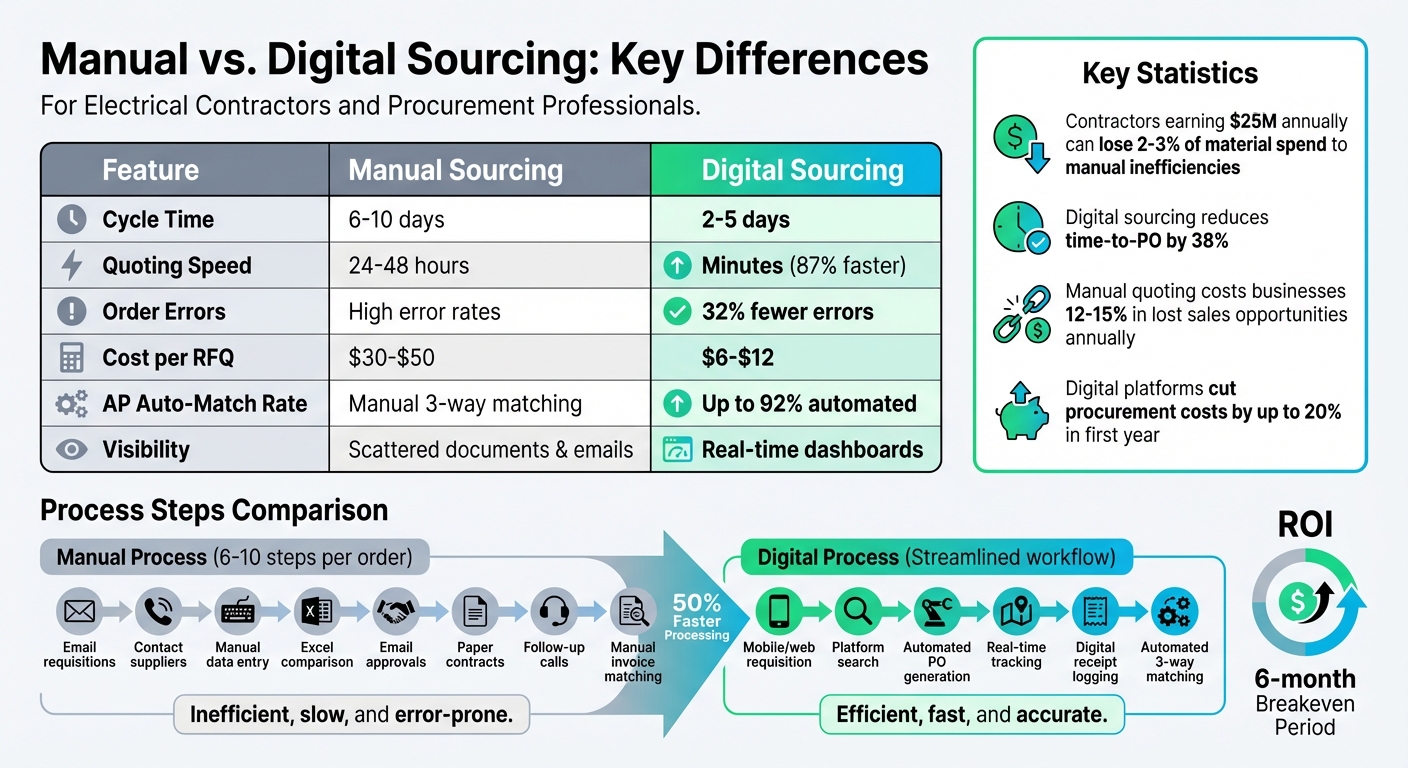
Manual vs Digital Sourcing Comparison for Electrical Contractors
What is Digital Procurement?
sbb-itb-501186b
Manual Sourcing Explained
Manual sourcing is a traditional approach to procurement that relies on human effort and tools like phone calls, emails, spreadsheets, and physical paperwork. In this process, electrical contractors typically email requisitions to their purchasing teams. From there, the purchasing team contacts suppliers, enters data into order templates, and tracks shipments through follow-up calls.
This method leans heavily on personal networks and institutional knowledge. Procurement professionals often find vendors using industry directories, word-of-mouth recommendations, and long-standing relationships. However, the information they rely on is often scattered across emails, local files, and handwritten notes. As ProcurePro puts it:
"Procurement in construction has long depended on spreadsheets, inboxes, and persistence. Tendering, tracking, comparing, and signing were done manually - mostly... by copying from the last job and hoping nothing got missed".
Here’s a closer look at how the manual sourcing process unfolds.
The Manual Sourcing Process
The process usually starts when a field team identifies a need and sends a spreadsheet requisition to the purchasing department. The purchasing team then reaches out to two or three known suppliers for quotes. Once the bids come in, they’re manually entered into Excel for comparison - a step that’s not immune to typos or delays.
After selecting a supplier, the team creates a purchase order by copying data from the requisition into a standard template. Approvals are handled through email threads, while contracts are printed, signed, and filed manually. Tracking orders involves handwritten notes and follow-up calls with suppliers. When materials arrive, warehouse staff log receipts on paper, and invoices are matched against purchase orders and receiving documents - again, manually, using Excel.
While straightforward, this approach has both strengths and weaknesses worth considering.
Benefits of Manual Sourcing
One of the main advantages of manual sourcing is the level of personal control it offers. Procurement professionals can cultivate strong relationships with suppliers through direct communication, which can foster trust and flexibility when handling custom or complex orders.
Another benefit is its accessibility. For smaller electrical contractors with limited budgets, manual sourcing eliminates the need for expensive software or lengthy training. This makes it a practical choice for businesses with lower procurement volumes, where decisions are guided by industry know-how rather than automated tools.
Drawbacks of Manual Sourcing
Despite its familiarity, manual sourcing comes with significant downsides, especially in terms of time and cost. For example, a contractor earning $25 million annually could lose 2% to 3% of material spend to inefficiencies like rush shipping, duplicate orders, or invoice errors - amounting to six-figure losses each year. Manual processes also require 6 to 10 additional steps per order compared to automated systems.
There’s also a risk tied to reliance on key personnel. If a key employee leaves, the company may lose critical supply chain connections. Additionally, manual quoting in B2B distribution can reduce annual sales opportunities by 12% to 15%. Manual data entry, meanwhile, is prone to errors caused by fatigue or oversight. As Vipul Aggarwal from BetterCommerce explains:
"Manual processes may feel familiar, but they're riddled with hidden costs. In most B2B tool distribution environments, teams spend hours on tasks like quote configuration, stock lookup, catalog enrichment, and order status updates - all handled through email threads, Excel sheets, or phone calls".
Finally, manual sourcing creates information silos, leading to a lack of real-time updates for project teams. Field workers often face delays as purchasing staff scramble to locate materials, resulting in late or missing status updates. These inefficiencies can disrupt project timelines and reduce profit margins.
Digital Sourcing Explained
Digital sourcing, also known as e-sourcing, takes the hassle out of manual procurement by automating key steps in the process. Instead of juggling spreadsheets, paper logs, and endless phone calls, procurement teams can use digital tools to identify, evaluate, and select suppliers quickly and efficiently. This approach is a cornerstone of digital procurement, which streamlines the entire cycle - from identifying needs to tracking deliveries - through automation.
One of the game-changing aspects of digital sourcing is its ability to centralize data. Gone are the days of scattered notes and relying on institutional knowledge. With a unified system, procurement teams can issue Requests for Quotation (RFQs) to suppliers worldwide, compare bids instantly, and even finalize contracts within 24 hours using electronic signatures. As CADDi succinctly puts it:
"The power of digital procurement lies in replacing slow, error-prone manual processes with fast, data-driven workflows".
For industries like electrical contracting, this translates into faster turnaround times and better cost management. By cutting out administrative delays, digital procurement can speed up processes by as much as 50%. Features like e-auctions not only drive competition but can also reduce procurement costs by up to 20% in the first year alone. Platforms such as Electrical Trader allow buyers to browse thousands of electrical components - everything from breakers to power generation equipment - compare prices, and place orders without the back-and-forth of traditional quoting. This efficiency sets the stage for smoother operations across the board.
The Digital Sourcing Process
Digital sourcing kicks off when a field team submits a requisition through a mobile app or web portal. The request is then routed to the purchasing department, where procurement professionals can search platforms like Electrical Trader for the exact components they need. Instead of reaching out to a handful of familiar suppliers, they can access a broader pool of vendors, compare stock availability, and check real-time pricing.
Once a supplier is chosen, the system generates a purchase order automatically. This eliminates the need for lengthy email chains and manual data entry, while real-time shipment updates - enabled through EDI or API integrations - reduce the need for follow-up calls. When the materials arrive, warehouse staff can log receipts digitally, often with photo documentation. Automated 3-way or 4-way matching ensures price and quantity discrepancies are flagged before payment is processed.
This optimized workflow significantly shortens the time-to-PO cycle, cutting it from 6–10 days to just 2–5 days. For example, a mid-size commercial contractor earning around $40 million annually saw a 38% reduction in time-to-PO within 90 days of switching to an integrated procurement platform. Their AP auto-match rate hit 92%, and smarter purchasing reduced material spend variance by 3% to 5%, thanks to fewer last-minute orders.
Benefits of Digital Sourcing
Digital sourcing offers clear advantages. By removing 6–10 manual steps per order and enabling automated bid evaluations, procurement teams can shift their focus from tedious tasks to strategic decision-making. Digital platforms also expand access to suppliers beyond local or familiar networks, connecting contractors to national and international markets. On platforms like Electrical Trader, buyers can find everything from 3-phase transformers to emergency standby diesel generators in one convenient place.
This level of transparency fosters competition and prevents overpayment, while real-time tracking allows for live budget monitoring and immediate alerts for variances.
The numbers back up these benefits. Vodafone’s global procurement team, handling 800,000 purchase orders annually, implemented a supply-chain analytics control center powered by AI and RPA. This upgrade increased their perfect purchase order rate from 73% to 96%, reduced the cost per purchase order from $2.70 to $2.36, and cut overall procurement costs by 11%. Similarly, Kawasaki Railcar adopted CADDi Drawer, a cloud-based tool that links order data with technical drawings. This allowed their procurement teams to quickly access past projects and identify the best suppliers.
Drawbacks of Digital Sourcing
Despite its many benefits, digital sourcing isn’t without challenges. A stable internet connection is critical - without it, the entire system can come to a standstill. This reliance also raises cybersecurity concerns, requiring robust measures to protect sensitive data.
Adopting digital tools often involves retraining staff, especially those accustomed to manual processes, which can lead to resistance. Integrating new systems with older ERP software can also be tricky, requiring significant IT expertise to ensure smooth data flow.
Another potential hurdle is data quality. Issues like inconsistent product naming or siloed databases can undermine the efficiency of these systems. Smaller suppliers may also struggle to participate effectively unless supported by supplier enablement programs.
While digital procurement is becoming essential for modern businesses, its success depends on careful planning, phased implementation, and strong data management practices.
Comparing Manual and Digital Sourcing
Side-by-Side Comparison
Manual sourcing involves 6–10 steps per order, which often leads to delays and mistakes. On the other hand, digital platforms streamline the process, cutting down on these interactions significantly. For electrical contractors - where materials typically account for 30–40% of revenue - manual sourcing can waste 2–3% of that spend due to errors, delays, and last-minute orders.
| Feature | Manual Sourcing | Digital Sourcing |
|---|---|---|
| Cycle Time | 6–10 days | 2–5 days |
| Quoting Speed | 24–48 hours | Minutes (87% faster) |
| Order Errors | High error rates | 32% fewer errors |
| AP Auto-Match Rate | Manual 3-way matching | Up to 92% automated |
| Visibility | Scattered emails and spreadsheets | Real-time dashboards |
| Cost per RFQ | $30–$50 | $6–$12 |
Take the example of a mid-size commercial electrical contractor with $40 million in revenue. In 2025, they transitioned from Excel-based manual systems to a fully integrated digital platform. The results? Their time-to-PO dropped by 38%, their AP auto-match rate soared to 92%, and materials spend variance improved by 3% to 5%. Even better, the technology investment broke even in less than six months. These numbers highlight the stark contrasts between the two approaches. Now, let’s explore when each method works best.
Best Use Cases for Manual Sourcing
Manual sourcing still has its place, especially in highly specialized negotiations where personal relationships and detailed customizations are essential. If you're sourcing high-value, mission-critical items that require thorough due diligence, face-to-face discussions can provide the nuance and trust that digital platforms lack.
This method is also practical for smaller organizations working with suppliers who lack digital tools. For example, if your vendor network includes local shops without online integration, manual methods like phone calls or in-person visits might be your only option. These scenarios are less common but still relevant, particularly when dealing with custom-fabricated components or replacing legacy equipment that requires extensive back-and-forth over technical specifications.
Best Use Cases for Digital Sourcing
Digital sourcing is ideal for high-volume operations where speed and cost transparency are crucial to maintaining slim profit margins. For electrical contractors juggling thousands of SKUs across multiple job sites, platforms like Electrical Trader offer instant access to pricing, availability, and product details - eliminating the inefficiencies of phone tag. The ability to compare quotes and track shipments in real-time is invaluable for managing deliveries on complex, multi-phase construction projects.
In competitive markets, the advantages of digital sourcing are even more pronounced. Manual quoting processes in B2B distribution can cost businesses 12% to 15% in lost sales opportunities annually. Digital platforms, by reducing response times from days to minutes, help companies secure better pricing and shorten project timelines. For distributors and contractors, this speed not only improves win rates but also boosts customer satisfaction. Whether you're sourcing 3-phase transformers or emergency standby diesel generators, digital sourcing isn’t just a convenience - it’s a critical edge in today’s fast-paced industry.
Conclusion
Deciding between manual and digital sourcing hinges on your organization's specific requirements. Manual sourcing continues to play a key role in niche scenarios, such as specialized negotiations or situations where supplier relationships are deeply established. It’s also a practical choice when suppliers lack the infrastructure for digital integration. On the other hand, for most electrical equipment procurement - especially in high-volume operations with countless stock-keeping units - digital sourcing can dramatically improve efficiency, accuracy, and cost management.
As highlighted earlier, digital platforms can reduce the requisition-to-payment cycle by more than 50%, turning process enhancements into measurable cost savings. For electrical contractors, eliminating inefficiencies from manual processes directly boosts profit margins and shortens project timelines. Errors, delays, and last-minute orders in manual systems often chip away at profitability through extra shipping costs, duplicate purchases, and invoice issues.
Many organizations find that combining both methods works best. Digital sourcing is ideal for high-volume or regulated items, while manual methods remain valuable for custom-fabricated components or replacing legacy equipment. If you're planning to transition, start small - connect with your top suppliers, test digital receiving on a single project for two weeks, and set up a straightforward approval process before scaling across your operations.
Ultimately, aligning your sourcing strategy with your business objectives is key to achieving efficiency. Platforms like Electrical Trader offer the tools you need - real-time pricing, availability, and transparency - to thrive in today’s fast-paced electrical equipment market. By leveraging the strengths of both manual and digital sourcing, you can position your organization for greater profitability and success.
FAQs
How do I know if my team is ready to switch to digital sourcing?
To gauge if your team is ready, take a closer look at their digital maturity. This goes beyond simply using tools - it’s about how well data informs decision-making. Key signs to watch for include: a shift in mindset that values collaboration and ongoing improvement, a solid infrastructure that can handle digital tools, and an openness to simplifying manual processes. A formal readiness assessment can provide clarity on whether your team is truly prepared to make the leap.
What should I digitize first to get quick wins in procurement?
Digitization in procurement doesn’t have to be overwhelming. For quick wins, focus on areas where even small changes can make a big difference. One smart move? Start with electronic signatures for contracts and purchase orders. This type of implementation typically takes just 1 to 3 months, but the payoff is immediate: less manual paperwork, faster processing times, and smoother approval workflows. It’s a simple way to speed up procurement cycles and see results right away.
How can I bring small suppliers into a digital sourcing workflow?
To bring small suppliers into a digital sourcing workflow, consider using e-sourcing tools and automation platforms. These tools streamline how you discover suppliers, communicate with them, and handle transactions - all online. Platforms like Electrical Trader can be especially helpful, as they support real-time communication, order tracking, and bid submissions, making the process smoother for everyone.
By automating workflows and centralizing supplier data, you can simplify collaboration, cut down on manual follow-ups, and build a procurement process that's both inclusive and more efficient.