Top Medium Voltage Switchgear Brands for Commercial Use
When selecting medium voltage (MV) switchgear for commercial use, the choice of brand is critical. MV switchgear manages voltages between 1 kV and 38 kV, ensuring safe power distribution, fault protection, and system isolation for maintenance. The top brands in 2026 - like ABB, Siemens Energy, Schneider Electric, Eaton, and others - offer solutions tailored for specific needs, balancing safety, reliability, and cost-effectiveness.
Key Takeaways:
- Schneider Electric: Known for space-saving designs like the SureSeT series, ideal for retrofits, and the high-capacity Masterclad series for critical facilities.
- Siemens Energy: Offers air- and gas-insulated switchgear with advanced safety features like arc-resistant designs and remote monitoring.
- ABB: Provides a broad range of solutions, including digital and SF6-free options, with a focus on modularity and sustainability.
- Eaton: Specializes in compact, front-access designs like the MEF series, perfect for tight spaces, and robust automation features.
- Hitachi Energy: Focuses on integrating smart monitoring systems and reducing environmental impact with SF6-free designs.
- GE Vernova: Delivers reliable solutions with long-lasting spring-operated mechanisms and eco-friendly gas options.
- Mitsubishi Electric: Offers compact, air-insulated switchgear with low-maintenance vacuum breakers for high-demand facilities.
- Powell Industries: Features arc-resistant designs and narrow configurations for space-constrained installations.
- Toshiba: Provides durable metal-clad and gas-insulated options, emphasizing safety and long-term durability.
- Lucy Electric: Focuses on ring main units (RMUs) for compact and efficient power distribution, with zero-emission insulation options.
Quick Comparison Table:
| Brand | Voltage Range | Special Features | Best For |
|---|---|---|---|
| Schneider Electric | 4.76–27 kV | Compact retrofits, real-time monitoring | Hospitals, data centers, retrofits |
| Siemens Energy | Up to 36 kV | Arc-resistant, eco-friendly insulation | High-occupancy buildings, sustainability |
| ABB | Up to 40.5 kV | Modular, digital, SF6-free designs | Large facilities, complex layouts |
| Eaton | Up to 38 kV | Front-access designs, automation-ready | Space-constrained rooms |
| Hitachi Energy | Up to 38 kV | Smart monitoring, SF6-free solutions | Smart buildings, renewable integration |
| GE Vernova | Up to 40.5 kV | Long-lasting mechanisms, green gas tech | Utility-scale and large commercial setups |
| Mitsubishi Electric | Up to 24 kV | Compact air-insulated designs | Heavy-duty commercial loads |
| Powell Industries | Up to 38 kV | Arc-resistant, narrow configurations | High-risk environments |
| Toshiba | Up to 38 kV | Metal-clad and gas-insulated options | Energy-intensive facilities |
| Lucy Electric | Up to 36 kV | RMUs, zero-emission insulation | Compact power distribution setups |
Choosing the right MV switchgear depends on your facility’s voltage requirements, space constraints, safety needs, and budget. For high-demand facilities like hospitals or data centers, focus on brands offering arc-resistant and digitally monitored options. For retrofits or tight spaces, compact designs like Eaton’s MEF or Schneider’s SureSeT are excellent choices. Always consider long-term costs, including maintenance and energy efficiency, to ensure the best fit for your commercial needs.
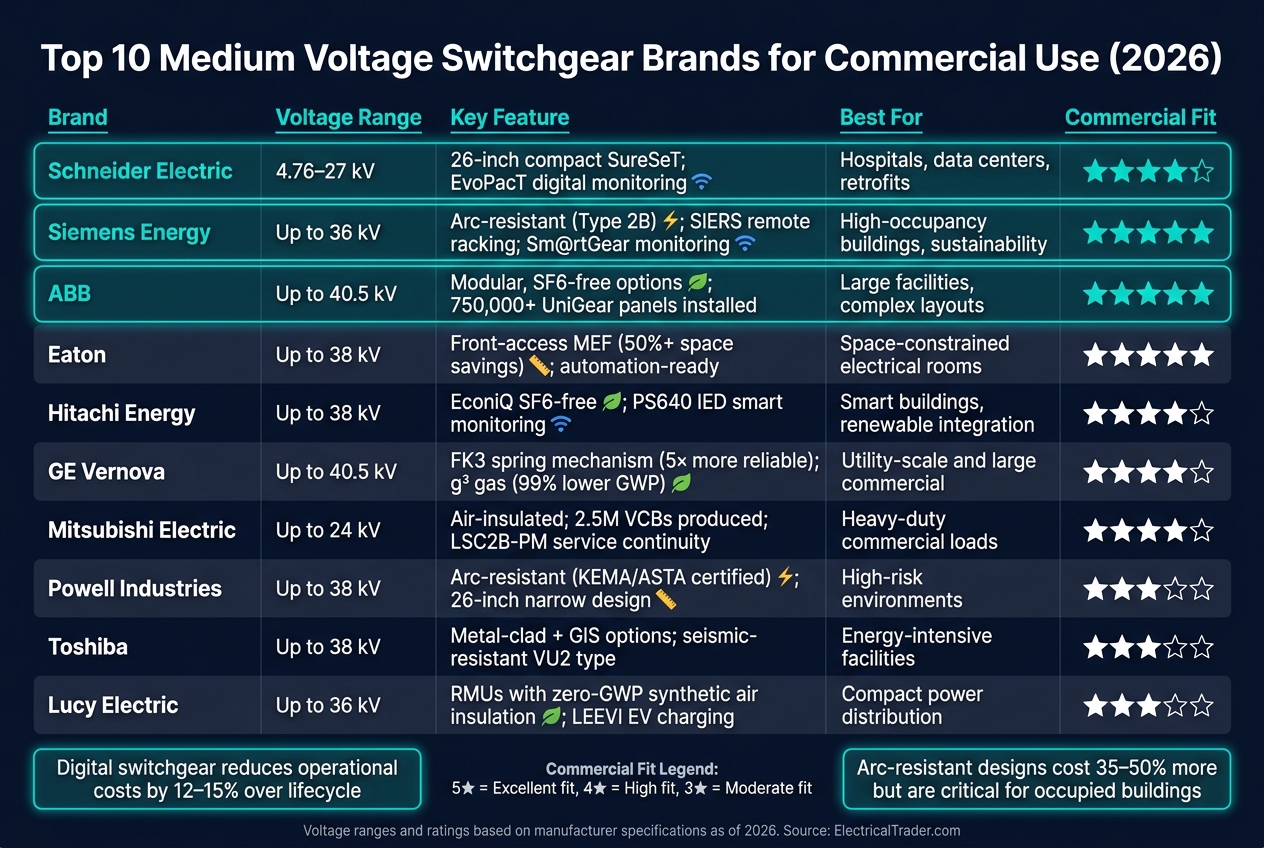
Top 10 Medium Voltage Switchgear Brands Compared (2026)
The Power to Adapt: ABB SF6-free switchgear portfolio - UniSec Air
1. Schneider Electric

Schneider Electric offers two main medium voltage switchgear product lines tailored for commercial systems: Masterclad and SureSeT. Each series is designed to meet specific needs in commercial applications.
The Masterclad series is a durable, air-insulated, metal-clad switchgear built for critical main service entrance protection. It’s ideal for facilities like large commercial buildings, data centers, and hospitals where uptime is non-negotiable. This series operates within a voltage range of 4.76 kV to 27 kV, supports current ratings up to 4,000 A at 15 kV, and provides interrupting ratings from 25 kA to 63 kA, adhering to ANSI C37.20.2 standards. Its 3-cycle VR vacuum breakers are designed for up to 10,000 mechanical operations, which helps reduce the need for frequent maintenance shutdowns.
The SureSeT series, on the other hand, is engineered for compact spaces with a 26-inch-wide, two-high circuit breaker configuration, making it perfect for retrofits in space-constrained environments. It incorporates EvoPacT vacuum breakers with digital monitoring capabilities, offering real-time data on equipment health.
Both series feature fully compartmentalized construction, grounded barriers, and mechanical interlocks to enhance safety. Optional arc-resistant structures and remote racking systems allow operators to rack breakers in or out from a safe distance, outside the arc flash boundary.
| Feature | Masterclad | SureSeT |
|---|---|---|
| Voltage Range | 4.76 kV to 27 kV | Up to 15 kV |
| Max Current | 4,000 A at 15 kV | Compact loads |
| Footprint | Standard ANSI configuration | 26-inch wide |
| Circuit Breaker | 3-cycle VR Vacuum | EvoPacT Vacuum |
| Best For | Large service entrances, hospitals, data centers | Space-constrained commercial retrofits |
Both UL Listed and compliant with IEEE 37.20.2 standards, the Masterclad series is suited for high-demand facilities, while the SureSeT series is an excellent choice for retrofits in smaller, confined spaces.
2. Siemens Energy
Siemens Energy offers medium voltage switchgear solutions ranging from 5 kV to 36 kV. Their lineup includes air-insulated, gas-insulated, and hybrid designs, giving commercial facility managers options that balance space, budget, and environmental considerations.
Among their standout products are the GM-SG and GM-SG-AR models, tailored for commercial settings. Both support power distribution up to 27 kV, but the GM-SG-AR takes safety up a notch with arc-resistant construction tested to IEEE C37.20.7 Type 2B standards. This makes it a suitable choice for high-occupancy spaces like hospitals and high-rise offices. The GM-SG series also features a two-high configuration and the SIERS system, allowing remote circuit breaker racking outside the arc-flash zone for added safety. Additionally, their Sm@rtGear technology ensures continuous monitoring, predictive diagnostics, and remote control capabilities.
For those prioritizing sustainability, Siemens Energy offers innovative options like the NXAIR and NXPLUS C 24 "Blue GIS." The NXAIR uses SF6-free natural air insulation, supporting up to 36 kV and 31.5 kA, with service intervals extending beyond 10 years. Meanwhile, the NXPLUS C 24 incorporates Clean Air insulation with a Global Warming Potential (GWP) of less than 1, setting a new benchmark for environmentally conscious designs.
| Model | Max Voltage | Insulation | Advantage |
|---|---|---|---|
| GM-SG-AR | 27 kV | Air | Arc-resistant (Type 2B) with SIERS remote racking |
| NXAIR | 36 kV | Natural Air (SF6-free) | Long service intervals and eco-friendly design |
| SIMOSEC | 24 kV | Air/Gas Hybrid | Compact design ideal for secondary distribution |
| SIEBREAK-VCB | 15–38 kV | Air | Quick arc-flash interruption, reducing energy to 2.1 cal/cm² |
Siemens Energy also emphasizes advanced safety features. The SIQuench module efficiently extinguishes arcing faults, helping to minimize equipment damage. The SIEBREAK-VCB model is particularly noteworthy for its ability to interrupt arcs in just 60 ms, reducing arc-flash energy to 2.1 cal/cm² while offering vacuum interrupters rated for up to 30,000 switching cycles. Altogether, these solutions highlight Siemens Energy's focus on creating switchgear that blends space efficiency, safety, and eco-conscious performance for commercial applications.
3. Hitachi Energy
Hitachi Energy brings over a century of experience in substation technology, showcased through its medium-voltage switchgear solutions. Their lineup includes Air-Insulated Switchgear (AIS), Gas-Insulated Switchgear (GIS), and Hybrid solutions, offering options that cater to various space, environmental, and budget considerations. This variety highlights their focus on delivering tailored solutions for commercial power systems.
For commercial buildings, their EDI air-insulated modules stand out. These compact, modular designs are easy to integrate into existing power systems, making them a practical choice for smaller setups. On the other hand, their Dead Tank Circuit Breakers (DTB) are well-suited for primary substations that supply power to larger commercial facilities.
Hitachi Energy's PS640 Intelligent Electronic Devices (IEDs) combine protection, control, measurement, and supervision into one platform, ideal for medium-voltage feeders, transformers, and motors. For example, the PSF640 offers advanced features like four-stage overcurrent protection, earth fault detection, auto-reclosing, and GOOSE-based circuit breaker control. It also supports Parallel Redundancy Protocol (PRP) and Rapid Spanning Tree Protocol (RSTP) to create self-healing communication networks. This ensures reliable performance and minimizes downtime during network faults - critical for commercial operations.
"Distribution system operators need protection and control devices that are reliable, secure, compatible, and easy to integrate with existing devices." - Hitachi Energy
Sustainability is another key focus for Hitachi Energy. Traditional switchgear often uses SF6 gas, which is 24,300 times more potent than CO2 as a greenhouse gas. To address this, the EconiQ® product line eliminates over 3,000 kilograms of SF6 in certain network installations, making it an environmentally responsible choice for projects with strict compliance requirements. Additionally, their global service network ensures local support, simplifying installation and maintenance while managing risks effectively throughout a project's lifecycle.
4. ABB
ABB provides a wide-ranging portfolio of medium voltage switchgear, spanning 5 kV to 40.5 kV, with three insulation options: air-insulated (AIS), gas-insulated (GIS), and solid-dielectric. For U.S. commercial buildings, the Advance® ANSI platform (available in 5, 15, and 27 kV) and the SafeGear series are standout choices. Both adhere to ANSI/IEEE standards, with SafeGear offering a practical advantage - it saves 2.5 square feet of floor space compared to standard designs, making it ideal for tight electrical rooms. These solutions emphasize safety and operational efficiency.
The SafeGear and SafeGear HD models comply with IEEE C37.20.7 arc-resistant guidelines, ensuring protection in high-occupancy facilities. ABB has incorporated REA arc flash relays, closed-door racking, and safety interlocks to minimize risks associated with equipment maloperation.
"ABB's switchgear smart solutions are designed to help our customers make data-driven decisions." - ABB
ABB also focuses on automation to enhance system intelligence. Their digital switchgear includes advanced sensors and remote monitoring capabilities, simplifying installation and improving system oversight. Additionally, their vacuum breakers - ADVAC (spring-charged) and AMVAC (magnetically actuated) - are designed for low-maintenance operation, reducing long-term costs.
For urban commercial buildings, ABB offers compact GIS options like SafePlus and ZX2. The ZX2 model supports up to 5,000 A continuous current within a sealed enclosure, making it a powerful choice for high-demand applications. ABB also addresses sustainability concerns with SF6-free options, such as SafePlus Air and UniSec Air, which use dry air or natural-origin gases with a global warming potential (GWP) of less than 1. These products align with stricter environmental regulations, reflecting ABB's commitment to modern energy standards.
| Product Line | Insulation Type | Max Voltage | Standards | Commercial Use |
|---|---|---|---|---|
| Advance® | Air (AIS) | 27 kV | ANSI/IEEE | Primary distribution, Indoor/Outdoor |
| SafeGear | Air (AIS) | 15 kV | ANSI/IEEE | Primary distribution, Indoor |
| SafePlus | Gas (GIS) | 40.5 kV | IEC | Secondary distribution, Compact spaces |
| ZX2 | Gas (GIS) | 40.5 kV | IEC/IEEE | High-demand primary distribution |
| Elastimold | Solid-Dielectric | 38 kV | IEEE/ANSI | Pad-mount retrofits, Maintenance-free |
5. Eaton
Eaton offers a versatile range of medium voltage switchgear, covering 5 kV to 38 kV, with support for up to 4,000 A fan-cooled currents and interruption ratings reaching 63 kAIC. This makes their equipment a strong choice for handling demanding commercial loads.
Eaton's lineup includes several enclosure types, each tailored for specific needs. The VacClad-W, their flagship metal-clad option, features fully compartmentalized construction and draw-out VCP-W vacuum interrupter circuit breakers, ensuring reliable power distribution. The MEF (Front Accessible) switchgear is designed to mount flush against walls, cutting the required footprint by over 50%. For even tighter spaces, the MVS-ND (Narrow Design) reduces the width to just 18 inches. Meanwhile, the Power Xpert IGX offers a sealed, gas-insulated compartment (using either SF6 or natural-origin gas), capable of handling up to 38 kV and 3,150 A, making it a low-maintenance choice.
"Eaton's MEF is the most flexible, cost-effective and space-efficient medium voltage switchgear available... allowing for space savings of more than 50%." - Eaton
Eaton also prioritizes safety and monitoring. Their arc-resistant switchgear meets IEEE C37.20.7 standards for Types 2, 2B, and 2C. The MR2 system enhances safety by enabling remote breaker racking. Additional features like Insulgard, Exertherm sensors, and OVS provide online partial discharge detection, thermal monitoring, and maintenance-free voltage sensing.
Here’s a quick breakdown of Eaton’s key products:
| Product | Type | Voltage Range | Max Current | Key Advantage |
|---|---|---|---|---|
| VacClad-W | Metal-Clad | 5 kV – 38 kV | 4,000 A | Compartmentalized design with draw-out breakers |
| MEF | Metal-Enclosed | 5 kV – 15 kV | 2,000 A | 50%+ space savings with front-access design |
| MVS-ND | Metal-Enclosed | 5 kV – 15 kV | 1,200 A | 18-inch width for tight installations |
| Power Xpert IGX | Compact GIS | 5 kV – 38 kV | 3,150 A | Sealed, gas-insulated solution |
Eaton doesn’t stop at compact designs. Their switchgear integrates advanced automation features for managing critical loads. Automatic transfer schemes - whether main-main, main-tie-main, or main-generator - are supported through ATC-900 controllers or PLC systems. Additionally, many of their products meet IBC/CBC and OSHPD/HCAI seismic standards, making them well-suited for earthquake-prone areas like California.
6. Mitsubishi Electric

Mitsubishi Electric brings decades of experience to the medium voltage switchgear market, having produced over 250,000 panels since the 1950s and 2.5 million vacuum circuit breakers (VCBs) since 1982.
The company offers two primary product lines: the MS-E series (7.2/12 kV, up to 3,150 A) and the MS-EBG series (up to 24 kV, up to 4,000 A). Both rely on air insulation instead of SF₆ gas, a material known for its significant global warming potential - approximately 25,000 times that of CO₂. The MS-E series features a compact, 2-tier stacked design, making it ideal for commercial electrical rooms where floor space is at a premium. Meanwhile, the MS-EBG series accommodates higher voltage and current capacities, making it better suited for larger facilities like data centers and critical infrastructure.
"MS-EBG represents an up-to-date and reliable medium voltage panel design, offering fully withdrawable vacuum circuit breakers and contactors to provide maximum availability." - Mitsubishi Electric
Both series are designed with safety and reliability in mind. They carry an IAC AFLR internal arc classification of up to 40 kA/1 second, ensuring personnel protection on all sides of the equipment. They also achieve the top LSC2B-PM service continuity rating, which allows maintenance on individual compartments without needing to shut down the entire switchgear. For added safety, their drawer-type VCB and VMC units can be moved between disconnected and operating positions without opening the panel door, minimizing risks during routine maintenance.
In commercial applications, the Vacuum Magnetic Contactor Type VZ-E stands out for its ability to handle frequent switching operations. It boasts a maintenance-free lifespan of 15 years and is rated for 2.5 million operations.
| Specification | MS-E Series | MS-EBG Series |
|---|---|---|
| Rated Voltage | 7.2 / 12 kV | 7.2 / 12 / 17.5 / 24 kV |
| Rated Current | Up to 3,150 A | Up to 4,000 A |
| Short-time Withstand | Up to 40 kA | Up to 40 / 50 / 63 kA |
| Internal Arc Class | AFLR 40 kA/1s | AFLR 40 kA (50 kA)/1s |
| Service Continuity | LSC2B-PM | LSC2B-PM |
| Insulation Medium | Air | Air |
7. GE Vernova
GE Vernova has made a strong impact in the medium voltage switchgear market, with over 100,000 circuit breakers featuring spring-spring operating mechanisms installed globally. This extensive presence highlights its reliability in challenging power environments. Beyond its proven track record, GE Vernova continues to deliver forward-thinking features for both operation and installation.
A key innovation in their product lineup is the FK3 spring-operated mechanism. Unlike hydraulic or pneumatic systems, the FK3 eliminates the need for fluid-based components, avoiding the maintenance headaches that often come with them. According to CIGRE report 510, spring-spring mechanisms are 5 times more reliable than hydraulic, pneumatic, or hybrid designs. GE Vernova rates these mechanisms for a service life of 50 years or more, making them an attractive option for commercial facilities planning long-term investments.
For facilities facing space constraints or dealing with aging infrastructure, the Compact Air-Insulated Breaker Assembly (CABA) offers a practical solution. This assembly combines a circuit breaker and disconnect switch on a single frame, allowing it to fit existing foundations without requiring major structural changes. Since it comes factory-preset, it eliminates the need for field adjustments, cutting down on installation costs and speeding up commissioning timelines.
GE Vernova also addresses environmental concerns with its g³ (Green Gas for Grid) technology. This gas blend - composed of CO₂, O₂, and C4F7N - reduces the global warming impact of traditional SF₆ gas by 99%. For even more flexibility, the company offers "Dual Gas" GIS bays, which use SF₆ initially but can transition to g³ as regulations evolve, helping buyers meet environmental compliance and net-zero goals.
To improve system reliability, the CBWatch3 delivers online condition monitoring, enabling health-based maintenance strategies. This predictive approach reduces long-term operating costs and aligns with the demands of commercial facilities. Additionally, all equipment is designed to meet both IEC and IEEE/ANSI standards, ensuring it integrates seamlessly with U.S. commercial power systems.
sbb-itb-501186b
8. Powell Industries

Powell Industries, based in the U.S., focuses on manufacturing medium voltage switchgear for both commercial and industrial needs. Their standout product, the PowlVac® Metal-Clad Switchgear, supports voltage ranges from 5kV to 38kV, with main bus ratings between 1,200A and 4,000A and a fault interrupting capacity reaching up to 63kA. Available in both indoor (NEMA-1) and outdoor (NEMA-3R) enclosures, this product is versatile enough for controlled indoor environments or outdoor substations. For installations where space is limited, Powell also offers compact options to meet specific requirements.
For tighter spaces, the PowlVac-ND® (Narrow Design) is an excellent solution. At just 26 inches wide for 5kV configurations, it can replace older air-magnetic switchgear without requiring significant room modifications. Despite its compact size, it incorporates advanced automation and safety features, making it a modern and efficient choice.
Powell takes safety seriously, as seen in its PowlVac-AR® (Arc-Resistant) line. This product complies with ANSI C37.20.7 standards for Types 1, 2B, and 2C accessibility, ensuring energy from internal arcing faults is contained and redirected safely away from personnel. Unlike many competitors, Powell’s products are independently certified by KEMA and ASTA, proving their performance under maximum fault conditions, not just under idealized testing scenarios.
On the automation front, Powell integrates its proprietary Powell Automation platform with optional Thermal & Equipment Health Monitoring. These features enable predictive maintenance, which is especially valuable for commercial operations where downtime can lead to significant costs. Powell also supports serviceability with a suite of dedicated accessories, such as breaker lift trucks, test cabinets, and ground and test devices.
| Product | Voltage Range | Max Interrupting | Enclosure Type |
|---|---|---|---|
| PowlVac® Standard | 5kV – 38kV | 63kA | NEMA-1, NEMA-3R |
| PowlVac-AR® | 5kV – 38kV | 63kA | Arc-Resistant (1, 2B, 2C) |
| PowlVac-ND® | 5kV – 27kV | 50kA | Narrow (space-saving) |
| PowlGear™ ME | Up to 15kV | 25kA | Metal-Enclosed |
Powell’s entire product range adheres to ANSI, IEEE, NEMA, and UL standards, ensuring reliable performance across diverse operating conditions. This commitment to quality and safety makes Powell a trusted choice for commercial and industrial applications.
9. Toshiba
Toshiba delivers a diverse lineup of medium voltage switchgear tailored for commercial power systems. Their offerings include Air Insulated Switchgear (AIS), Ring Main Switchgear (RMS), and a specialized Control Gear series that merges metal-clad switchgear with motor control centers. For customers in North America, Toshiba manufactures its HVK/VK vacuum breakers in Houston, Texas. Below is a summary of key specifications for their models.
The VEZ type operates at voltage levels between 7.2–15kV, handles up to 4,000A, and supports a fault capacity of 50kA. Meanwhile, the VDZ type is designed for up to 24kV, with a maximum current of 2,000A and a short-time withstand of 25kA. For applications with limited space, such as commercial buildings, the Ring Main Switchgear (VSBM) uses vacuum interrupters encased in epoxy resin and isolated phase structures, ensuring reliable performance even in challenging environmental conditions.
| Model | Rated Voltage | Rated Current | Short-Time Withstand |
|---|---|---|---|
| VEZ Type | 7.2 / 12 / 15kV | Up to 4,000A | Up to 50kA |
| VDZ Type | 24kV | Up to 2,000A | Up to 25kA |
| VU2 Type | 3.6 / 7.2kV | 1,250–3,150A | 31.5 / 40kA |
| Control Gear | Up to 7.2kV | Up to 3,000A | – |
Safety is a cornerstone of Toshiba's design philosophy. Operators can activate the Vacuum Circuit Breaker (VCB) and earthing switch with the door closed, minimizing exposure during switching operations. Additional safety features include arc-proof construction, mechanical interlocks, and KEMA certification.
Toshiba's integrated Control Gear combines motor control centers (JK MCC) with its switchgear, offering a compact solution for managing multiple power sources. The Sync-Xfer system ensures smooth transitions between variable frequency drives and utility power, while multi-mode relays handle both protection and measurement tasks. The draw-out design with front-mounted cables allows technicians to perform maintenance without extensive disassembly. For areas prone to earthquakes, the VU2 type is available in a seismic-resistant configuration, making it especially suitable for regions like California and the Pacific Northwest.
With streamlined maintenance features and robust safety measures, Toshiba's switchgear is well-suited for the demands of modern commercial power systems.
10. Lucy Electric
Lucy Electric continues to push boundaries with its medium voltage solutions designed to meet the demands of modern commercial operations.
Based in the UK, Lucy Electric boasts over a century of expertise in electrical distribution, serving customers worldwide. Their medium voltage offerings focus on Ring Main Units (RMUs), which are essential for "last mile" power distribution to commercial complexes, industrial parks, and utility networks.
Their product range supports applications from 12 kV to 36 kV. A standout in their lineup is the Aegis 36, capable of handling up to 36 kV. This unit is maintenance-free, making it an appealing option for operators looking to cut down on long-term service expenses. For 12 kV applications, Lucy Electric offers the SabreEcoTec and AegisEcoTec, both of which use synthetic air insulation to achieve zero Global Warming Potential (GWP). This feature is particularly relevant for facilities committed to Net Zero goals or those facing stricter environmental regulations. These EcoTec models provide zero-emission insulation without sacrificing performance, setting them apart in the market.
Both the SabreEcoTec and AegisEcoTec share key electrical specifications: a short-time withstand current of 20 kA for 3 seconds, a peak withstand current of 52.5 kA, and a circuit breaker rating of up to 630 A. These units are built to withstand temperatures ranging from -25°C to +55°C (-13°F to +131°F) and relative humidity levels up to 95%. The main difference lies in their installation options: the SabreEcoTec supports both free-standing and transformer-mounted setups, while the AegisEcoTec features front cable entry, making it ideal for tight electrical spaces.
| Model | Voltage | Insulation | Short-Time Withstand | Enclosure Options | IP Rating |
|---|---|---|---|---|---|
| SabreEcoTec | 12 kV | Synthetic Air | 20 kA / 3s | Free-standing, Transformer-mounted | Indoor / Outdoor rated |
| AegisEcoTec | 12 kV | Synthetic Air | 20 kA / 3s | Front cable entry RMU | Indoor / Outdoor rated |
| Aegis 36 | Up to 36 kV | Gas/Air/Oil | Not specified | Indoor / Outdoor | Varies |
Lucy Electric also integrates automation and remote control into its systems, supporting the transition to smart grids. Safety and protection features include microprocessor-based relays compliant with IEC 60255 standards, Voltage Presence Indication Systems (VPIS), Voltage Detection Systems (VDS), and internal arc classifications (AF/AFL/AFLR) to enhance operator safety. For commercial facilities expanding into EV charging, the company offers the LEEVI solution. This system combines remote automation with scalable options, covering everything from substations to EV charger networks. These capabilities highlight Lucy Electric's role in advancing integrated, eco-conscious power solutions for the commercial sector.
Brand Comparison for Commercial Buildings
Here’s a breakdown of how different brands stack up in terms of voltage range, enclosure types, protection features, and overall suitability for commercial applications:
| Brand | Voltage Range | Enclosure Types | Protection & Automation | Commercial Fit |
|---|---|---|---|---|
| Schneider Electric | 4.76 kV – 27 kV | AIS, Metal-clad, Arc-Resistant | Active arc extinguishing, EvoPacT digital monitoring, HMI screens, optional remote racking | High - 26-inch narrow footprint (SureSeT); rated for up to 10,000 VCB operations |
| Siemens Energy | Up to 27 kV | AIS, Metal-clad | SIQuench arc mitigation, SIERS remote racking, Sm@rtgear monitoring | Excellent - stacked two-breaker design saves floor space |
| Hitachi Energy | Up to 38 kV | AIS, GIS | Monitoring and sustainability-focused systems | Good - well-suited for smart buildings and facilities connected with renewables |
| ABB | Up to 40.5 kV | AIS, GIS, SF6‑free, Modular | Digital diagnostics, safety interlocks, and arc‑proof design | High - modular architecture adapts to complex layouts; 750,000+ UniGear panels installed |
| Eaton | Up to 38 kV | AIS, GIS, SIS | Automation‑ready for BMS integration and energy‑efficient monitoring | High - front‑access designs ideal for space‑constrained electrical rooms |
| Mitsubishi Electric | Up to 38 kV | GIS, Metal‑enclosed | High‑quality vacuum circuit breakers with low maintenance | Moderate‑High - best for heavy‑duty commercial and industrial loads |
| GE Vernova | Up to 40.5 kV | AIS, GIS | SecoGear series emphasizing safety and international standards compliance | Reliable - trusted for large commercial and utility‑scale distribution |
| Powell Industries | Up to 38 kV | AIS, Arc‑Resistant, Modular | Specialized arc‑resistant structures and modular solutions | Moderate - ideal for high‑risk commercial and industrial environments |
| Toshiba | Up to 38 kV | Metal‑clad, GIS | Durable metal‑clad units paired with efficient gas‑insulated options | Moderate - suited for energy‑intensive facilities requiring long‑term durability |
Key Takeaways
ABB and GE Vernova stand out with their 40.5 kV voltage range, making them a solid choice for primary distribution in larger facilities. On the other hand, Schneider Electric and Siemens Energy excel in compact, safety-focused designs, which are particularly useful in buildings where space and personnel safety are critical.
Gas-insulated switchgear (GIS) options from Mitsubishi Electric, Toshiba, and Eaton offer lower maintenance demands, despite higher initial costs. While GIS units can cost 30–35% more than air-insulated switchgear (AIS), they shine in environments like hospitals and data centers where downtime must be minimized. Moreover, digital switchgear systems can reduce operational expenses by 12–15% over their lifecycle, making them a smart long-term investment.
"Medium voltage switchgear is evolving from traditional electromechanical devices into digital, eco‑friendly, and modular energy infrastructure units." - Thor, Senior Electrical Engineer, Weisho Electric Co., Ltd.
Another important consideration is expandability. ABB’s UniSec line, for instance, is designed for backward compatibility, allowing seamless integration of new modules into existing systems. Similarly, Siemens’ stacked breaker design and Schneider Electric’s flexible bus configurations make phased expansions practical. These features ensure that commercial buildings can meet growing electrical demands without major overhauls.
How to Choose Medium Voltage Switchgear for Commercial Use
Start by identifying your system voltage. Most commercial buildings connect to utility services ranging from 4.16 kV to 34.5 kV, so your switchgear needs to match that voltage exactly. Planning for future expansions - like adding floors, data halls, or EV charging stations - is also crucial. Let your manufacturer know early if growth is expected within the next 5 to 10 years. Many switchgear lineups can include extra "ways" for future feeders, which can save you from a costly upgrade later.
Before locking in specifications, two key engineering studies are essential: a short-circuit analysis and an arc flash study. The short-circuit analysis determines the maximum fault current the equipment must interrupt. Commercial-grade vacuum circuit breakers typically handle 25–63 kAIC symmetrical currents, with short-circuit withstand ratings reaching up to 101 kA asymmetrical. The arc flash study assesses whether arc-resistant construction, rated to ANSI/IEEE C37.20.7, is necessary. These designs redirect fault energy away from personnel and are particularly important in occupied buildings where maintenance staff work near energized equipment. While arc-resistant designs cost 35% to 50% more than standard options, their safety benefits often justify the expense.
Your installation location plays a central role in determining other specifications. Indoor setups usually require NEMA 1 or NEMA 12 enclosures, while outdoor gear needs at least NEMA 3R or NEMA 4 ratings to withstand weather conditions. In tight spaces - common in urban commercial buildings - front-access designs can eliminate rear clearance requirements by allowing placement directly against a wall. Special conditions like high humidity call for anti-condensation heaters, and high-altitude locations (above 3,280 feet) demand upgraded insulation due to reduced dielectric strength in thinner air. These environmental factors also impact transformer and feeder coordination, which is another critical consideration.
Coordinating transformers and feeders is vital for smooth integration into your power system. Proper relay coordination ensures that a fault on one feeder trips only its breaker, avoiding a complete building blackout. This is especially important in facilities like hospitals, data centers, and high-rise offices, where partial outages are far less disruptive than total power loss. Numerical multifunction relays with IEC 61850 communication capabilities can connect directly to your Building Management System (BMS), providing real-time insights into breaker health and load conditions.
Lastly, evaluate the total cost of ownership (TCO) instead of focusing solely on the upfront price. As Degatech Electric explains:
"A cheaper panel might save you 15% upfront but could cost 50% more in energy losses, maintenance, and downtime over a 20-year lifespan."
New 15 kV switchgear with 5 to 8 breakers typically costs $200,000 to $500,000, while used or reconditioned units are 30% to 60% cheaper. Adding digital monitoring features increases costs by about 15% to 25%, but these features can reduce long-term expenses through predictive maintenance over a 20- to 30-year lifespan. This strategic approach ensures reliable, safe, and cost-effective power distribution tailored to commercial needs.
Brand Selection Tips for Electrical Trader Buyers
When browsing Electrical Trader for medium voltage switchgear, keeping a few key factors in mind can help ensure you select reliable equipment for commercial use.
Start by focusing on brand reputation. Leading manufacturers like ABB, Siemens, Schneider Electric, and Eaton often produce their vacuum circuit breakers (VCBs) and relay systems in-house. This typically means better quality control compared to brands that outsource components, which can lead to inconsistent performance and shorter lifespans. Another critical detail is the busbar material: high-quality systems use high-purity electrolytic copper with silver plating to prevent oxidation. In contrast, aluminum busbars or tin-plated copper can create higher resistance and heat buildup, reducing efficiency.
For used equipment, documentation is non-negotiable. Check for complete records, including operation manuals, original drawings, and recent test results. These tests should cover insulation, contact resistance, timing, and relay functionality. Specifications like voltage rating (common ranges are 4.16 kV to 34.5 kV), continuous current rating (600 A to 4,000 A), interrupting capacity (measured in kAIC), and relay communication protocols (such as IEC 61850, Modbus, or DNP3) must align with your facility’s requirements. You should also inquire about the circuit breaker’s operation count and any fault interruption history - critical since breakers are rated for a specific number of fault events before requiring major inspection. Missing or incomplete records should raise concerns.
Experts emphasize the importance of professional evaluations:
"It is absolutely mandatory to engage a licensed professional electrical engineer to meticulously conduct a comprehensive short-circuit study and a protective coordination analysis." - Weisho Electric Co., Ltd.
Finally, consider the full cost beyond the initial listing price. Testing and certification can range from $10,000 to $30,000, while transportation and rigging may add $10,000 to $50,000. Installation and commissioning costs can climb to $100,000, depending on the complexity of the system. Used or reconditioned units generally sell for 30%–60% of the price of new equipment, while fully refurbished units with warranties are priced at 50%–70% of new costs. Reviewing these costs, along with documentation and brand quality, ensures a smarter long-term investment in dependable components.
Conclusion
When it comes to commercial power systems, each brand brings its own strengths to the table. Schneider Electric and Eaton stand out for their focus on space-saving designs and smooth building integration. Meanwhile, ABB and Siemens Energy shine with their advanced digital features and dependable long-term performance. As of 2026, trusted names like ABB, Schneider Electric, and Siemens Energy continue to lead the market.
Choosing the right brand largely depends on specific project needs, including factors like floor space, maintenance resources, and system integration requirements. For example, hospitals and data centers often require arc-resistant, digitally monitored solutions, making Siemens Energy or ABB ideal choices. On the other hand, mid-size office spaces can benefit from Eaton's budget-friendly, compact metal-enclosed designs or Schneider Electric's space-efficient SureSeT lineup.
FAQs
AIS or GIS for my building?
Choosing between Air-Insulated Switchgear (AIS) and Gas-Insulated Switchgear (GIS) comes down to your building's specific requirements.
- Go with AIS if you have plenty of space, a limited budget, and prefer a modular, more traditional setup.
- Opt for GIS if you're dealing with space constraints or harsh environments. Its compact design and low-maintenance features make it ideal, especially at voltage levels like 27 kV and 38 kV.
Electrical Trader provides a variety of power distribution components to suit your needs.
Do I really need arc-resistant gear?
Deciding whether you need arc-resistant gear comes down to your facility's specific safety requirements and the results of your Arc Flash study. While standard switchgear is safe for everyday operations, it’s not designed to manage the intense energy from electrical faults. Arc-resistant gear, which complies with IEEE C37.20.7 standards, is specifically engineered to contain and redirect this energy, offering an added layer of safety. Although it typically costs 35–50% more than standard options, it can lower the need for heavy protective clothing and provide better protection for operators.
What should I check when buying used MV switchgear?
When purchasing used medium voltage switchgear, a detailed inspection is crucial to ensure both safety and performance. Start by checking for any physical damage, such as rust, deformations, or broken connections. Pay close attention to the condition of the insulation - look for cracks, dust accumulation, or other signs of wear that could impact functionality.
Test the mechanical components thoroughly. This includes verifying the operation of breaker racking systems and trip mechanisms to ensure they function as intended. Using infrared thermography can help identify potential hotspots that might indicate underlying issues.
Finally, confirm that the equipment complies with IEEE or IEC standards for quality and safety. It's also essential to check that spare parts and maintenance services are readily available to avoid future complications.