2026 Electrical Code Updates: What Changed?
The 2026 National Electrical Code (NEC) introduces several updates to improve safety and align with modern electrical practices. Here’s what’s new:
- Arc Flash Protection: Now required for all non-dwelling service equipment, removing the 1,000-ampere threshold.
- Electric Vehicle Supply Equipment (EVSE): Receptacles rated at 30A, 50A, and 60A must now be specifically listed for EVSE use.
- Dwelling Unit Load Calculations: Reduced from 3VA to 2VA per square foot due to efficient LED lighting.
- GFCI Protection: Expanded to outdoor outlets rated up to 60A and specific appliances, with mandatory compliance for HVAC systems by September 1, 2026.
- Service Disconnects: Outdoor disconnects are now required for one- and two-family dwellings, with specific labeling guidelines.
- Code Structure Changes: Load calculations moved to Article 120; energy management systems now in Article 130.
These changes reflect the industry’s focus on safety, efficiency, and accommodating emerging technologies. Contractors and electricians should familiarize themselves with these updates to ensure compliance and avoid delays.
1. 2026 NEC Electrical Code Updates
Structural Changes
The 2026 NEC introduces a restructured layout aimed at improving usability and aligning with modern electrical practices. Notably, load calculations are now located in Article 120 within Chapter 1, while energy management systems have shifted to Article 130.
A major update involves Chapter 8, which previously operated independently. It is now fully integrated with Chapters 1 through 7, meaning its requirements must align with the overall NEC framework. Additionally, snap switches (like dimmers and wall switches) have been reassigned from Article 404 to Article 406, which now focuses on wiring devices. Article 404, in turn, is dedicated solely to heavy-duty switchgear and disconnects.
"These recent and upcoming structural changes are to ensure the NEC is keeping pace with what electrical installations look like today and will look like moving forward." - Dunbar's Electric
These revisions aim to streamline navigation while introducing significant changes for specific voltage systems.
Medium-Voltage System Updates
For systems exceeding 1,000V AC or 1,500V DC, the code consolidates previously scattered requirements into five new articles (265–270) within Chapter 2. This centralized approach simplifies compliance for contractors handling medium-voltage installations, such as power distribution equipment and transformers. These updates also lay the groundwork for expanded safety measures, particularly in the area of GFCI protection.
GFCI Protection Expansions
The 2026 NEC raises the threshold for GFCI protection on outdoor dwelling unit outlets from 50A to 60A. This change now includes larger appliances like pool heaters and air-conditioning compressors. The grace period for HVAC equipment (Exception No. 2) ends on September 1, 2026, after which GFCI protection becomes mandatory.
The code also mandates Class A GFCI protection for receptacles supplying 12 specific appliances, including clothes dryers, microwave ovens, and electric ranges, on circuits up to 60A. To address issues like nuisance tripping caused by high-frequency noise from variable frequency drives (VFDs), new HF-rated GFCIs have been introduced. Furthermore, receptacles rated at 30A, 50A, and 60A used for EV charging must now be specifically listed for EVSE applications to handle continuous high-heat loads safely.
Service Disconnect and Working Space Revisions
To enhance safety, the code revises service disconnect requirements for one- and two-family dwellings. Disconnects must now be located outdoors - either on the dwelling itself or within sight at a maximum of 50 feet. Enclosures must include an "EMERGENCY DISCONNECT" label with white text on a red background, using letters at least 1/2 inch high. Previous emergency disconnect rules from Section 230.85 have been removed and integrated into Section 230.70(A).
The NEC also expands arc flash labeling to include all non-dwelling service and feeder equipment. Additionally, it clarifies that remote-control devices, such as shunt-trip pushbuttons, cannot function as the primary service disconnecting means.
sbb-itb-501186b
2. 2023 NEC Electrical Code Standards
Structural Changes
The 2023 NEC introduced a reorganization of limited-energy systems to make the code easier to navigate and align with modern installation practices. A major update involved moving Class 1 circuits to a newly created Article 724, while Class 2 and Class 3 circuits remained under Article 725.
Another notable addition was Article 726, which introduced Class 4 fault-managed power systems. These systems allow for higher power levels but include continuous monitoring - up to 500 checks per second - and immediate circuit shutdown when a fault is detected. Ryan Jackson described this as a "safety game-changer". The update process itself was extensive, with 4,006 public inputs reviewed. These adjustments lay the groundwork for additional updates, such as changes to GFCI and service disconnect standards.
GFCI Protection Expansions
The 2023 NEC expanded the requirements for GFCI protection across residential and commercial installations. Previously, the code applied only to 125-volt, 15- and 20-ampere receptacles. Now, it covers all 125-volt to 250-volt receptacles supplied by single-phase branch circuits rated at 150 volts or less to ground.
For residential kitchens, the protection requirements grew significantly. While the 2020 NEC focused on receptacles "serving countertop surfaces", the 2023 version now includes all kitchen receptacles, whether they’re behind appliances, under counters, or in other locations. Section 210.8(F) also introduced GFCI requirements for outdoor outlets (not just plug-in types) rated 50 amperes or less. This includes hard-wired equipment like air conditioning units and pool pumps.
In commercial and non-dwelling settings, the number of protected locations increased from 12 to 15. The new requirements now cover three-phase branch circuits rated at 150 volts or less to ground and 100 amperes or less. Michael Crepps, a Fluke Application Specialist, highlighted the broader scope:
"The 2023 NEC clarifies and expands the scope of ground fault protection equipment (GFPE) and ground-fault circuit interrupter (GFCI) requirements".
Service Disconnect and Working Space Revisions
Beyond GFCI updates, the 2023 NEC introduced changes to service disconnect and working space rules aimed at improving safety. For non-dwelling service and feeder equipment rated at 1,000 amperes or more, arc flash labeling is now mandatory. Additional updates included expanded SPD (surge protective device) requirements for non-dwelling settings like dormitories, hotel guest rooms, and patient sleeping areas in nursing homes.
For marine installations, the code clarified safety measures for docking facilities. Feeders must include ground-fault protection of equipment (GFPE) with a maximum trip setting of 100 milliamperes, while shore power receptacles require GFPE rated at no more than 30 milliamperes.
100 days of the 2026 NEC changes. Day 1: Overview and code-wide changes
Pros and Cons
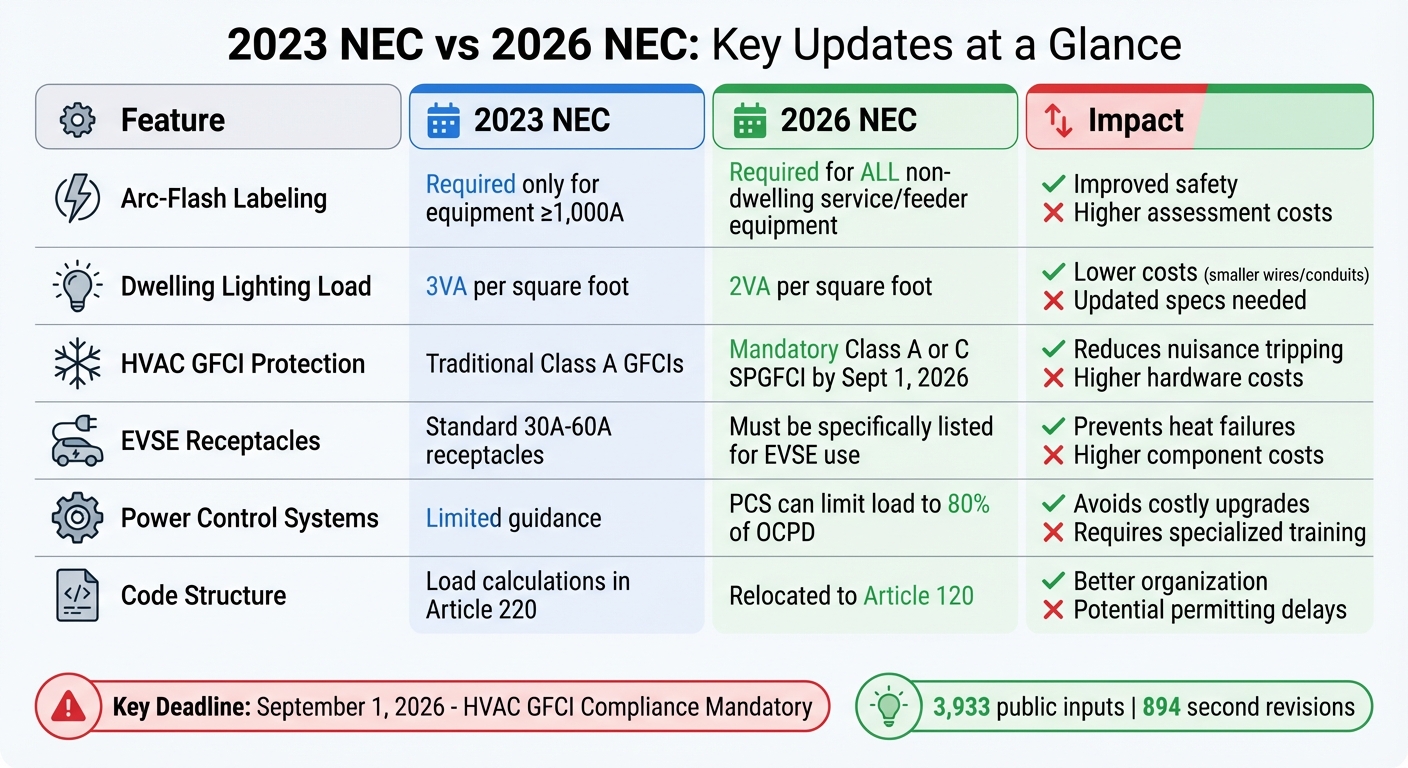
2023 vs 2026 NEC Code Updates Comparison Chart
Here's a quick summary of how the 2026 NEC updates stack up against the 2023 NEC standards, highlighting both the benefits and challenges:
| Feature | 2023 NEC Standard | 2026 NEC Update | Impact |
|---|---|---|---|
| Arc-Flash Labeling | Required only for equipment rated 1,000A or more | Now required for all non-dwelling service/feeder equipment |
Pro: Improves safety across all equipment sizes Con: Adds to assessment costs |
| Dwelling Lighting Load | Calculated at 3VA per square foot | Reduced to 2VA per square foot |
Pro: Smaller wires, conduits, and equipment lower costs Con: Necessitates updated specifications |
| HVAC GFCI Protection | Traditional Class A GFCIs often used | Mandatory Class A or C SPGFCI by September 1, 2026 |
Pro: Reduces nuisance tripping Con: Increases hardware costs and requires new testing |
| EVSE Receptacles | Standard 30A-60A receptacles | Must be specifically listed for EVSE use |
Pro: Prevents heat-related failures under continuous loads Con: Higher component and labor expenses |
| Power Control Systems | Limited guidance | PCS can limit calculated load to 80% of OCPD |
Pro: Avoids costly service upgrades Con: Requires specialized training |
| Code Structure | Load calculations in Article 220 | Relocated to Article 120 |
Pro: Easier organization for emerging technologies Con: Potential permitting delays during the transition |
Dean Austin, Senior Electrical Specialist at NFPA, highlights a key administrative change:
"The 2026 NEC has made the marking requirements more explicit, requiring that one of the main items being displayed must now be the date the assessment was completed".
This adjustment not only increases documentation efforts but also boosts accountability for long-term safety.
The development of the 2026 NEC was no small feat. It involved 3,933 public inputs and 894 second revisions, showcasing the industry's dedication to balancing new advancements with practical application. For businesses, the challenge lies in managing the upfront compliance costs while considering the long-term benefits of improved safety and operational efficiency.
Conclusion
The comparison between the 2023 and 2026 standards highlights the progression in safety measures and the incorporation of emerging technologies. The 2026 NEC brings notable updates, such as amended arc flash standards, lower lighting load requirements, and mandatory outdoor disconnects for one- and two-family homes.
One crucial deadline to keep in mind is September 1, 2026, for HVAC GFCI compliance. Ensure you’re using Class C SPGFCIs for HVAC systems and listed EVSE receptacles rated at 30A, 50A, and 60A to align with the updated guidelines.
The relocation of Articles within the code aims to streamline the permitting process. To avoid unnecessary delays or rework, update your templates and bid documents accordingly. These adjustments will also help in sourcing equipment that meets compliance standards.
For sourcing compliant equipment - whether it’s EVSE-listed receptacles or Power Control Systems designed to cap loads at 80% of OCPD ratings - Electrical Trader offers a practical solution. This platform provides access to both new and pre-owned components that adhere to the 2026 standards, making it easier to prepare for inspections and ensure projects align with the updated code.
These extensive revisions showcase the industry's dedication to improvement. By adopting these changes, you can enhance safety, cut long-term expenses, and stay ahead of the electrification trends shaping the future of power distribution work.
FAQs
What’s the biggest 2026 NEC change I should plan for first?
The biggest change in the 2026 NEC to pay attention to is the removal of the 1,000A threshold for arc flash hazard labeling. Under this update, all service and feeder equipment - with the exception of those in dwellings - must now feature hazard labels. This adjustment improves safety and compliance by making it easier to identify potential risks across a broader range of equipment.
Will the new 2VA/ft² rule lower my home’s service size?
The 2026 NEC's 2 VA per square foot rule for general lighting and receptacles is designed to streamline load calculations. While this change may not directly lower the service size of your home, it could influence how load evaluations are conducted to determine it. To ensure your property meets the updated code and has accurate load assessments, always work with a licensed electrician.
Do I need a special 50A receptacle for EV charging now?
Yes, according to the NEC 2026 updates, EV charging installations now require a specific 50A receptacle. Additionally, any hardwired EVSE (electric vehicle supply equipment) must be installed by a licensed electrician to meet the updated standards and ensure proper compliance.