Used vs. New Transformers: Cost Comparison
When deciding between used and new transformers, the choice boils down to balancing upfront costs with long-term expenses. Here's the key takeaway:
- Used transformers can save you 30–60% upfront, making them ideal for tight budgets or urgent needs. However, they often come with higher operating costs, shorter lifespans, and more frequent maintenance.
- New transformers have higher purchase prices but offer better energy efficiency, longer service lives (30–40 years), and lower maintenance needs, leading to a lower total cost of ownership (TCO) over time.
Quick Overview:
- Used Transformers: Cheaper upfront, readily available, but less efficient and shorter lifespan.
- New Transformers: Expensive initially, longer lead times, but more reliable and cost-efficient in the long run.
Quick Comparison:
| Feature | New Transformers | Used Transformers |
|---|---|---|
| Upfront Cost | $25,000–$600,000 | $10,000–$400,000 |
| Energy Efficiency | High | Lower |
| Lifespan | 30–40 years | 5–15 years (as-is), 15–25 years (refurbished) |
| Maintenance | Low | Moderate to High |
| Availability | Long lead times | Immediate |
| Warranty | 24–36 months | None or limited (6–12 months) |
| Total Cost (10 Years) | $368,000 (new 10 MVA) | $415,000 (used 10 MVA) |
For critical, long-term applications like utility grids, new transformers are the better choice. For temporary or budget-sensitive projects, used or refurbished units may be more practical. Always evaluate the total cost of ownership rather than just the purchase price.
New vs Used Transformers: 10-Year Total Cost Comparison
Initial Purchase Costs
Price Ranges by Size
The cost of purchasing a transformer upfront depends heavily on its capacity and whether it's new or used. Here's a breakdown of pricing across various size categories:
| Transformer Size | Capacity Range | New Price (USD) | Used/Refurbished Price (USD) | Typical Savings |
|---|---|---|---|---|
| Small | 500 kVA – 2.5 MVA | $25,000 – $35,000 | $10,000 – $18,000 | 45–60% |
| Medium | 2.5 MVA – 10 MVA | $65,000 – $90,000 | $35,000 – $50,000 | 35–45% |
| Large | 10 MVA+ | $180,000 – $600,000 | $110,000 – $400,000 | 25–40% |
For instance, small transformers can offer savings of up to 60% when purchased used. On the larger end, a 60 MVA power transformer that costs $450,000 to $600,000 new might sell for $300,000 to $400,000 used. Pricing is also influenced by voltage class. Distribution-class transformers (≤33 kV) tend to lose value faster because of higher market supply, while high-voltage power transformers (≥132 kV) hold their value better due to lower availability. These variations highlight the impact of factors like capacity, age, and refurbishment on pricing.
Cost Savings with Used Transformers
Opting for a used transformer can save buyers 30–60% compared to purchasing new. The extent of these savings depends on factors like the unit's age, refurbishment level, and market conditions.
Age plays a major role in determining value. Transformers that are 3–10 years old typically retain 65–80% of their original price, while those over 20 years old might drop to 20–40% of their initial cost. For example, a 10-year-old transformer in its "mid-life" stage usually sells for 40–60% of the price of a new one.
Refurbishment also affects pricing. A basic used transformer sold "as-is" offers the largest discount, but a fully refurbished unit - complete with rewinding and insulation upgrades - can add 25–35% to the cost. Market demand is another factor; when original equipment manufacturers (OEMs) face long lead times, the value of refurbished transformers can increase by 20–30% due to their faster availability. This makes used transformers an appealing choice for buyers dealing with budget constraints or urgent project deadlines.
For those seeking competitive options, Electrical Trader provides a wide range of both new and used transformers, helping buyers match their needs with their budget.
sbb-itb-501186b
Total Ownership Costs
Maintenance and Lifespan
Initial purchase costs only tell part of the story - maintenance and lifespan are just as important when evaluating total ownership costs. Maintenance needs vary significantly between new, refurbished, and used transformers. New transformers typically have low maintenance demands, while used "as-is" units often require frequent and costly upkeep throughout their service life. Refurbished transformers fall somewhere in between, with moderate maintenance requirements.
Used transformers often need proactive attention. Common tasks include annual oil testing, infrared thermography, and inspections of bushings or tap changers every 2–3 years. Older units, particularly those over 25 years old, may require major repairs like oil reclamation, re-gasketing, or full reconditioning, which can cost between $5,000 and $20,000.
Lifespan differences are also noteworthy. New IEC-certified transformers are built to last 30–40 years, while used "as-is" units may only provide 5–15 years of service. Refurbished transformers typically last 15–25 years, and professional refurbishment can extend their lifespan by 10 to 20 years.
| Condition | Typical Remaining Life (Years) | Performance Reliability | Maintenance Cost Trend |
|---|---|---|---|
| New (IEC-certified) | 30–40 | Excellent | Low |
| Refurbished (Factory-overhauled) | 15–25 | Good | Moderate |
| Used (As-is) | 5–15 | Variable | High |
Beyond maintenance, energy efficiency plays a major role in lifetime costs.
Energy Efficiency and Operating Costs
Energy losses can pile up quickly, and older transformers are far less efficient than modern designs. For example, a 10-year-old used transformer can result in over $100,000 in extra energy losses compared to a modern high-efficiency transformer over just 10 years. Since transformers often operate continuously for decades, these operating costs can far exceed the initial purchase price.
The efficiency gap is evident in annual operating expenses. For a 10 MVA transformer, a new IEC Tier II unit incurs around $21,000 per year in energy losses, while a 15+ year-old used unit costs $32,000 annually. That’s an extra $11,000 per year due to reduced efficiency.
| Transformer Type | Average Load Losses (kW) | No-Load Losses (kW) | Annual Energy Cost (USD) |
|---|---|---|---|
| New 10 MVA (IEC Tier II) | 40 | 8 | $21,000 |
| Refurbished 10 MVA | 55 | 10 | $28,000 |
| Used 10 MVA (15+ yrs) | 65 | 12 | $32,000 |
Over time, these efficiency differences lead to significant disparities in the total cost of ownership (TCO).
20-30 Year Cost Comparison
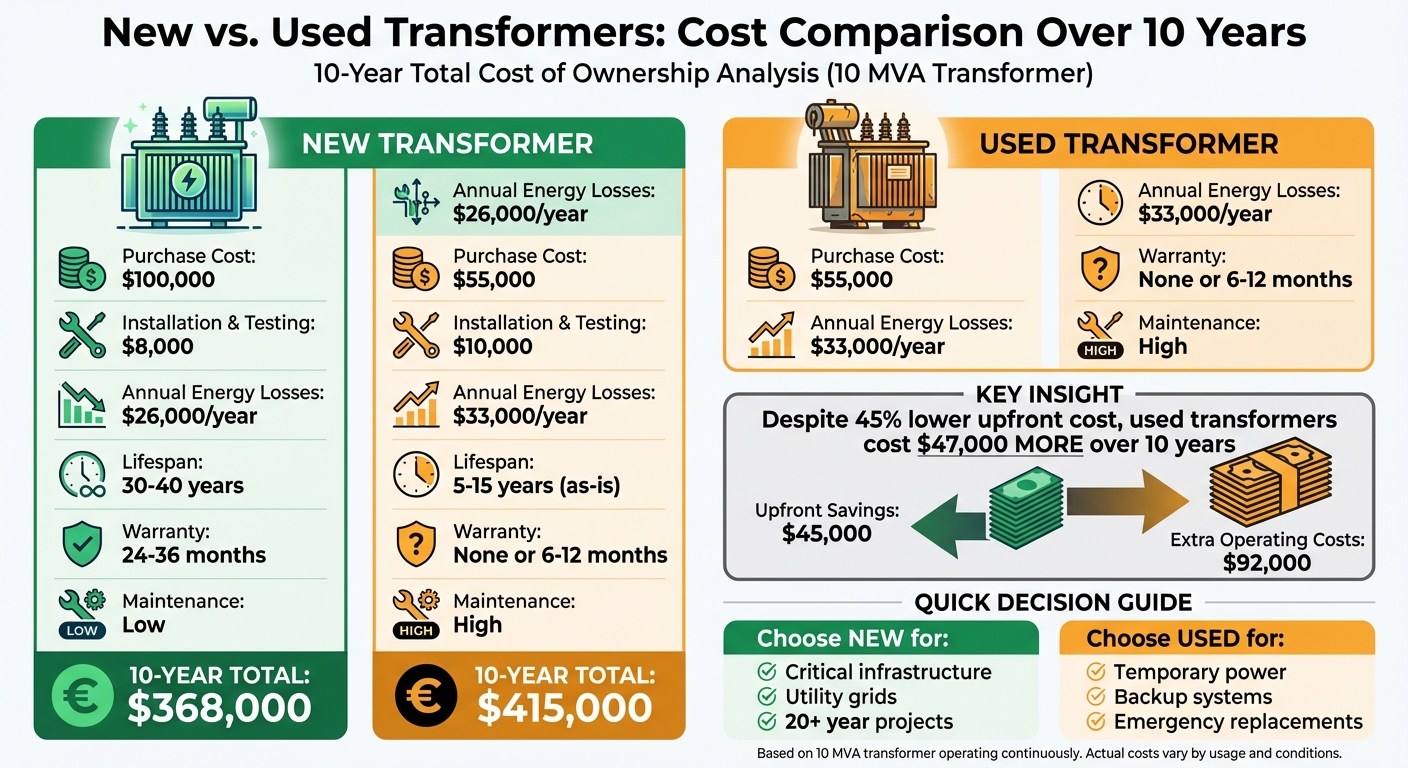
When you evaluate the Total Cost of Ownership (TCO) over a 10-year period, the numbers reveal a clear picture. For a 10 MVA transformer, a new unit costs $100,000 to purchase, with $8,000 for installation and testing, and annual energy losses of $26,000. In contrast, a used unit costs $55,000 upfront, $10,000 for installation and testing, but incurs $33,000 annually in energy losses.
Over 10 years, the TCO for a new transformer totals $368,000, while a used unit reaches $415,000. That’s $47,000 more for the used transformer despite its lower initial cost.
| Parameter | New Transformer | Used Transformer |
|---|---|---|
| Purchase Cost | $100,000 | $55,000 |
| Installation & Testing | $8,000 | $10,000 |
| Annual Energy Losses | $26,000 | $33,000 |
| 10-Year Total Cost | $368,000 | $415,000 |
| Net Outcome | Lower TCO | Higher TCO (+$47,000) |
For critical applications like utility grids or permanent substations, investing in a new transformer ensures reliability and lower long-term costs. Refurbished units are a good fit for temporary or backup power needs, where shorter lifespans and moderate reliability are acceptable.
Used Transformers: Pros and Cons
Benefits of Used Transformers
One of the biggest perks of opting for used transformers is the significant cost savings. Compared to new units, buyers can save anywhere from 30% to 60% upfront, as highlighted in the pricing analysis. This is largely due to the fact that transformers experience the steepest depreciation early in their lifespan. As a result, used units tend to hold their value better over time. Transformers from top-tier manufacturers like ABB, Siemens, and Schneider often fetch 10–20% higher resale prices because of their solid reputation, detailed documentation, and reliable performance.
Another major benefit is immediate availability. Unlike new transformers, which often come with long lead times - sometimes stretching into months - used models are typically ready for shipment. This makes them an excellent choice for emergency replacements or temporary needs, such as construction site power or backup systems.
However, these savings and convenience come with some trade-offs, which are explored below.
Drawbacks of Used Transformers
While the lower upfront cost is appealing, used transformers can lead to higher long-term expenses, as outlined in the Total Cost of Ownership analysis. Older designs often lack the energy efficiency of modern units, resulting in operating costs that can be 52% higher. Over a 10-year period, this inefficiency can add more than $100,000 in extra energy expenses.
Another downside is the uncertainty around maintenance history. Without complete documentation, buyers face the risk of undetected wear and tear, which can lead to expensive repairs. Used transformers also tend to require more frequent maintenance, and major refurbishments for units over 25 years old can cost anywhere from $5,000 to $20,000. Finding replacement parts for older components, such as tap changers or bushings, can be both time-consuming and costly. Additionally, most used transformers are sold "as-is", meaning they come with no warranty. Even refurbished units typically offer only a limited 6–12 month warranty.
| Category | Advantages (Pros) | Disadvantages (Cons) |
|---|---|---|
| Cost | 30–60% lower upfront purchase price; reduced capital expense | Higher long-term operating costs due to energy inefficiency |
| Availability | Ready for immediate shipment; ideal for emergencies | Limited options for specific, custom configurations |
| Reliability | Reliable performance if maintenance history is available | Risk of hidden aging, corrosion, or insulation issues |
| Maintenance | Familiarity with simpler, older designs | More frequent upkeep; hard-to-find legacy parts |
| Warranty | Refurbished units may include 6–12-month coverage | "As-is" units usually come with no warranty |
| Efficiency | Supports reuse and reduces waste | Often fails to meet modern energy-efficiency standards |
New Transformers: Pros and Cons
Benefits of New Transformers
When it comes to long-term value, new transformers bring a host of advantages that can greatly influence the total cost of ownership. One of the most notable perks is their reliability. With a lifespan of 30–40 years, these units far outlast their used counterparts, ensuring dependable performance for decades.
Another major benefit is energy efficiency. Modern transformers are designed to meet the latest standards, such as IEC Tier II, which translates to considerable energy savings over time. These savings can significantly offset the initial investment.
New transformers also come with extensive warranty coverage, typically ranging from 24 to 36 months. This kind of protection is rarely available with used units. Alongside the warranty, buyers receive detailed Factory Acceptance Test (FAT) reports and ISO 9001 quality assurance documentation, confirming that the equipment meets all required specifications. Maintenance is minimal during the early years, and finding replacement parts is generally hassle-free, unlike the challenges of sourcing outdated components for older models.
For critical applications - like utility grids, renewable energy plants, or permanent substations - new transformers are often the go-to choice. This is particularly true in regions where regulations demand efficiency certificates and adherence to environmental standards.
Drawbacks of New Transformers
However, new transformers are not without their challenges. The most immediate concern for buyers is the higher upfront cost. These units typically cost 30–60% more than comparable used transformers, which can be a significant barrier for budget-conscious projects.
Another drawback is the longer lead time. Unlike used transformers, which are often ready for quick shipment, new units are generally built to order. This makes them less suitable for emergency replacements or projects with tight deadlines.
| Category | Advantages (Pros) | Disadvantages (Cons) |
|---|---|---|
| Cost | Lower operating costs; potential energy savings exceeding $100,000 over 10 years | 30–60% higher initial purchase price |
| Availability | Tailored to meet modern specifications | Longer lead times; unsuitable for urgent needs |
| Reliability | 30–40 year lifespan with consistent performance | Requires a larger upfront capital investment |
| Warranty | 24–36 months of manufacturer coverage | Not ideal for short-term or temporary projects |
| Compliance | Meets current IEC and environmental standards | - |
| Testing | Includes full FAT reports and quality assurance documentation | - |
How to Choose Between Used and New
Deciding whether to go with a used or new transformer depends on factors like your project's importance, budget, and timeline. If you're working on critical projects like utility grids or renewable energy plants, new transformers are often the better choice for their long-term reliability. On the other hand, used or refurbished transformers can be a practical option for temporary construction projects or industrial backup systems, especially when upfront savings are a priority.
However, don't let the purchase price alone drive your decision. The total cost of ownership often outweighs the initial savings. For instance, while a used 10 MVA transformer might save you about $45,000 upfront, its higher energy losses over a decade could exceed $100,000. A new 10 MVA transformer typically costs around $21,000 annually in operating expenses, whereas a 15-year-old unit could cost closer to $32,000 per year. Compliance is another key consideration - new transformers are more likely to meet the latest grid interconnection standards, such as IEC 60076 or energy-efficiency directives, which older units may not. Lastly, think about the service life you need. A new transformer can last 30–40 years, a refurbished one offers 15–25 years, and an "as-is" used unit may only last 5–15 years. If your project only requires 10 years, paying for a 40-year lifespan might not make sense.
Assessing Quality and Condition
Evaluating the quality of a used transformer goes beyond a simple visual check. Issues like insulation aging, dissolved gas problems, or core damage aren’t visible from the outside. To get a clearer picture, always request a recent oil analysis report (dated within the last six months) that includes Dissolved Gas Analysis (DGA). This can uncover hidden faults - like arcing indicated by C₂H₂ or hydrogen levels above 100 ppm, which could signal trouble. Additionally, an oil breakdown voltage (BDV) below 40 kV is a red flag for reduced dielectric strength.
Electrical tests are equally important. Look for:
- Insulation resistance (IR) of at least 1,000 MΩ
- Polarization index (PI) greater than 1.5
- Turns ratio test (TTR) deviation within ±0.5%
Physical inspections are also critical. Examine the tank and radiators for rust, dents, or leaks, check bushings for cracks or contamination, and ensure the nameplate data matches your requirements. Test the tap changers to confirm smooth operation.
For older transformers, PCB testing is a must. If the unit has been refurbished, verify that the work aligns with IEC 60076-18 standards. This should include oil filtration or replacement, new gaskets, and a thorough overhaul of the tap changer.
The reputation of the manufacturer can also make a difference. Brands like ABB, Siemens, Schneider, and TBEA are known for reliable designs, better documentation, and easier access to replacement parts. This can enhance both reliability and resale value by 10–20%.
Finding Reliable Suppliers
Once you've assessed the transformer's condition, the next step is finding a trustworthy supplier. A reliable supplier ensures you’re getting a dependable unit instead of a costly headache. Start by confirming that the supplier adheres to international standards such as IEC 60076, IEEE C57, or ANSI. Legitimate suppliers should provide full documentation, including Factory Test Reports (FAT), routine and type test certificates, and detailed maintenance or refurbishment records. For refurbished transformers, post-refurbishment FAT reports compliant with IEC 60076-18 are essential.
Warranties are another sign of a supplier's confidence in their product. Be cautious with "as-is" sales that offer no warranty unless the price reflects the added risk.
Online platforms like Electrical Trader are a good place to start. They allow you to compare options, verify supplier credentials, and access transformers from Tier-1 manufacturers as well as certified refurbished units.
When you consider the total cost of ownership, the differences between new and used transformers become clearer. For example, a new 10 MVA transformer might cost $100,000 upfront, with $260,000 in energy losses over 10 years, totaling $368,000. Meanwhile, a used unit priced at $55,000 upfront could incur approximately $330,000 in energy losses over the same period, bringing the total to $415,000. That’s a difference of about $47,000 over a decade. While the used transformer might seem cheaper at first, it could end up being more expensive in the long run.
Conclusion
Deciding between used and new transformers boils down to weighing upfront cost savings against long-term reliability and expenses. Used transformers can be appealing, offering 30–60% lower purchase prices, especially for tight budgets or urgent projects. For instance, while a used 10 MVA transformer might save you $45,000 initially, it could end up costing $47,000 more over a decade due to higher energy consumption and maintenance needs.
On the other hand, new transformers justify their higher price tags with better efficiency and longer service lives. With a lifespan of 30–40 years compared to just 5–15 years for "as-is" used units, new transformers deliver predictable performance and lower operational costs. For example, a new 10 MVA transformer costs about $21,000 annually to operate, while a 15-year-old used unit could cost closer to $32,000 per year. That $11,000 annual difference adds up significantly over time, making total cost of ownership a crucial factor.
Market conditions also play a role in the decision-making process. With the U.S. experiencing a 30% shortfall in power transformers and lead times for new high-voltage units extending beyond two years, used and refurbished transformers have become vital for keeping projects on track. For critical infrastructure like utility grids or renewable energy projects, waiting for new equipment may be the better choice. However, for temporary power needs or industrial backup systems, refurbished units can provide a practical and cost-effective solution.
Your decision should align with your project's timeline, importance, and expected service life. When considering used equipment, always insist on thorough testing - including Dissolved Gas Analysis, Insulation Resistance tests, and Oil Breakdown Voltage checks - to ensure reliability. Resources like Electrical Trader can help you compare options and connect with trusted suppliers offering both new and certified refurbished transformers. By focusing on total ownership costs rather than just the initial price, you can avoid unexpected expenses down the line.
FAQs
How do I calculate transformer TCO for my site?
When evaluating a transformer’s Total Cost of Ownership (TCO), it’s essential to look beyond the initial purchase price and consider long-term expenses. Here's how to break it down:
- Purchase Price: Obtain quotes that reflect the transformer's size, type, and condition (new or used). This will give you a starting point for your cost analysis.
- Operational Costs: These include ongoing expenses like maintenance, energy losses during operation, and potential repair costs over the transformer's lifespan. These figures can significantly impact the overall cost.
- End-of-Life Value: Don’t overlook the potential resale value or the costs associated with disposal. This factor can offset some of the total expense.
By adding these components together, you’ll get a more accurate understanding of the TCO, helping you make an informed decision.
What tests should I require before buying a used transformer?
Before buying a used transformer, it's important to perform a few key tests to ensure it’s in good working condition:
- Insulation resistance testing: Assesses the condition of the insulation system to avoid potential failures.
- Turns ratio testing: Verifies that the voltage ratios are accurate and consistent with the transformer's specifications.
- Power factor testing: Helps uncover potential insulation problems that could lead to inefficiencies or breakdowns.
- Visual inspection: Identifies any visible signs of damage, overheating, or wear that could affect performance.
- Oil analysis (if the transformer uses oil): Detects moisture, gases, or contaminants that might compromise its operation.
These steps are critical for ensuring the transformer’s reliability and extending its lifespan.
When does a refurbished transformer make more sense than new?
Refurbished transformers can be a smart option when keeping costs low is the main goal, especially if you're willing to accept some potential compromises in areas like reliability or warranty coverage. These units typically come with lower upfront costs and quicker delivery times, making them a practical choice for projects with tight budgets or urgent timelines. That said, it's crucial to conduct detailed inspections and evaluate potential risks to ensure the transformer will perform reliably over the long term.