Ultimate Guide to Turbine Lubrication Systems
Turbine lubrication systems are critical for keeping industrial turbines running smoothly by reducing friction, managing heat, and maintaining oil quality. These systems directly impact efficiency, maintenance costs, and equipment lifespan. Here’s what you need to know:
- Key Functions: Circulates oil to high-speed bearings, reduces wear, dissipates heat, and filters contaminants.
- Main Components: Oil tanks, pumps (main, auxiliary, emergency), coolers, filters, and monitoring systems.
- Maintenance Essentials: Regular inspections, maintaining ISO cleanliness levels (e.g., 18/16/13), controlling water content (<200 ppm), and oil analysis.
- Upgrades: Advanced filtration, Variable Speed Drive (VSD) pumps, and real-time monitoring can improve performance and reduce downtime.
Proper maintenance and modern upgrades ensure turbines operate efficiently, avoid costly failures, and extend service life. Ready to dive deeper? Let’s explore the components, processes, and maintenance strategies that make these systems work.
Bearing and Oil System in steam turbine (Part 65)
sbb-itb-501186b
Main Components of Turbine Lubrication Systems
A turbine lubrication system depends on several interconnected components to ensure smooth operation and protect high-speed bearings. These parts, each with a specific role, work together to store, circulate, and regulate oil while maintaining temperature and pressure. Understanding these elements can help operators detect potential issues and improve system efficiency.
Oil Tanks and Pumps
The oil tank (also called a reservoir) holds the lubricant and includes deaerator trays to remove air from the returning oil. This setup also provides space for oil expansion as it heats up while circulating through bearings and gears. Large turbines often use dry-sump systems, where oil is stored in an external tank for better thermal management. Smaller turbines may use wet-sump systems, where oil is stored within the turbine assembly itself.
Oil pumps play a critical role by circulating oil under pressure to key components. Most systems use three types of pumps:
- A main pump for standard operation.
- An auxiliary pump powered by an AC motor to provide backup.
- An emergency pump, often DC-powered or supported by an uninterruptible power supply (UPS), to handle power outages.
To ensure reliability, API 614 standards recommend connecting the main and auxiliary pumps to separate power sources. Modern systems with Variable Speed Drive (VSD) pumps offer significant energy savings - up to 33% compared to fixed-speed AC pumps and up to 50% compared to mechanically driven shaft pumps.
After circulation, the oil must be cooled and cleaned to maintain system performance.
Oil Coolers and Filters
Oil coolers manage oil temperature by dissipating the heat absorbed during operation. This is crucial for maintaining proper viscosity, which prevents oil breakdown and ensures consistent bearing protection under varying loads. Without effective cooling, lubricants can degrade, leading to reduced performance and potential damage.
Oil filters remove contaminants before the oil reaches the bearings. These filters are typically made from either replaceable laminated paper or durable stainless steel mesh. While paper filters are more cost-effective, stainless steel mesh filters are better suited for demanding environments due to their durability. Clean oil is essential to protect bearings - like antifriction balls and rollers - from wear, directly impacting turbine reliability and maintenance schedules.
These cooling and filtration processes pave the way for advanced monitoring and control.
Monitoring and Control Components
Control components keep the lubrication system running smoothly by managing pressure and responding to changes in real time. Pressure relief valves prevent damage to oil coolers by diverting excess oil back to the pump inlet. Meanwhile, Programmable Logic Controllers (PLCs) monitor pressure levels and automatically activate standby pumps if the primary system fails, ensuring uninterrupted lubrication.
For compressors with low rotor weight, reverse rotation detectors play a vital role. These devices signal the PLC to activate pumps during reverse rotation events caused by gas blow-down, protecting the bearings from damage.
"The use of VSDs allow the end-user to gather additional operating data (speed, power, hours of operation, flow, operating current, torque, motor temperature, etc.), which further enables monitoring and diagnostics of the pump and motor health." - Peter Rupprecht, Fluid Systems Application Engineer, Siemens Energy
VSD-equipped systems go a step further by eliminating traditional pressure-regulating valves. Instead, they adjust pump speed in real time to meet demand. This design reduces oil volume requirements by 40% - from 8,600 liters in conventional setups to 5,200 liters - and cuts the weight and size of lubrication skids by 35%. These advanced monitoring and control features ensure the lubrication system consistently protects turbine bearings under all conditions.
How Turbine Lubrication Systems Work
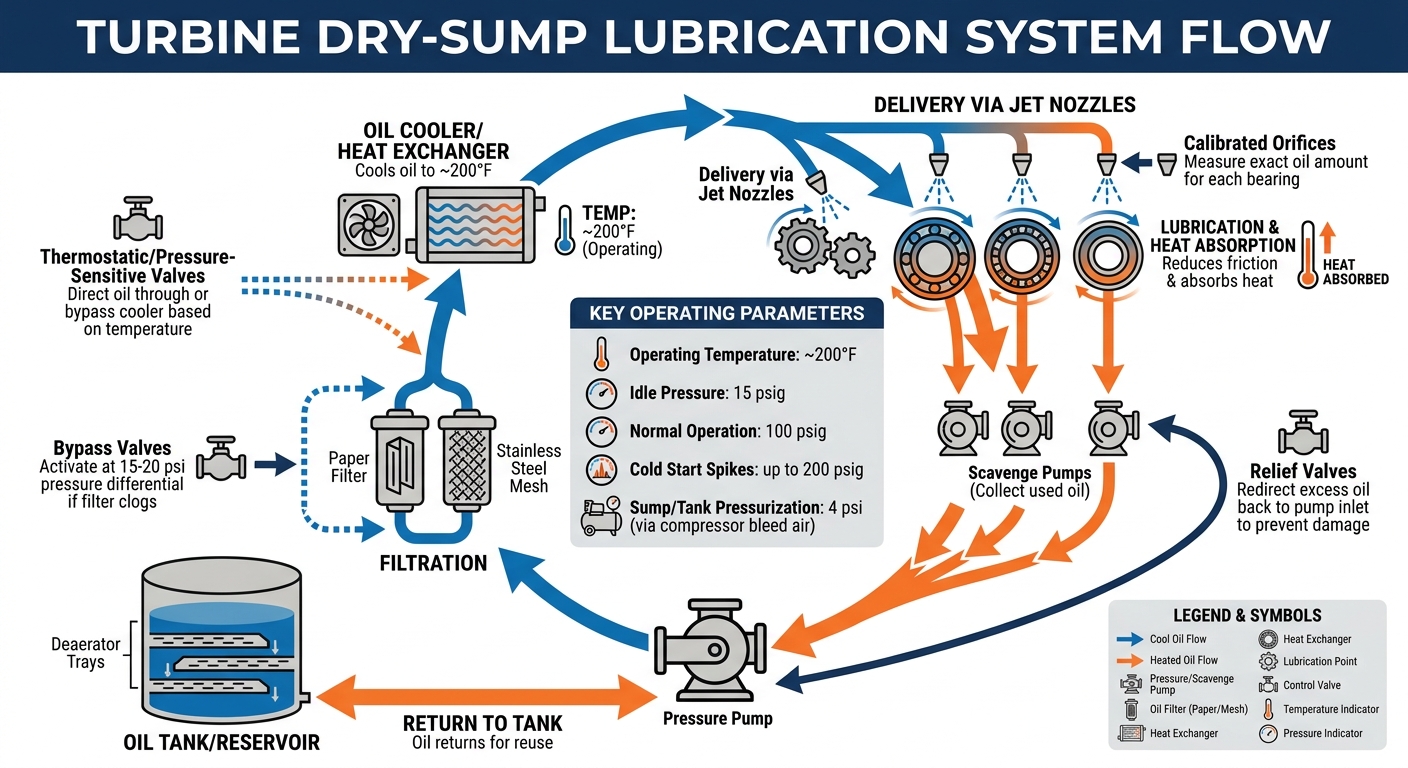
How Turbine Lubrication Systems Work: Oil Flow and Pressure Regulation Process
A dry-sump system operates by using a pressure pump to pull oil from an external tank. Once drawn, the oil is filtered, cooled, and delivered through jet nozzles to bearings and gears, ensuring they receive the necessary lubrication. This system relies on the combined action of oil tanks, pumps, and filters. After the oil has done its job lubricating the moving components, scavenge pumps collect it from sumps and return it to the tank for reuse.
Lubrication and Cooling Processes
As oil circulates through the system, it serves two key purposes: reducing friction and removing heat. By lubricating moving parts, it minimizes wear, while also absorbing heat from high-speed bearings. This heat is then transferred out of the system through oil coolers, or heat exchangers, before the oil returns to the reservoir.
Fuel-cooled systems are often favored because the large volume of fuel flow can absorb more heat. This allows for smaller, lighter coolers, which are advantageous in turbine applications. Thermostatic or pressure-sensitive valves play a vital role here, directing the oil either through the cooler or bypassing it, depending on the system's temperature needs. These valves help maintain an operating temperature of around 200°F, which is critical for optimal performance. If oil gets too cold, it won’t flow effectively; if it gets too hot, it risks breaking down. System pressures typically range from 15 psig at idle to 100 psig during normal operation, with spikes up to 200 psig during cold starts.
Pressure Regulation and System Efficiency
Maintaining proper oil pressure is essential for effective lubrication and cooling. This is achieved through precise pressure regulation, ensuring every bearing receives the right amount of oil. Gear-type and Gerotor-type pumps control the oil flow in proportion to engine RPM until a relief valve limit is reached. Relief valves are crucial safety features - they prevent excessive pressure by redirecting surplus oil back to the pump inlet, protecting components like oil coolers from damage.
To ensure consistent delivery, calibrated orifices measure the exact amount of oil needed for each bearing, despite any system fluctuations. Additionally, compressor bleed air pressurizes the sumps and tanks to about 4 psi. This constant head pressure prevents pump cavitation, especially at high altitudes, and creates a pressure differential that stops oil from leaking past seals. If a filter becomes clogged, bypass valves automatically activate when the pressure differential hits 15–20 psi, ensuring oil flow continues even if filtration is temporarily compromised.
Maintenance of Turbine Lubrication Systems
Keeping turbine lubrication systems in top shape is all about prevention. Regular inspections, monitoring oil quality, and planning maintenance wisely are the keys to avoiding breakdowns and increasing turbine uptime. Among the most common threats is particulate contamination, which can damage bearings, shorten gear life, and cause issues like servo-valve failures and foaming in the system. That’s why adhering to ISO cleanliness standards for bearing oils and hydraulic systems is non-negotiable.
Water contamination is another major concern. Even small amounts can lead to hydrogen embrittlement, causing micro-cracks in bearings. To prevent this, systems need to maintain water levels below 200 ppm, using tools like vacuum dehydration or coalescing filters. If water levels exceed 400 ppm, centrifugal purification is the go-to solution. Temperature control also plays a role - keeping reservoir temperatures within the right range helps naturally remove water and insoluble contaminants. Together, these practices create a solid foundation for daily inspections and condition monitoring.
Routine Inspection and Cleaning
Daily checks are essential. Look for leaks in bearing seals, oil-supply lines, and cooler tube joints, as leaks can compromise both safety and performance. Filters should be replaced as per the manufacturer’s guidelines, but don’t wait for scheduled maintenance - monitor pressure differentials regularly. A clogged filter often reveals itself through increased pressure drops. Keeping detailed logs of oil and water temperatures can help spot early signs of deposit buildup in coolers before it becomes a serious issue.
Reservoir cleaning during shutdowns is another critical step. Sludge buildup can block oil passages and starve bearings, so inspect sumps for debris and ensure scavenge pumps are functioning properly. Effective ventilation, whether through controlled negative pressure in vacuum systems or moisture breathers in atmospheric setups, helps keep moisture at bay. These routine tasks directly support effective condition monitoring.
Lubricant Condition Monitoring
Routine inspections are just the beginning - condition monitoring takes maintenance to the next level.
"Condition monitoring can be used for lubrication systems as it can highlight developing problems at an early stage. This is akin to blood tests for humans." - Amin Almasi
Used Oil Analysis (UOA) is an invaluable tool for spotting equipment wear, contamination, and lubricant degradation. Tests should include acid number, viscosity at 104°F, Karl Fischer water content, and particle counts. Modern particle counters can detect contaminants ranging from 0.5 to 600 µm, making it easier to catch issues early.
For even greater accuracy, real-time monitoring with online sensors can detect sudden changes in viscosity, oxidation, or dilution as they happen. Pay attention to the rate of change - a spike in wear metals or particle counts often signals an emerging failure. Bearings are a common weak point, accounting for 50% to 70% of failures in small and medium turbines, with over half of those linked to lubrication problems.
One success story comes from Monmouth Energy’s Tinton Falls, New Jersey facility, where two Solar Turbines Taurus 60 units achieved over 90,000 hours on a single oil fill. This was made possible by combining high-performance synthetic oil with routine UOA. Support from ExxonMobil field engineers Gary Brown and Jim Hannon demonstrated how systematic monitoring can significantly extend oil life.
Maintenance Scheduling
Smart scheduling ties everything together. Inspections and condition analysis should inform maintenance timelines. Instead of relying on calendar-based intervals, use Factored Fired Hours (FFH) and Factored Fired Starts (FFS), which account for operational stress and firing temperatures. Oil changes should be based on the oil’s actual condition, not an arbitrary schedule - specifically, replace oil when antioxidants drop to 25% of their original level. This approach avoids unnecessary oil changes and reduces the risks that come with opening the system.
Replacing oil isn’t cheap - when you factor in labor, production loss, and filtration, the real cost can be 2 to 5 times the price of the oil itself. Before adding makeup oil, always conduct ASTM D7155 compatibility tests to prevent foaming or deposit issues. To minimize downtime, group smaller inspections into larger overhauls whenever possible.
| Maintenance Parameter | Target Level |
|---|---|
| Bearing Oil Cleanliness | ISO 18/16/13 or lower |
| Hydraulic System Cleanliness | ISO 16/14/11 |
| Water Content | < 200 ppm |
| Antioxidant Depletion Limit | 25% of new oil |
Upgrades and Modernization Options
Modern upgrades can significantly improve turbine lubrication performance, especially when paired with strong maintenance practices. With modern turbines subjecting oil to up to 400% more stress than older systems were designed for, many legacy setups struggle to keep up. However, targeted upgrades can boost performance without requiring a full system replacement.
Advanced Filtration and Pump Technologies
Older systems often rely on outdated filtration methods that can't handle issues like valve-clogging deposits or startup delays. Upgrading to varnish-targeted filtration systems tackles these challenges effectively - something traditional 1970s-era technology simply can't do. When paired with Gas-to-Liquid (GTL) base oils, these upgrades offer additional benefits, such as higher purity, better viscosity stability, and fewer contaminants like nitrogen and sulfur.
For even more modernization, retrofitting older systems with Variable Speed Drive (VSD) pumps can make a huge difference. These pumps remove the need for bulky components like rundown tanks and pressure-regulating valves, while also delivering energy savings and reducing the system's footprint. This makes them an excellent choice for aging setups that need a performance boost without the cost of a full replacement.
Integration of Monitoring Technology
Hardware upgrades are even more effective when paired with real-time monitoring tools. Online viscometers with self-cleaning sensors and automated alerts allow operators to detect oil issues - like thinning or thickening - much faster than traditional lab testing. Additionally, continuous monitoring of particulates, moisture, and conductivity ensures small problems are caught before they escalate. Many VSD upgrade packages now include these monitoring features, providing older systems with the advanced operational visibility they need.
Retrofitting Older Systems
Replacing an entire system isn’t always necessary. High-performance synthetic oils and automated predictive maintenance systems can extend service intervals from two years to over a decade. This not only reduces waste oil but also minimizes hazardous offshore operations. When implementing these upgrades, it’s crucial to ensure all new lubricants and components are approved by both the turbine OEM and the component manufacturer.
For example, advancements in gear oil technology are expected to save the U.S. wind fleet about $6 billion by 2050. These upgrades integrate seamlessly into existing maintenance schedules, providing a practical way to maintain turbine efficiency over time.
Conclusion
Lubrication systems play a critical role in shielding turbine bearings, gears, and control valves from the intense demands of operation. With modern turbines facing up to 400% more oil stress compared to older models, proper upkeep is no longer optional - it’s essential to avoid expensive downtime. The key lies in sticking to fundamental practices.
The basics? Keep the oil clean, dry, and properly cooled. Routine oil analysis (UOA) and temperature monitoring are invaluable tools for spotting early signs of wear or contamination. As Gary Brown and Jim Hannon from ExxonMobil aptly state:
"Lubrication is the first line of defense to protect equipment from harsh operating conditions".
For those looking to go a step further, system upgrades can make a big difference. High-performance synthetic or gas-to-liquid (GTL) oils, advanced filtration systems, and real-time monitoring technologies have proven to extend equipment life significantly. A great example is Monmouth Energy in Tinton Falls, New Jersey, which achieved over 90,000 hours on a single oil fill - showing just how impactful a well-maintained system can be. The rewards? Fewer oil changes, reduced replacements, and minimized outages. Whether managing older systems or cutting-edge turbines, effective lubrication management directly translates to lower costs and improved reliability.
FAQs
How do I choose between a wet-sump and dry-sump lube system?
When deciding between the two, it all comes down to the size of the application, its requirements, and the operating conditions.
Wet-sump systems keep the oil stored inside the engine. This design is straightforward, less expensive, and works well for smaller engines or setups where space is tight.
On the other hand, dry-sump systems rely on external reservoirs, which provide better temperature regulation, steady pressure, and superior oil management. These systems are typically used for larger turbines or high-performance applications. However, they are more intricate and are best suited for situations where precise oil control is essential.
What are the first signs my turbine lube oil is contaminated or degrading?
Early indicators of turbine lube oil contamination or deterioration include visible changes in the oil's color - like darkening or becoming cloudy - and the appearance of sludge or sediment. These problems can harm system performance, making routine monitoring a critical part of maintenance.
Which upgrade provides the fastest reliability payoff: VSD pumps, better filtration, or online sensors?
Online sensors deliver the quickest boost to reliability. By offering real-time monitoring of critical factors like oil temperature, pressure, and contamination, they allow for fast issue detection and proactive maintenance. While VSD pumps help by optimizing flow and minimizing wear over time, and improved filtration enhances oil quality, neither can match the immediate diagnostic and response advantages that online sensors bring for swift reliability gains.