

Ultimate Guide to Global Voltage and Frequency Standards
Electricity standards vary worldwide, impacting how devices function across regions. Most countries use 220–240V at 50 Hz, while North America relies on 120/240V at 60 Hz. These differences affect the performance, safety, and compatibility of electrical equipment.
Key points to remember:
- 70% of the world operates at 50 Hz, while 30% uses 60 Hz (e.g., North America, South Korea, and the Philippines).
- Voltage mismatch can damage devices, while frequency differences can alter motor speeds or timing.
- Three-phase systems are common in industrial setups, offering more efficiency than single-phase systems.
- Japan is unique, with 100V and split grids using both 50 Hz (East) and 60 Hz (West).
- Certification like UL (U.S.) or CE (EU) ensures compliance and safety when sourcing equipment internationally.
Pro Tip: Always check voltage, frequency, and grounding compatibility before using devices abroad. For industrial environments, verify three-phase voltage tiers to avoid costly errors.
Core Concepts: Voltage, Frequency, and Phase Systems
Voltage, Frequency, and Power Parameters Explained
Voltage and frequency are the backbone of any electrical system, determining how power is delivered and utilized. Voltage refers to the potential difference that pushes current through a circuit, while frequency, measured in Hertz (Hz), reflects how often the current changes direction.
Industrial equipment typically operates within a ±10% voltage tolerance of its nominal value. If the supply voltage strays beyond this range, performance issues arise. For instance, a motor running on the lower end of its voltage range may draw extra current to compensate, leading to overheating, faster insulation deterioration, and increased mechanical wear.
60 Hz systems have a slight edge over 50 Hz systems in specific applications. The higher frequency allows for smaller transformer cores and power supply filter capacitors. This is why high-frequency systems like 400 Hz are common in aircraft and military equipment, where minimizing weight and size is critical.
These factors directly influence power configurations, such as single-phase and three-phase systems.
Single-Phase vs. Three-Phase Systems
Single-phase power is widely used in residential and small business settings. It uses two wires - one phase and one neutral - and generates a sine wave voltage that alternates smoothly, crossing zero twice per cycle. While adequate for lighting and small appliances, this zero crossing causes slight pulsations, making it less suitable for larger motors.
Three-phase power, on the other hand, delivers three alternating currents offset by 120 degrees, ensuring constant power delivery. This steady flow is why three-phase motors are self-starting and experience less vibration compared to single-phase motors. Additionally, three-phase systems are more efficient, requiring 75% less conductor material to deliver the same power.
The table below shows how single-phase (line-to-neutral) and three-phase (line-to-line) voltages compare across regions:
| Single-Phase (Line-to-Neutral) | Three-Phase (Line-to-Line) | Common Regions |
|---|---|---|
| 120V | 208V | North America (Commercial) |
| 220V | 380V | China, Parts of Asia/Africa |
| 230V | 400V | European Union (Harmonized) |
| 240V | 415V | UK, Australia, India |
| 277V | 480V | North America (Industrial) |
In North American industrial environments, 480V three-phase is the standard rather than 220V. Verifying the voltage tier during equipment selection is critical to avoid costly mismatches. Proper system identification ensures compatibility and adherence to regulations.
Safety and Compatibility Risks
Voltage and frequency mismatches can lead to inefficiency, equipment damage, or even safety hazards. The table below outlines common risks and their potential consequences:
| Risk Type | Cause | Potential Impact |
|---|---|---|
| Overvoltage | Connecting low-voltage equipment to a higher-voltage supply | Immediate failure, fire hazard, or permanent damage |
| Undervoltage | Insufficient voltage for equipment ratings | Motor overheating, failure to start, reduced lifespan |
| Frequency Mismatch | Using 60 Hz equipment on a 50 Hz grid (or vice versa) | Speed variations, incorrect timing, potential overheating |
| Earthing Failure | Using non-compliant or "universal" sockets | Increased shock risk, loss of surge protection |
One of the most critical risks is earthing (grounding) failure. "Universal" sockets, common in some regions, can accommodate various plug types but often fail to establish proper grounding. Without adequate grounding, electrical surges and faults pose a serious hazard.
For frequency-sensitive devices like clocks, older variable-speed drives, or synchronous motors, frequency compatibility is crucial. The synchronous speed of an AC motor is determined by the formula N = 120f/P, where f is the frequency and P is the number of poles. For example, a 2-pole motor runs at 3,600 RPM on 60 Hz but only 3,000 RPM on 50 Hz. When using such equipment across different frequency grids, it’s essential to ensure compatibility rather than relying on aftermarket converters.
Being aware of these risks helps in selecting the right equipment and maintaining compliance, which will be explored further in the next sections.
sbb-itb-501186b
What are the comparison between 50Hz and 60Hz systems | 50Hz vs 60Hz Explained!
Voltage and Frequency Standards by Region
Global Voltage & Frequency Standards by Region
Regional Voltage and Frequency Overview
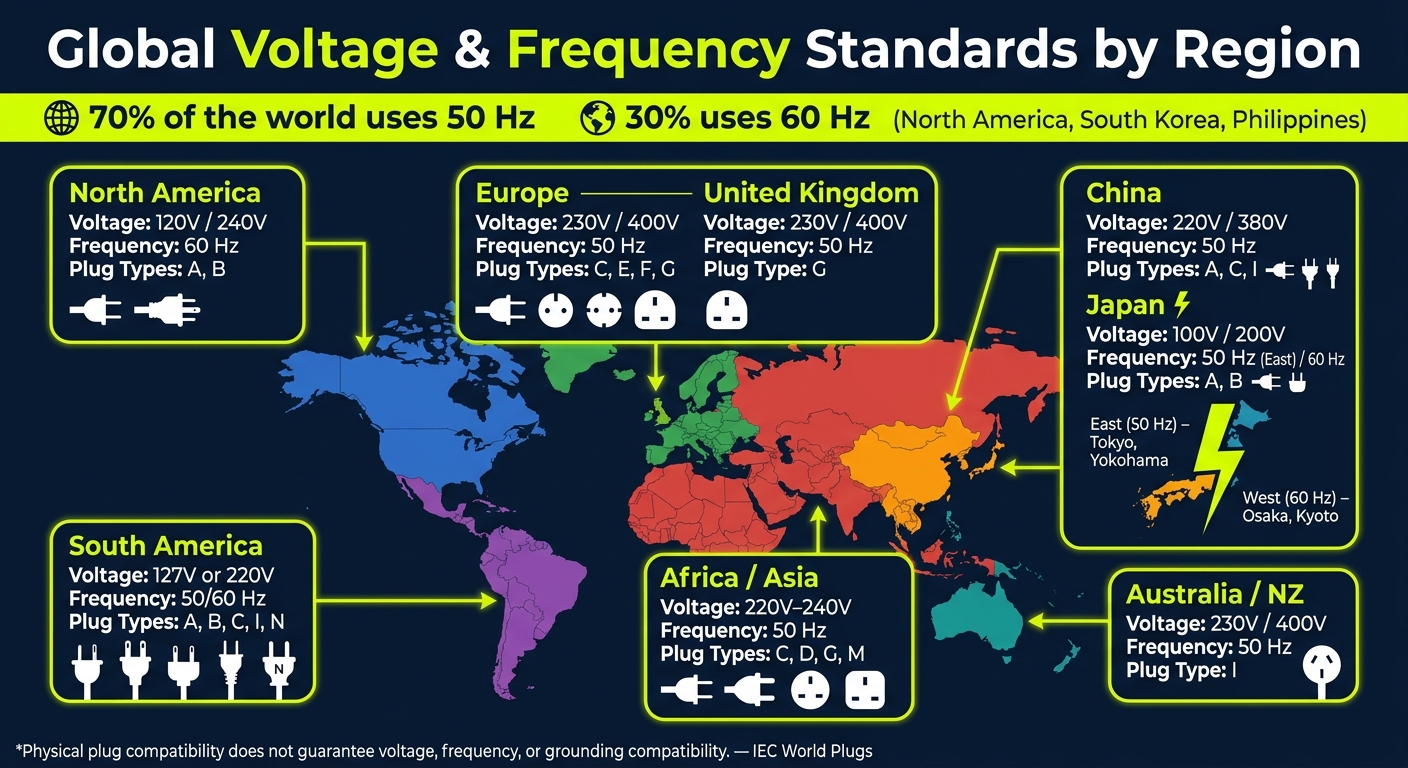
When deploying equipment internationally, knowing regional voltage and frequency standards is essential. North America operates on a 120V/240V split-phase system at 60 Hz, while Europe, Asia, Africa, and Oceania primarily use a 230V/400V system at 50 Hz.
Japan stands out as a unique case. Residential voltage is 100V, but the country is divided into two grids: Eastern Japan (e.g., Tokyo, Yokohama) uses 50 Hz, while Western Japan (e.g., Osaka, Kyoto) operates at 60 Hz. In South America, standards can vary widely. For instance, Brazil has cities that use either 127V or 220V, with frequencies of 50 Hz or 60 Hz.
| Region | Nominal Voltage | Frequency | Common Plug Types |
|---|---|---|---|
| North America | 120V / 240V | 60 Hz | A, B |
| Europe | 230V / 400V | 50 Hz | C, E, F, G |
| United Kingdom | 230V / 400V | 50 Hz | G |
| China | 220V / 380V | 50 Hz | A, C, I |
| Japan | 100V / 200V | 50/60 Hz | A, B |
| Australia / NZ | 230V / 400V | 50 Hz | I |
| South America | 127V or 220V | 50/60 Hz | A, B, C, I, N |
| Africa / Asia | 220V – 240V | 50 Hz | C, D, G, M |
Understanding these variations is the first step. Next, let’s explore the frameworks that define and enforce these standards.
Key Standards Frameworks: IEC, IEEE, and ANSI
Three major organizations define global voltage and frequency standards:
- IEC 60038: This international standard specifies nominal supply voltages for both low- and high-voltage AC and DC systems. Since 1997, the IEC has harmonized supply voltages to 230/400V, requiring countries with older systems to align within ±10% by 2003.
- ANSI and NEMA: In North America, the American National Standards Institute and the National Electrical Manufacturers Association govern voltage and frequency guidelines. For instance, NEMA 5-15 covers the standard 120V/60 Hz outlets used in U.S. homes and offices.
- IEEE Standards: These are critical for industrial and utility-scale applications, shaping how equipment interacts with power systems.
One important reminder: just because a plug fits into an outlet doesn’t mean the device will work properly. Voltage, frequency, and grounding must all align for safe operation.
Country-Level Voltage and Frequency Data
When installing or sourcing equipment for a specific country, relying on regional averages isn’t enough. Country-specific details matter, as even neighboring nations can have different standards. For example, while most of Europe follows the 230V/50 Hz standard, China uses 220V/50 Hz for residential services and 380V for three-phase industrial supplies.
These differences are especially critical when dealing with industrial voltage tiers. Selecting the wrong transformer, breaker, or motor starter can lead to equipment failure or safety hazards. For instance, a transformer rated for 480V/60 Hz won’t work correctly on a 400V/50 Hz grid without engineering adjustments.
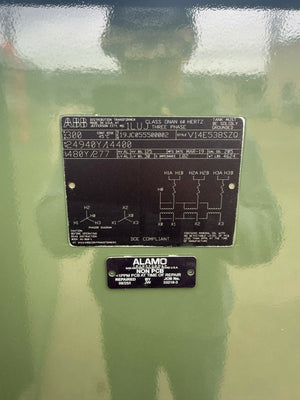
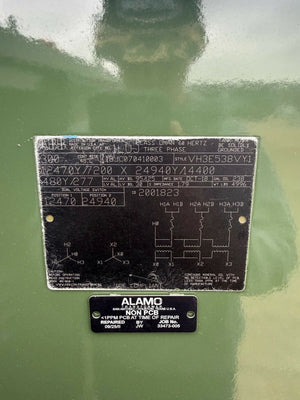
This is particularly important when importing used or surplus equipment. Always verify nameplate data against the destination country's actual voltage and frequency to ensure compatibility. This step is crucial for making informed decisions and avoiding compliance issues during cross-border equipment deployment.
Meeting Voltage and Frequency Compliance Requirements
Aligning Equipment Ratings with Regulatory Requirements
To avoid compatibility issues, always source equipment that matches your facility's native power supply - whether that's 120V/60 Hz in the U.S. or 230V/50 Hz in Europe. Converting between these standards not only adds to your costs but also introduces energy losses of 5% to 15% each time power passes through a transformer or converter.
Start by documenting your facility's voltage, frequency, phase, and amperage requirements, and share this information with your supplier. This simple step can prevent most compatibility problems. Equipment should also be designed to handle standard grid variations of ±10%. For example, a machine rated at 220V must operate safely within a range of 198V to 242V.
Certification is a must. For equipment sold in North America, UL listing is required, while the CE marking ensures compliance with the EU's Low Voltage and EMC directives. These certifications come with costs: UL listing typically ranges from $5,000 to $15,000, and CE marking costs between €3,000 and €10,000. Be sure to budget for these certifications early, as they are essential, not optional.
Selecting Compliant Breakers, Transformers, and Generators
When choosing breakers and transformers, ensuring frequency compatibility is critical:
"Voltage tolerance of ±10% is generally acceptable for most equipment... However, frequency mismatch is more critical - motors designed for 50Hz will run 20% faster on 60Hz, affecting performance and lifespan."
Using a 50 Hz-rated circuit breaker in a 60 Hz system can increase contact erosion and alter dielectric withstand requirements. To avoid these issues, always request type test certifications from accredited labs like KEMA or CESI when crossing frequency standards. Transformers also differ: 34.5 kV primaries are standard in ANSI/60 Hz markets, while 33 kV is typical in IEC/50 Hz systems. Using the wrong transformer isn't just inefficient - it can lead to compliance failures.
For generators, pure sine wave inverters are essential for motorized or sensitive electronic equipment. Modified sine wave outputs create stepped waveforms that stress capacitors and shorten component lifespans. It's also important to verify that the generator's surge power rating can handle the higher startup loads of motors, which often exceed their continuous power draw.
Adapting Imported Equipment for Local Use
When importing equipment, proper adaptation is key to avoiding compatibility problems. Assuming a simple plug adapter will resolve voltage or frequency differences is a costly mistake. The physical fit of a plug has no bearing on its electrical compatibility. Inadequate product documentation is one of the leading causes of equipment returns and warranty disputes in B2B transactions.
Always check the equipment's nameplate. For instance, if the equipment is rated for 480V/60 Hz but will be used on a 400V/50 Hz grid, you'll need a Variable Frequency Drive (VFD) for frequency adaptation and a transformer for voltage conversion. VFDs also offer soft-start capability and speed control, with costs ranging from $500 to $3,000+, depending on the power rating.
Running equipment outside its rated frequency can lead to overheating and faster wear on components like bearings. To prevent this, derate the equipment's capacity accordingly. Additionally, ensure all hardwired connections meet the National Electrical Code (NEC) to avoid voiding warranties or creating liability issues.
For sourcing compliant equipment, consider using trusted platforms like Electrical Trader, which specialize in meeting these strict standards.
Working Across Multiple Voltage and Frequency Standards
Choosing Equipment for Multi-Region Use
One of the easiest ways to avoid compatibility headaches when working across regions is to opt for dual-rated or wide-range equipment. Devices labeled "100–240V, 50/60Hz" are designed with switching power supplies that automatically adapt to local grid conditions. All you’ll need is a plug adapter to get them up and running. Many laptops, modern power tools, and industrial control units fall into this category.
For equipment that isn’t universally rated, it’s essential to check the nameplate against your region’s requirements before purchasing. For instance, a device marked "60Hz only" will require a frequency converter when used abroad - not just a voltage transformer. Japan illustrates how specific this can get: Tokyo operates on 50Hz, while Osaka uses 60Hz. The same piece of equipment might perform differently depending on the city.
If you're sourcing equipment for use in multiple regions, brands such as Siemens, ABB, GE, Square D, and Eaton are worth considering. These companies often offer product lines with dual-voltage configurations and maintain service centers in various countries, which is crucial for installation, maintenance, and ensuring long-term compliance.
Transformers, Frequency Converters, and UPS Systems
When dealing with devices that aren’t dual-rated, choosing the right conversion tool is critical. The type of tool you need depends on the device’s requirements. A voltage transformer can handle the common task of stepping 220V down to 110V or vice versa, but it doesn’t adjust frequency. This works fine for resistive loads like heaters but won’t help a motor designed for 50Hz running on a 60Hz grid.
For frequency-sensitive equipment like motors, lab instruments, or medical devices, a solid-state frequency converter is the best option. These converters regenerate power entirely, providing clean output at the correct voltage and frequency. A real-world example: Singapore General Hospital used a PowerXchanger X-15 frequency converter to operate a U.S.-designed brain surgery guidance system (rated 120V/60Hz) on Singapore’s 230V/50Hz grid - no modifications to the device were needed.
"A voltage transformer only changes the voltage, while a frequency converter changes both voltage and frequency." - PowerXchanger
It’s worth avoiding thyristor-based converters for anything beyond resistive loads. Their erratic output waveforms can damage electronics, induction motors, and even transformers.
Here’s a quick breakdown of tools and their uses:
| Tool | Changes Voltage | Changes Frequency | Best For | Key Limitation |
|---|---|---|---|---|
| Voltage Transformer | ✅ Yes | ❌ No | Heating elements, simple tools | Won’t fix frequency mismatch |
| Solid-State Frequency Converter | ✅ Yes | ✅ Yes | Medical gear, lab equipment, motors | More expensive than transformers |
| VFD | ✅ Yes | ✅ Yes | Industrial pumps, lathes, compressors | Requires professional programming |
| Thyristor-Based Converter | ✅ Yes | ❌ No | Resistive loads only (heaters, bulbs) | Destroys electronics and motors |
| UPS with Pure Sine Wave Inverter | ✅ Yes | ✅ Yes | Sensitive electronics, critical systems | Higher idle power draw |
When sizing converters, aim for 2–3 times the appliance’s continuous wattage to handle startup surge currents safely. Each tool has its role in ensuring system safety and meeting regional requirements.
Sourcing Compliant Equipment Through Electrical Trader
Selecting the right hardware is just the first step - ensuring proper certification and documentation is equally important for meeting multi-region compliance standards. Before purchasing, check that the equipment carries the correct certification mark for its destination: UL for the U.S., CE for the EU, BIS for India, TIS for Thailand, and BSMI for Taiwan. Missing certification can lead to customs delays or even void warranties.
A good resource for cross-region sourcing is Electrical Trader. This platform offers a range of products, from breakers to transformers, covering a wide voltage spectrum. For example, you’ll find items like Square D PowerPact 600V 200A breakers for $390.00, 100 KVA pole-mount transformers at $13,000.00, and reconditioned 2,000 kVA three-phase substation transformers for $75,000.00. The convenience of browsing both new and used inventory in one place makes it easier to match equipment specifications to regional grid requirements.
If the equipment includes a battery system - such as a UPS - make sure to verify its transport classification. Lithium-ion and lead-acid batteries are subject to different air and sea freight restrictions, and any misclassification can cause significant shipping delays.
Key Takeaways on Voltage and Frequency Standards
Navigating global electrical standards is about more than just technical specs - it directly impacts how equipment performs, its safety, and adherence to regulations. Here's the key divide: most of the world operates on 220–240V at 50 Hz, while North America uses 120/240V at 60 Hz. This difference plays a major role in how devices function.
One thing that often gets overlooked? Frequency matters more than you might think. For example, devices like pumps, clocks, or lab instruments designed for 60 Hz will not perform as intended on a 50 Hz supply - even if the voltage is correct. And then there are exceptions, like Japan, where frequencies vary depending on the region. These quirks make it crucial to double-check compatibility.
Grasping these voltage and frequency details is vital for ensuring safe, efficient, and compliant equipment operation. For industrial setups, don't make assumptions - 220V isn't typical for U.S. facilities. Many North American industrial plants rely on 480V three-phase Wye systems, a detail that often trips up professionals when specifying equipment. When working on global projects, it's always smarter to confirm the actual site conditions instead of relying on general regional guidelines.
"Physical compatibility of receptacles may not ensure compatibility of voltage, frequency, or connection to earth (ground)." - IEC World Plugs
FAQs
Do I need a transformer or a frequency converter?
When deciding between a transformer and a frequency converter, it all comes down to what your equipment needs. A transformer is used to adjust voltage levels. For instance, if you have equipment designed for 120V but are working with a 240V system, a step-down transformer would be the right choice.
However, if the issue involves frequency differences - like running 60Hz equipment in a region with a 50Hz power supply - you’ll need a frequency converter or a dual-frequency transformer. Always verify the voltage, frequency, and power ratings of your equipment to ensure you select the appropriate solution.
Which devices fail on 50 Hz vs 60 Hz?
Devices such as induction motors, clocks, timers, and other equipment that depend on line frequency for timing or synchronization can experience issues when operated on a different frequency - like 50 Hz instead of 60 Hz. These changes can affect how they perform, so it's crucial to check compatibility beforehand.
How do I confirm three-phase voltage on-site?
To check three-phase voltage on-site, here’s what you need to do:
- Use a power quality meter that matches the voltage range of the circuit you’re testing.
- Attach the meter’s leads to each phase, following the wiring configuration (wye or delta) and the manufacturer’s guidelines.
- Check the readings to confirm the phase voltages align with expected values (like around 480V for typical U.S. industrial circuits) and verify the phase sequence is correct.
If the readings seem off, double-check your connections.