Voltage Regulators vs. Stabilizers: Energy Efficiency
Voltage regulators and stabilizers both ensure electrical devices receive the correct voltage, but they serve different purposes and operate differently.
- Voltage Stabilizers: Automatically adjust voltage during grid fluctuations like sags or surges. Commonly used for protecting equipment in areas with unstable power grids. Efficiency ranges from 92%–98% depending on type (relay, servo, or IGBT).
- Voltage Regulators: Maintain a steady, precise output voltage regardless of input or load changes. Often used in utility systems and sensitive equipment. Distribution regulators typically achieve 99% efficiency.
Quick Overview:
- Stabilizers: Best for areas with frequent voltage swings or sensitive devices like CNC machines and medical imaging systems.
- Regulators: Ideal for large-scale applications like utility distribution or precise voltage control in labs.
Quick Comparison:
| Device Type | Efficiency Range | Output Accuracy | Response Time | Best For |
|---|---|---|---|---|
| Relay Stabilizer | 92%–95% | ±5–8% | <20ms | General loads, HVAC, lighting |
| Servo Stabilizer | 95%–98% | ±0.5–3% | 1–2s | Industrial machines, motors |
| IGBT (Static) Stabilizer | 90%–95% | ±0.5% | <10ms | Data centers, medical devices |
| Distribution Regulator | ~99% | ±0.625%/step | <10s | Utility systems, long feeders |
Choosing the right device depends on your application, load type, and precision needs. Proper sizing and selection can reduce energy losses, improve equipment lifespan, and lower electricity costs.
Core Concepts: Voltage Regulation and Stability
Voltage Regulation and Power Distribution Efficiency
Voltage regulation and voltage stability are two related but distinct concepts in power systems. Voltage regulation measures how much voltage changes as current flows from the source to the load, while voltage stability ensures that the system maintains steady voltage even during disruptions, such as load changes or transformer adjustments.
"Voltage stability means that the grid voltage remains permanently within a defined tolerance range – the foundation for a reliable power supply." - A. Eberle
Voltage deviations can have serious consequences. Overvoltage can stress insulation and increase reactive power, while undervoltage can lead to excess motor current and overheating, reducing the lifespan of equipment. Eaton highlights this clearly: "Supplying unregulated voltage can cause lighting brownouts, overheat and shorten motor life and cause premature failure of electronics". To maintain power quality, the EN 50160 standard sets an acceptable tolerance of ±10% of nominal voltage. Deviations outside this range signal power quality problems.
What Is a Voltage Stabilizer?
A voltage stabilizer is an automatic device designed to take in fluctuating input voltage and deliver a stable output. It protects equipment, particularly in areas where the grid supply is unreliable.
There are three main types of voltage stabilizers, each suited to specific needs:
| Technology | Precision | Response Time | Best For |
|---|---|---|---|
| Relay | ±5–8% | <20ms | General loads, lighting, HVAC |
| Servo | ±0.5–3% | 1–2s | CNC machines, industrial automation |
| IGBT | ±0.5% | <10ms | Medical imaging, data centers |
- Relay stabilizers use electromagnetic contactors for quick but less precise adjustments, making them suitable for general applications like lighting or HVAC systems.
- Servo stabilizers rely on a motor-driven variable autotransformer, offering finer control but slower response times, ideal for industrial machinery.
- IGBT stabilizers (static models) use advanced pulse-width modulation for near-instant corrections, making them essential in environments like data centers or medical facilities, where even brief voltage dips can be critical.
What Is a Voltage Regulator?
A voltage regulator is designed to maintain a constant output voltage despite changes in input voltage or load conditions. While stabilizers focus on managing wide fluctuations, regulators provide precise voltage control, often used in generators, utility distribution systems, or for sensitive equipment requiring tightly controlled power.
In utility systems, voltage regulators are typically autotransformers equipped with tap changers. A standard regulator offers 32 steps of regulation at 5/8% per step, covering a range of ±10% of the system voltage. Modern tap changers, such as "Quik-Drive", can cycle through all 32 steps in under 10 seconds, ensuring quick recovery from voltage fluctuations. Additionally, a high-quality power transformer should achieve a voltage regulation percentage below 3%, reflecting efficient and precise control under load conditions. These principles set the stage for understanding how operational mechanisms and energy efficiency compare in various systems.
sbb-itb-501186b
How Voltage Regulators and Stabilizers Work
How Voltage Stabilizers Operate
Voltage stabilizers work by constantly monitoring the incoming AC voltage and comparing it to a predetermined reference point. If the input voltage falls outside the acceptable range, the stabilizer corrects it using one of three methods: relay switching, servo motor adjustments, or solid-state electronics like IGBT technology.
The correction mechanism depends on the type of stabilizer. Relay-based models adjust voltage by switching between transformer taps in discrete steps, typically responding within 20 milliseconds. Servo-controlled stabilizers, on the other hand, use a carbon brush that moves across a variable autotransformer (variac), allowing for smooth, continuous adjustments within 1–2 seconds. Meanwhile, IGBT static stabilizers rely on pulse-width modulation (PWM) for almost instantaneous corrections, often under 10 milliseconds.
"The efficiency of a stabilizer comes from its continuous monitoring capabilities." - Weisho Electric Co., Ltd.
Both relay and servo stabilizers are efficient because they only process the difference between the input voltage and the desired output, rather than the entire power load. This buck/boost autotransformer design keeps their power losses low, typically between 3% and 5%, with servo models performing exceptionally well under full load conditions.
In contrast, voltage regulators use a different method for adjusting output voltage, which is explained below.
How Voltage Regulators Operate
Voltage regulators designed for distribution systems use autotransformers equipped with load tap changers (LTC). These devices adjust voltage by stepping through as many as 33 positions across 32 steps. The adjustments are guided by electronic sensing controls that continuously monitor line voltage in real time.
Since the autotransformer in these regulators only manages the voltage correction rather than the entire power flow, they operate with very high efficiency, typically around 99%. However, IGBT-based regulators that use a double-conversion (AC-DC-AC) design sacrifice some efficiency for greater precision. These systems usually operate within the 90%–95% efficiency range due to energy losses during the two-stage conversion process.
This difference in operational design is why distribution regulators generally achieve higher efficiency compared to double-conversion setups.
Energy Loss Mechanisms
Both stabilizers and regulators experience energy losses, but the specific mechanisms vary depending on the design. Here’s a breakdown of typical efficiency and primary loss sources for each type:
| Device Type | Typical Efficiency | Primary Loss Mechanisms |
|---|---|---|
| Relay Stabilizer | >97% | Core losses in transformers, contact resistance |
| Servo Stabilizer | 95%–98% | Copper losses in windings, mechanical brush friction |
| IGBT/Static Stabilizer | 90%–95% | Switching losses in semiconductors, AC-DC-AC heat |
| Distribution Regulator | ~99% | Core and copper losses in autotransformer windings |
Each of these losses impacts overall system efficiency differently.
Core losses result from hysteresis and eddy currents in the steel transformer core and occur regardless of load. Copper losses (or I²R losses) are tied to the resistance in windings and increase with current. To minimize these losses, manufacturers like VoltaPex use 100% electrolytic copper windings, which reduce resistance and improve heat dissipation. Mechanical losses are specific to servo stabilizers and arise from motor friction and wear on the carbon brush, which can increase resistance if maintenance is neglected. Switching losses, common in IGBT designs, come from the high-frequency semiconductor switching required for precise voltage corrections, leading to 5%–15% losses in double-conversion systems.
Environmental factors also play a role. For example, high ambient temperatures (above 104°F or 40°C) or altitudes over 3,280 feet (1,000 meters) can reduce cooling efficiency, causing actual performance to fall below rated values.
Static Voltage Stabilizer and regulators. [ Detail Guide]. IGBT based PWM method.
Energy Efficiency Comparison: Regulators vs. Stabilizers
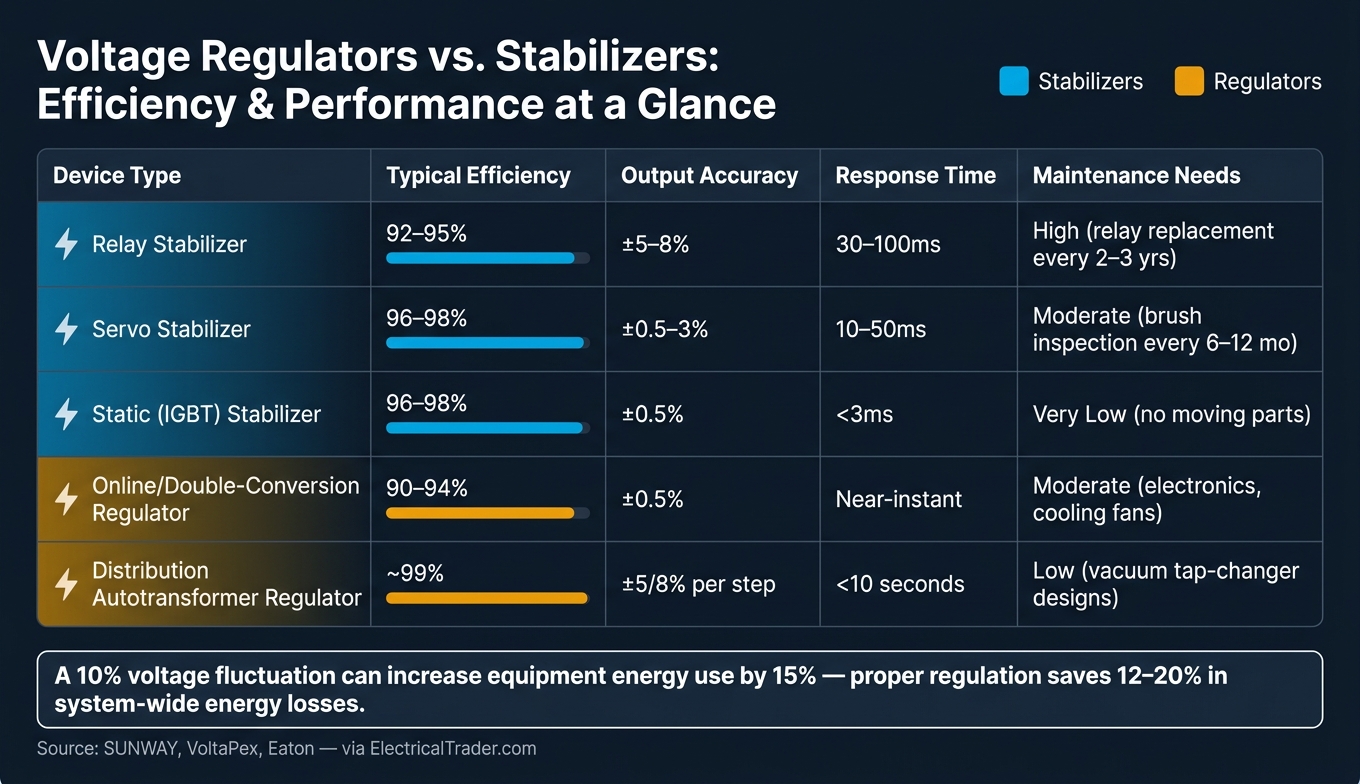
Voltage Regulators vs. Stabilizers: Efficiency & Performance Comparison
Let’s dive into the energy efficiency differences between regulators and stabilizers, building on the mechanisms discussed earlier.
Typical Efficiency Ranges
When comparing efficiency, the differences might seem small but can be critical depending on the application. Servo-controlled and static (IGBT) stabilizers operate within a 96%–98% efficiency range, rivaling most distribution regulators. Relay-type stabilizers, however, fall slightly behind at 92%–95%, mainly due to step-switching and contact resistance losses. The online/double-conversion regulator is less efficient, ranging from 90%–94%, as energy is lost during its dual-stage AC-DC-AC conversion. On the other hand, distribution-grade autotransformer regulators lead the pack with about 99% efficiency, though this figure applies specifically to the regulator itself, not the entire system.
Now, let’s see how load variations impact these figures.
Part-Load vs. Full-Load Efficiency
Both stabilizers and regulators perform best under full load. At partial load, fixed losses - such as core losses and control electronics - consume a higher percentage of the total power, reducing overall efficiency. This is especially noticeable in relay-type stabilizers, where light loads make fixed losses more prominent. Proper sizing is crucial to minimize such energy losses.
"A quality stabilizer itself consumes a small amount of power (core/copper losses, control electronics). Good designs minimize no-load loss (efficiency often >95%)." - SUNWAY
For servo stabilizers, high-quality copper-wound models can achieve ≥98% efficiency at full load. To avoid efficiency drops due to thermal stress, it’s recommended to size stabilizers with a 20%–25% safety margin above the calculated load.
Effect on System-Wide Energy Losses
Efficiency ratings alone don’t tell the whole story. The broader impact comes from how well these devices regulate voltage. Even a 10% voltage fluctuation can increase equipment energy use by 15%, while unregulated voltage can lead to system-wide energy losses of 12%–20%.
"By keeping voltage near nominal, a stabilizer can reduce the extra energy wasted by the connected loads." - SUNWAY
Precise voltage regulation also reduces I²R losses in motors and other inductive loads. Undervoltage, in particular, forces motors to draw more current to maintain torque, generating excess heat and increasing resistive losses. While IGBT stabilizers have slightly higher internal losses, their ±0.5% accuracy ensures loads operate closer to their ideal range compared to the ±5%–8% tolerance of relay stabilizers. This tighter control minimizes indirect energy waste.
Comparison Table: Voltage Regulators vs. Stabilizers
| Device Type | Typical Efficiency | Output Accuracy | Response Time | Maintenance Needs |
|---|---|---|---|---|
| Relay Stabilizer | 92–95% | ±5–8% | 30–100ms | High (relay replacement every 2–3 years) |
| Servo Stabilizer | 96–98% | ±0.5–3% | 10–50ms | Moderate (brush inspection every 6–12 months) |
| Static (IGBT) Stabilizer | 96–98% | ±0.5% | <3ms | Very low (no moving parts) |
| Online/Double-Conversion Regulator | 90–94% | ±0.5% | Near-instant | Moderate (electronics, cooling fans) |
| Distribution Autotransformer Regulator | ~99% | ±5/8% per step | <10 seconds | Low (vacuum tap-changer designs) |
Choosing the right device depends on your priorities. If raw efficiency is key and your power grid is stable, a distribution autotransformer regulator is an excellent choice. For scenarios requiring fast and precise voltage correction, static IGBT stabilizers offer tighter control, even with their slightly higher internal losses.
Choosing the Right Device for Energy Efficiency
Selecting the best device for energy efficiency requires aligning its performance with the specific needs of your application. While efficiency ratings provide a baseline, they only hold value when the device is appropriately matched to its intended use. For instance, a voltage regulator designed for large-scale utility applications won't suit a small CNC shop, and a relay-based stabilizer won't deliver the precision required for medical imaging systems.
When to Use a Voltage Stabilizer
Voltage stabilizers are ideal for areas with unstable power grids and sensitive equipment. If your facility experiences frequent voltage swings of ±20% or more - a common issue in rural locations or at the ends of long distribution lines - a stabilizer can automatically correct these fluctuations.
For inductive loads like motors or compressors, servo stabilizers are the go-to option. They can handle startup surges that are 6–8 times the normal current while maintaining an output precision of ±0.5%–3%, making them suitable for CNC machines and injection molding equipment. On the other hand, relay stabilizers offer a cost-effective solution for less demanding loads, such as commercial HVAC systems or lighting, with a precision range of ±5%–8%.
When sizing a stabilizer, consider the load type. For resistive loads, allow a margin of 20%–30%, while for inductive loads, a margin of 100%–200% is recommended to account for inrush currents.
When to Use a Voltage Regulator
Voltage regulators are designed for large-scale applications, such as managing voltage drops over long feeder lines. They are particularly effective in implementing Conservation Voltage Reduction (CVR), which helps reduce energy consumption across an entire distribution system by maintaining voltage at the lower acceptable limit.
Modern regulators equipped with electronic controls are compatible with SCADA systems and Integrated Volt/VAR Control (IVVC), making them an excellent fit for smart grid operations. In laboratory or testing scenarios, variable autotransformer regulators allow for precise manual voltage adjustments, which is essential for experiments requiring exact voltage levels.
Key Factors in Device Selection
Efficiency, while important, is only one piece of the puzzle. To ensure the right choice, evaluate these practical considerations:
- Load Type: Inductive loads, like motors and compressors, require higher safety margins and benefit from servo or wide-range stabilizers. Resistive loads, such as lighting or heating, are less demanding.
- Fluctuation Range: Voltage stabilizers are necessary when input voltage swings exceed ±10%. Wide-range stabilizers can handle fluctuations from ±20% to ±50%, while regulators typically manage a ±10% range in 32 steps.
- Precision Requirements: Sensitive equipment, such as in medical imaging or data centers, often requires precision within ±0.5%, making IGBT stabilizers a preferred choice.
- Environmental Conditions: Devices installed above 3,280 feet (1,000 meters) require capacity derating - about 1% for every additional 330 feet (100 meters) - to account for reduced cooling efficiency. For dusty or corrosive environments, sealed relay or IGBT models are more reliable than servo units with exposed components.
- Budget: IGBT stabilizers can cost 30%–50% more than servo models. If your application doesn't need sub-cycle response times, a servo stabilizer may offer comparable precision at a lower cost.
Application Table: Matching Scenarios to the Right Device
The table below provides a quick reference for selecting the appropriate device based on specific scenarios:
| Scenario | Recommended Device | Key Reason |
|---|---|---|
| Utility/Industrial Feeders | Distribution Voltage Regulator | Manages voltage drops over long distances and supports CVR. |
| Data Centers | IGBT Stabilizer | Sub-cycle response (< 10ms) and ±0.5% precision protect sensitive electronics. |
| CNC Machining & Automation | Servo Stabilizer | Handles high motor inrush with ±0.5%–3% precision and high efficiency (≥98%). |
| Medical Imaging (CT/MRI) | IGBT or Online Regulator | Provides near-instantaneous transfer and isolates diagnostics from grid harmonics. |
| Commercial HVAC & Lighting | Relay Stabilizer | Cost-effective protection with a ±5%–8% tolerance. |
| Rural/Agricultural Pumps | Wide-Range Stabilizer | Manages chronic undervoltage and heavy motor startup surges. |
| Laboratory Testing | Variable Transformer (Regulator) | Allows precise manual voltage adjustment for testing scenarios. |
Conclusion: Voltage Regulators vs. Stabilizers - Key Takeaways
Voltage stabilizers and regulators share a common purpose: ensuring that connected equipment receives the correct voltage. However, they accomplish this in distinct ways. Stabilizers are ideal for automatically correcting unpredictable grid fluctuations, while regulators excel at managing voltage across long distribution lines or enabling precise, controlled adjustments. These differences also shape how each device contributes to energy efficiency.
Energy efficiency isn't just about minimizing losses within the device itself - it also includes the broader impact on energy consumption. As IREM highlights, "Properly regulated voltage is not only a protection factor, but can become a technical tool for controlling real energy consumption and improving plant efficiency". For example, data shows that facilities with poor voltage supply quality saw electricity bills drop by 5%–15% after installing a voltage stabilizer.
The choice of device depends heavily on the technology. Static (IGBT) stabilizers, known for their efficiencies exceeding 98% and response times under 10 milliseconds, are perfect for critical applications like data centers and medical imaging. Servo stabilizers, offering precision levels of ±0.5%–3%, strike a balance between performance and cost, making them suitable for industrial equipment like CNC machines. Relay stabilizers, while more affordable, have a wider tolerance range of ±5%–10%, making them less suitable for sensitive electronics.
To ensure maximum efficiency, select a unit sized so the connected load operates at roughly 80% of its capacity. This not only reduces heat buildup but also extends the unit's lifespan and keeps it running efficiently. For inductive loads, remember to account for startup currents that can be 3–5 times the rated current.
Choosing the right device to match your performance and efficiency requirements enhances system reliability and energy savings. If you're in the market for new or replacement equipment, Electrical Trader provides a variety of voltage regulators, stabilizers, and power distribution solutions - whether for a single facility or a larger project.
FAQs
Do I need a stabilizer or a regulator for my site?
If your power supply often experiences dips or fluctuations and you need to maintain voltage within a safe range for household use or basic appliances, go with a stabilizer. On the other hand, choose a regulator when you require precise, fixed voltage with quicker correction - ideal for sensitive equipment like servers, medical devices, or industrial tools. For situations demanding tight accuracy, such as ±5%, a regulator is the more suitable option.
How do I size one for motor inrush and startup surges?
To determine the right voltage stabilizer size for a motor's inrush current, you need to factor in the high starting current, which is usually 3 to 8 times the motor's full-load current. Start by calculating the total connected load in kVA. Then, apply a multiplier of 1.2 to 1.5 to account for the inductive nature of the load.
Additionally, include a safety margin of 20% to 50% to handle startup surges and allow for potential future expansions. Finally, round up to the nearest standard unit rating to ensure reliable performance and stability.
Will voltage correction actually lower my energy bill?
Yes, managing voltage levels can help lower your energy bill by ensuring your electrical devices run as efficiently as they’re designed to. When voltage is too high, equipment tends to draw more power than necessary, leading to unnecessary energy consumption. Proper voltage regulation eliminates this excess. For example, adjusting voltage levels can improve the efficiency of lighting systems and motors. While utility companies implement large-scale voltage adjustments, using localized voltage regulators or stabilizers can safeguard your devices and improve their performance.