




Digital Voltage Regulators for Industrial Use
Digital voltage regulators are critical for stabilizing power in industrial settings, protecting equipment from voltage fluctuations, sags, and surges. These devices use microprocessors and advanced software to provide precise voltage regulation, typically within ±0.5%, ensuring reliability and extending the lifespan of machinery. Unlike analog systems, digital regulators offer features like real-time monitoring, remote diagnostics, and integration with SCADA and PLC systems via protocols like Modbus and RS485. They respond to voltage changes in milliseconds and are well-suited for harsh conditions, making them ideal for industries like manufacturing, data centers, and healthcare.
Key takeaways:
- Precision: Regulation accuracy of ±0.5%.
- Speed: Responds to voltage changes in under 20 milliseconds.
- Integration: Supports SCADA/PLC systems for remote monitoring.
- Durability: Designed for harsh environments with minimal maintenance.
- Applications: Used in manufacturing, automation, power distribution, and critical industries.
Digital regulators outperform analog systems in accuracy, flexibility, and longevity, making them a reliable choice for industries requiring stable power. Regular maintenance and proper selection based on load and environmental needs ensure optimal performance and cost savings.
Stabilize Voltage and Maximize Reliability with PowerLogic DVR | Schneider Electric

sbb-itb-501186b
How Digital Voltage Regulators Work
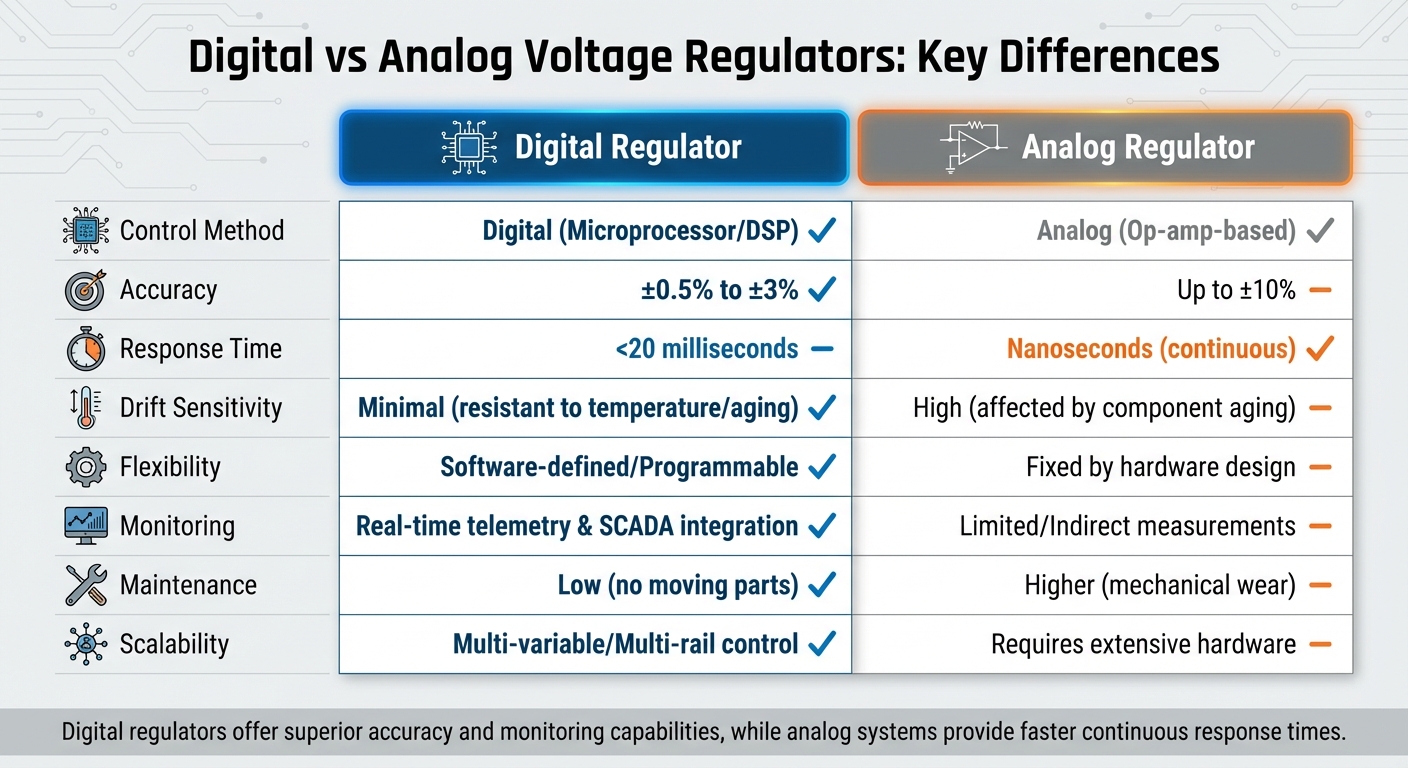
Digital vs Analog Voltage Regulators: Key Differences Comparison
Digital voltage regulators operate as closed-loop systems, constantly monitoring incoming voltage, comparing it to a pre-set target, and making quick adjustments to address any deviations. The process begins with potential transformers or precision dividers that reduce high AC voltage to manageable levels. This signal is then rectified, filtered, and converted into a digital format using an ADC (Analog-to-Digital Converter).
Once digitized, a microcontroller or DSP (Digital Signal Processor) analyzes the voltage at sampling rates reaching tens of thousands of times per second. Using algorithms like Digital PID, fuzzy logic, or adaptive control, the system calculates any variance from the desired voltage. It then generates a PWM (Pulse Width Modulation) signal to control power devices such as IGBTs or thyristors, adjusting the duty cycle to stabilize the output voltage within 20 milliseconds. Some advanced models employ Dynamic Voltage Scaling (DVS) to predict load fluctuations, reducing the chances of voltage dips or overshoots. This predictive capability sets digital regulators apart from systems that only react to changes. These fast, precise corrections form the backbone of the advanced features discussed below.
Main Features of Digital Voltage Regulators
Digital voltage regulators are known for their impressive accuracy, typically maintaining voltage regulation within ±0.5%. This level of precision surpasses what most analog systems can achieve. Thanks to their microprocessor-based design, they avoid the drift and component degradation that often affect analog systems. Shravan Govindaraj, Product Marketing Manager at XP Power, highlights this advantage:
"The digital control loop... is insensitive to the environment, temperature, ageing and tolerances of the control loop components."
These systems also provide real-time monitoring, giving operators full visibility into voltage levels, load conditions, and overall system health through digital displays and telemetry. Modern digital regulators integrate with PLC and SCADA systems via industrial protocols like Modbus, CAN, or RS485, enabling remote diagnostics and centralized control. Additionally, multi-phase control technology allows a single digital controller to manage multiple regulators simultaneously, reducing hardware requirements and simplifying communication and metering.
With a solid-state design, digital regulators eliminate the mechanical components found in older systems, cutting down on wear and maintenance needs. Built-in protections guard against issues like over-voltage, under-frequency, short-circuits, and overheating, ensuring both the regulator and connected equipment remain safe. Many digital systems also offer up to 32 regulation steps - often in increments of 5/8% per step - allowing for a total regulation range of ±10%. This precise control loop is what makes modern digital regulators so effective and adaptable.
Digital vs. Analog Regulators
Digital voltage regulators bring a fundamentally different approach compared to their analog counterparts. While analog systems rely on continuous hardware-based circuits, such as op-amps, digital regulators use programmable software algorithms that can be updated without altering the hardware. As ZM Peterson, Founder of Northwest Engineering Solutions, explains:
"Digital control sacrifices some bandwidth for enhanced functionality and adaptability."
By replacing multiple analog components - like comparators, op-amps, and compensation networks - with a single microcontroller, digital regulators achieve a more compact and streamlined design. They can also perform system identification, automatically measuring plant transfer functions and fine-tuning compensation networks in real time.
| Feature | Digital Regulator | Analog Regulator |
|---|---|---|
| Control Method | Digital (Microprocessor/DSP) | Analog (Op-amp-based) |
| Accuracy | ±0.5% to ±3% | Up to ±10% |
| Response Time | <20 milliseconds | Nanoseconds (continuous) |
| Drift Sensitivity | Minimal (resistant to temperature/aging) | High (affected by component aging) |
| Flexibility | Software-defined/Programmable | Fixed by hardware design |
| Monitoring | Real-time telemetry & SCADA integration | Limited/Indirect measurements |
| Maintenance | Low (no moving parts) | Higher (mechanical wear) |
| Scalability | Multi-variable/Multi-rail control | Requires extensive hardware |
Digital regulators are commonly used to retrofit older synchronous generators, provided the voltage sensing and excitation ratings are compatible. This ability to integrate with older systems, combined with their stability over time, has led most modern generator manufacturers to adopt fully digital designs.
Industrial Applications for Digital Voltage Regulators
Power Distribution Systems
Digital voltage regulators play a key role in stabilizing voltage across utilities, power generation facilities, and smart grid networks. These systems handle voltage drops caused by high load density and long feeder lines in substations and distribution networks. With integration into smart-grid technology and SCADA systems, operators can remotely monitor and adjust voltage as needed. Most standard regulators offer 32 regulation steps (±10% total range), while advanced models with Quik-Drive tap changers can cycle through all steps in under 10 seconds, significantly outpacing older spring-based devices.
In manufacturing and heavy industries, these regulators prevent disruptions caused by voltage sags when large motors or welders operate on shared circuits. Industries like semiconductor manufacturing, 3D printing, and robotic assembly rely on voltage stability to ensure product quality and avoid costly downtime. Similarly, data centers and telecommunications hubs integrate digital regulators with UPS systems and remote monitoring to protect IT infrastructure from voltage-related failures. Healthcare facilities depend on these systems for critical equipment like MRI and CT scanners, which require stable voltage to deliver accurate diagnostics and avoid damage to expensive machinery.
This precise voltage control also supports the smooth operation of automation and control systems, making digital regulators a practical choice for environments with specific load and environmental demands.
Automation and Control Systems
Digital voltage regulators are essential for powering automation and control systems. They provide steady voltage to Programmable Logic Controllers (PLCs), sensors, and control circuits, preventing unexpected resets or inaccurate readings in measurement equipment. Modern regulators often support CANbus, Modbus, or RS485 integration, enabling seamless communication with industrial controllers and Automatic Gen-set Controllers (AGCs). This connectivity simplifies real-time control and facilitates proactive maintenance and troubleshooting. Features like the Load Acceptance Module (LAM) enhance generator performance during heavy load impacts - such as motor startups - boosting efficiency by up to 10%.
By maintaining voltage within strict limits - typically ±10% of nominal - these regulators prevent issues like motor overheating (from undervoltage) and circuit board damage in robotics or control systems (from overvoltage). Advanced models can handle load currents with up to 30% Total Harmonic Distortion (THDi), ensuring reliable performance even in environments with significant electrical noise.
Harsh Industrial Environments
Digital voltage regulators are built to perform in some of the toughest industrial conditions. They are designed to withstand challenges like mechanical vibrations, contaminants, and high humidity. Using microprocessors and DSP technology, these regulators maintain excellent temperature stability and avoid performance drift, even as components age. They typically operate in ambient temperatures ranging from 14°F to 122°F (–10°C to +50°C), with optional heaters available for colder climates.
To manage heat in high-temperature settings, industrial-grade regulators incorporate features like heat sinks, thermal pads, and active cooling systems, preventing thermal shutdowns. Many models comply with IEC 60664 standards, offering protection against overvoltages up to 60V, which is crucial in unstable grid conditions. High-efficiency switching regulators, with efficiencies exceeding 95%, minimize power loss as heat - an important factor in enclosed or high-temperature industrial setups. These ruggedized systems are especially valuable in oil, gas, and mining operations, where they protect sensitive exploration and refining equipment from grid instability and frequent load switching.
How to Select a Digital Voltage Regulator
Load and Capacity Requirements
Start by determining your facility's peak and inrush current demands. Industrial equipment, like motors and transformers, often draws significantly higher current during startup - sometimes several times their standard operating current. This surge, lasting about half a second, can strain components and reduce their lifespan. Servo-based regulators are a solid choice for such scenarios, as they can handle inrush currents up to 10 times their maximum rating for 2 seconds, making them ideal for high-demand applications.
To ensure smooth operation, calculate the maximum current draw, including startup surges. This prevents issues like overcurrent protection triggering or overheating of the unit. Oversizing the regulator beyond the projected maximum current is a practical step to maintain steady voltage and avoid thermal strain. For example, in April 2023, Coca-Cola's manufacturing plant in Saudi Arabia installed a 1,000 kVA 3-phase AVR to manage voltage fluctuations of up to 18% beyond nominal ratings. The result? The facility's voltage was stabilized to within ±0.5% of acceptable limits, reducing equipment repairs and eliminating production downtime. Once you've addressed load requirements, evaluate the installation environment to ensure the regulator is built to handle your specific operational conditions.
Environmental and Efficiency Considerations
Choosing the right design for your environment is crucial. Thermal management plays a significant role here. Linear regulators, for instance, dissipate excess power as heat, requiring large heatsinks or fans. On the other hand, switching regulators operate with 70–90% efficiency, generating far less waste heat. If your facility is in a high-temperature area, check the regulator's datasheet for its operating temperature range and consider adding cooling systems if necessary.
For harsh environments, ruggedized designs are essential. Whether your challenges involve dust, moisture, vibration, or extreme temperatures, ensure the regulator is built to withstand them. Beyond energy savings, efficiency reduces overall operating costs and lessens the cooling load on your facility. A great example comes from Glavcom, a joinery manufacturing company in Australia. In April 2023, they installed a 3-phase AVR, cutting their daily energy consumption from 958 kWh to 690 kWh. This reduction of 268 kWh per day translated into annual savings of AU$39,128.
Digital Features and Connectivity
Once you've addressed capacity and efficiency, turn your attention to digital features that enhance monitoring and control. Look for connectivity and monitoring capabilities that can optimize operational efficiency and minimize downtime. Digital AVRs, for instance, offer voltage regulation within ±0.5% and respond in under 20 milliseconds, outperforming analog models.
Features like self-diagnostics - covering over-voltage, under-frequency, and fault alarms - can detect problems before they escalate. Advanced metering options, including time- and date-stamped demand records and tap position tracking, provide critical data for maintenance planning. Additionally, multi-phase control simplifies programming and reduces maintenance by allowing two or three regulators to operate through a single controller. A notable example comes from SP Group, Singapore's national grid operator. Facing severe voltage drops during a 1,200-meter tunnel project in April 2023, they installed 12 magnetic induction voltage stabilizers for $2,441,120, saving approximately $9.4 million compared to the cost of replacing transmission cables.
Maintenance and Troubleshooting
Routine Maintenance Practices
Keeping your digital voltage regulator in good shape can extend its lifespan, which typically ranges from 7 to 10 years. A few simple tasks every few months can make a big difference. Start by cleaning the cooling vents and interior parts using a vacuum or soft cloth. This prevents dust buildup, which can lead to overheating. Also, inspect wiring terminals to avoid issues like arcing or voltage drops.
Pay special attention to high-wear components like carbon brushes, relays, and cooling fans. If the carbon brushes are worn, replace them with ones that match the original specifications. To ensure a flat contact surface, use zero-size sandpaper to grind them as needed. For new or idle units, check insulation resistance with a 500-volt megohmmeter. A safe reading is at least 5 megohms. Additionally, every 200 operating hours, use a digital multimeter to confirm that input and output voltages align with the manufacturer's specs. In areas with high humidity or salty air, choosing regulators with conformal coatings can protect internal electronics from corrosion.
Using Monitoring Tools
Routine maintenance is essential, but monitoring tools take it a step further by offering continuous oversight and early fault detection. Most digital voltage regulators come equipped with built-in diagnostics that flag issues like overvoltage, undervoltage, or excitation failure before they become major problems. These modern systems rely on microprocessors that adjust output voltage in real time - within 1 to 7 milliseconds - making them far more responsive than older analog models.
Remote monitoring capabilities let technicians manage performance and tweak settings without being on-site. To confirm proper operation, set a digital multimeter to DC voltage and connect it to the exciter field winding terminals (F1 and F2) while the generator is running. A fluctuating reading between a few volts and 30 V DC indicates the regulator is functioning correctly. Be on the lookout for warning signs like burnt smells or discolored components, as these could point to overheating or imminent failure. For critical environments like hospitals or data centers, an annual calibration check ensures voltage levels stay within the tight range of ±0.25% to ±0.5%, which is crucial for sensitive equipment.
Upgrades and Replacements
If regular maintenance isn't enough to keep your regulator running smoothly, it might be time for an upgrade or replacement. Watch for signs like erratic voltage readings, frequent resets, excessive heat, buzzing sounds, or burnt odors - these often mean the unit is nearing the end of its life. Visible wear on components such as carbon brushes, relays, or leaking capacitors is another red flag. If your facility has grown and the regulator can't handle the increased load, upgrading to a higher-capacity model is a smart move.
When replacing a regulator, ensure the new unit matches or exceeds the voltage and current requirements of your connected equipment. Upgrading from analog to digital models offers several advantages, including faster response times, built-in diagnostics, and compatibility with PLC and SCADA systems via protocols like Modbus or RS485. For facilities where downtime isn't an option, consider replacing regulators proactively every 7 to 10 years to avoid unexpected failures. During installation, enhance ventilation and add surge protection devices to maximize the lifespan of your new regulator.
Where to Buy Digital Voltage Regulators
Finding dependable digital voltage regulators is crucial for maintaining operational efficiency, and Electrical Trader simplifies the process by offering a wide range of options.
Products Available on Electrical Trader
Electrical Trader provides an extensive inventory of both new and refurbished power distribution equipment. Their selection includes digital voltage regulators, three-phase stabilizers, and other essential components. Here’s a quick breakdown of their offerings:
- Digital voltage regulators ranging from 3.5–10 kVA, priced between $45–$182.
- Heavy-duty three-phase models from 20–60 kVA, available for $192–$799.
- High-power units from 100–300 kVA, starting at $1,100.
In addition to voltage regulators, the marketplace offers a variety of products like breakers, transformers, and power generation tools, catering to both low and high-voltage needs. With options for three-phase transformers and substation equipment, Electrical Trader makes it easy to source everything required for building or upgrading a power distribution system. Whether you're replacing a single regulator or equipping an entire facility, the mix of new and refurbished items ensures flexibility in both specifications and budget.
Why Use Electrical Trader
Electrical Trader stands out not just for its product variety but also for the value it delivers. Opting for used or refurbished equipment can save you up to 90% compared to buying new. These refurbished items undergo extensive updates, including firmware upgrades, thorough calibration, and rigorous testing, ensuring they perform like new. This means you can access high-quality digital voltage regulators without overextending your budget.
Additional benefits include a 30-day right-of-return and warranties ranging from 90 days to full "like-new" coverage, which lowers the risks associated with purchasing. To ensure reliability, look for suppliers with a "Verified Supplier" status, at least five years of experience, and strong reorder rates - some suppliers boast reorder rates of 18% to 41%.
The platform’s user-friendly design allows electricians, industrial buyers, and end-users to connect directly with sellers, making the procurement process seamless. With the global market for digital voltage stabilizers valued at around $9.5 billion and growing at an annual rate of 6.8%, having access to a trusted marketplace like Electrical Trader ensures you can keep operations running smoothly while meeting industrial demands efficiently.
Conclusion
Digital voltage regulators play a crucial role in industrial operations that demand precision and reliability. With voltage regulation accuracy reaching ±0.5% and response times under 20 ms, these devices help shield sensitive equipment from potentially costly damage. Considering that facility-wide outages can cost large enterprises as much as $5 million per hour, investing in proper voltage regulation is a decision that can’t be overlooked.
Choosing the right regulator means focusing on factors like load capacity, environmental conditions, and digital connectivity features. For example, a servo-type unit is ideal for high-precision tasks, while a magnetic induction model is better suited for harsh conditions. By aligning the regulator with your specific needs, you can ensure peak performance. Additionally, regular maintenance and monitoring are key to extending the lifespan of your equipment and avoiding unexpected failures.
Case studies from Australia and Singapore highlight how strategic use of these regulators has delivered measurable cost savings and improved operational efficiency.
Electrical Trader makes the procurement process easier by offering a wide range of digital voltage regulators, both new and refurbished. With options spanning power ratings from 3.5 kVA to 300 kVA, and refurbished units providing up to 90% savings, they provide solutions for businesses of all sizes. Investing in the right digital voltage regulator is a step toward ensuring smooth and reliable industrial operations.
FAQs
How do I size a digital voltage regulator for motor inrush current?
To choose the right digital voltage regulator for a motor's inrush current, you need to factor in the surge that happens during startup. This surge can be 20–25 times higher than the motor's steady-state current. Start by calculating the motor's full load current. Then, multiply that value by the inrush factor to estimate the peak current. Select a regulator that can handle this peak and has a rating slightly above it.
Another option is to use a regulator with soft-start features, which help minimize the impact of inrush current. No matter which approach you take, always add a safety margin to ensure reliable performance.
Will a digital voltage regulator work with my existing PLC/SCADA setup?
A digital voltage regulator works well with most PLC and SCADA systems. It keeps an eye on voltage levels in real time and ensures precise control. Its digital displays are designed to integrate smoothly with modern control setups, making operations more efficient.
What are the warning signs that my voltage regulator needs replacement?
Common signs of a failing regulator include output voltage fluctuations, irregular voltage levels, or equipment malfunctions. These symptoms often point to underlying issues with the regulator. Taking quick action when these problems arise can help protect your equipment from further damage.





