

IEC vs. IEEE Standards for High-Voltage Systems
Choosing between IEC and IEEE standards for high-voltage systems depends on your project's location, regulatory requirements, and technical needs. Here's a quick breakdown:
-
IEC (International Electrotechnical Commission):
- Used globally, especially in Europe, Asia, and Africa.
- Consolidates equipment categories (e.g., switchboards and panelboards under one standard).
- Focuses on performance and testing methodologies.
- Examples: IEC 60076 for transformers, IEC 62271 for circuit breakers.
-
IEEE (Institute of Electrical and Electronics Engineers):
- Dominates in North America (USA, Canada).
- Separates equipment into distinct standards (e.g., transformers, switchgear).
- Emphasizes construction details and safety.
- Examples: IEEE C57 series for transformers, IEEE C37 series for switchgear.
Key Differences:
- Design Philosophy: IEC combines categories; IEEE separates them.
- Testing: Different methods for insulation, voltage, and harmonics.
- Geographic Adoption: IEC is global; IEEE is regional (North America).
Quick Comparison:
| Criteria | IEC Standards | IEEE Standards |
|---|---|---|
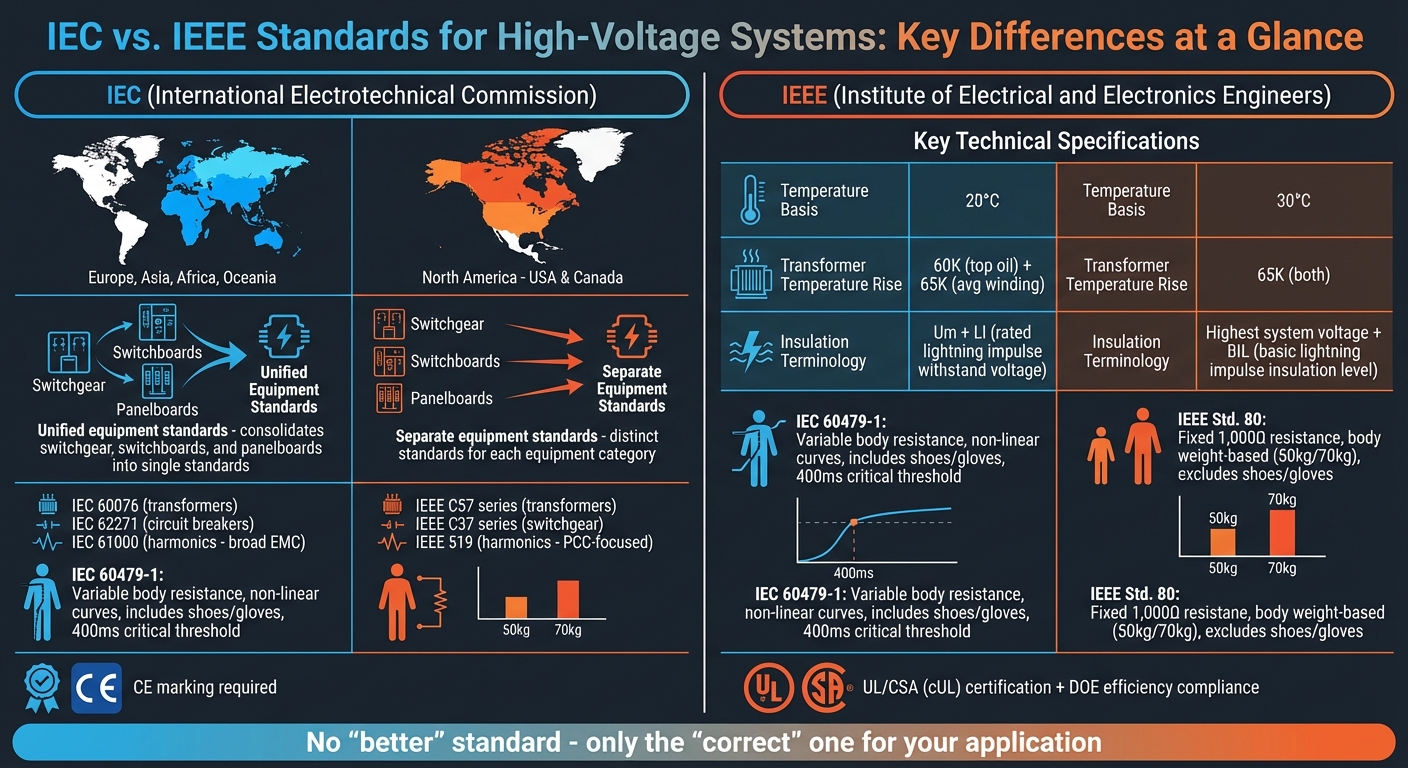
| Geographic Focus | Europe, Asia, Africa | North America |
| Approach | Unified equipment standards | Separate equipment standards |
| Temperature Basis | 20°C | 30°C |
| Harmonics | Broad (IEC 61000) | PCC-focused (IEEE 519) |
| Safety | Variable resistance (IEC 60479-1) | Fixed resistance (IEEE Std. 80) |
Understanding these differences ensures compliance, reliability, and compatibility for your high-voltage projects. Let’s dive deeper into how these standards impact equipment design, testing, and global trade.
IEC vs IEEE Standards Comparison for High-Voltage Systems
Main Differences Between IEC and IEEE Standards
Design Philosophy: Design-Driven vs. Performance-Guided
The IEC takes a streamlined approach by combining various equipment types - like switchgear, switchboards, and panelboards - into a single standard. In contrast, IEEE/ANSI separates these into distinct standards for each category. E. Wilkie highlights this in IEEE Transactions on Industry Applications:
"In the North American marketplace, independent American National Standards Institute (ANSI) or Underwriters Laboratories (UL) standards exist for each type of equipment. In the International Electrotechnical Commission (IEC) marketplace, these types of equipment are consolidated into one assembly with one product standard."
This difference extends to technical specifications. For example, IEC 60076 defines two temperature rise values for transformers - 60 K for top oil temperature and 65 K for average winding temperature. On the other hand, IEEE C57.12.90 uses a single value, typically 65 K, for both metrics. Another variation lies in insulation coordination: IEC bases test voltages on the "highest voltage for the equipment (Um)" and uses "rated lightning impulse withstand voltage (LI)" terminology. Meanwhile, IEEE relies on the "highest system voltage" and uses "basic lightning impulse insulation level (BIL)" instead. These distinctions influence how testing and design are approached.
Testing Methods and Compliance Requirements
Testing protocols are a key point of divergence. For high-voltage circuit breakers above 1,000 V, the standards differ in how they assess breaking capability, particularly with Transient Recovery Voltage (TRV). IEEE C37.011, updated in 2019, outlines specific procedures and calculations for comparing TRV ratings against system TRV duties. In contrast, the IEC 62271 series has its own TRV framework, ensuring both electrical and mechanical compatibility.
When it comes to converters or rectifiers, both standards address harmonics through additional specialized standards. Engineers working across these frameworks must carefully account for differences in construction and compliance testing to ensure proper integration. These testing variations highlight the broader impact of each organization's methodologies on equipment performance.
Geographic Adoption and Regulatory Frameworks
Indi Wang, a transformer business developer based in Hefei, Anhui, China, sheds light on the geographical divide:
"IEC standards are predominant in Europe and widely used in Asia. In North America, ANSI/IEEE standards are commonly specified, although IEC standards are also accepted."
This divide stems from historical and regulatory differences. In North America, standards emphasize distinct equipment categories, while the IEC approach consolidates categories into unified assemblies. Industries like oil and gas often weigh both standards when selecting or replacing transformers to meet regional needs. As global markets grow more interconnected, manufacturers aim to design products that align with both frameworks, though differences in construction and testing remain hurdles.
sbb-itb-501186b
Standards Comparison for High-Voltage Equipment
High-Voltage Circuit Breakers: IEC 62271-100 vs. IEEE C37 Standards
Both IEC 62271-100 and IEEE C37.04 apply to AC high-voltage circuit breakers operating above 1,000 V at 50/60 Hz, but their focus and methodology differ. IEC 62271-100 prioritizes performance and testing for switchgear and controlgear, while IEEE C37.04 centers on rating structures, preferred ratings, and construction guidelines. For reference, the IEC standard spans 778 pages in its 2008+AMD1:2012 edition and costs CHF 1,370.
A key area of alignment between the two standards is the transient recovery voltage (TRV) waveshapes for equipment rated at 100 kV or higher. This alignment is crucial because TRV directly impacts the breaking capabilities of circuit breakers. When system TRV duty exceeds a breaker's rating, IEEE C37.011 provides calculation methods and strategies to address these challenges.
For generator circuit breakers rated at 10 MVA or higher, both standards defer to the unified IEC/IEEE 62271-37-013, eliminating the need to choose between frameworks for such applications. Additionally, IEEE C37.06.1-2025 introduces provisions for "definite purpose" circuit breakers designed to handle rapid TRV rise times, often seen in transformer-limited fault conditions.
| Feature | IEC 62271-100 | IEEE C37.04 |
|---|---|---|
| Primary Focus | Switchgear performance and testing | Rating structures and construction |
| Voltage Range | Above 1,000 V | 4.76 kV to 800 kV |
| TRV Waveshapes | Aligned with IEEE for ≥ 100 kV | Aligned with IEC for ≥ 100 kV |
| Current Ratings | Defined by technical committee | Preferred: 600 A, 1,200 A, 2,000 A, 3,000 A, 4,000 A |
| Generator Breakers | Refers to IEC/IEEE 62271-37-013 | Refers to IEC/IEEE 62271-37-013 |
Harmonics and Power Quality: IEC 61000 vs. IEEE 519
IEEE 519-2022, approved on May 13, 2022, sets design targets for systems with both linear and nonlinear loads. It focuses on the Point of Common Coupling (PCC) - the interface where utility and user systems meet - and establishes limits for voltage and current distortion at this point to reduce interference with equipment. While the standard primarily addresses steady-state harmonic levels, it acknowledges that transient conditions may occasionally exceed these limits.
On the other hand, IEC 61000 adopts a broader perspective, dealing with electromagnetic compatibility (EMC) across both systems and individual equipment. Unlike IEEE 519, which zeroes in on the PCC, IEC 61000 encompasses harmonic emissions and immunity levels across diverse scenarios. For designers working with IEEE 519, identifying the PCC and accounting for harmonic contributions from nonlinear devices are critical to staying within steady-state limits.
Safety and Fault Duration: IEC 60479-1 vs. IEEE Std. 80
Safety calculations under IEEE Std. 80 and IEC 60479-1 diverge significantly. IEEE Std. 80 bases its allowable body current calculations on body weight (e.g., 50 kg or 70 kg) and uses formulas like $I_B = 0.116 / \sqrt{t_f}$ for a 50 kg individual. It assumes a fixed body resistance of 1,000 Ω and models the foot as a conductor with a 0.08 m radius.
IEC 60479-1, however, evaluates fibrillation risk using non-linear curves that factor in current duration, touch voltage, and variable body impedance. These curves also account for population percentiles (5th, 50th, or 95th) and environmental conditions, such as whether the contact is wet or dry. A notable distinction occurs around 400 ms, where IEC 60479-1 identifies a "turning point" - fault currents lasting longer than this can interfere with the heart's T-phase, increasing the risk of ventricular fibrillation.
IEC 60479-1 also allows for additional resistances, such as those from shoes or gloves, in safety calculations. In contrast, IEEE Std. 80 focuses on the resistance of the foot and surface layers, like crushed rock. While the IEEE approach offers simpler calculations, the IEC method requires referencing curves and tables to determine permissible body currents and corresponding resistances.
| Feature | IEEE Std. 80-2013 | IEC 60479-1:2010 |
|---|---|---|
| Body Resistance | Fixed at 1,000 Ω | Variable (voltage-dependent) |
| Safety Basis | Body weight (50 kg or 70 kg) | Current duration |
| Additional Gear | Excludes shoes/gloves | Includes shoes/gloves |
| Fault Duration | Inverse square root relationship | Non-linear curves (T-phase sensitive) |
| Critical Threshold | Not specified | 400 ms turning point |
These differences illustrate how each framework tailors its safety and protection measures to accommodate distinct high-voltage application needs.
Choosing the Right Standards for High-Voltage Projects
Factors to Consider When Choosing Standards
When selecting standards for high-voltage projects, geographic location is a key factor. In North America, including the USA and Canada, compliance with IEEE/ANSI standards is mandatory. Meanwhile, IEC standards govern regions like Europe, Asia, Africa, and Oceania. Regulatory bodies and local utilities ensure adherence to these standards. For example, projects in North America must secure UL or CSA (cUL) certifications and meet Department of Energy (DOE) efficiency requirements. On the other hand, European projects require CE marking.
Another critical consideration is grid interoperability. Standards define specific ratings and connection dimensions to ensure that equipment integrates smoothly with the local power grid. Before finalizing equipment specifications, consulting local utilities or regulators is crucial, as they may enforce additional requirements. Ambient conditions also influence equipment performance. For instance, IEEE standards assume an average ambient temperature of 30°C, while IEC standards use 20°C, impacting sizing and performance calculations.
Additionally, the technical design approach varies between standards. IEEE standards often emphasize construction and safety details, such as requiring tamper-resistant enclosures in public spaces. In contrast, IEC standards focus more on performance principles and testing methodologies, offering greater design flexibility. As Winley Electric aptly states:
"There is no 'better' standard, only the 'correct' one for the application".
These factors highlight the importance of aligning standards with both regional and operational needs.
Dual Compliance Challenges and Solutions
For multinational projects, navigating the differences between standards is a significant hurdle. Reconciling the requirements of IEC and IEEE standards is often necessary. In February 2026, Winley Electric showcased this dual-compliance strategy during global procurement efforts. For a solar project in Canada, they designed three-phase pad-mounted transformers to meet ANSI C57.12.34 and CSA C227.4 standards, ensuring DOE 2016 efficiency compliance and obtaining cUL certification. Meanwhile, for a similar project in France, they engineered oil-immersed units according to IEC 60076 and applicable EN standards to achieve CE marking. Advanced testing, including lightning impulse tests, was used to verify performance across both frameworks.
One of the primary challenges in dual compliance is managing differences in terminology and specifications. For example, varying assumptions about ambient temperature and testing protocols can complicate equipment selection for multinational projects. To avoid procurement mistakes, using a cross-reference list that aligns terminology between standards is highly effective. Moreover, working with suppliers that have "dual-capability" engineering teams - proficient in both ANSI/IEEE and IEC standards - can significantly reduce supply chain risks for multinational EPCs.
Conclusion
Summary of Main Differences and Applications
The key distinctions between IEC and IEEE standards lie in their design approach and regional focus. IEEE/ANSI standards clearly differentiate between equipment categories - for instance, they separate low-voltage metal-enclosed switchgear from distribution switchboards and panelboards. In contrast, IEC standards group these into unified assembly standards. This also reflects in technical details: IEC transformer standards specify dual temperature rise values (commonly 60 K for top oil and 65 K for average winding temperature), while IEEE standards use a single 65 K value for both.
Geographical usage is another dividing line. IEC standards are prevalent in Europe and Asia, whereas IEEE/ANSI standards dominate in North America. Efforts toward harmonization are narrowing these differences, with newer circuit breaker and switchgear standards showing greater alignment. As E. Wilkie highlights:
"The application of the products in an environment foreign to the standard to which it was designed requires careful consideration".
For professionals, understanding these distinctions is critical to selecting the appropriate standard that aligns with regulatory and performance requirements for their projects.
Why Standards Matter in High-Voltage Systems
The importance of standards becomes especially clear in high-voltage applications. They ensure system reliability, safety, and compatibility. Standards specify how equipment should manage electrical stresses like lightning impulses and short-circuit currents, ensuring that circuit breakers and other components can protect distribution systems effectively. Without these guidelines, power grids would face higher risks of failure, increased costs, and reduced compatibility.
Standards also facilitate mechanical and electrical compatibility across different power grids. Whether you're sourcing equipment for a solar project in Texas or building a substation in Singapore, applying the correct standard is essential for compliance, optimal performance, and long-term reliability. For professionals seeking high-voltage equipment such as transformers and circuit breakers, platforms like Electrical Trader provide access to components meeting both IEC and IEEE standards, catering to diverse global project needs.
Standards comparison IEC/IEEE62271-37-013 version 2015 vs 2021
FAQs
Can IEC-rated equipment be used on an IEEE/ANSI project (or vice versa)?
Yes, equipment rated under IEC standards can often be used in IEEE/ANSI projects, and the reverse is also true. However, there are key differences between these standards that must be taken into account. These include differences in design principles, testing protocols, and application criteria. Whether the equipment is compatible depends on whether it satisfies the specific performance and safety requirements of the project. It’s essential to verify compliance, and if necessary, make adjustments or secure approvals to ensure the equipment operates safely and effectively.
What’s the difference between BIL and lightning impulse (LI) ratings?
BIL (Basic Impulse Level) represents the highest voltage that high-voltage equipment can handle during lightning or switching surges without breaking down. This standard is defined by organizations like IEEE. On the other hand, lightning impulse (LI) ratings focus on the voltage applied during tests to confirm the insulation's strength. Put simply, BIL reflects the equipment's overall insulation capacity, while LI ratings serve as a way to test and verify that capability under standardized conditions.
How do IEC and IEEE handle ambient temperature assumptions in equipment ratings?
When it comes to equipment ratings, IEC and IEEE standards approach ambient temperature assumptions differently. IEC standards typically consider a minimum ambient temperature of -25°C, while IEEE standards generally use -20°C as their baseline.
This 5°C difference might seem minor, but it has significant implications for temperature rise and performance criteria. IEC's lower temperature assumption means its standards account for slightly colder conditions, which can influence the design and testing requirements of high-voltage systems. This difference ensures equipment is prepared to perform reliably under the specific conditions outlined by each standard.