10 Tips for Improving Turbine Thermal Efficiency
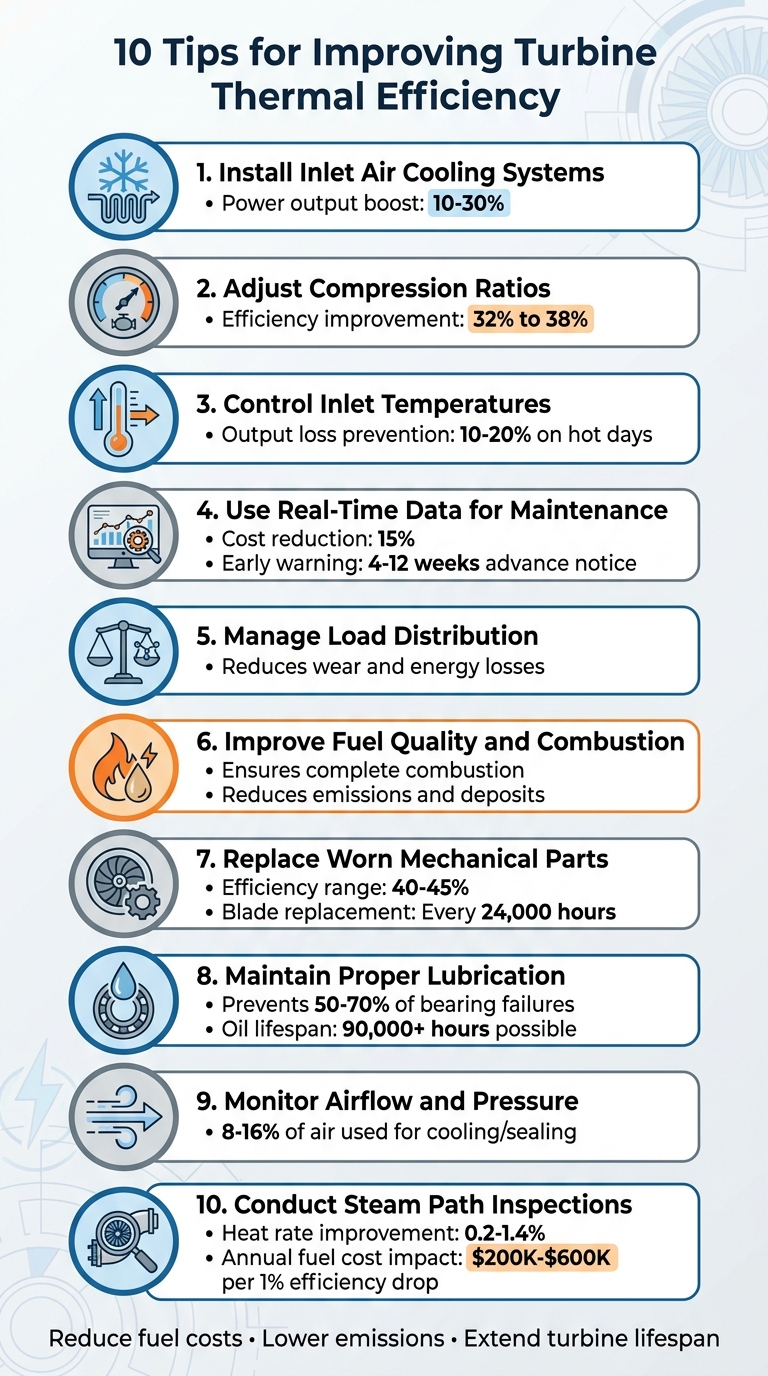
Improving turbine thermal efficiency can reduce fuel costs, lower emissions, and extend turbine lifespan. Here are 10 actionable strategies to achieve better performance:
- Install Inlet Air Cooling Systems: Boost power output by 10–30% during hot weather by increasing air density with cooling systems like fogging or mechanical chillers.
- Adjust Compression Ratios: Fine-tune compression to lower fuel consumption and improve energy extraction.
- Control Inlet Temperatures: Maintain optimal inlet air temperatures to counteract efficiency losses caused by ambient heat.
- Use Real-Time Data for Maintenance: Leverage live analytics to detect performance issues early, reducing downtime and repair costs.
- Manage Load Distribution: Operate turbines within their optimal load range to minimize wear and improve efficiency.
- Improve Fuel Quality and Combustion: Use high-quality fuel to ensure complete combustion, reduce deposits, and maintain steady performance.
- Replace Worn Mechanical Parts: Restore and upgrade components like blades and seals to regain lost efficiency and durability.
- Maintain Proper Lubrication and Reduce Vibration: Prevent friction and mechanical instability to protect turbine components and sustain performance.
- Monitor Airflow and Pressure Levels: Ensure precise fuel-to-air ratios and clear cooling passages to optimize energy transfer.
- Conduct Steam Path Inspections: Identify and address steam leakage, erosion, and misalignment to maintain aerodynamic performance.
These strategies not only cut costs but also improve reliability and reduce environmental impact. Investing in regular maintenance, monitoring, and upgrades ensures turbines operate efficiently and last longer.
10 Strategies to Improve Turbine Thermal Efficiency
Gas Turbine Performance: How to Increase Efficiency & Reduce Heat Rat
sbb-itb-501186b
1. Install Inlet Air Cooling Systems
If you're looking for a practical way to boost turbine performance during scorching summer months, inlet air cooling systems are a smart choice. By cooling the air entering the turbine, these systems increase air density, allowing more mass to flow into the combustion chamber. This is especially important because gas turbines operate as constant-volume machines, meaning cooler air directly enhances their performance.
Thermal Efficiency Improvement Potential
Hot weather can significantly drag down gas turbine efficiency - sometimes by as much as 40%. However, cooling the inlet air can counteract this, boosting power output by anywhere from 10% to 30%. Since the compressor typically uses 50% to 66% of the turbine's total power output, reducing its energy demands has a direct impact on overall efficiency.
"An inlet air cooling (IAC) system offers one of the most cost-effective ways to improve gas turbine (GT) performance - especially during the peak hours of hot summer months." – Sanjeev Jolly, Senior Engineer, NAES Corp
Besides improving power output, inlet air cooling enhances the turbine's heat rate. This means the turbine can generate the same amount of electricity while using less fuel. By lowering the compressor discharge temperature, these systems allow more fuel to burn without exceeding safe firing limits, delivering extra power at a reduced fuel cost per kilowatt.
Operational Cost-Effectiveness
When it comes to affordability, fogging systems stand out. They cost between $35 and $60 per kW of added capacity, a fraction of the $300 to $450 per kW required for new standby units. Mechanical chillers, though more expensive upfront ($185 to $400 per kW), offer consistent performance even in high-humidity areas. It's worth noting that the auxiliary load for chillers typically consumes about one-third of their output gain, so this should be factored into efficiency calculations.
| Technology | Capital Cost per kW | Cooling Limit | Best Climate |
|---|---|---|---|
| Fogging/Evaporative | $35–$60 | Wet-bulb temperature | Arid, low humidity |
| Mechanical Chilling | $185–$400 | 45°F–50°F | Humid regions |
Most systems recoup their installation costs within 3 to 5 years. Pairing mechanical chillers with Thermal Energy Storage (TES) can further cut costs. TES allows chillers to operate during off-peak hours when electricity is cheaper, building cold reserves for later use. By reducing compressor energy demands and fuel consumption, these systems make turbines more efficient and cost-effective.
Ease of Implementation
Inlet cooling systems are quick to stabilize. Fogging systems can reach steady-state operation within minutes, while chilled systems take slightly longer. This responsiveness makes them compatible with turbines that require fast cycling. Importantly, these systems don't delay turbine startup times, as their activation aligns with standard turbine startup sequences.
However, proper maintenance is crucial. Fogging systems require demineralized water to prevent mineral buildup on compressor blades. Droplet size should stay under 20 microns to ensure complete evaporation before the air reaches the compressor, reducing the risk of erosion. Cooling the air too much - below 45°F to 50°F - can lead to ice formation, which could damage the blades and cause vibration issues. With proper controls and setup, these systems can be a reliable upgrade for turbine performance.
Impact on Turbine Longevity
Inlet air cooling systems can extend turbine life by reducing NOx emissions. Fogging systems add water vapor, and cooler combustion temperatures help prevent hot spots in the combustor, which protects components. A well-designed system also minimizes blade wear and allows for more predictable maintenance schedules. To avoid issues, ensure proper drainage to manage condensation and follow OEM guidelines for wet compression flow rates, usually capped at 0.5% to 2% of total air intake.
"TIC not only helps increase GT output capacity and efficiency, it also helps reduce emissions for electric power generation." – Don Punwani, Executive Director, Turbine Inlet Cooling Association
Choosing the right technology depends on your climate. Evaporative cooling works best in dry regions where the difference between dry-bulb and wet-bulb temperatures makes it worthwhile. In humid areas, mechanical chillers are the better option, as they provide consistent cooling below the dew point regardless of moisture levels. These improvements in air management are key to optimizing turbine thermal efficiency.
2. Adjust Compression Ratios
After implementing air cooling techniques, fine-tuning the compression ratio becomes a key step in boosting turbine thermal efficiency.
Thermal Efficiency Improvement Potential
Increasing the compression ratio allows for better energy extraction from fuel. Since gas turbine compressors consume most of the turbine's output power, even small improvements here can lead to noticeable efficiency gains. For instance, lowering the compressor outlet temperature from 547°K to 477°K can improve adiabatic efficiency from 32% to 38%, which translates into reduced fuel costs and enhanced performance.
One effective method is installing high-pressure water injectors in the compressor's final stages. Known as wet compression, this technique decreases the outlet temperature and pressure while boosting the total mass flow through the turbine. This reduces the energy needed for compression, freeing up more power for the turbine's output. However, to avoid moisture condensation - which can damage compressor blades - the outlet temperature must stay at least 12°K above saturation.
These adjustments not only enhance efficiency but also pave the way for significant savings over the turbine's lifecycle.
Operational Cost-Effectiveness
Energy consumption makes up about 70% of the total lifecycle costs for gas compressors. By optimizing compression ratios, operators can achieve meaningful long-term savings. However, the pressure ratio - and consequently the turbine’s power and efficiency - is limited by the blade-tip speed. For example, a 15-MW industrial gas turbine with a 12-stage axial compressor typically operates at a total pressure ratio of 18.5, averaging about 1.28 per stage.
Wet compression requires upfront modifications, such as installing high-pressure injectors into the compressor casing. While this involves initial costs, the resulting efficiency gains and lower fuel consumption often justify the investment. It’s worth noting that around 8% to 16% of the air from the compressor is used for cooling and sealing instead of combustion. This makes optimizing the remaining airflow even more critical for cost-effectiveness.
Ease of Implementation
To adjust compression ratios effectively, consider using high-pressure water injection and variable guide vanes (VGVs). These methods reduce the energy required for compression and allow the system to adapt to real-time conditions. Water injection demands precise engineering to avoid blade erosion and is influenced by ambient weather conditions. Proper drainage systems are also critical to manage condensation and prevent moisture-related damage.
VGVs, on the other hand, enhance performance by maintaining surge-free operation and can be adjusted dynamically based on operating conditions. For smaller turbines, keeping a close eye on rotating speeds is essential - micro-turbines may need speeds as high as 300,000 rpm to maintain efficient pressure ratios. These modifications not only improve efficiency but also contribute to the turbine's long-term durability.
Impact on Turbine Longevity
While higher compression ratios improve efficiency, they also increase thermal stress on turbine components. Using advanced materials like ceramic matrix composites can help these parts endure higher temperatures and pressures. Maintaining proper pressure regulation is equally important, as fluctuations can disrupt thermal stability and accelerate wear.
Interestingly, wet compression can extend turbine life when managed correctly. By lowering compressor discharge temperatures, it reduces thermal stress on downstream components. Regular airflow and pressure audits are crucial to ensure smooth operation, as unrestricted flow is key to both efficiency and component longevity. These adjustments, when combined with inlet air cooling and other strategies, create a comprehensive approach to improving turbine thermal efficiency.
3. Control Inlet Temperatures
Thermal Efficiency Improvement Potential
Managing inlet temperatures effectively tackles a critical issue for turbines: fluctuations in ambient air temperature. When temperatures rise, air becomes less dense, forcing compressors to work harder and reducing overall turbine efficiency.
For example, turbine output can drop by 10%–20% on hot days, with every 1°F increase cutting output by 0.3%–0.5%. By utilizing turbine inlet cooling (TIC) systems, operators can counteract these losses and sustain performance during peak demand. With optimal inlet temperatures, combined-cycle turbines can achieve up to 61% efficiency.
"As compressor inlet temperature increases, the specific compression work increases while the air mass flow rate decreases... Accordingly, there is a decrease in turbine efficiency, useful work and power." - TMI Staff & Contributors
This approach works hand-in-hand with earlier air cooling methods to combat efficiency drops caused by high ambient temperatures.
Operational Cost-Effectiveness
Temperature control doesn’t just boost efficiency - it also delivers economic advantages. Economical solutions like fogging systems, which cost between $35 and $60 per kW, can serve as a budget-friendly alternative to costly standby units.
On top of the initial savings, TIC systems cut fuel consumption during high-demand periods. As Don Punwani explains:
"Since TIC also increases electric generation efficiency, it allows power producers to produce electricity at lower fuel cost than that possible without TIC".
This cost efficiency becomes especially critical during summer months when electricity demand surges. Without TIC, operators may rely on older, less-efficient backup units, which drive up costs and emissions.
Ease of Implementation
Inlet cooling technologies vary in complexity and speed of deployment. For instance:
- Fogging systems can reach full operation in just 2 to 3 minutes.
- Wetted-media systems take about 6 minutes.
- Thermal energy storage and wet compression typically require under 10 minutes.
- Chilled water systems need 10 to 15 minutes to stabilize.
Selecting the right solution depends on site-specific factors like local climate, fuel expenses, and operational schedules. Precision is key - real-time controllers must regulate cooling to maintain ideal inlet temperatures.
Impact on Turbine Longevity
Properly managing inlet temperatures not only boosts efficiency but also reduces thermal stress, which can extend turbine life. However, poor implementation can have the opposite effect. For example, high-fogging systems producing droplets larger than 20 microns may cause erosion on turbine blade edges and rotor suction sides.
Another challenge lies in system integration. Cooling systems can alter exhaust temperatures, and if turbine controls aren’t calibrated correctly, they may reduce fuel flow in response to elevated exhaust readings. This could cancel out power gains and increase emissions. When properly integrated, TIC systems protect components while enhancing efficiency and reducing emissions in combined-cycle operations.
4. Use Real-Time Data for Maintenance Scheduling
Thermal Efficiency Improvement Potential
Real-time data analytics allows operators to fine-tune turbine operations on the fly, ensuring maximum performance. For example, adjustments to fuel mixtures and operating parameters in gas turbines can be made instantly based on live performance data. A great case in point is Enel Green Power, which used real-time analytics to boost production by 5%.
One specific area where this shines is in monitoring the Exhaust Temperature Spread (ETS). Traditional systems often catch issues only when they hit critical levels, but real-time systems can detect subtle temperature shifts - 9 to 18°F - weeks in advance. This is a game-changer for efficiency. Using machine learning models, these systems can distinguish between normal and faulty combustion conditions with an impressive 97.2% accuracy. Just like earlier techniques for improving inlet cooling and compression, real-time analytics offer a proactive way to enhance turbine performance.
Operational Cost-Effectiveness
Downtime is expensive - $125,000 per hour, to be exact. AI-powered anomaly detection can provide a heads-up 4 to 12 weeks in advance, helping reduce operational costs by 15%. For example, GE Aerospace's AI-based blade inspection tool cut processing time from 3 hours to just 1.5 hours. Additionally, studies indicate that nearly 40% of reliability issues in F-class gas turbines could be avoided with better instrumentation and monitoring systems.
Ease of Implementation
The best part? Real-time data systems are designed to integrate smoothly with existing turbine controls. Platforms like these connect through protocols such as OPC-UA or Modbus, and the setup typically takes just 1–2 weeks - all without interrupting production. The process starts by linking the system to the plant's DCS/SCADA setup, allowing it to gather data without the need for extensive hardware installations. A critical step is establishing a baseline "footprint" for each turbine - essentially learning its unique temperature and vibration patterns instead of relying on generic thresholds. Once this baseline is set, the system can automatically generate work orders in the Computerized Maintenance Management System (CMMS) whenever anomalies are detected.
"A faster outage means the interval between shutting down a power plant for maintenance work and bringing it back online is shorter and the power plant can go back to producing and selling power more quickly, which benefits our customers." – Nathan Race, GE Vernova
Impact on Turbine Longevity
Real-time monitoring doesn't just improve efficiency and cut costs - it also protects the lifespan of turbines. Temperature management plays a crucial role here. For instance, a 90°F rise in combustor outlet temperature can drastically shorten turbine blade life by a factor of ten. Real-time systems catch these issues early, preventing such damage. Many ETS problems start as minor deviations of 27–36°F, which operators might overlook. By the time these variations hit critical levels, significant blade damage has already occurred. Advanced tools like Waygate Technologies' Everest Mentor Visual iQ+ borescope, enhanced with AI, have improved the detection of high-pressure compressor defects by 33.6%. Spotting these problems early helps avoid further damage and extends the turbine's operational life.
5. Manage Load Distribution
Managing load distribution is a key strategy to maintain turbine efficiency, especially when paired with real-time monitoring.
Thermal Efficiency and Performance
Every turbine is designed to perform best within a specific load range. Operating outside this range not only increases energy losses but also accelerates wear and tear on components. Adjusting load distribution - similar to optimizing inlet cooling or compression - helps improve efficiency and reduce stress on the system. Temperature control plays a big role here, as it complements load adjustments to boost performance.
Modern load management systems use smart technology to automatically balance loads, preventing surges and maintaining stability. These systems analyze performance trends and environmental factors in real time, redistributing loads without requiring manual input. This reduces parasitic air losses, which directly enhances overall efficiency.
Reducing Operational Costs
Running turbines outside their optimal load zone doesn’t just hurt efficiency - it also drives up maintenance costs. The wear caused by temperature fluctuations and load imbalances can quickly add up.
"The implementation of smart load management technologies enables balancing of loads between different demand cycles while preventing power surges and reducing the wear on turbine components." – Plant Automation Technology
The challenge lies in identifying when equipment is operating under stress, such as during startups or unexpected conditions. By adjusting procedures to minimize these periods, you can avoid unnecessary strain. Twin-shaft turbines, for instance, offer speed ranges from 58% to 104% of nominal speed, giving operators the flexibility to adapt to varying demands without sacrificing efficiency.
Extending Turbine Lifespan
Staying within the ideal load range doesn’t just conserve fuel - it also protects your turbine from damage. Load imbalances and power surges create mechanical stress that can weaken blades, shafts, and bearings over time. Intelligent load management systems help prevent these issues, reducing the likelihood of unplanned shutdowns and the need for costly component replacements.
"Energy losses increase together with component wear when operation happens persistently outside the sweet spot." – Plant Automation Technology
This approach works seamlessly with real-time monitoring. While monitoring tools detect potential problems early, effective load management ensures those problems are less likely to develop in the first place. Deploying sensors for precise load adjustments can significantly enhance reliability and extend the life of your turbine. Together, these strategies create a proactive system for maintaining performance and durability.
6. Improve Fuel Quality and Combustion
Just like fine-tuning inlet cooling and compression, keeping fuel quality in check is essential for getting the most out of your turbine. The quality of your fuel directly impacts how efficiently your turbine converts energy. Poor-quality fuel doesn’t just waste energy - it also leaves harmful deposits on key components, leading to incomplete combustion and requiring more fuel to achieve the same output. Over time, this can hit both performance and the lifespan of your equipment.
Thermal Efficiency Improvement Potential
Using high-quality fuel ensures complete combustion, which is key to improving thermal efficiency. When fuel contains impurities like ash, sodium, or vanadium, these contaminants can form deposits on turbine blades. These deposits block airflow and reduce heat transfer, forcing the turbine to burn extra fuel just to maintain the same power output.
"High-quality fuel contributes to efficient combustion, leading to optimal thermal efficiency and reduced emissions." – Turbine Logic
For instance, pipeline natural gas often has a Wobbe index of around 1,220, which directly influences turbine mass flow. While slight variations in this index might boost power output, they often increase the workload on the compressor, negating any efficiency gains. Consistent fuel quality helps avoid such fluctuations and keeps operations running smoothly.
Operational Cost-Effectiveness
The benefits of premium fuel go beyond efficiency. Although it may cost more upfront, it can save you money in the long run by reducing fuel consumption, cutting down on emissions penalties, and lowering maintenance needs. To make monitoring easier, you can install inline gas chromatographs or liquid fuel sampling ports. Pairing these tools with a strict testing schedule for suppliers ensures you stay on top of fuel quality.
Impact on Turbine Longevity
Fuel contaminants can have a serious impact on turbine durability. High sulfur content, for example, can cause hot corrosion, while ash and vanadium accelerate wear in combustion chambers. These issues can lead to unexpected failures and costly repairs.
Additionally, contaminants can clog the internal air system, which uses about 8% to 16% of the compressor's air for cooling and sealing. Regular audits of your fuel suppliers and proper storage conditions can prevent environmental contamination, ensuring that your fuel reaches the combustion chamber clean and ready to perform. This proactive approach helps protect your turbine and extends its lifespan.
7. Replace Worn Mechanical Parts
Replacing worn mechanical parts is a critical step in maintaining optimal turbine performance. Over time, components like blades and seals degrade, leading to reduced thermal efficiency. As erosion and wear distort aerodynamic profiles, energy escapes through flow losses and parasitic flows instead of contributing to power generation. By replacing these components, turbines can regain their original design performance. Below, we explore how this practice improves efficiency, reduces costs, and extends turbine longevity.
Thermal Efficiency Improvement Potential
Installing new or updated components doesn't just restore performance - it often enhances it. Modern materials like ceramic matrix composites and thermal barrier coatings allow turbines to handle inlet temperatures above 2,300°F (1,300°C). These advancements push thermal efficiency levels to between 40% and 45%. Key areas to focus on include tip clearances, seal geometries, and blade surface quality, as these factors directly impact compressor performance.
Operational Cost-Effectiveness
Restoring performance doesn't always require brand-new parts. For example, in 2025, Mechanical Dynamics & Analysis (MD&A) evaluated two sets of GE 7FA second-stage blades at their San Antonio, Texas facility. These blades had completed two service intervals and were no longer meeting minimum strength standards. Using a vacuum heat treat furnace, they rejuvenated the GTD 111 nickel-based superalloy, bringing the blades back to a condition that exceeded strength requirements. This process extended the blades' service life and delivered performance comparable to new OEM parts - all at a lower cost.
"Aging fleets often suffer from a lack of compatible replacement parts due to design obsolescence. To address this, we utilize reverse engineering to manufacture custom components that match or exceed original specifications." – Jay Eldridge, Vice President of Sales and Marketing, Mechanical Dynamics & Analysis (MD&A)
Impact on Turbine Longevity
Regularly replacing worn parts can significantly increase a turbine's operational life. For instance, single-crystal (SX) turbine blades typically require replacement after 24,000 operating hours unless specialized repair facilities are available. Upgraded blades with advanced coatings offer added protection against hot corrosion and reduce heat transfer, helping to prevent premature wear and unexpected failures. Additionally, maintaining proper tip clearances and seal integrity ensures critical cooling airflow reaches essential components, reducing thermal stress and further prolonging the turbine's lifespan.
8. Maintain Proper Lubrication and Reduce Vibration
Lubrication plays a key role in minimizing friction and preventing deposit buildup, while vibration control ensures mechanical stability. Together, these practices are crucial for maintaining turbine thermal efficiency. Bearing issues account for 50% to 70% of failures in small and medium-sized turbomachinery, with over half of these failures linked to poor lubrication practices. For aero-derivative turbines, oil serves a dual purpose: lubricating moving parts and transferring heat away from critical components like bearings and shafts, keeping operating temperatures within an optimal range.
Thermal Efficiency Improvement Potential
Proper lubrication prevents the formation of varnish and sludge, which can severely impact efficiency. When deposits form on servo-valves or bearing surfaces, they obstruct oil flow and create hot spots, reducing heat transfer capabilities. In fact, 40% of gas turbine plant operators have reported varnish problems within the first six years of oil use. Keeping oil clean - at an ISO Cleanliness Level of 18/16/13 or lower - ensures cooling pathways remain clear and friction is minimized. On the vibration side, precision alignment and balancing are critical, as they prevent energy losses caused by mechanical instability and misalignment.
Operational Cost-Effectiveness
Using high-quality lubricants can extend oil-drain intervals and reduce unexpected downtime, ultimately lowering the Total Cost of Ownership. For instance, in February 2025, Monmouth Energy in Tinton Falls, New Jersey, enhanced the performance of two Solar Turbines Taurus 60 gas turbines by switching to a high-performance synthetic turbine oil and conducting routine Used Oil Analysis (UOA) as recommended by ExxonMobil. These turbines achieved over 90,000 hours of operation on a single oil fill. This not only extended the oil's lifespan but also boosted productivity and power generation while cutting costs associated with oil changes and waste disposal.
Ease of Implementation
Maintenance teams can adopt these improvements by following lubrication best practices. This includes regular Used Oil Analysis, proper storage (keeping oil drums indoors and horizontally positioned), and maintaining effective filtration systems. It's also critical to keep water contamination below 200 ppm to avoid problems like hydrogen embrittlement and micro-cracking. For vibration control, monitoring phase angles during startup can help identify issues. A rotating phase indicates a dynamic rub, while a stable phase points to thermal bow or alignment shifts. Alignments should be maintained within ±0.025 mm (0.001 in) to minimize vibration.
Impact on Turbine Longevity
"Lubrication is the first line of defense to protect equipment from harsh operating conditions." – Gary Brown and Jim Hannon, ExxonMobil
Proper lubrication prevents damaging metal-to-metal contact, abrasive wear, and issues like pitting and spalling caused by water contamination. When combined with effective vibration management, these practices significantly extend the lifespan of turbine components and lower the risk of catastrophic failures. It’s worth noting that oil stress in modern turbines has increased by up to 400%, driven by higher power outputs and smaller lubricant reservoirs. Together, these strategies play a vital role in ensuring long-term turbine reliability and performance.
9. Monitor Airflow and Pressure Levels
Keeping a close eye on airflow and pressure is key to maintaining the right fuel-to-air ratio and flame temperature, which directly boosts turbine performance. Did you know that 8% to 16% of compressor air is redirected for cooling and sealing instead of combustion? When too much air is diverted to cooling systems, like first-stage nozzle vanes, it leaves less for combustion liners, which can limit the turbine's output. Worse yet, blockages in nozzles or cooling passages can push flames onto liner walls, risking burnout and structural damage. By ensuring precise monitoring, you can help sustain the efficiency gains achieved through proper load and temperature control.
Thermal Efficiency Improvement Potential
Accurate airflow monitoring is another step toward better turbine performance. It helps reduce turbulence and drag forces that waste energy. For instance, internal leakages and tip clearance flows between 0.02 in and 0.06 in (0.5 mm to 1.5 mm) can cause significant energy losses in gas turbines. During component refurbishment, vacuum flow testing ensures that combustion liners maintain their proper flow areas and achieve uniform temperatures across the combustor. This keeps the flame pattern steady and supports maximum energy extraction.
Operational Cost-Effectiveness
"Enhancing airflow and pressure delivery represents the most economically beneficial approach to enhance entire turbine performance levels." – Plant Automation Technology
Clogged filters make turbines work harder to produce the same output, driving up fuel costs. Regular differential pressure checks can catch clogs early, avoiding performance dips [51,52]. A great example comes from ENEL Green Power's Rancia 2 Geothermal Plant in Italy. In 2017, they installed a remote diagnostics system using Dewesoft KRYPTON and SIRIUS DAQ modules combined with a Historian time-series database. Shortly after, engineers identified dangerous mechanical issues in evaporation towers. This effort aimed to increase production by 12 GWh annually across two units.
Ease of Implementation
Airflow and pressure audits don’t need to be complicated. Conducting these checks every few months can spot problems early. Vacuum flow testing is particularly helpful for ensuring cooling passages remain clear. When using spare fuel nozzles, always verify their flow rates match original specs; even small differences can impact start-up performance. Simple practices like monitoring differential pressure across filters and ensuring proper ductwork alignment can deliver immediate results.
Impact on Turbine Longevity
Poor airflow regulation can lead to thermal stress and uneven heating, which wear down materials over time. Inadequate filtration allows dust and dirt to enter, damaging turbine blades and reducing combustion efficiency. This can even lead to catastrophic component failure [51,52]. Regular audits help maintain stability, prevent temperature fluctuations, and protect key components like hot-gas-path parts. Keeping cooling passages clear and maintaining proper fuel-to-air ratios are all part of preserving long-term thermal efficiency.
10. Conduct Steam Path Inspections
Regular steam path inspections are essential for identifying problems before they escalate into expensive breakdowns. Deposits on blades can hurt aerodynamic performance and increase fuel consumption, while worn seals allow high-energy steam to escape at critical points. These inspections help uncover issues like erosion caused by wet steam, misalignment, and mechanical wear in blades and nozzles - all of which quietly undermine thermal efficiency. Watch for warning signs such as efficiency drops, unusual noises, or heightened vibration levels - these often signal it's time for an inspection. These checks serve as a proactive layer of maintenance, targeting internal steam path problems directly.
Thermal Efficiency Improvement Potential
Steam path inspections can lead to measurable gains in efficiency. For example, addressing steam path issues can improve the heat rate by over 0.2%, while fixing condenser pressure problems can result in up to a 1.4% improvement. Upgrading high-pressure dummy seals can add another 0.05% to 0.2% in heat rate improvement. Muhammad Saqib Riaz, Manager of Steam Turbine Engineering at Mitsubishi Hitachi Power Systems, emphasizes the importance of addressing leaks:
"HP inlet bushing leakage wastes some of the highest energy steam in the turbine, and has the highest pressure".
During inspections, prioritize checking radial clearances - large gaps can lead to significant steam leakage and higher heat rates.
Operational Cost-Effectiveness
Modern inspection tools have streamlined the process, reducing downtime while providing valuable insights. For instance, robotic crawlers like GenEX can inspect internal components in just hours instead of the weeks required for traditional rotor removal. Richard Hatley, President of Nova Technology, highlights the efficiency of these tools:
"The GenEX provides accurate assessments in hours or days, not weeks".
The financial benefits of these inspections are clear. Major blade path improvements can cost over $1,000,000, while high-pressure dummy seal upgrades typically exceed $500,000. However, the savings are undeniable - a 1% drop in turbine efficiency can result in $200,000 to $600,000 per year in additional fuel costs.
Impact on Turbine Longevity
Beyond efficiency and cost savings, regular inspections play a critical role in preserving turbine longevity. Early detection of wear prevents catastrophic failures that could halt operations entirely. Non-destructive testing methods, such as phased-array ultrasonic and eddy current techniques, can identify cracks and other damage without requiring disassembly. Thermographic inspections are also valuable for spotting thermal imbalances and insulation issues that often point to underlying steam path problems. Most turbines require annual servicing, depending on usage and manufacturer recommendations. Consistent inspections and maintenance not only extend the turbine's operational life but also ensure continued reliability by addressing issues like corrosion and mechanical wear before they force unplanned outages. Together with other maintenance practices, steam path inspections are a cornerstone of optimizing turbine thermal efficiency.
Where to Source Turbine Components
Finding the right components is crucial for maintaining turbines and keeping their thermal efficiency at its peak. Reliable spare parts not only support regular maintenance but also play a significant role in upgrades. Electrical Trader is a trusted online marketplace offering new, used, and surplus power generation equipment and replacement parts. Their inventory includes generators, circuit breakers, and transformers, with filtering options by voltage, capacity, and category to help handle urgent maintenance needs quickly and efficiently. These solutions tie directly to the efficiency goals discussed earlier.
Surplus marketplaces are also a smart option for cutting costs while reducing lead times. For instance, Electrical Trader offers items like an ABB Industrial Power Circuit Breaker 15 GHK 750 for $8,800, a 300 KVA Refurbished Transformer for $18,500, and an 85 kW Winpower Powr-Pak Generator for $12,500. Choosing refurbished or surplus components can significantly lower project expenses without compromising performance.
When it comes to aging turbine fleets, custom solutions are often the answer. If original equipment manufacturer (OEM) parts are no longer available, companies like MD&A step in with advanced techniques like 3D scanning and reverse engineering to create custom components that meet or even exceed the original specifications. Jay Eldridge, Vice President of Sales and Marketing at MD&A, highlights the importance of preparation:
"The most effective maintenance strategies for reducing turbine downtime are those that prioritize proactive planning, advanced diagnostics, and unit operational duty understanding".
For cost-effective solutions tailored to your turbine's needs, reach out to verified sellers online for custom quotes on refurbished or surplus units. Ensuring the availability of high-quality, compatible components is essential for maintaining thermal efficiency and reliable energy output.
Conclusion
Boosting turbine thermal efficiency isn't just about cutting costs - it's about achieving a balance of financial benefits and reduced environmental impact. The ten strategies outlined here collectively lower operational expenses, extend the lifespan of components through proactive care, and increase revenue by improving system reliability and output. While mechanical upgrades and hardware tweaks often provide quick returns on investment, fine-tuning airflow management stands out as one of the most cost-effective ways to enhance turbine performance.
On the financial side, transitioning from reactive fixes to real-time, data-driven maintenance minimizes costly downtime and prevents major system failures. This shift forms the backbone of the efficiency strategies discussed. Prolonging component life delays expensive replacements, while smart load management reduces wear and tear. As an expert from Plant Automation Technology aptly put it, "Future energy dominance will belong to those operators who achieve maximum efficiency in power generation rather than raw output production."
From an environmental perspective, efficiency improvements directly contribute to sustainability. Better combustion and fuel utilization mean fewer pollutants and greenhouse gas emissions. Every gain in thermal efficiency reduces the fuel needed for energy production, shrinking the carbon footprint. Heat recovery systems capture wasted thermal energy, and repair techniques extend the life of components, reducing the demand for new manufacturing. These measures not only lower emissions but also promote longer, more stable turbine operation.
Over time, turbines that operate within their designed load limits experience less wear, maintain peak fuel efficiency, and often surpass their standard 30-year operational lifespan. Regular checks - like airflow audits, proper lubrication, and steam path inspections - ensure turbines run efficiently while minimizing energy waste. These practices lay the groundwork for reliable, cost-effective, and environmentally conscious power generation.
FAQs
Which efficiency upgrade has the fastest payback for my turbine?
When looking for a quick and cost-effective way to improve efficiency, certain upgrades stand out. For instance, seal upgrades and blade path enhancements are popular choices. These solutions can lower the heat rate and enhance overall performance without demanding a hefty investment. They’re practical, affordable, and deliver measurable improvements.
How do I choose between fogging and mechanical inlet chilling?
Choosing between fogging and mechanical inlet chilling comes down to your turbine's specific operational requirements and the surrounding environmental conditions.
- Fogging involves spraying high-pressure water to cool inlet air via evaporation. This method works well in moderate climates and provides a fast cooling solution.
- Mechanical chilling, on the other hand, uses refrigeration to deliver precise and steady cooling. It's especially effective in hot or humid environments where evaporation might not work as efficiently.
Key factors to weigh include the ambient temperature, humidity levels, water quality, and the cooling range you need to achieve. Each approach offers its own advantages depending on these conditions.
What data should I track to catch efficiency losses early?
Monitoring real-time data like vibration levels, temperature, and wear indicators is crucial. These metrics act as early warning signs, highlighting potential efficiency problems. By keeping an eye on them, you can address issues promptly with maintenance or adjustments, preventing bigger problems down the line.