

Thermal Performance in Connectors: Key Insights
If a connector runs hot, the problem is usually contact resistance. I’d boil the whole article down to this: current, contact pressure, conductor size, ambient heat, and installation quality decide whether a connector runs cool or becomes a hot spot.
If I were buying or specifying connectors, I’d check these points first:
- Cable lugs and crimp terminals: good for high current, but bad crimps, loose bolts, and aluminum oxide can drive heat up fast
- Terminal blocks: screw types can heat up if torque drifts; spring-clamp types hold pressure better during vibration and heat cycling
- Industrial and EV power connectors: built for high current and often include locking, sealing, and temperature checks
- PCB power connectors: have the least thermal margin because pins are small, spaced close together, and often sit in hot enclosures
A few numbers make the issue plain. At 86°F (30°C), a 50 mm² copper conductor is rated at 168 A, while the same size in aluminum is 142 A. In PCB connectors, contact resistance is often held to 10 mΩ or less, and about 72% of field failures come from pin-contact issues.
The short answer: I’d trust connector ratings only after checking derating, enclosure heat, vibration, duty cycle, and how the contact force is kept over time.
Connector Types: Thermal Performance Comparison Guide
Connector Temperature Rise and Derating
Quick Comparison
| Connector Type | Current Level | Main Heat Risk | What Usually Helps |
|---|---|---|---|
| Cable lugs & crimp terminals | Low to very high | Loose or poor-quality termination | Correct crimp, correct torque, clean conductor |
| Screw terminal blocks | Medium to high | Torque loss over time | Proper tightening and locking features |
| Spring-clamp terminal blocks | Low to medium, sometimes high | Less room at the top end of current | Steady spring pressure |
| Industrial & EV connectors | High to very high | Hot spots from contact drift under load | Locking, sealing, monitoring, strong contact design |
| PCB power connectors | Low to medium | Small pins, dense layouts, trapped heat | Derating, better plating, airflow, lower pin loading |
That’s the core takeaway from the full article: the best connector is the one that keeps low resistance under your actual heat and load conditions, not just on the catalog page.
1. Cable Lugs and Crimp Terminals
This type shows just how fast thermal performance can fall off when contact quality slips.
Current Capacity
For lugs, thermal performance comes down to three things: conductor size, alloy choice, and joint quality. Cable lugs and ring terminals are standard for high-current cable, busbar, and motor terminations because their stud-and-pad design keeps contact area large and resistance low.
Material choice has a big effect here. Electrolytic tough pitch (ETP) copper is usually preferred for high-current lugs because it has lower resistance under load than brass and other lower-conductivity alloys. If a spec sheet says "copper alloy," it's worth checking the exact alloy. Some alloys conduct less well and run hotter.
Temperature Rise
Loose or under-torqued terminations increase contact resistance. That extra resistance creates local hot spots, which can damage insulation and windings over time.
That’s why installation matters just as much as the connector’s rated ampacity. Use a calibrated torque wrench and follow the manufacturer’s stated torque value in lb-in or Nm. A lug with a high current rating can still run hot if the joint isn’t tightened the right way.
Contact Resistance Stability
Resistance at a lug connection doesn’t always stay the same over time. Thermal cycling - repeated heating and cooling as loads switch on and off - makes terminal materials expand and contract. Over time, that movement can relax a bolted lug joint and increase resistance.
In high-vibration settings like pumps or compressors, the problem gets worse. Lock washers can help maintain clamp force.
Aluminum adds another issue. An oxide layer forms within seconds on the stripped surface and creates a high-resistance barrier if it is not treated. Applying anti-oxidant compound right after stripping and working it into the strands helps limit re-oxidation and keep the joint at low resistance.
Derating Factors
The table below uses BS 7671 ratings at 86°F (30°C) ambient. Higher ambient temperatures call for derating. Aluminum also needs about 1.6 times the cross-sectional area of copper to carry the same current. You can see that gap across common wire sizes:
| Conductor Size | Copper Rating | Aluminum Rating |
|---|---|---|
| 16 mm² (~6 AWG) | 87A | 73A |
| 25 mm² (~4 AWG) | 114A | 96A |
| 35 mm² (~2 AWG) | 141A | 119A |
| 50 mm² (~1/0 AWG) | 168A | 142A |
Ratings based on BS 7671:2018+A4:2026, Method C, 86°F (30°C) ambient.
Bundled conductors trap heat, so each lug needs derating. When comparing supplier specs, buyers should check whether the published ratings reflect these jobsite conditions or only ideal single-conductor setups. That distinction matters a lot when heat is the weak point.
2. Terminal Blocks: Spring Clamp vs. Screw
Where lugs depend on bolted joints, terminal blocks depend on clamping force. That small detail matters a lot. Thermal behavior comes down to one thing: whether the contact pressure stays steady over time.
Current Capacity
Screw terminals still make sense for very large conductors. As current goes up, heat goes up with it, so conductor size and contact stability matter more. High-current spring-clamp models are getting closer, though, and that gap is getting smaller.
Temperature Rise
For screw terminals, the main trouble spot is installation torque. If a screw is under-torqued, resistance goes up. Then heat follows.
It’s a simple chain reaction: loose pressure leads to more resistance, and more resistance leads to a hotter connection.
Contact Resistance Stability
Spring terminals tend to hold resistance at a steadier level because they keep pressure on the conductor as it settles over time. That’s a big deal in setups that see heat cycles or normal material creep.
Screw terminals can drift loose over long periods of vibration unless they use anti-loosening features or other locking measures.
Derating Factors
Both terminal types need derating above 104°F (40°C) and in tightly packed block layouts. Material choice matters too:
- Use copper contacts
- Avoid aluminum for high-current blocks
- Tin plating is standard
- Silver plating offers better conductivity and heat tolerance
The same contact-pressure problem gets even more important in higher-power industrial and EV connectors.
3. High-Current Industrial and EV Power Connectors
In high-current systems, even a slightly loose connection can turn into trouble fast. It can overheat, damage insulation, and fail in short order. The same contact-pressure rules still apply here, but the stakes are much higher than they are with panel terminals.
Current Capacity
Industrial medium-voltage (MV) connectors are grouped into standard interface tiers. Those tiers set two key limits: continuous current capacity and short-time withstand current.
| Interface Type | Current Rating | Short-Time Withstand (1 sec) | Peak Current |
|---|---|---|---|
| Type A | 200 A | 12.5 kA | 31.5 kA |
| Type B | 400 A | 16 kA | 40 kA |
| Type C | 630 A | 25 kA | 62.5 kA |
EV power connectors face a different challenge: they have to carry high current inside tight enclosures. That’s why they use features like mechanical interlocks and touch-safe designs. Common EV charging connectors, including Type 2, CCS, and CHAdeMO, also include dedicated communication channels that track temperature, voltage, and charging safety in real time.
Temperature Rise
The failure pattern is the same in both industrial and EV connectors: when contact resistance goes up, hot spots form. It sounds simple, but this is where many connector problems begin.
Contact Resistance Stability
Vibration is a constant headache in both settings because it can reduce contact pressure over time. In practice, spring cage clamps do better than screw contacts here, since they hold pressure more steadily under vibration.
A few material choices matter a lot:
- Use ETP copper
- Avoid aluminum where vibration and heat cycling are severe
- Use silver plating when temperature margin is tight
Derating Factors
Bundled conductors heat each other up, which cuts the current the connector can carry. In automotive systems, thermal cycling adds more stress. Each power-on and power-off cycle causes expansion and contraction, and that repeated movement wears on the connection.
So the nameplate rating isn’t enough on its own. You need to check that the derated rating still stays above full-load current.
The same heat limits show up again in PCB power connectors, where smaller contact mass leaves less room for error.
sbb-itb-501186b
4. PCB Power Connectors and Headers
At the PCB level, thermal headroom gets tighter because there’s simply less metal and the pins sit closer together. That gives PCB power connectors and headers much less room for heat than larger industrial connectors. If the connector is undersized or the termination is poor, overheating can show up early. Compared with lugs, terminal blocks, and industrial plugs, PCB connectors heat up faster because they have less contact mass and tighter spacing.
Current Capacity
Pitch - the center-to-center distance between pins - is the main driver of current capacity, and it links straight to temperature rise. Smaller pitch usually means smaller pins, less contact area, lower current limits, and less metal to soak up heat.
JST’s XH Series, with a 2.5 mm pitch, supports moderate to high current loads and is often used for power connections and control boards. The SH Series, at 1.0 mm pitch, is meant for low-current, ultra-compact use. WTB connectors usually carry 1–20 A, while B2B connectors are often in the 0.5–3 A range.
Temperature Rise
With such a small contact area, resistance drift tends to show up sooner. Push past the rated current, and you can kick off a heat-oxidation-resistance loop that speeds up failure. In practice, about 72% of field failures trace back to pin contact problems, not the wire or the housing.
Contact Resistance Stability
Professional-grade PCB connectors are built to keep contact resistance at ≤10 mΩ. Gold plating helps keep resistance lower and steadier in high-cycle use. Tin costs less, but it oxidizes faster. On small pins, spring-type female contacts also do a better job of holding contact pressure under flex and vibration.
Derating Factors
Grouped loaded circuits and sealed enclosures can trap heat and cut airflow, which pushes local temperatures past what the nameplate rating assumes. That’s why it’s smart to ask the manufacturer for thermal rise data and derating curves. In day-to-day comparison, pitch, plating, and enclosure density are the main thermal factors to look at.
Side-by-Side Thermal Comparison
This comparison boils each connector type down to three thermal questions: How much current can it carry? How well does it keep contact pressure? And what happens when heat builds up? The table below puts those thermal differences in one place.
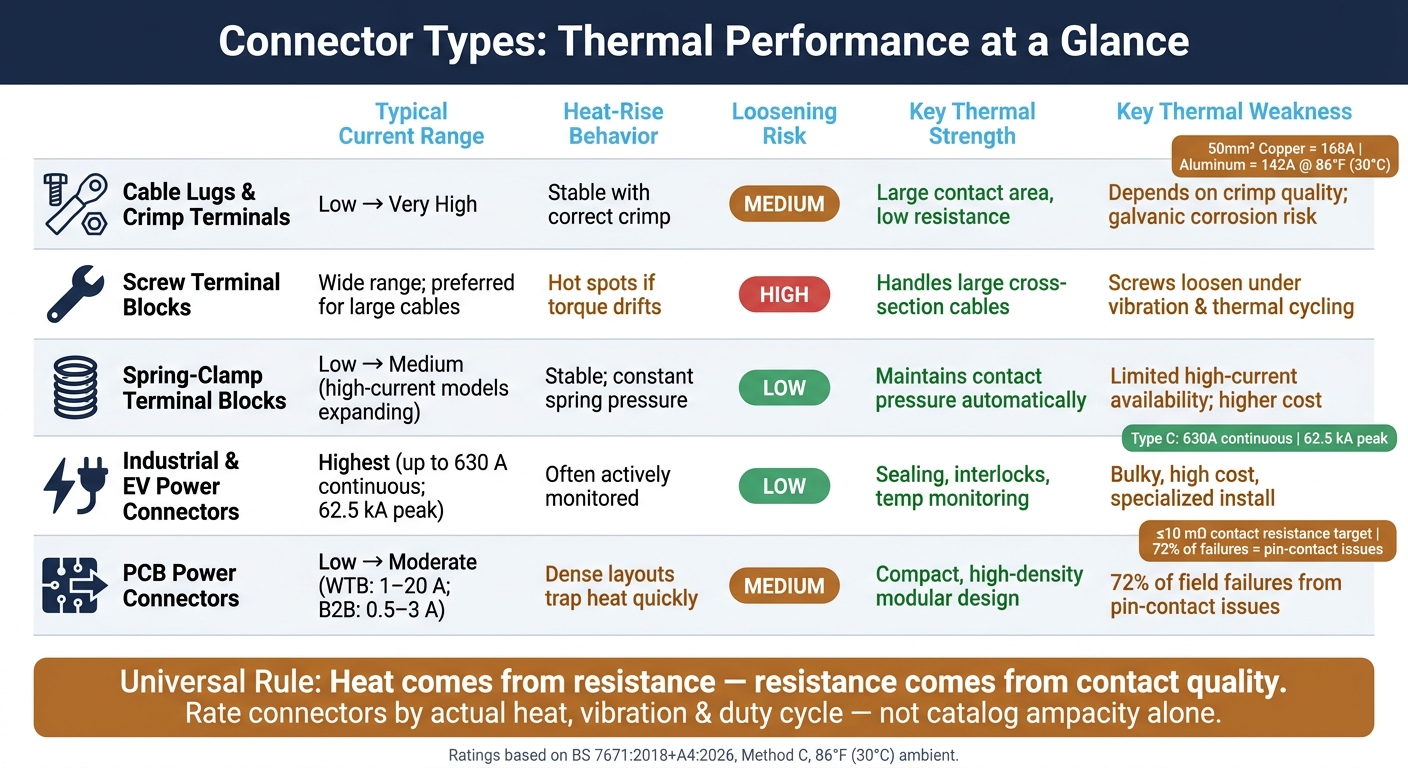
| Connector Group | Typical Current Range | Heat-Rise Behavior | Loosening Risk | Best Uses |
|---|---|---|---|---|
| Cable Lugs and Crimp Terminals | Low to very high | Stable when crimped correctly | Moderate; depends on stud/screw torque | Heavy-duty power distribution, EV battery leads |
| Terminal Blocks (Screw) | Wide; preferred for large cables and high current | Hot spots if torque is inconsistent | High; screws loosen under vibration and thermal cycling | Industrial control cabinets, power distribution |
| Terminal Blocks (Spring Clamp) | Small to medium; high-current models are expanding | Stable; constant spring pressure reduces drift | Low; automatically compensates for vibration and expansion | Home appliances, compact devices |
| High-Current Industrial and EV Power Connectors | Highest in this group | Often monitored | Low; robust locking and sealing | EV powertrains, charging stations, heavy machinery |
| PCB Power Connectors and Headers | Low to moderate | Dense layouts trap heat | Moderate; solder joints are the weak point | Consumer electronics, automotive ECUs, IoT devices |
The pattern here is pretty clear. Screw terminals and cable lugs can work very well, but they depend more on the installer getting the crimp or torque right. If that step is off, heat and contact issues can creep in.
Spring clamps and high-current EV connectors take more of that human variable out of the process. That usually means steadier contact pressure, less drift over time, and fewer problems from vibration or thermal cycling.
Those trade-offs show up in the pros and cons next.
Pros and Cons by Connector Type
Every connector type has a thermal sweet spot and a point where things start to go wrong. The table below turns the earlier comparison into a buyer-focused snapshot of where each option performs well, where it can struggle, and where it fits best.
| Connector Group | Thermal Strengths | Thermal Limitations | Ideal Use Cases |
|---|---|---|---|
| Cable Lugs & Crimp Terminals | Low resistance when crimp quality is consistent | Depends on crimp quality; risk of galvanic corrosion over time | Heavy-duty power distribution; battery cables |
| Screw Terminal Blocks | Handles large cross-section cables well; high torque capability | Hot spots rise when torque drifts | Industrial control cabinets; traditional power wiring |
| Spring-Clamp Terminals | Maintains contact pressure with little drift | Limited availability for very high-current models; higher unit cost | High-vibration environments; standardized assembly lines |
| High-Current Industrial/EV Connectors | Highest monitoring and protection margin | Bulky; high cost; specialized installation | EV powertrains; rail transit; energy storage systems |
| PCB Power Connectors | Compact; supports high-density modular designs | Heat builds quickly in dense layouts | Consumer electronics; automotive ECUs; IoT devices |
One pattern shows up again and again: thermal performance depends less on the nameplate rating and more on whether the contact stays stable during actual use.
For buyers, that usually comes down to a simple issue: which connector keeps contact pressure steady without adding extra upkeep? Spring-clamp terminals do that well. They keep pressure through vibration and thermal cycling, which cuts down on re-torque work.
Industrial and EV connectors take things a step further. They often include sealing, interlocks, and temperature monitoring. That gives you more protection, but it also means more size, more cost, and more installation effort.
Conclusion
Across all four connector types, the same basic rule holds: heat comes from resistance, and resistance comes from contact quality. When current stays high for long periods, connectors with more contact area and steady clamping force tend to do better. PCB power connectors also need heavy derating inside hot, enclosed equipment.
So the choice comes down to two things: how much current needs to pass and how steady the contact needs to stay over time. In setups with vibration and repeated thermal cycling, spring-cage and push-in terminals are the most reliable pick. Screw-clamp designs tend to drift more as temperatures swing. Lugs and disconnectable power connectors fit heavy current loads. Spring-clamp terminals fit vibration-prone use. PCB connectors need the smallest thermal cushion.
Published connector ratings matter, but long-term thermal behavior depends on how well the contact keeps holding under load. In practice, performance comes down to temperature-rise data, conductor size, ambient heat, enclosure density, and contact stability. Buy for actual heat, vibration, and duty cycle - not catalog ampacity alone.
FAQs
How do I know if a connector is undersized for the load?
Check that the connector’s ampacity and temperature ratings line up with the load and with the lowest-rated part in the system.
For example, if a 90°C (194°F) conductor connects to a 75°C (167°F) terminal, size the circuit using the 75°C ampacity. That lower temperature rating sets the limit.
It also helps to look for warning signs in the field, such as:
- Heat damage
- Loose connections
- Rising contact resistance
Apply the 125% factor for continuous loads. You should also adjust for ambient temperatures above 86°F (30°C) and for tightly packed conduits.
Which connector type handles vibration and heat cycling best?
For vibration and heat cycling, spring terminal connectors usually do better than old-school screw terminals. The reason is pretty simple: the spring keeps steady pressure on the connection, even when parts shift a bit over time. That helps the contact stay stable for the long haul.
In harsh automotive and industrial settings, sealed connectors like Deutsch DT and AMP Superseal matter too. They’re built to handle vibration, temperature swings, and moisture getting into the connection.
What derating factors matter most in real installations?
In day-to-day installations, derating helps keep conductors from running too hot and can help equipment last longer.
The main things that drive derating are:
- Ambient temperatures above 86°F (30°C)
- Grouped or bundled cables and packed conduit, which can push internal temperatures up by 36°F (20°C)
- Burial depths over 36 in. and soil with high thermal resistivity
It also helps to look at the Rated Diversity Factor (RDF) when circuits won’t all run at full load at the same time. For the right site-based correction factors, check the NEC and the manufacturer’s data.