Copper vs. Aluminum Windings: Loss Reduction Comparison
If you want lower losses, lower heat, and a smaller transformer, I’d pick copper. If you want a lower purchase price and less weight, I’d look at aluminum.
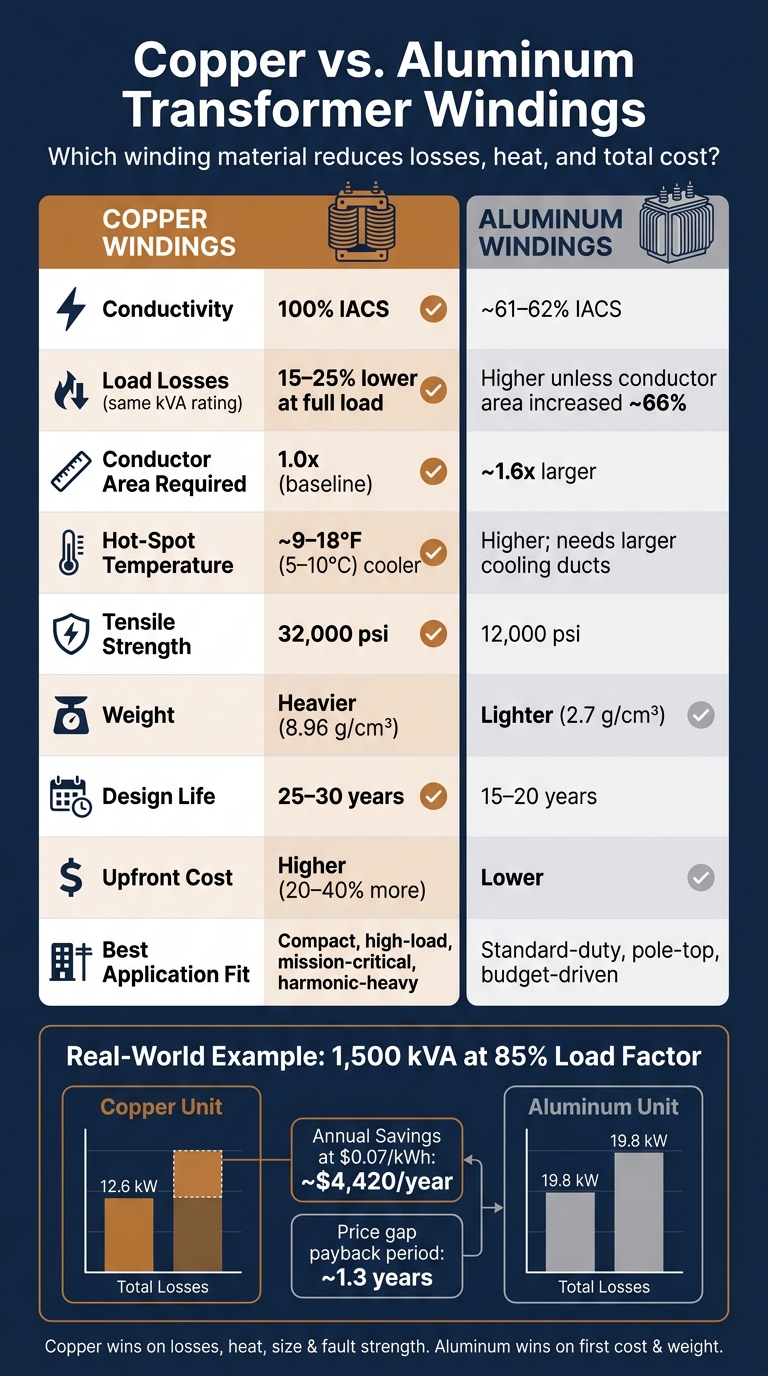
Here’s the short answer: copper cuts load losses because its resistance is lower, while aluminum costs less but needs more conductor area to keep up. In the example from the article, a 1,500 kVA copper unit at an 85% load factor had 12.6 kW of total losses versus 19.8 kW for a standard aluminum unit. At $0.07/kWh, that is about $4,420 per year in power-cost savings, with a $5,900 price gap paid back in about 1.3 years.
If I were comparing the two, I’d focus on these points first:
- Load loss: Copper is usually lower under load.
- No-load loss: Mostly driven by the core, but aluminum designs can need a larger core.
- Heat: Copper often runs about 9–18°F (5–10°C) cooler.
- Size: Aluminum needs about 1.6x to 1.66x more conductor area for the same resistance.
- Weight: Aluminum is much lighter.
- Strength: Copper handles fault stress better.
- Service life: Copper is often chosen for longer-life, higher-stress duty.
- Best fit: Copper for tight spaces and hard duty; aluminum for standard-duty, cost-driven jobs.
Bottom line: copper tends to win on loss reduction, heat, size, and fault strength; aluminum tends to win on first cost and weight.
Copper vs. Aluminum Transformer Windings: Full Comparison
Copper vs Aluminum Transformer Windings
sbb-itb-501186b
Quick Comparison
| Criteria | Copper | Aluminum |
|---|---|---|
| Conductivity | Higher | Lower |
| Load losses | Lower | Higher unless conductor size is increased |
| Conductor area needed | Smaller | About 1.6x–1.66x larger |
| Transformer footprint | Smaller | Larger |
| Weight | Heavier | Lighter |
| Hot-spot temperature | Lower | Higher |
| Short-circuit strength | Higher | Lower |
| Upfront price | Higher | Lower |
| Common fit | High-load, compact, hard-duty use | Standard-duty, budget-driven use |
If you’re buying on total cost over many years, losses and heat often matter more than the quote price. If you’re buying for lowest upfront cost or pole-top weight limits, aluminum can still be the right call.
Copper Windings vs. Aluminum Windings: Core Performance Differences
Copper's higher conductivity cuts winding resistance and allows a smaller coil. That's the main reason it performs better under load. Annealed copper sits at 100% IACS (International Annealed Copper Standard), while aluminum reaches only about 61% to 62% of copper's conductivity. That gap affects winding resistance, transformer size, mechanical strength, and long-term service life.
Copper Windings: Lower Resistance and Compact High-Load Design
Because copper conducts electricity so well, it can carry the same current as aluminum with a much smaller cross-section. That means a smaller winding and a more compact transformer.
Copper also stands up better to physical stress. Its tensile strength is 32,000 psi, compared with aluminum's 12,000 psi. During a short-circuit event, windings face sudden, intense electromagnetic force. Copper's higher strength makes the coil less likely to deform, which helps the transformer last longer.
"Copper is stronger than aluminum and, therefore, withstands stresses imposed by fault currents better than aluminum. Because the coil is stronger and less likely to deform, transformer life is extended and lifecycle maintenance costs are reduced." - Ravi Rahangdale, President, Pennsylvania Transformer Technology Inc.
There's also a connection advantage. Copper oxide, the surface layer that forms over time, still conducts electricity. So bolted joints can keep low resistance without extra treatment. That's one big reason copper is often chosen when low losses and compact size matter most.
Aluminum Windings: Larger Conductor Size at Lower Material Cost
To match copper's electrical resistance, an aluminum conductor needs about 1.6 times the cross-sectional area. That larger conductor needs a bigger core window, more lamination steel, and a larger tank. In practice, the active part can be about 66% larger than a similar copper design.
The upside is cost and weight. Aluminum has a density of 2.7 g/cm³, while copper comes in at 8.96 g/cm³. So even with the larger conductor size, aluminum windings are much lighter. That can make a big difference in pole-top distribution transformers, where lower weight reduces the load on the structure.
Upfront cost is another draw. Aluminum-wound units usually cost 20% to 40% less than copper models with the same capacity.
The catch is at the connection points. Aluminum oxidizes as soon as it's exposed to air, and aluminum oxide is an electrical insulator. Copper oxide isn't. Without joint compound or plated terminals, aluminum connections can build up more resistance and more heat over time. So aluminum's edge comes from lower material cost and lower weight, not lower resistance.
Comparison Table: Conductivity, Resistance, Size, Weight, and Mechanical Strength
| Property | Copper Windings | Aluminum Windings |
|---|---|---|
| Conductivity (IACS) | 100% | ~61%–62% |
| Resistance (same size) | Baseline | ~64% higher |
| Required conductor area | 1.0x (baseline) | ~1.6x larger |
| Transformer size impact | Compact | Larger footprint |
| Tensile strength | 32,000 psi | 12,000 psi |
| Weight | Heavier | Lighter |
These physical differences show up most clearly in load loss, heat rise, and operating expense.
Loss Reduction Comparison: Efficiency, Heat Rise, and Operating Expense
Load Losses and No-Load Losses in Practical Transformer Design
The resistance difference shows up first in load loss. Winding material has a direct effect on load loss, but it doesn't drive no-load loss. No-load losses - the energy a transformer uses just by being energized - come from the magnetic core, not the windings.
Because copper has lower resistance, it produces less I²R loss under load. Aluminum can narrow that gap, but only if designers use more conductor area. The catch is that this can make the core bigger and push no-load loss up. In practice, larger aluminum conductors can increase core volume and mass by about 29%, which can increase no-load loss.
So yes, a well-designed aluminum transformer can get closer on efficiency. But that doesn't happen by accident. It takes careful sizing and cooling choices to pull it off.
Hot-Spot Temperature Rise and Thermal Margin Under Load
Lower loss means less heat to deal with. Copper also transfers heat better than aluminum, so hot-spot temperatures usually run about 9–18°F (5–10°C) lower under the same load.
That extra thermal margin matters. Cooler windings put less strain on insulation, which helps reliability over time. As the Copper Development Association puts it:
"Efficient transformers run cooler, and thus more reliably, because of decreased stress on insulation materials." - Copper Development Association
This becomes even more important with harmonic-heavy or other non-linear loads, where heat can build fast compared with standard linear-load setups. Copper's lower hot-spot rise gives it more room to handle those conditions. Aluminum units can work in those cases too, but they need larger cooling ducts and tuned radiator surfaces to make up the difference.
Copper also handles short overloads for a longer stretch. Copper windings can usually sustain overloads for 1–2 hours, while aluminum windings may be limited to less than 30 minutes because temperature rises faster.
Comparison Table: Efficiency, Thermal Performance, and Lifecycle Cost
The day-to-day result shows up in efficiency, heat margin, and total operating cost.
| Factor | Copper Windings | Aluminum Windings |
|---|---|---|
| Load losses (same kVA rating) | Typically 15%–25% lower at full load | Higher unless conductor area is increased by about 66% |
| No-load loss impact | Lower; more compact core window | Can be higher if the larger winding requires a larger core |
| Hot-spot temperature tendency | About 9–18°F (5–10°C) lower; faster heat dissipation | Higher; requires larger surface area or cooling ducts |
| Design life | 25–30 years | 15–20 years |
Choosing by Application: When Copper or Aluminum Is the Better Fit
Loss data matters. But in the field, installation limits and duty cycle usually settle the debate.
So the choice becomes pretty simple: do you need compact size and long-term toughness, or do you need lower upfront cost and less weight?
Where Copper Is the Stronger Choice
Copper makes more sense in space-limited, high-load, and mission-critical installations. In compact indoor electrical rooms - like high-rise buildings or basement installations - copper’s higher conductivity means a smaller transformer footprint, a smaller core, and less insulating oil required.
PTTI uses copper exclusively for utility customers who expect 40- to 50-year service lives with minimal maintenance.
Copper is also the better pick for harmonic-heavy or pulsed-load systems. Its lower resistance and higher mechanical strength give you tighter thermal margins and more headroom during short-circuit events.
If those demands aren’t front and center, aluminum is often the easier call.
Where Aluminum Is the More Practical Choice
Aluminum fits standard-duty, budget-sensitive, and weight-sensitive installations. It works well when first cost and lighter weight matter more than maximum compactness. In North America, aluminum is the standard winding material for low-voltage dry-type transformers rated 15 kVA and above.
For pole-top distribution transformers, aluminum’s lower density cuts the mechanical load on the pole. That makes it a better fit when space isn’t tight.
It also lines up well with cost-sensitive commercial projects, including:
- General lighting
- HVAC
- Standard distribution
Use UL-listed Al/Cu lugs, spring-pressure connectors, and joint compound to cut oxidation and contact heating.
Comparison Table: Application Fit by Operating Priority
At this point, the tradeoff isn’t about a single winner. It’s about what matters most in the job.
| Operating Priority | More Suitable Material | Rationale |
|---|---|---|
| Lowest first cost | Aluminum | Lower raw material cost and easier manufacturing |
| Compact footprint | Copper | Requires 1.66x less conductor area; smaller core and tank |
| Lightest weight | Aluminum | Lower density; ideal for pole-top or rooftop installations |
| High-harmonic or peak loads | Copper | Higher tensile strength resists mechanical stress from current pulses |
| Mission-critical reliability | Copper | Long service life, stronger terminations, and better short-circuit margin |
| Standard commercial distribution | Aluminum | Meets efficiency targets at a lower price point for standard-duty service |
| Short-circuit withstand | Copper | About 2.6x higher tensile strength than aluminum of equal cross-section |
Conclusion: How to Choose the Right Winding Material
Once you compare loss, heat, size, and cost, the decision usually comes down to six things: efficiency target, budget, footprint, weight, thermal margin, and short-circuit duty.
In plain English, the tradeoff is pretty simple. Copper tends to fit compact, high-load installations better. Aluminum tends to make more sense for lighter, standard-duty installations. In most cases, those priorities push the choice in one clear direction.
For cyclic peak loads, fault currents, or a 40- to 50-year service life, copper often earns its higher material cost. Its mechanical strength and connection reliability matter more in those tougher conditions. Aluminum needs more care at the connection point, including tin-plated or silver-plated Al/Cu lugs and spring-loaded connections, to help avoid joint failure over time.
Copper also tends to make loss reduction easier in a smaller package. That said, aluminum can still hit the same efficiency goals when the design is done well, and it may reach those goals at a lower material cost.
Key Takeaways for Specification and Purchasing
The right winding material is the one that cuts total cost and risk for the actual operating duty. That means matching the material to the load profile, installation limits, connection environment, and lifecycle cost.
If the job calls for a smaller footprint, higher load stress, or tougher fault duty, copper will often be the better fit. If weight and upfront material cost matter more, and the installation is standard-duty, aluminum may be the smarter pick.
FAQs
How much can copper really save over time?
Copper-wound transformers can deliver major long-term energy savings because they reduce conductor losses, especially in high-load applications.
Here’s why that matters: transformer losses rise with the square of the load. So when demand goes up, losses don’t just inch higher. They climb fast. In those conditions, high-efficiency copper units can lower total losses compared with standard designs.
Studies show the savings can reach several kilowatts per unit, and those gains build over time. Once the upfront price premium is paid back, the savings keep coming through the transformer's service life, which often spans multiple decades.
When is aluminum the better transformer choice?
Aluminum is often the go-to choice for transformers rated at 15 kVA or larger, especially in North America. The big reason is simple: it usually costs less up front. It’s also highly malleable, which can make the manufacturing process easier.
Because the raw material is less expensive, manufacturers can use larger conductor cross-sections to match copper’s energy efficiency without pushing total cost as high. And when aluminum connections are installed the right way by people who know the material well, it can also offer better short-term overload capability.
Do aluminum windings need special connectors?
Yes. Aluminum windings need extra care at the connection point because aluminum oxide doesn’t conduct as well as copper oxide.
That’s why you should use properly rated Al/Cu hardware, such as tin-plated or silver-plated aluminum lugs. It also helps to avoid direct contact between unplated aluminum and copper, which can lead to corrosion and weaken long-term reliability.