

Connector Applications in Power Distribution Systems
Connectors are critical for reliable power distribution, linking components like transformers, switchgears, and circuit breakers. However, overheating, corrosion, and mechanical wear can lead to failures, causing safety risks and financial losses. For example, high-resistance connectors in industrial setups can result in energy losses of up to $300,000 annually. This article explores real-world solutions from the utility, military, and maritime sectors:
- Utility Networks: Fire Wedge connectors reduced outages and maintenance in India by maintaining low resistance and consistent contact pressure.
- Military Applications: High-capacity connectors with PowerBud technology handled extreme conditions, delivering up to 265 amps without degradation.
- Maritime Systems: IEC Lock connectors improved reliability in harsh marine environments by preventing accidental disconnections due to vibration.
Each case study highlights how tailored connector designs address specific challenges, ensuring long-term performance and reducing costs.
Case Study 1: Fire Wedge Connectors in Utility Networks
Problems in Utility Networks
Southern Power Distribution Company Ltd (SPDCL) in Andhra Pradesh, India, faced a significant hurdle: connector issues were responsible for over half of their outages. On top of that, degradation accounted for 4–5% of system losses, while technical losses soared to nearly 80%. The existing connectors offered limited metal contact, which led to excessive heat and resistance - especially problematic in SPDCL's high-demand network. Over time, oxidation created insulating films, and thermal cycling caused conductor expansion, both of which weakened the connections. SPDCL needed a solution that could handle temperatures up to 266°F during peak transmission while maintaining consistent contact pressure. Clearly, the situation demanded a cutting-edge approach.
Installation and Results
To tackle these challenges, SPDCL turned to a precision-engineered fix. In October 2021, they teamed up with Raychem RPG to roll out Fire Wedge connector technology throughout their network. Over 400,000 Fire Wedge connectors were installed across 950 substations. Before installation, site surveys and thermo-scanning were conducted to identify hotspots in the network.
The Fire Wedge connectors were specifically designed to address SPDCL's core issues. Their C-shaped spring body ensured constant contact, while power-actuated tools allowed for consistent installations. During installation, the wedge abraded the conductor surfaces, removing oxide films and creating high-quality electrical connections.
The impact was immediate. SPDCL achieved a maintenance-free power supply, reducing distribution losses and increasing revenue through uninterrupted service. Unlike traditional bolted connectors, which required regular retightening, Fire Wedge connectors maintained low resistance and stable contact pressure without the need for ongoing maintenance.
sbb-itb-501186b
Case Study 2: High-Capacity Connectors in Military Applications
Design Requirements for Military Equipment
As utility networks evolve, military applications require connector solutions that can meet increasingly complex challenges. For example, helicopter blade hubs in military settings demand connectors capable of handling rotational functionality and high amperage delivery within the tight confines of a hub assembly. Methode Power Solutions addressed this by creating a low-profile laminated bus bar shaped like a pentagon, ensuring it fits snugly within the hub. Power is routed from the center of the device through PowerFlex cables, then distributed to printed circuit boards located at each edge.
These connectors must endure extreme conditions, such as vibrations and temperature fluctuations, while delivering up to 265 amps of power. Standard connectors fall short, as they either lack the required capacity or take up too much space. Methode's patented PowerBud technology solves this issue with its massively parallel contact points, reducing both resistance and insertion force without increasing the connector's size.
"The patented PowerBud technology lowers contact resistance and contact normal force without increasing connector size." - Methode Power Solutions Group
The MDUAL series connectors are available in three pin sizes: 0.25, 0.36, and 0.5 inches. The largest pin size supports the full 265-amp capacity. These connectors also feature blind-mate housings with self-aligning guideposts, making them ideal for use in confined internal assemblies where precise alignment is challenging.
Performance Results
The durability of the PowerBud design stood out during testing. MDUAL connectors showed no performance degradation even after 10,000 mating-unmating cycles, far surpassing the 500-cycle requirement of MIL-DTL-38999 Series III specifications. The parallel contact points ensured reliable electrical performance, even under the mechanical stresses typical of aerospace environments.
Thermal management was another area where these connectors excelled. Methode added PowerStuds to the termination bodies, which act as heat sinks to counteract temperature increases caused by multiple high-current connections. For example, standard 0.36-inch PowerBud contacts are rated for 175 amps with an 86°F temperature rise. However, in high-density configurations, the rating is adjusted to 145 amps to manage heat buildup effectively. Additionally, the connectors comply with RoHS-3 standards and feature halogen-free housings, eliminating the need for future material validation testing.
This success demonstrates how these connectors can meet the rigorous demands of military applications, paving the way for further advancements in specialized environments.
Case Study 3: IEC Lock Connectors in Maritime Applications

Problems in Maritime Power Systems
Marine and offshore environments bring a unique set of challenges for power distribution systems. Take Kongsberg Maritime, a leader in digital switchgear for vessels, as an example. They faced recurring issues with standard electrical connectors failing under persistent vibration and shocks. These failures, particularly in critical systems like servers and PDU power strips, jeopardized both power continuity and data integrity.
The harsh conditions at sea - salt, humidity, and mechanical stress - meant any downtime could severely impact digital switchgear or overall vessel performance. For Kongsberg, maintaining the highest levels of operational safety and availability was non-negotiable. Adding to the complexity, managing multiple cable connections during routine operations or maintenance heightened the risk of accidental disconnections. Traditional friction-fit connectors simply weren’t up to the task, creating the need for a more reliable solution. This is where IEC Lock technology stepped in.
Advantages of IEC Lock Connectors
Kongsberg Maritime turned to IEC Lock connectors to tackle these maritime challenges head-on. Designed to handle salt exposure, humidity, and constant vibration, the patented locking mechanism automatically secures the plug, preventing disconnections caused by vibration. Unlike manual locking systems, the IEC Lock requires the user to release it by pulling a distinctive red locking mechanism, ensuring a secure connection.
"The patented IEC LOCK® is compatible with all standard IEC C14 and IEC C20 plugs, ensuring an integral connection that is protected against disconnection due to vibration and accidental unplugging." – Transfer Multisort Elektronik
These connectors significantly improved power supply reliability by securing PDU-to-server connections, keeping critical maritime equipment running without interruptions. Kongsberg also benefited from several customization options, including a variety of cable lengths and connector types (C14, C20, or stripped ends), enabling seamless integration into tight spaces on vessels.
Additional features like LSZH (low smoke, zero halogen) versions enhanced safety in enclosed shipboard environments. Color-coded options further simplified maintenance, helping technicians quickly identify and manage different power paths, which reduced the likelihood of human error during servicing.
4 times more with M12 Power
Connector Solutions: Benefits and Comparison
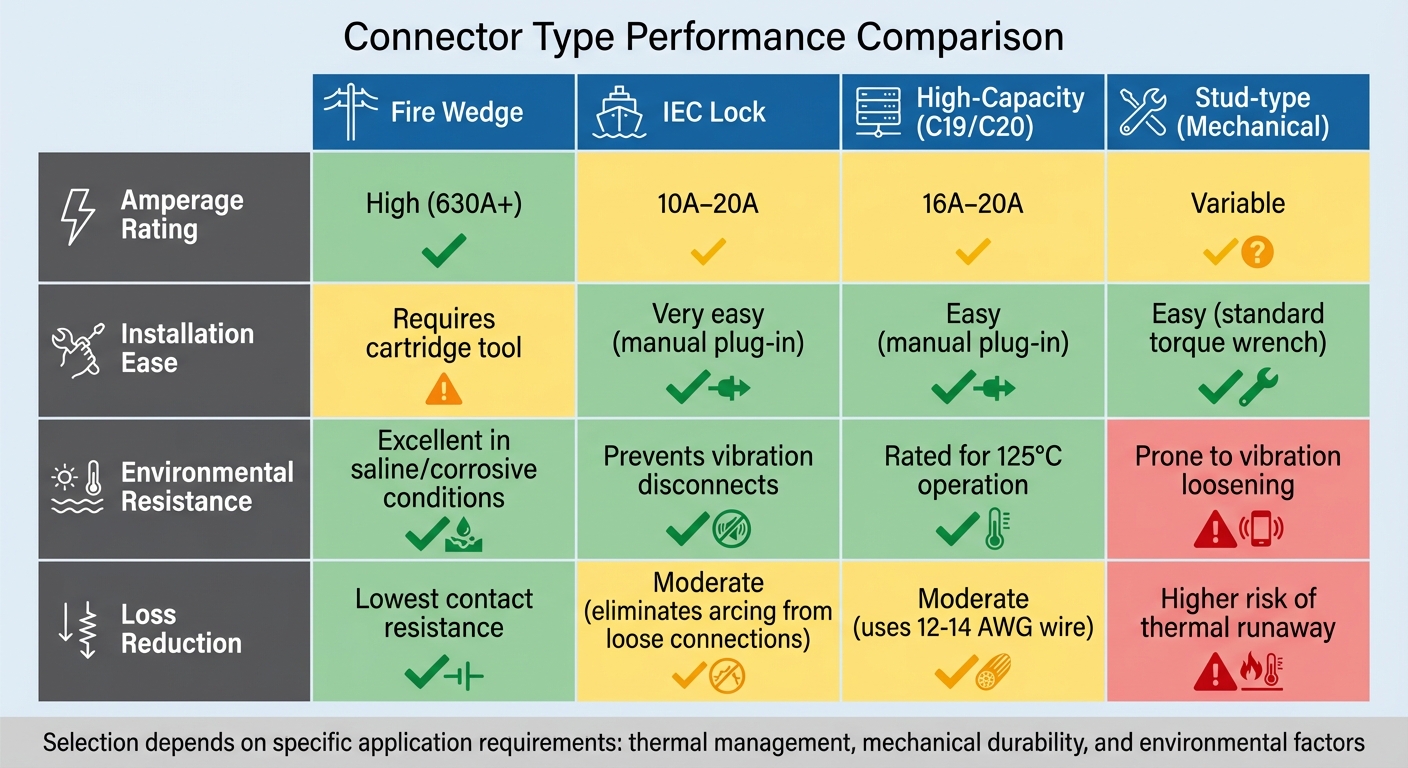
Power Distribution Connector Types: Performance Comparison Chart
Connector Type Comparison
Different connector types bring specific advantages to power distribution systems, addressing unique operational challenges. For example, Fire Wedge connectors deliver an average elastic restoring force of 21,400 N, ensuring conductors stay secure even under thermal cycling and environmental stress. A 1996 Pacific Gas and Electric test demonstrated their reliability, with stable performance sustained over 500 cycles in a 5% salt fog environment - outperforming bolted alternatives in durability.
High-capacity connectors, like the Molex SideWize series, are designed for demanding environments such as military and data center applications. These connectors handle 16A–20A loads and operate at temperatures up to 125°C, significantly higher than the 70°C limit of standard C13/C14 connectors. This capability is crucial for preventing overheating in GPU servers and other high-density computing setups.
IEC Lock connectors offer a deliberate-release locking mechanism paired with color coding, making them ideal for high-vibration environments. This design minimizes accidental disconnections and simplifies maintenance, making them especially suited for maritime and mobile military applications.
Selecting the right connector technology depends on the specific needs of your system. For instance, compression connectors are recommended for high-strand count cables in applications like rail transit or heavy machinery, where vibration resistance is essential. To avoid failure in aluminum mechanical connections, applying oxide inhibitors can prevent the formation of non-conductive oxide layers. Meanwhile, rectangular modular connectors are a great choice for systems requiring frequent reconfiguration, as they allow quick upgrades without specialized tools.
Here's a quick comparison of key connector types and their features:
| Connector Type | Amperage Rating | Installation Ease | Environmental Resistance | Loss Reduction |
|---|---|---|---|---|
| Fire Wedge | High (630A+) | Requires cartridge tool | Excellent in saline/corrosive conditions | Lowest contact resistance |
| IEC Lock | 10A–20A | Very easy (manual plug-in) | Prevents vibration disconnects | Moderate (eliminates arcing from loose connections) |
| High-Capacity (C19/C20) | 16A–20A | Easy (manual plug-in) | Rated for 125°C operation | Moderate (uses 12-14 AWG wire) |
| Stud-type (Mechanical) | Variable | Easy (standard torque wrench) | Prone to vibration loosening | Higher risk of thermal runaway |
Conclusion
Selecting the right connector means balancing thermal management, mechanical durability, and environmental factors throughout the system's lifespan. Even small amounts of resistance can jeopardize a connector's performance and reliability.
Case studies highlight how customized connector designs prevent failures and reduce costs. For example, Fire Wedge connectors in utility networks maintain consistent contact resistance for up to 25 years between maintenance intervals. In military settings, high-capacity connectors handle extreme thermal and mechanical stress. Meanwhile, IEC Lock connectors prevent vibration-induced disconnections in maritime environments. These tailored solutions address challenges that off-the-shelf connectors can't effectively manage.
These examples underline the importance of specialized connectors. Engineers should collaborate with connector experts early in the design process to ensure system reliability. As Jason Wright, Head of Power Transmission and Distribution at Stäubli North America, explains:
"Every system requires its own solution... We need to consider factors of the system. Does this need to be plugged in by humans? Is it done by a tool? Is it being isolated?"
Platforms like Electrical Trader make sourcing connectors easier by offering extensive catalogs and professional guidance. Their marketplace provides detailed technical documentation, including series specifications and unique ID numbers, helping users evaluate components on factors like durability, engagement force, IP ratings, and certifications (UL, SAE, CSA). Whether you're sourcing loadbreak separable connectors for a 24 kV substation or modular connectors for a data center, having access to both new and used options, along with expert consultancy, simplifies the process and ensures you find the perfect fit for your needs.
FAQs
How do I choose the right connector for heat, vibration, and corrosion?
When choosing a connector to handle heat, vibration, and corrosion, it's all about selecting materials and designs that can endure tough conditions. Look for connectors made from materials specifically designed to resist environmental stress. For vibration, prioritize options with secure locking mechanisms and appropriate engagement force to keep connections stable.
For heat resistance, check that the materials can tolerate high temperatures and verify the connector's current rating to ensure it performs reliably. Lastly, consider the connector's cycle life and overall durability to ensure it holds up over time in demanding environments.
What tests or inspections detect high-resistance connector hot spots early?
Thermal imaging, using a thermal camera, is a practical way to spot hot spots that often result from loose or corroded connections. By identifying overheating components early, this technique helps address potential problems linked to increased resistance before they escalate.
When is a locking connector worth it compared to a standard plug?
A locking connector is a smart choice when you need a secure and stable connection that won’t accidentally come loose. This becomes especially crucial in environments with heavy vibrations, frequent movement, or high foot traffic. Think industrial facilities, outdoor events, or any setting where a loose plug could lead to disruptions - or even safety risks.