Tesla Powerwall vs Sonnen: Which Is Better for Solar?
If I had to boil it down to one line: Tesla Powerwall 3 is the better pick for high-output backup at a lower upfront cost, while Sonnen is the better pick for daily battery use and longer warranty retention.
If you’re choosing between these batteries for a U.S. solar home, here’s what matters most:
-
Tesla Powerwall 3
- 13.5 kWh usable storage
- 11.5 kW continuous power
- About $11,500–$16,000 installed
- Best if you want whole-home backup from one unit
-
sonnenCore+
- 10 kWh usable storage
- 4.8 kW continuous power
- About $14,000–$18,000 installed
- Best if you want critical-load backup and frequent battery cycling
-
Sonnen ecoLinx
- 10–20+ kWh usable storage
- 10 kW continuous power
- About $10,000–$15,000 installed for 10 kWh
- Best if you want daily solar shifting and grid program support
What decides this matchup is simple:
- Choose Tesla if you care most about running large loads during outages
- Choose Sonnen if you care most about battery life, grid programs, and day-to-day cycling
- Check installed cost, panel setup, and utility programs before you decide
Sonnen Battery vs Tesla Powerwall 2: 2022 Lithium Battery Comparison. Best back up battery is?
sbb-itb-501186b
Quick Comparison
| System | Usable Capacity | Continuous Power | Warranty | Installed Cost | Best Fit |
|---|---|---|---|---|---|
| Tesla Powerwall 3 | 13.5 kWh | 11.5 kW | 10 years, 70% retention | $11,500–$16,000 | Whole-home backup |
| sonnenCore+ | 10 kWh | 4.8 kW | 10 years, 10,000 cycles, 80% retention | $14,000–$18,000 | Critical loads, frequent cycling |
| Sonnen ecoLinx | 10–20+ kWh | 10 kW | 10 years, 10,000 cycles, up to 80% retention depending on model details in the article | $10,000–$15,000 for 10 kWh | Daily solar use, grid programs |
My short take: Tesla wins on power per dollar. Sonnen wins on long-run cycling and utility-facing controls. So the better battery depends on whether you want your solar battery to act more like an outage tool or a daily energy tool.
Tesla Powerwall and Sonnen at a Glance
For solar homes, usable capacity tells you how much extra solar energy you can save during the day. Power output tells you how much of your home can keep running if the grid goes down.
Tesla Powerwall Overview
Tesla Powerwall 3 is a wall-mounted LFP battery with 13.5 kWh of usable capacity and 11.5 kW of continuous output - enough to run larger household loads. It comes with a 10-year warranty, 70% capacity retention, and IP67 weather protection.
That mix makes it a good pick for homeowners who want whole-home backup from a single unit. It also makes sense for people who already drive a Tesla EV and want to stay inside the Tesla setup.
Sonnen takes a different route. It gives up some output in exchange for longer cycle life and more control over how energy gets used around the house.
Sonnen Home Battery Overview
Sonnen puts the focus on long-term cycling and smart grid features. Its two main U.S. products - the sonnenCore+ and the sonnen ecoLinx - both use LFP chemistry.
The sonnenCore+ provides 10 kWh of usable storage and 4.8 kW of continuous power. The ecoLinx can scale from 10 kWh to 20+ kWh and delivers 10 kW continuously.
Where Sonnen stands out is its built-in energy management and VPP readiness. It also offers a 10-year warranty, 10,000 cycles, and 80% capacity retention. That makes it a better long-run match for homeowners who care more about using more of their own solar energy day after day.
| Feature | Tesla Powerwall 3 | sonnenCore+ 10 | Sonnen ecoLinx |
|---|---|---|---|
| Chemistry | LFP | LFP | LFP |
| Usable Capacity | 13.5 kWh | 10 kWh | 10–20+ kWh |
| Continuous Power | 11.5 kW | 4.8 kW | 10 kW |
| Warranty | 10 years / 70% retention | 10 years / 10,000 cycles / 80% retention | 10 years / 10,000 cycles / 80% retention |
| Best For | Whole-home backup | Critical-load backup, VPP participation | Daily solar shifting |
These gaps show up most clearly in three areas: backup output, battery life, and control software. The next step is to look at how those specs play out in day-to-day backup, long-term use, and app control.
Head-to-Head Comparison: Performance, Lifespan, and Features
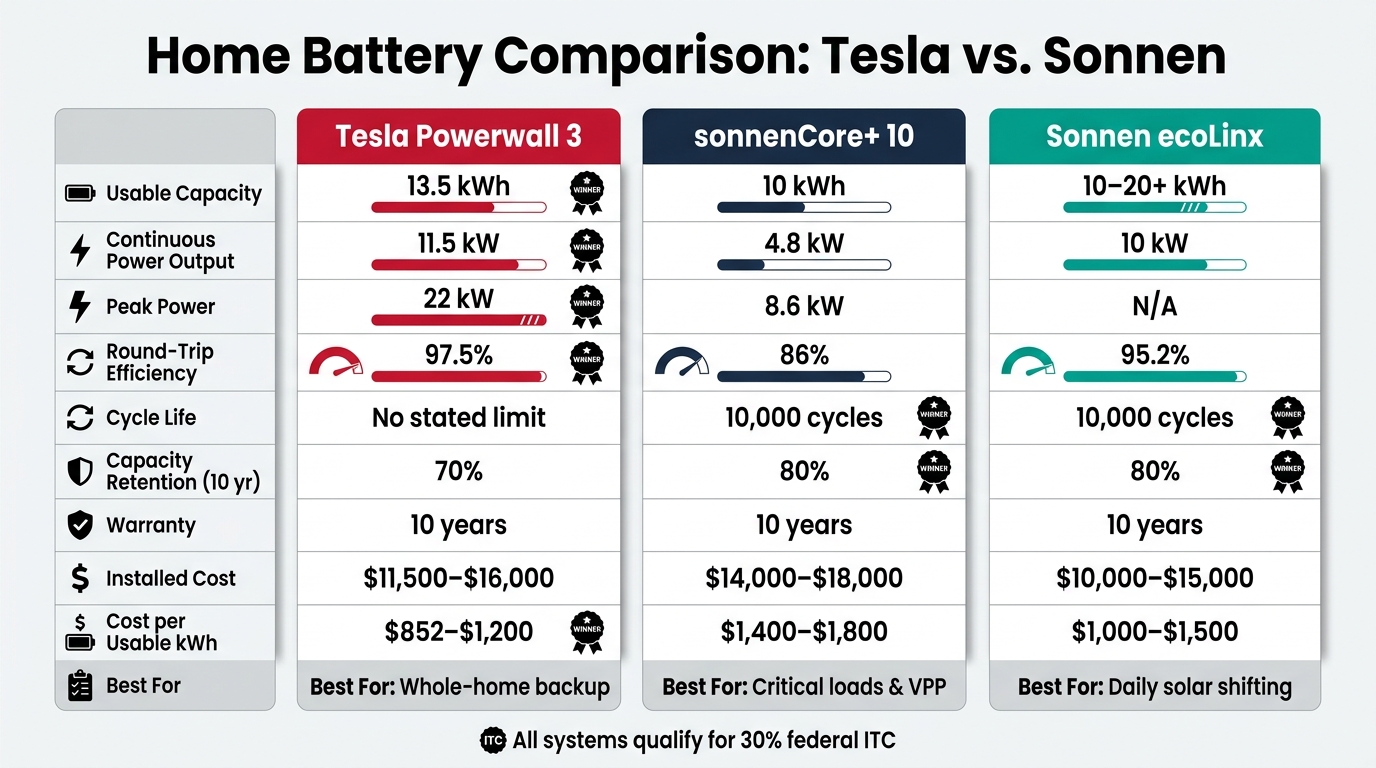
Tesla Powerwall 3 vs Sonnen: Side-by-Side Solar Battery Comparison
Capacity, Power Output, and Backup Behavior
The split between raw power and long-life design shows up fast during an outage.
The Tesla Powerwall 3 puts out 11.5 kW of continuous power and 22 kW of peak power. It also has a motor-start surge current rating of 185 LRA, which helps when heavy loads kick on, like well pumps and central air conditioners.
The sonnenCore+ delivers 4.8 kW continuous power and 8.6 kW peak power. That works for critical loads, but not full-home backup. If you want to handle the surge demand of a central AC, you'd likely need two or three sonnenCore+ units.
The ecoLinx gets closer, with 10 kW continuous power, but Powerwall 3 still leads if you're looking at a single-battery setup.
Both systems switch over in under 100 milliseconds, which helps protect sensitive electronics.
That power gap starts to matter even more once installation limits and solar panel compatibility come into play.
Efficiency, Cycle Life, and Warranty Terms
This is where the two brands go in different directions. One leans harder into energy efficiency. The other makes a stronger case for long-term battery retention.
| Spec | Tesla Powerwall 3 | sonnenCore+ 10 | Sonnen ecoLinx |
|---|---|---|---|
| Round-Trip Efficiency | 97.5% | 86% | 95.2% |
| Chemistry | LFP | LFP | LFP |
| Cycle Life | No stated cycle limit for normal solar use | 10,000 cycles | 10,000 cycles |
| Capacity Retention at 10 Years | 70% | 80% | 70% |
| Warranty | 10 years | 10 years | 10 years |
Powerwall 3's 97.5% round-trip efficiency means less solar power is lost while charging and discharging. In plain English, more of the energy your panels make can be used later.
Sonnen, though, has the stronger retention claim. The sonnenCore+ keeps 80% capacity after 10 years or 10,000 cycles, compared with Tesla's 70%. So if your main focus is battery health over the long haul, Sonnen comes out ahead.
The next piece is less about specs on paper and more about day-to-day use: app control, utility links, and grid programs.
Apps, Controls, and Grid Program Readiness
Tesla keeps things simple. Its app is built for real-time monitoring and EV charging control, which makes it a good match for homes that already use Tesla products.
Sonnen leans more toward utility coordination. Its software offers deeper load monitoring and is built to work with utility communication protocols and demand response programs. For homeowners interested in Virtual Power Plant programs or utility rebates in certain markets, that can be a big deal.
Put simply, Powerwall fits homes centered on Tesla gear, while Sonnen fits homes that want tighter utility and grid-service ties.
Those differences in software and backup setup also shape installation complexity and total system cost.
Installation, Costs, and Electrical Infrastructure
Installed Cost and Value per kWh
Once you move past performance specs, installation is where the price spread starts to hit home. And when you compare these systems, cost per usable kWh tells you a lot more than the sticker price alone.
The Tesla Powerwall 3 comes in at $11,500–$16,000 installed for one 13.5 kWh unit. That works out to $852–$1,200 per usable kWh. The sonnenCore+ 10 lands at $14,000–$18,000 installed for 10 kWh, or $1,400–$1,800 per usable kWh. The Sonnen ecoLinx 10 is priced at $10,000–$15,000 installed, which puts it at $1,000–$1,500 per usable kWh.
| System | Usable Capacity | Installed Cost Range | Cost per Usable kWh |
|---|---|---|---|
| Tesla Powerwall 3 | 13.5 kWh | $11,500–$16,000 | $852–$1,200 |
| sonnenCore+ 10 | 10 kWh | $14,000–$18,000 | $1,400–$1,800 |
| Sonnen ecoLinx 10 | 10 kWh | $10,000–$15,000 | $1,000–$1,500 |
All three systems qualify for the 30% federal Investment Tax Credit (ITC). That helps, but it doesn't erase install extras. Permits and main service panel upgrades can add another $1,000–$3,000 to the project total.
On straight upfront cost per kWh, Powerwall leads. Sonnen starts to look better when long-life cycling and ATS integration carry more weight.
Hardware choices can push those numbers up or pull them down.
Solar Compatibility and Panel-Side Requirements
The way a battery connects to the solar side affects both labor and equipment cost. That's where the split between new installs and retrofits becomes pretty clear.
The Powerwall 3 includes a fully integrated hybrid solar inverter with 6 MPPTs. In a new build, that means the panels can wire straight into the battery unit, with no separate solar inverter needed. That setup can cut $1,500–$3,000 in equipment cost. If the home already has a solar array, though, Powerwall 3 has to use AC-coupling.
Sonnen systems are often installed as AC-coupled setups, which makes them a better fit for retrofit jobs where the current inverter stays in place. The ecoLinx also includes an integrated automatic transfer switch (ATS). That can trim $500–$1,500 in switchgear cost compared with setups that need an external unit.
Both systems can still trigger a main service panel upgrade if the current busbar doesn't meet the NEC 120% rule for solar-plus-storage interconnection.
And those wiring decisions shape the rest of the electrical gear the installer may need.
Sourcing Supporting Electrical Equipment
For residential solar-plus-storage projects, Electrical Trader offers new and used breakers, switchgear, transformers, and other power distribution equipment.
Which Is Better for Solar? Final Verdict by Use Case
After looking at output, lifespan, software, and installed cost, the better battery comes down to one thing: how you plan to use your solar storage.
When Tesla Powerwall Is the Better Choice
Powerwall 3 makes more sense when backup power during outages is your main goal. Its 11.5 kW of continuous power is enough to run central HVAC, well pumps, and EV chargers from one unit. By comparison, a single sonnenCore+ delivers 4.8 kW.
It also comes in at a lower installed cost per usable kWh than either Sonnen model.
So if your mindset is backup first, Tesla has the edge. Sonnen makes more sense for homes that use battery storage more often day to day.
When Sonnen Is the Better Choice
Sonnen is a better match when daily cycling and long-term lifespan matter more than peak backup output. Its 10,000-cycle warranty goes beyond Tesla's year-10 guarantee, with 80% capacity retention guaranteed.
There’s also the grid side of the story. If your utility offers virtual power plant programs or demand response plans, Sonnen’s smart-grid setup can be a big plus. For some homeowners, that can tip the scales.
Key Takeaways
| Use Case | Stronger Fit | Primary Reason |
|---|---|---|
| Whole-home backup | Tesla Powerwall 3 | High 11.5 kW output handles HVAC and large motor loads |
| Daily peak-rate shifting | Sonnen | LFP chemistry and 10,000-cycle warranty for frequent use |
| Long-term longevity | Sonnen | 80% capacity retention guaranteed at year 10 |
| Virtual power plant programs | Sonnen | Advanced smart-grid integration and utility program readiness |
| Budget-conscious buyer | Tesla Powerwall 3 | Lower installed cost per usable kWh |
Neither system wins in every situation. The better pick depends on your load profile, outage frequency, utility rates, and how much space you have for the install.
FAQs
How many batteries do I need?
It comes down to three things: how much electricity you use each day, which devices you need during an outage, and how far you want to go with energy independence.
Most homes in the U.S. use about 30.00 kWh per day. A single 13.5 kWh Tesla Powerwall can usually keep must-have loads running for about 24 hours, but it often won’t cover heavy-use equipment like HVAC. If you want backup for the whole house, two or more units are usually the better fit.
Will my current solar setup work?
Yes. Tesla Powerwall and Sonnen are both built to work with existing solar panels and inverters.
They store extra energy made during the day, then let you use it at night or during a power outage. Both systems also use a modular setup, which means you can often add more capacity later if your energy use grows.
That said, compatibility isn't one-size-fits-all. A licensed professional can check your solar array, inverter, and household load to make sure everything lines up.
Which battery is better for outages?
Both Tesla Powerwall and Sonnen are strong picks for backup power when the grid goes down. Tesla Powerwall 3 stands out for whole-home backup because its 11.5 kW continuous output can handle bigger loads, including appliances like HVAC systems.
Sonnen batteries use lithium iron phosphate (LiFePO4) chemistry. Many homeowners like this battery type for its safety profile and long service life. Both brands also come with automatic backup modes that detect grid outages and keep essential appliances running.