

How Tariffs Shape Power Equipment Costs Globally
Tariffs on power equipment, such as transformers and switchgear, are driving up costs and causing supply chain disruptions. Here's what you need to know:
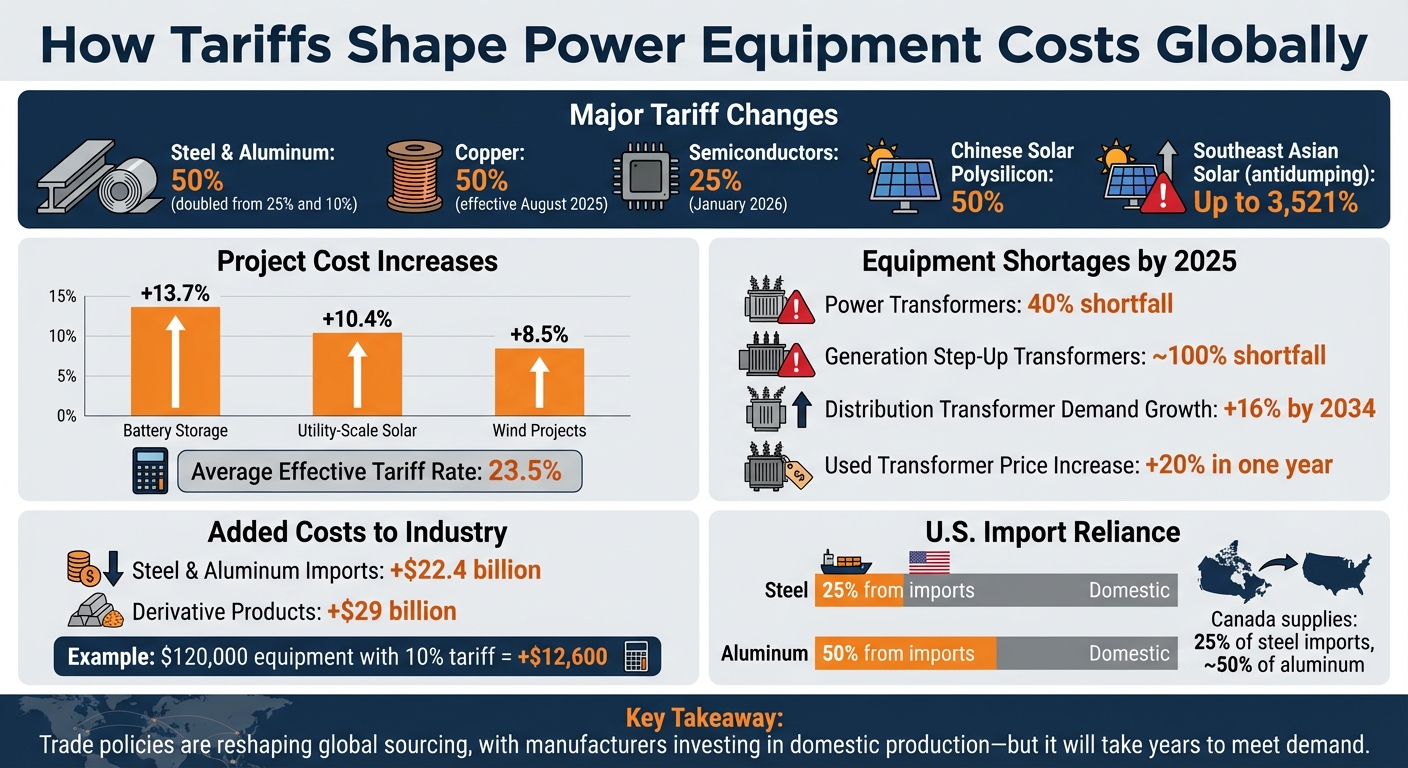
- Tariff Increases: U.S. Section 232 tariffs on steel and aluminum rose to 50% by mid-2025, doubling from earlier rates. Copper and solar components also face steep duties.
- Impact on Costs: Tariffs add significant expenses to imported goods. For example, a $120,000 piece of equipment with a 10% tariff sees an additional $12,600 in costs.
- Supply Chain Issues: Tariffs are causing delays and shortages, with power transformer supply projected to fall 40% short by 2025.
- Higher Utility Rates: Rising equipment costs are passed on to consumers, increasing electricity rates.
These policies are reshaping global sourcing strategies and pushing manufacturers to invest in domestic production, though it will take years to meet demand.
How Tariffs Impact Power Equipment Costs: Key Statistics and Projections
Understanding Tariffs | An Equipment Dealers Perspective
sbb-itb-501186b
Major Tariff Policies Affecting Power Equipment Costs
The U.S. tariff structure has undergone notable changes, directly influencing the pricing and sourcing of power equipment. A significant driver of these changes is the Section 232 tariffs, which have expanded from raw materials to include a variety of finished and derivative products. By June 2025, tariffs on steel and aluminum imports will rise to 50%, doubling from their initial rates of 25% and 10%, respectively. This sharp increase has pushed manufacturers and utilities to rethink their procurement strategies.
These tariffs now extend to structural steel beams, critical components, and semi-finished copper products, forcing companies to adapt their sourcing. For instance, a 50% tariff on copper, effective August 2025, impacts essential grid components like transformers. Adding to the challenge, the U.S. government removed the individual exclusion system in March 2025, making it impossible for companies to request exemptions for materials unavailable domestically. Nicole Voigt, Managing Director and Partner at BCG, emphasized the urgency of adapting:
"Steel and aluminum producers and customers must move swiftly to understand what these tariffs will mean to them and how they can mitigate any negative impact".
Let’s take a closer look at how Section 232 tariffs are shaping the landscape for key metals.
Section 232 Tariffs on Steel and Aluminum
Initially introduced for national security reasons, Section 232 tariffs now enforce a 50% duty on most trading partners, with a few exceptions. For example, the United Kingdom benefits from a lower 25% rate under the U.S.-UK Economic Prosperity Deal, while Russia faces a punitive 200% aluminum tariff. Even Canada and Mexico, despite being part of the USMCA, are subject to the full 50% rate on metals, although certain vehicle-related components are exempt.
Before 2025, these tariffs had already pushed steel and aluminum prices up by 2.4% and 1.6%, respectively. With the new 50% rate, these costs have surged further. The U.S. relies heavily on imports, sourcing 25% of its steel and 50% of its aluminum from abroad. Canada alone supplies 25% of U.S. steel imports and nearly half of its aluminum. This dependence means manufacturers face either steep cost increases or delays as they search for alternative suppliers.
The tariff system has also become more intricate. For standard steel and aluminum products (under HTS Chapters 73 or 76), the 50% duty applies to the full value of the merchandise. However, for more complex items like transformers or switchgear, the tariff applies only to the metal content, requiring detailed documentation to calculate. The U.S. updates these rules three times a year - in January, May, and September - to include additional downstream products. In the September 2025 update alone, 95 requests covering 695 product codes, valued at $287 billion in imports, were submitted.
Beyond U.S. policies, international tariff practices further complicate the situation for power equipment sourcing.
How Different Countries Apply Tariffs to Power Equipment
Tariff policies differ widely across regions, creating a challenging environment for global sourcing. While the U.S. broadly enforces the 50% rate, some sectors receive exemptions under bilateral agreements. For instance, the European Union and Japan have secured exemptions for aerospace products.
In addition to metals, the U.S. has targeted specific sectors critical to power infrastructure. A 25% tariff on semiconductors began in January 2026, though it excludes U.S. data centers and consumer applications. Solar components face even steeper duties: Chinese-sourced polysilicon now carries a 50% tariff as of January 2025, while solar cells and panels routed through Southeast Asia (Cambodia, Malaysia, Thailand, and Vietnam) are subject to antidumping duties that can reach up to 3,521%. These measures aim to counteract China's dominance in global solar supply chains, even though China directly supplies just 1% of U.S. solar imports while controlling over 80% of global production capacity.
In retaliation, trade partners have implemented their own tariffs. For example, Canada imposed 25% duties on approximately C$15.6 billion ($11 billion) worth of U.S. steel and aluminum. As a result, U.S. steel imports dropped 14% by value between January and July 2025 compared to the same period in 2024, while aluminum imports fell by 1%. For buyers of power equipment, these policies translate to higher costs, fewer supplier options, and longer lead times as manufacturers overhaul their supply chains.
How Tariffs Increase Material and Equipment Costs
Tariffs create a ripple effect that drives up costs throughout the manufacturing chain. For example, when raw materials like steel and aluminum are hit with 25% tariffs, the price hikes don’t stop there - they escalate as these materials move through production. The situation worsens with the inclusion of "derivative" products, such as components made from steel and aluminum. Now, manufacturers are paying duties on sub-assemblies used in power equipment, not just on the raw materials themselves. This layered cost structure is pushing project budgets higher, potentially jeopardizing new power infrastructure. These extra expenses stack up at every stage of production.
The numbers are staggering: new tariffs are expected to add $22.4 billion to imported steel and aluminum costs, plus another $29 billion for derivative products. For the power sector, this means significantly higher equipment prices. Tariffs have already driven up costs for battery storage projects by 13.7%, utility-scale solar by 10.4%, and wind projects by 8.5%. On average, the effective tariff rate on materials used in the power sector now stands at 23.5%.
Materials Most Affected by Tariffs
Copper, steel, and aluminum are the backbone of power distribution equipment, and all three face heavy tariff pressures. Copper is indispensable for transformer windings and electrical conductors. Steel is critical for structural support and magnetic cores, while aluminum serves as a lightweight option for conductors and enclosures. The U.S. metals manufacturing industry relies heavily on imports - 24% of steel and 35% of aluminum come from abroad. This dependence makes domestic manufacturers especially vulnerable to tariff-induced price increases.
Manufacturers are left with two difficult choices: pay the full tariff on imported specialized metals or compete for a limited domestic supply, which drives up local prices regardless of origin. This is particularly challenging for equipment like transformers and turbines, which require large quantities of these metals and are affected by cumulative tariffs on multiple materials. Ultimately, these rising material costs are making domestic production more expensive across the board.
How Tariffs Raise Domestic Manufacturing Costs
Even equipment made entirely in the U.S. isn’t immune to higher costs. Domestic producers still need to import raw materials, and with nearly 75% of U.S. steel imports now subject to 25% tariffs - including imports from major partners like the EU, Canada, Mexico, and Japan - options are limited. Iacob Koch-Weser, Associate Director at BCG, summed it up:
"The main options are to source domestically or pay more for imported materials. Shifting sourcing locations is less useful if everyone faces the same tariffs".
This creates a supply crunch, allowing domestic mills to charge more since imported alternatives are burdened with steep duties. For power equipment manufacturers, input costs rise no matter where the materials come from. The issue is especially severe for specialized equipment, which is already in short supply. For instance, the supply of power transformers is projected to fall 40% short by 2025, while generation step-up transformers could face a near 100% shortfall. With demand for distribution transformers expected to grow by 16% by 2034, these tariff-driven price increases are straining an already tight market.
Supply Chain Disruptions Caused by Tariffs
Tariff hikes are doing more than just raising costs - they’re throwing supply chains into chaos, delaying projects across the board. Sudden shifts or sharp increases in tariffs leave manufacturers stuck between a rock and a hard place. When tariffs jump by 25% to 50%, companies can’t simply absorb those costs overnight. This uncertainty freezes decision-making and halts orders in their tracks. As Saulco Enterprises put it:
"There is no way anyone in the sales channel can pay a 25% duty and then eat it if the tariffs are removed afterwards. Our guess is that most or all orders are going to be put on hold if subject to tariffs."
This hesitation doesn’t just affect individual companies - it ripples through the entire supply chain, creating bottlenecks, especially for specialized equipment that’s already in short supply. The result? Production and delivery delays that are hard to ignore.
Production and Delivery Delays for Power Equipment
One area hit particularly hard is transformer production. In October 2025, Benjamin Boucher, a Senior Analyst at Wood Mackenzie, revealed that the supply of power transformers is projected to fall 40% short in 2025. For Generation Step-Up (GSU) transformers, the situation is even worse, with a nearly 100% shortage expected. Lead times for these critical components, which used to be measured in months, are now stretching into years. Travis Edmonds, Vice President of Supply Chain at Hitachi Energy, highlighted that lead times for key transformer types are now 3 to 4 times longer than they were just a few years ago.
The scarcity is also driving up prices. Over the past year, used transformer prices have surged by 20% as industrial and renewable energy sectors scramble to secure equipment. Gas turbines are facing similar issues. With demand from data centers skyrocketing, production has fallen behind, causing prices to more than double in recent years. Even transporting these massive pieces of equipment has become a challenge - specialized railcars and semi-trailers needed for large transformers now require 18 months for construction and testing.
Changes in Global Sourcing Strategies
In response to these disruptions, manufacturers are rethinking their sourcing strategies. With China’s trade-weighted average tariff rate hitting 41% by late 2025 - creating a 24 to 30 percentage point gap compared to ASEAN countries - many companies are shifting supply chains to regions like Taiwan, Indonesia, Vietnam, and Malaysia. To counteract this trend, the U.S. has introduced a 40% transshipment tariff to discourage goods from high-tariff countries like China being rerouted through low-tariff hubs such as Singapore.
At the same time, manufacturers are doubling down on U.S. production to avoid import duties. In April 2025, GE Vernova announced a $600 million investment in its factories in Clearwater, Florida, and Charleroi, Pennsylvania, to ramp up production of high-voltage transformers and circuit breakers. Hitachi Energy followed suit, putting $22.5 million into a new dry-type transformer facility in southwest Virginia. Schneider Electric is also in the mix, committing $700 million to expand facilities in Tennessee, Missouri, and North Carolina through 2027. As Travis Edmonds from Hitachi Energy explained:
"Building local capacity is critical to strengthening supply chain resilience, but it doesn't eliminate the need for a global supply chain to meet demand when it can't be fully served from within the U.S."
While these investments are promising, they won’t solve the problem overnight. It will take years for these facilities to become fully operational, meaning supply chain challenges aren’t going away anytime soon. For buyers navigating these delays, platforms like Electrical Trader (https://electricaltrader.com) offer a lifeline, providing access to both new and used power distribution equipment when lead times stretch into years.
How Tariffs Affect Utility Companies and Electricity Rates
Higher Equipment Costs for Utility Companies
Tariffs are driving up the cost of essential equipment for utility companies. For instance, the U.S. power industry now faces an average tariff rate of 38% on electrical equipment. By late 2025, tariffs on imports are expected to reach an effective rate of 23.5%. These increases have significantly impacted power projects, with grid upgrade costs climbing sharply. Tariffs on grid-scale batteries alone hover around 65% and could potentially exceed 80%.
The situation is further complicated by tariffs on materials like steel, aluminum, and copper, which are critical for grid upgrades and expansion projects. These higher material costs ripple through the entire power sector, creating a challenging landscape for manufacturers and utility companies alike. This dynamic has led to a policy contradiction: federal clean energy subsidies are being offset by the rising costs caused by tariffs. Chris Seiple, Vice Chairman of Power and Renewables at Wood Mackenzie, summed up the issue:
"In a business with 5-to-10-year planning cycles, not knowing what a project will cost next year or the year after is disruptive and causes massive uncertainty for US power industry participants."
Ultimately, these escalating construction and upgrade expenses are passed down to consumers, leading to higher electricity rates.
Potential Increases in Consumer Electricity Rates
As equipment costs rise, utility companies are left with little choice but to adjust consumer rates. The increased expenses directly affect electricity bills, as regulated utilities typically recover these "prudent costs" through rate hikes. Tariff-driven capital expenditures, therefore, make higher electricity rates almost inevitable. Additionally, sudden cost surges can strain the financial stability of utility companies, potentially increasing their borrowing costs. Jasper Shi, Assistant Vice President of Corporate Ratings, explained:
"U.S. regulated utilities are confronting the current 50% tariffs on steel, aluminum, and copper with a mix of caution and resilience. Credit impacts should be manageable for most, provided regulators continue to support prudent cost recovery, but there is little doubt the tariffs have introduced incremental risk."
The situation is further complicated by delays in clean energy projects. For example, $9.5 billion worth of battery projects were canceled between 2024 and 2025, forcing utilities to rely on costly fossil fuel "peaker" plants to meet rising demand from data centers and electrification. In areas with a high concentration of data centers, tariffs have pushed construction costs up by mid-to-high single digits, delaying the integration of clean energy sources and keeping electricity rates elevated. These challenges underscore how tariff policies are reshaping the economics of the energy sector, influencing both utility decision-making and consumer costs.
Conclusion
Tariffs are shaking up the global power equipment market, impacting everything from procurement strategies to consumer electricity costs. Battery storage project expenses have risen by 13.7%, utility-scale solar by 10.4%, and wind energy by 8.5%. Meanwhile, the average effective tariff has climbed to 23.5%. These changes are causing ripple effects across the industry.
To sidestep high-tariff zones, companies are restructuring supply chains, shifting production to places like Taiwan, Indonesia, and domestic facilities. However, equipment shortages are becoming a pressing issue. By 2025, there’s a forecasted 40% shortfall in power transformers and an almost total shortage of generation step-up transformers, forcing utilities to rethink project timelines and energy strategies.
Staying prepared is now more important than ever for industry professionals. Practices like conducting tariff audits, keeping up with updates to the Harmonized Tariff Schedule codes, and developing financial models based on different scenarios are becoming essential. Additionally, contractual measures such as tariff-sharing clauses can provide flexibility when policies change.
Trade policies are redrawing the power equipment landscape, and those who adapt quickly are more likely to stay competitive. Understanding how tariffs affect costs - from CIF values to final landed expenses - has become a critical skill. For professionals navigating these challenges, resources like Electrical Trader offer access to both new and used power distribution equipment, helping them make informed decisions in this unpredictable market.
FAQs
Why can U.S.-made power equipment still get more expensive during tariffs?
U.S.-made power equipment often faces rising costs during tariff periods. This increase stems from issues like supply chain disruptions, longer project timelines, and equipment shortages. Instead of reshoring production to address these challenges, manufacturers frequently choose to raise prices, which adds to the overall expense.
How do companies calculate tariffs on complex equipment like transformers and switchgear?
When companies calculate tariffs on complex equipment, they focus on the country of origin to determine the applicable duties. These tariffs are then included in the final landed cost, which accounts for the product price, freight, insurance, and various import fees. It's important to note that the shipping location has no impact on how tariffs are calculated.
What can utilities and buyers do now to reduce tariff-driven delays and costs?
Utilities and buyers can tackle tariff-related delays and expenses by implementing strategies such as strategic sourcing, stockpiling essential equipment, and pushing for policy adjustments. These approaches aim to control escalating costs and reduce supply chain interruptions that affect power distribution equipment.