STATCOM vs Capacitor Bank in Wind Farm Voltage Control
If you need fast voltage control at a wind farm PCC, I’d pick a STATCOM. If you mainly need low-cost power-factor correction on a strong grid, I’d pick capacitor banks.
That’s the short answer. A STATCOM reacts in milliseconds, can keep supplying reactive current during voltage dips, and is often the better fit for weak grids, LVRT rules, and flicker control. A capacitor bank costs far less - often around $5–$15/kVAR versus about $40–$80/kVAR for a STATCOM - but it works in fixed or switched steps, moves much more slowly, and gives less reactive power when voltage drops.
If I were narrowing the choice, I’d look at these points first:
- Response time: STATCOMs act in under 2 cycles; capacitor banks switch in seconds
- Fault support: STATCOMs help during LVRT events; capacitor output drops with voltage
- Grid strength: STATCOMs fit weak or soft grids better
- Cost: Capacitor banks are usually the lower-price option
- Power quality: STATCOMs help with flicker; capacitor banks can add harmonic resonance risk
- Space: STATCOMs usually need less yard space
- Maintenance: STATCOMs need power-electronics and controls support; capacitor banks are simpler to maintain
- Best middle ground: many projects use a hybrid setup - capacitor banks for base VARs, a smaller STATCOM for fast events
Bottom line: STATCOM for dynamic grid support, capacitor banks for steady-state correction, and a hybrid design when you need both cost control and fast VAR response.
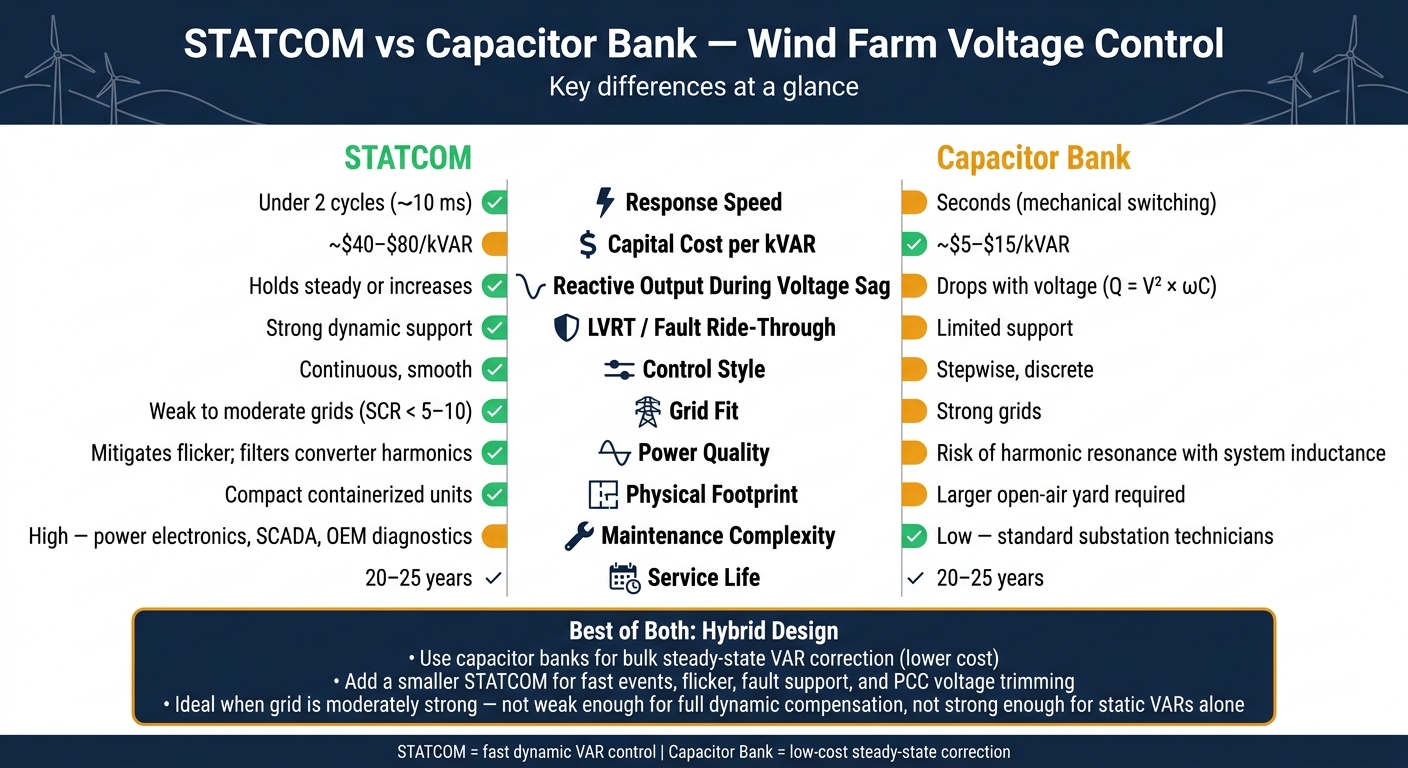
STATCOM vs Capacitor Bank: Wind Farm Voltage Control Comparison
STATCOM vs SVC: What's the Real Difference?
sbb-itb-501186b
Quick Comparison
| Criteria | STATCOM | Capacitor Bank |
|---|---|---|
| Main job | Dynamic voltage and reactive power control | Steady-state reactive power support |
| Response | Milliseconds | Seconds |
| Reactive output during voltage sag | Holds up better | Falls with voltage |
| LVRT support | Strong | Limited |
| Control style | Continuous | Stepwise |
| Grid fit | Weak to moderate grids | Strong grids |
| Power quality | Helps with flicker; uses filters for converter harmonics | Can resonate with system inductance |
| Footprint | Smaller | Larger |
| CAPEX | Higher | Lower |
| Service needs | Higher skill level, OEM support | Simpler substation maintenance |
| Best use case | Tight grid-code response and fault support | Low-cost PF correction |
| Hybrid role | Handles fast events and trimming | Covers bulk steady-state VAR demand |
If you’re deciding between the two, I’d frame it this way: Are you buying cheap static VARs, or are you buying voltage control that can react when the grid gets hit? That one question usually points to the right answer.
How Each Technology Works in a Wind Farm
Once you see how each device operates, the tradeoff becomes a lot easier to understand.
STATCOM: Converter-Based Reactive Power with Millisecond Response
A STATCOM is a shunt-connected voltage source converter (VSC) tied to the collector bus or substation through a coupling transformer. Inside the unit, power-electronic switches generate an AC voltage waveform. When the STATCOM adjusts that output voltage against the grid voltage at the PCC, it can inject reactive current in capacitive mode or absorb it in inductive mode.
Because this response comes from electronics, reactive current can begin flowing in under 10 ms, with full step response arriving in tens to hundreds of milliseconds. That kind of speed matters when voltage dips hit the system or when grid codes call for fast ride-through support. A STATCOM can also hold steady - or even deliver more - reactive current when voltage drops. That lines up with what grid codes ask for during low-voltage ride-through (LVRT) events.
Capacitor Bank: Fixed or Switched Reactive Power for Steady-State Correction
A shunt capacitor bank is connected in parallel at the collector bus or substation. Its reactive output follows Q = V² × ωC, which means output falls as voltage falls.
A fixed bank stays online all the time and provides a steady reactive boost under normal operating conditions. A switched bank splits that output into steps, with each step turned on or off by breakers or contactors based on voltage, power factor, or reactive power flow. The switching happens in discrete steps and depends on mechanical devices, so it moves more slowly than a STATCOM. And when voltage sags, capacitor output drops with it. That’s why capacitor banks are better suited to steady-state correction than fault response.
STATCOM vs Capacitor Bank: Performance, Grid Support, and Footprint
The choice usually comes down to speed, grid strength, and installed cost. Once the basic operating difference is clear, the next step is simpler: which option keeps PCC voltage in line when the grid gets messy, without adding extra cost or risk?
| Category | STATCOM | Capacitor Bank |
|---|---|---|
| Response Speed | Under 2 cycles, continuous VAR control | Seconds, stepwise switching |
| Fault Ride-Through | Strong dynamic support; injects reactive current during LVRT events | Limited; output falls as voltage falls |
| Power Quality | Actively mitigates flicker; filters can manage converter harmonics | Passive; can resonate with system inductance and amplify harmonics |
| Footprint | Compact containerized units; smaller footprint | Larger open-air yard |
Response Speed and Voltage Stability During Wind Swings and Faults
Wind ramps can move PCC voltage fast, and STATCOMs can keep up. That speed gap shows up most clearly during faults and sharp wind swings, when voltage support has to happen almost immediately.
This is not just about better performance on paper. It affects whether the wind farm stays inside interconnection limits during grid disturbances. In plain terms, it’s a compliance issue as much as an equipment choice.
Ride-Through, Flicker, Harmonics, and Weak-Grid Performance
STATCOMs line up well with these grid demands. They can track grid-code reactive current curves and help keep turbines online during disturbances. A capacitor bank can’t give the same kind of fault support because its reactive output drops when voltage drops.
Power quality brings its own set of headaches. Capacitor banks can resonate with system inductance and amplify harmonics. That can turn a simple VAR device into a source of extra trouble in a weak grid. STATCOMs don’t have that same resonance issue, and they can include filters to limit converter switching harmonics.
Footprint and Clearance
Physical size can end up driving the layout. If the collector substation has little room to expand, footprint starts to matter fast.
STATCOMs usually fit into a smaller enclosed area, while capacitor banks need more open yard space and clearance. In a tight substation, that space difference alone can tip the decision.
STATCOM vs Capacitor Bank: Cost, Maintenance, and Equipment Planning
After performance and footprint, cost and upkeep usually decide what stays on the shortlist.
| Category | STATCOM | Capacitor Bank |
|---|---|---|
| Capital Cost per kVAR (approx.) | ~$40–$80/kVAR | ~$5–$15/kVAR |
| Maintenance Frequency | Quarterly to annual, with continuous online monitoring | Semiannual to annual inspections |
| Required Expertise | Power electronics, controls, SCADA, OEM diagnostics | Conventional substation technicians and electricians |
| Typical Service Life | 20–25 years, with major component replacement | 20–25 years, replace failed cans as needed |
| Common Failure Modes | IGBT/valve failures, control board faults, cooling system issues | Capacitor can failures, switch/contactor wear, fuse operations, insulation degradation |
Upfront Cost, Lifecycle Value, and When Higher Performance Pays Off
Capacitor banks are usually much cheaper at the start. A STATCOM can cost several times more per kVAR, so the price difference is hard to ignore.
That said, higher price doesn't always mean poor value. On weak grids, or on projects with strict ride-through rules, a STATCOM's fast and continuous reactive support can earn its keep. It can help a wind farm cut curtailment over the life of the project when the point of interconnection is weak. In U.S. ISO/RTO markets with strict LVRT and dynamic reactive response rules, it can also lower the risk of compliance penalties.
The practical way to judge that tradeoff is simple: model lifetime energy and compliance impact, then compare that value against the added CAPEX. If the grid is strong and the interconnection rules are more forgiving, capacitor banks are still the sensible low-cost pick. And that cost gap doesn't stop at procurement. It also shapes staffing needs, spare parts, and outage planning.
Maintenance Workload, Troubleshooting, and Parts Planning
The maintenance split looks a lot like the cost split.
Capacitor bank maintenance fits normal substation preventive work. That usually means visual checks, infrared scanning, insulation resistance testing, and mechanical inspection of switching devices. It's familiar work for most utility and plant teams.
STATCOM maintenance is a different animal. It calls for people who know power electronics, controls, SCADA, and OEM diagnostic workflows. Teams also need continuous monitoring of converter temperatures and DC-link voltages, plus access to event logs and waveform data when faults show up. In plain terms, troubleshooting a STATCOM is less like checking a breaker and more like tracing a hardware-software problem in an industrial control system.
Parts planning changes too:
- Capacitor banks usually need spare capacitor units, fuses, and switching-device parts
- STATCOMs usually need valve modules, control boards, and cooling components
For STATCOMs, it also makes sense to budget for mid-life component replacement, especially around years 10–15, and line up OEM support early. Fault diagnosis often depends on vendor tools and system data, so waiting until a trip happens is asking for trouble.
Those ownership differences lead straight into the final selection rules.
When to Choose STATCOM, Capacitor Banks, or a Hybrid Design
Once you've compared performance, cost, and footprint, the decision comes down to two things: grid strength and how fast the system needs to respond.
Choose STATCOM for Weak Grids, Strict Ride-Through Rules, and Fast Voltage Control
STATCOM is usually the right pick when the PCC grid is weak, often with a short-circuit ratio below 5 to 10, or when the wind farm ties in through a long radial line far from a strong transmission node. In plain terms, if the grid connection is "soft" or the line is long and exposed, you need fast dynamic VAR support to keep voltage in check.
It's also the better fit when your interconnection agreement or ISO/RTO rules call for low-voltage ride-through (LVRT), fast reactive response within 20 to 60 ms, or continuous VAR support during faults and post-fault recovery.
Choose Capacitor Banks for Lower-Cost Steady-State VAR Support
Capacitor banks make more sense when the grid is strong, PCC voltage stays close to nominal, and the job is mainly steady-state power-factor correction, such as holding a 0.95 lagging to 0.95 leading power-factor range instead of delivering fast dynamic support. Their lower CAPEX and simple staged expansion make them the lower-cost option.
Use a Hybrid Design When Projects Need Both Low Cost and Dynamic Performance
Between those two ends, a hybrid design often hits the sweet spot. It's a good fit when the grid is moderately strong - not weak enough to force full dynamic compensation, but not strong enough for static VARs alone.
The usual setup is simple:
- Use capacitor banks for most of the steady-state VAR correction
- Size a smaller STATCOM for fast events, flicker, fault support, and PCC voltage trimming
That way, capacitor banks cover most steady-state VAR demand at lower cost, while the STATCOM handles the fast stuff and gives the project some breathing room if grid requirements tighten later.
FAQs
How do I know if my grid is weak enough to need a STATCOM?
Check your grid connection strength and review the load survey results. One common sign of a weak grid is a low Short Circuit Ratio (SCR).
A STATCOM can make sense when voltage changes happen fast, such as sharp swings, flicker, or deep dips that mechanical capacitor banks can't react to in time. It can also help when non-linear loads push THD above 5%.
When does a hybrid STATCOM and capacitor bank design make the most sense?
A hybrid design often makes the most sense when both performance and cost control matter - especially in large industrial facilities with steady loads and fast-changing, voltage-sensitive processes.
Capacitor banks handle bulk reactive power at a lower cost. A STATCOM or SVG then adds millisecond-level response for transient events, flicker mitigation, and harmonic filtering. This setup is also a good fit when you can reuse existing capacitor infrastructure.
What hidden costs matter beyond $/kVAR?
Beyond the upfront cost per kVAR, STATCOM systems can bring a long list of extra expenses. The hardware price is only part of the picture. You may also need to budget for engineering, commissioning, and grid integration.
Then there are the costs that show up later. These can include inspections, firmware updates, control-system diagnostics, cooling-system service, and specialized staff training or vendor service contracts.
Capacitor banks can have hidden costs too. If THD goes above 5%, you may need detuned reactors. That can add a 20% to 30% price premium.