Top 5 Trends in Reactive Power Compensation
Reactive power compensation is crucial for maintaining stable voltage levels and improving power efficiency in modern grids. The market is growing rapidly, expected to increase from $6.9 billion in 2025 to $18.5 billion by 2033, with North America leading but Asia-Pacific catching up due to infrastructure expansion. Key players like ABB and Siemens are driving advancements to meet evolving grid demands.
Here are the top five trends shaping the future of reactive power compensation:
- Smart Systems: Real-time monitoring and control using advanced algorithms improve grid stability and reduce power losses, though they come with higher initial costs.
- Renewable Integration: Devices like STATCOMs and synchronous condensers address voltage fluctuations in weak grids caused by solar and wind energy.
- AI Solutions: AI-driven systems offer sub-second responses, predictive maintenance, and improved grid reliability through advanced data analysis.
- Overcurrent Protection: New technologies like thyristor switches and intelligent regulators enhance fault management and ensure equipment safety.
- High Voltage Methods: Active and passive solutions like STATCOMs, SVCs, and shunt capacitors optimize grid performance and delay costly infrastructure upgrades.
These trends are reshaping how utilities and industries manage reactive power, ensuring efficiency and reliability in a rapidly evolving energy landscape.
Reactive Power Compensation: A Balancing Act
sbb-itb-501186b
1. Smart Reactive Power Compensation Systems
Smart reactive power compensation systems rely on advanced control algorithms and digital signal processing to adjust the power factor in real time. This approach addresses the sluggish and inflexible nature of fixed capacitor banks, making the system more responsive and effective.
These systems constantly monitor voltage levels and use inverters - including grid-forming ones that operate as voltage sources - to inject or absorb reactive power instantly. This helps stabilize the grid, even during disturbances. A central controller utilizing a Q(U) function plays a key role by directing inverters to maintain voltage within a stable range as conditions shift.
"The state of the art in power factor compensation highlights a shift towards more efficient, intelligent, and adaptable solutions that aim to minimize power losses, improve power quality, and ensure optimal energy utilization." - IEEE
Smart compensation systems are versatile, fitting seamlessly into both industrial and renewable energy environments. For industrial facilities, they shield sensitive equipment from voltage fluctuations and harmonic distortion. In renewable setups like solar and storage installations, inverters can provide "Q on demand" - delivering reactive power at the grid connection point, even at night when no active power is being produced.
However, these systems come with higher upfront costs compared to passive options, along with ongoing maintenance expenses. Despite this, the investment often pays off by reducing energy losses and avoiding utility penalties. In the U.S., grid operators typically require a displacement power factor of at least 0.95, making it essential to size equipment correctly from the outset. This means accounting for apparent power (kVA) rather than just active power (kW) to ensure compliance without overbuilding the system.
The development of smart reactive compensation systems is paving the way for even better integration of renewable energy sources.
2. Integration with Renewable Energy Sources
Remote solar and wind farms often face reactive power issues due to weak grid connections. These locations typically have a low Short Circuit Ratio (SCR), which signals a weak grid. Without proper reactive power management, even small changes in wind speed or cloud cover can cause voltage fluctuations, potentially threatening grid stability. This highlights the importance of dynamic compensation solutions, as discussed in the earlier section on smart systems.
The primary solution for such environments is the Static Synchronous Compensator (STATCOM). This device can react to voltage disturbances in under 10 milliseconds - far faster than any mechanical switching option. However, renewables also need additional inertia support. To address this, many renewable sites now combine STATCOMs with synchronous condensers, which provide the physical inertia necessary to maintain stability.
Cost considerations play a big role in choosing the right technology. While STATCOMs have higher upfront costs compared to Static Var Compensators (SVCs), synchronous condensers are the most expensive option. That said, their 30+ year lifespan often justifies the investment for large-scale installations.
A hybrid compensation model offers a cost-effective alternative. By pairing Mechanically Switched Capacitors (MSCs) for steady-state reactive support with a STATCOM for dynamic response, this setup reduces the total cost of ownership while still ensuring strong performance during grid disturbances. This approach supports grid stability without compromising on reliability.
When designing these systems, performing an SCR analysis is crucial. The results will guide whether a STATCOM, synchronous condenser, or hybrid configuration is the best fit. Additionally, configuring renewable inverters to comply with IEEE 1547-2018 standards for autonomous volt-var support can reduce the demand on compensation hardware right from the start. These strategies align seamlessly with the advanced compensation methods discussed earlier.
3. AI-Powered Compensation Systems
Traditional tools like on-load tap changers (OLTCs) and fixed capacitor banks often struggle to keep up with the rapid load changes seen today. AI-powered compensation systems bridge this gap by delivering sub-second response times. Using edge intelligence at the Point of Common Coupling (PCC), these systems address disturbances directly on-site instead of relying on slower, centralized grid controls.
At the heart of these systems lies Model Predictive Control (MPC). By analyzing historical load data and schedules, MPC can predict and mitigate voltage deviations before they escalate. AI-driven grid edge controls operate at sampling rates exceeding 100 samples per cycle, making it possible to detect and respond to fast voltage and current fluctuations. This proactive approach ensures a more stable and reliable grid.
These systems typically operate within a three-tier hierarchical structure:
- Local control loops: Handle immediate stability at the site level.
- Supervisory layer: Focuses on optimizing efficiency across the system.
- Enterprise layer: Manages workload-aware coordination across networks.
This layered approach not only provides immediate grid stability but also scales effectively, from individual facilities to large utility networks, supporting the shift toward more dynamic reactive compensation strategies.
By maintaining a near-unity power factor, these systems reduce I²R losses and improve the utilization of transformers and cables. Beyond efficiency, they can transform large loads from passive consumers into grid-supportive assets, offering reactive support during peak stress events. This capability can help utilities avoid costly infrastructure upgrades.
"Future systems will increasingly leverage AI and reinforcement learning to optimize grid interaction while maintaining strict cybersecurity through zero-trust architectures." - IAS Research
For these systems to perform at their best, high-resolution data is critical. Deploying phasor measurement units (PMUs) and high-speed power quality meters ensures the AI algorithms receive the detailed input they need. Without accurate data, even the most advanced control systems will fall short. These advancements in AI-powered solutions complement ongoing progress in overcurrent protection, paving the way for further breakthroughs in reactive power compensation.
4. Overcurrent Protection Advances for Compensation Equipment
Recent progress in rapid-response systems has paved the way for better protection against overcurrent events, especially for reactive power compensation equipment, which has long been vulnerable in this area.
Traditionally, capacitor banks have relied on High Rupture Current (HRC) fuses rated at 4.1 to 5.1 times the capacitor's rated current. While effective in a static environment, this passive approach struggles to adapt to fast-changing conditions.
One major improvement is the shift from conventional contactors to thyristor switches. These switches can reintroduce a capacitor into the circuit within just 5 milliseconds after removal, a massive improvement over the several minutes required by traditional discharge resistors. This speed is essential for managing real-time load changes.
Additionally, modern intelligent regulators take protection to the next level by continuously monitoring critical factors like voltage, current, harmonics, and ambient temperature. They can automatically disconnect components when thresholds are exceeded. For instance, if total harmonic distortion (THD) in voltage exceeds 5%, the system typically triggers a shutdown. This kind of proactive monitoring is crucial for improving fault management in inverters.
Inverter technologies are also stepping up, incorporating advanced current-limiting strategies. For example, grid-forming inverters (GFMIs) now use a combination of virtual impedance and current-limiting techniques to handle faults while maintaining their role as voltage sources. As noted in a ScienceDirect analysis:
"Combined virtual impedance and current-limiting strategies enhance fault ride-through, reduce transient oscillations, and facilitate smooth grid support even at high renewable penetration."
A broader trend in system design is the integration of control and protection as interconnected challenges. Engineers are increasingly adopting simulation-based co-design methods, which consider the limited fault-current capabilities of inverter-based resources from the start. This is particularly important for low-inertia grids, where the declining use of conventional synchronous generators makes traditional protection methods less reliable. These co-designed systems are built to grow and adapt alongside the grid.
These innovations in overcurrent protection highlight the industry's focus on building more resilient and adaptable systems for today’s rapidly evolving power grid.
5. High Voltage Reactive Power Compensation Methods
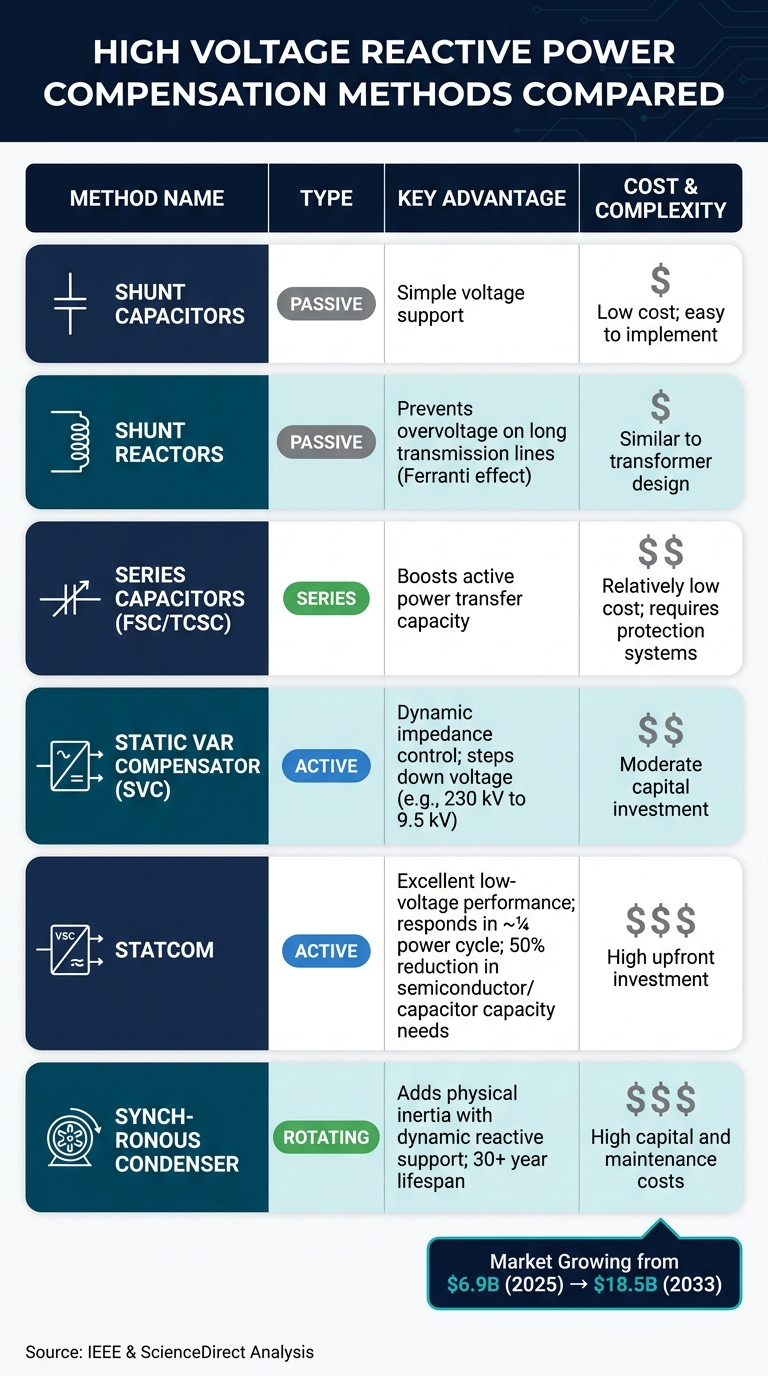
High Voltage Reactive Power Compensation Methods Compared
Handling reactive power at high voltage levels comes with its own set of challenges. The stakes are higher, the infrastructure is more complex, and any misstep can have immediate and widespread effects on grid stability. To address this, both passive and active compensation technologies have evolved significantly.
High voltage compensation typically falls into two categories: passive and active methods. Passive approaches include tools like shunt capacitors, shunt reactors, and series capacitors. For instance, shunt reactors are used to absorb excess reactive power on long transmission lines, helping to prevent overvoltage under light load conditions. This phenomenon, known as the Ferranti effect, is a common issue in high-voltage systems.
Active compensation, on the other hand, relies on advanced devices. Static VAR Compensators (SVCs) are a good example - they step down transmission voltages (e.g., from 230 kV to 9.5 kV) to reduce component size and overall cost. STATCOMs take this a step further by using Voltage Source Converter (VSC) technology, enabling them to respond in about a quarter of a power cycle. This innovation cuts the capacity needs for semiconductor converters and capacitor banks by half, making them more compact and efficient, albeit with a higher upfront cost.
| Method | Type | Key Advantage | Cost/Complexity |
|---|---|---|---|
| Shunt Capacitors | Passive | Simple voltage support | Low cost; easy to implement |
| Shunt Reactors | Passive | Prevents overvoltage on long lines | Similar to transformer design |
| Series Capacitors (FSC/TCSC) | Series | Boosts active power transfer capacity | Relatively low cost; needs protection |
| Static VAR Compensator (SVC) | Active | Dynamic impedance control | Moderate capital investment |
| STATCOM | Active | Excellent low-voltage performance; compact | High upfront investment |
| Synchronous Condenser | Rotating | Adds physical inertia with dynamic support | High capital and maintenance costs |
The variety of these methods reflects a growing trend toward distributing compensation efforts across the grid rather than centralizing them in one location.
One key issue with reactive power is its higher transmission losses compared to active power. For this reason, compensation devices need to be strategically placed throughout the grid. In grids with significant renewable energy sources, VSC-based STATCOMs are particularly useful. They outperform traditional SVCs in scenarios with frequent voltage disturbances, thanks to their rapid response time.
Aside from their technical benefits, advanced compensation methods also make economic sense. By enabling existing transmission lines to operate closer to their thermal limits, they can delay the need for costly new infrastructure. However, the high initial and maintenance costs remain a barrier, especially for smaller utilities. As grid expansion costs increase, these systems offer a practical way to maximize the efficiency of current assets.
Conclusion
Technological advancements are playing a key role in addressing the evolving challenges faced by modern power grids. The trends discussed - smart reactive power compensation systems, renewable energy integration, AI-driven solutions, overcurrent protection innovations, and high-voltage compensation methods - are reshaping how the power sector manages reactive power. Together, they tackle critical issues like grid instability, renewable energy variability, and the constraints of aging infrastructure.
The rapid growth of the market reflects the increasing demand for advanced solutions. As noted by IEEE:
"The state of the art in power factor compensation highlights a shift towards more efficient, intelligent, and adaptable solutions that aim to minimize power losses, improve power quality, and ensure optimal energy utilization in diverse applications and industries."
For engineers, utility operators, and procurement teams, having access to the right tools is essential. Equipment such as capacitor banks, synchronous condensers, STATCOMs, and static VAR compensators plays a critical role in ensuring grid reliability and efficiency. Platforms like Electrical Trader simplify the procurement process, offering a centralized marketplace for both new and used high-voltage and low-voltage compensation equipment, helping professionals streamline their projects.
As grid modernization progresses and renewable energy becomes more prominent, the role of reactive power compensation will only grow. These trends aren't just shaping the future - they are essential for meeting the industry's current demands.
FAQs
How do I choose between an SVC, STATCOM, synchronous condenser, or a hybrid setup?
The choice of technology depends on what the application requires, how the system operates, and budget constraints. SVCs (Static Var Compensators) work well in transmission networks, offering fast voltage control through power electronics. STATCOMs (Static Synchronous Compensators) are even quicker, providing dynamic support to enhance grid stability. Synchronous condensers, on the other hand, deliver consistent reactive power without relying on intricate electronic systems. For a more tailored solution, hybrid setups combine these technologies, balancing quick response times with durability, adjusted to fit the system's size, required response speed, and overall costs.
What data and sensors are needed for AI-based reactive power compensation to work well?
AI-based reactive power compensation depends heavily on precise data and reliable sensors to keep track of electrical conditions. The most critical inputs include real-time measurements of voltage, current, and the power factor. To gather this data, systems typically use tools like voltage transducers, current transformers, and power meters. For more advanced setups, transient detection sensors might also be employed to manage sudden shifts in load. These inputs feed into AI algorithms, which dynamically adjust equipment such as capacitor banks or STATCOMs, helping maintain an optimal power factor and ensuring the stability of the system.
Where should reactive power compensation be installed to minimize losses and improve voltage stability?
Reactive power compensation works best when installed in locations that improve voltage stability and minimize system losses. These spots are usually near the load or critical points along transmission lines. Placing compensation devices in these areas helps manage reactive power demands effectively and prevents voltage drops, ensuring the system operates efficiently.