Capacitor Banks vs STATCOM vs SVG: Comparison
If your load is steady, capacitor banks are usually the low-cost fix. If your voltage drops fast, STATCOM is the better pick. If harmonics, flicker, or phase imbalance are the main problem, SVG is often the better fit.
I’d sum it up like this: all three options cut reactive power demand, but they do very different jobs. A 500 kW load at 0.75 PF draws about 667 kVA. At 0.95 PF, that drops to about 526 kVA. That means about 21% less current and about 38% lower copper losses. So the right correction method can cut utility costs and help bus voltage at the same time.
Before I go deeper, here’s the plain-English version:
-
Capacitor banks
- Lowest first cost
- Best for steady motor loads
- Slow step switching
- Can run into harmonic resonance if not detuned
- Give less support when voltage sags
-
STATCOM
- Best for fast voltage support
- Reacts in milliseconds
- Stepless, bidirectional VAR control
- Higher first cost and more service work
- Fits arc furnaces, weak feeders, large motor starts, and renewable tie-ins
-
SVG
- Fast active compensation at the plant level
- Good for harmonics, flicker, and unbalanced loads
- Usually costs more than capacitor banks, less than utility-grade STATCOM
- Fits welders, cranes, VFD-heavy plants, injection molding, and EV charging
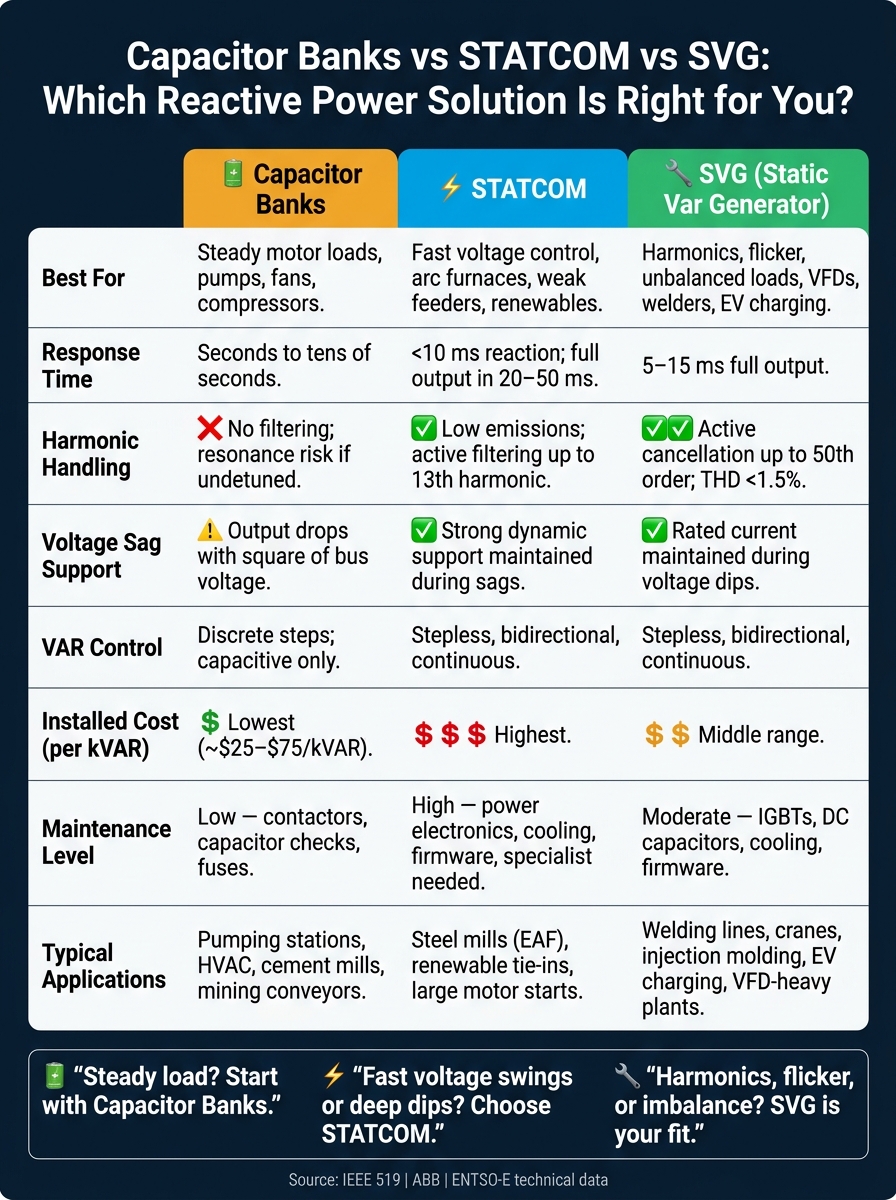
Capacitor Banks vs STATCOM vs SVG: Side-by-Side Comparison
STATCOM Explained - How It Beats the SVC
sbb-itb-501186b
Quick Comparison
| Option | Best For | Response | Harmonics | Voltage Sag Support | Cost |
|---|---|---|---|---|---|
| Capacitor Banks | Steady PF correction | Seconds to tens of seconds | No filtering; resonance risk | Output drops as voltage drops | Lowest |
| STATCOM | Fast voltage control | Less than 10 ms reaction; full output in 20–50 ms | Low converter emissions; some units filter harmonics | Strong support during sags | Highest |
| SVG | Harmonics, flicker, imbalance, fast load swings | About 5–15 ms | Active harmonic cancellation | Holds rated current during dips | Middle |
My bottom line: if you only need baseline power factor correction, start with capacitor banks. If the bus sees fast swings or deep dips, look at STATCOM. If the site is full of VFDs, welders, or unbalanced loads, SVG often makes more sense.
That’s the lens I’d use for the rest of this comparison: speed, harmonic risk, voltage support, installed cost, service needs, and best-fit use cases.
2. Capacitor banks: low first cost for steady power factor correction
Capacitor banks are the baseline option when the goal is steady, low-cost power factor correction. Fixed banks stay connected all the time, so they supply a constant kVAR output. Automatic banks switch fixed steps on and off as the load changes to keep power factor near a set target, usually 0.95 to 0.98 lagging. That works well for steady demand. The cracks start to show when loads swing fast or the bus has harmonics.
2.1 Response time, harmonic risk, and voltage support limits
Contactor-switched banks usually respond in seconds to tens of seconds when the next step is needed. That timing is fine for stable loads, but it’s too slow for fast swings.
Voltage support is limited too. Each capacitor step injects a fixed amount of kVAR, and that output drops with the square of bus voltage. So during a voltage sag, the bank gives less support at the exact moment you want more.
The biggest issue is harmonic resonance. Capacitor banks do not filter harmonics. In plants with VFDs, rectifiers, or other non-linear loads, an undetuned bank can set up parallel resonance between capacitor reactance and system inductance. That can get ugly fast. One harmonic study found that adding an undetuned bank pushed voltage THD from 1.18% to 8.25% and current THD from 4.53% to 78.75%.
The usual fix is a detuned bank, which adds series reactors to move the resonant frequency below the lowest major harmonic. A 7% detuning reactor is common for general non-linear loads, while 14% reactors are used when third-harmonic content is more dominant. In that same study, proper detuning cut voltage THD to 0.97% and current THD to 4.28%.
If a plant has a lot of non-linear load content, a harmonic study based on IEEE 519 should be done before installing large banks.
2.2 Installed cost, maintenance, and where capacitor banks work best
Capacitor banks are usually the lowest-cost reactive power compensation choice. Eaton technical data lists:
- Fixed low-voltage banks at about $25/kVAR installed
- Switched low- or medium-voltage banks at about $50/kVAR
- Thyristor-switched versions at roughly $75/kVAR
- Switched harmonic filter banks with reactors at about $60–$75/kVAR
Maintenance is fairly simple compared with active VAR systems. For fixed banks, the main jobs are visual checks for swollen or leaking capacitor cans, infrared scans for hot connections, and periodic capacitance testing. In larger banks, units that drift more than 5% from nameplate are usually replaced.
Automatic banks add more moving parts, so there’s more to watch. That includes contactor or breaker inspection, controller checks, and current balance between phases. Phase current unbalance should stay within 15%. In low-voltage industrial plants, annual inspections are common, though hot or harsh sites often need checks more often.
These banks fit best in places like pumping stations, HVAC systems, cement mills, mining conveyors, and continuous process lines - basically anywhere reactive demand is high, fairly steady, and easy to predict.
2.3 Capacitor bank comparison snapshot
| Feature | Fixed Capacitor Banks | Automatic Capacitor Banks |
|---|---|---|
| Response time | Always on; no dynamic switching | Step switching for moderate load variation |
| Harmonic exposure | Resonance risk if undetuned; detuning reactors are needed in non-linear environments | Same resonance risk; more step interaction complexity |
| Voltage support | Fixed kVAR boost; output falls as bus voltage sags | Adjustable by step, but still limited by delayed, step-based switching |
| Maintenance needs | Low - capacitor health, terminations, fuses, and periodic electrical checks | Moderate - adds contactor or breaker wear, controller checks, and functional testing |
| Best industrial fit | Stable motor loads, constant process lines, and baseline power factor correction at the main switchgear | Plants with shift-based load variation, mixed motor groups, and changing production demand |
When voltage dips, flicker, or load swings happen often, capacitor banks start to look less like a clean fix and more like a stopgap. That’s where dynamic VAR systems enter the picture.
3. STATCOM: fast dynamic VAR support for voltage-sensitive industrial systems
A STATCOM is a shunt-connected converter installed at a substation or distribution bus. It injects or absorbs reactive current in milliseconds, with smooth control from capacitive to inductive. That speed matters most when voltage dips and load swings hit faster than stepped correction can respond.
3.1 Response speed, voltage regulation, and harmonic performance
ABB material notes reaction starting in less than 10 ms, with full output in 20–50 ms, and ENTSO-E describes STATCOM response as less than 2 cycles. If a large motor starts or an arc furnace step-change hits the bus, a STATCOM begins injecting reactive current within milliseconds, which helps limit how deep the voltage dip gets and how long it lasts. Capacitor-bank VAR output falls during a sag, so it can't keep up with that kind of event.
On harmonics, STATCOM is usually a cleaner choice than capacitor banks. Multilevel PWM converters keep switching harmonics low, and many designs need little or no large external harmonic filtering. Some setups also offer active harmonic filtering up to the 13th harmonic. That's useful in plants with VFDs, rectifiers, or arc furnaces, where capacitor banks may need detuning reactors to avoid resonance.
3.2 Cost, maintenance, and best-fit facilities
STATCOM comes with a much higher upfront cost than capacitor banks. The hardware is more complex and more expensive, and the total also includes engineering, commissioning, and grid integration work.
Maintenance is heavier too. STATCOM needs periodic inspection and replacement of power electronic modules, cooling-system service, firmware updates, and control-system diagnostics. In practice, plants usually need trained specialists or a vendor service contract to keep the unit working the way it should.
That higher price makes sense when voltage quality directly affects output or grid compliance. Electric arc furnace steel mills are a clear example. In November 2021, GE Power Conversion was awarded a STATCOM contract for a Serbian steel plant operating a 400 kT/Y mini mill with an electric arc furnace; the existing SVC could not meet flicker limits, and the MMC-based STATCOM achieved a flicker mitigation ratio up to 6.0.
STATCOM also fits renewable interconnections, large fluctuating motors, and grid-code-driven sites that need dynamic VAR support.
3.3 STATCOM vs. capacitor banks: side-by-side comparison
The main tradeoffs versus capacitor banks come down to speed, sag support, and harmonic behavior.
| Factor | STATCOM | Capacitor Banks |
|---|---|---|
| Response time | Less than 10 ms initial reaction; full output in 20–50 ms. | Seconds to tens of seconds for contactor-switched steps |
| Voltage support during sags | Maintains reactive current injection even at low voltage | VAR output drops with the square of bus voltage |
| Harmonic behavior | Low inherent emissions; active harmonic filtering available. | Resonance risk with non-linear loads; detuning reactors often required |
| VAR control | Continuous, stepless, bidirectional | Discrete steps; fixed or switched |
| First cost | Higher - power electronics, controls, cooling, and engineering | Lower first cost per kVAR |
| Maintenance complexity | High - specialized electronics, cooling, and controls expertise needed | Moderate - capacitor health, switching gear, and periodic electrical checks |
| Best industrial fit | Arc furnaces, flicker-sensitive loads, weak grids, renewable tie-in points. | Stable motor loads, predictable VAR demand, continuous process lines |
4. SVG: fast stepless compensation with stronger harmonic and imbalance control
If STATCOM is the utility-grade option, SVG is the plant-level choice for fast compensation and power-quality cleanup. It sits between passive capacitor banks and full STATCOM support.
Put simply, an SVG is an active VAR device for the plant floor. It reacts fast, handles load imbalance, and cuts harmonic side effects better than passive banks. SVG units connect straight to a low-voltage bus or to medium-voltage systems through an interface transformer. The controller measures current at the PCC and injects equal-and-opposite compensating current. That makes SVG a strong fit when reactive demand shifts fast and waveform quality matters.
4.1 How SVG handles harmonics, flicker, and unbalanced loads
SVG usually responds in 5 to 15 ms, which is fast enough for shock loads like arc welding, overhead cranes, and injection molding machines. That speed helps reduce voltage flicker during sharp load swings.
SVG also does more than reactive power control. It can work as an active power conditioner, targeting both low- and higher-order harmonics. Some designs reach the 50th order. That can make a big difference in plants with heavy VFD use or EV fast-charging stations.
Unlike passive banks, SVG does not create a fixed impedance that can interact with system inductance. Instead, it injects compensating current actively, which helps avoid passive resonance issues. SVGs also use three-phase current-balancing algorithms to correct unbalanced loads and cut negative-sequence voltage.
Use SVG when harmonics, flicker, or imbalance stay present at the PCC, especially in:
- Welding lines
- Crane systems
- VFD-heavy panels
- EV charging installations
The tradeoff is higher electronics complexity, which affects both cost and service needs.
4.2 Cost, service needs, and industrial fit
SVG costs more than capacitor banks, but less than utility-grade STATCOM at similar kvar ratings.
Service work usually centers on IGBTs, DC capacitors, cooling, and firmware. If a plant has a solid electrical maintenance team, or a service contract in place, this is often very workable. Most SVGs also tie into SCADA or power-quality monitoring systems for continuous alarm and status reporting.
The payback often shows up in fewer trips, lower THD or flicker penalties, and less transformer derating.
4.3 SVG vs. STATCOM vs. capacitor banks: full comparison table
| Factor | SVG | STATCOM | Capacitor Banks |
|---|---|---|---|
| Response time | 5–15 ms full output. | Milliseconds; full output in 20–50 ms. | Seconds to tens of seconds |
| Harmonic handling | Active cancellation of low- and higher-order harmonics; THD contribution typically below 1.5%. | Can mitigate harmonics and flicker | No mitigation; resonance risk with non-linear loads |
| Voltage support | Rated current maintained during voltage dips. | Strong dynamic support | VAR output falls as voltage drops |
| VAR control | Stepless, bidirectional. | Stepless, bidirectional | Discrete steps; capacitive only |
| Install cost | Higher than capacitor banks; lower than utility-grade STATCOM. | Highest of the three | Lowest first cost per kvar |
| Maintenance profile | IGBTs, DC capacitors, cooling, and firmware. | Specialized electronics, cooling, and controls | Contactors, capacitor checks, and protection devices |
| Best plant scenarios | Welding lines, cranes, injection molding, EV charging, and VFD-heavy plants needing IEEE 519 compliance. | Large facilities needing utility-grade dynamic VAR support | Stable motor loads and low-harmonic environments |
5. Choosing the right option: selection criteria, sourcing, and conclusion
5.1 Selection guide by load profile and plant priority
After comparing response speed, harmonics, and voltage support, the choice usually comes down to three things: how the load behaves, what the site can handle, and how much maintenance support you have.
Start with the load. Measure PF, kW, kVAR, voltage, THDi, and the harmonic spectrum at the main service during normal operating periods. A single snapshot won't tell the whole story. You want data from the times when the plant is actually doing its job.
| Load Profile | Best Fit | Key Drivers |
|---|---|---|
| Stable motors, pumps, fans, and compressors with low THD | Capacitor banks | Utility PF penalties, low downtime risk, simple maintenance |
| Fast-changing or voltage-sensitive loads | STATCOM | Tight voltage tolerance, high downtime cost, weak feeder |
| High THDi, flicker, or unbalanced three-phase loads (welders, rectifiers, many VFDs, single-phase process equipment) | SVG | Harmonic mitigation, waveform quality, phase balancing |
| Mixed retrofit with existing capacitor banks and electronic loads | Hybrid: capacitor banks + SVG or STATCOM | Budget limits, reuse of existing gear, incremental improvement |
Space and staffing can change the answer even when the load profile points in a clear direction. Capacitor banks often fit into existing MCC rooms and can usually be handled by standard electrical staff. STATCOM and SVG systems need more room, cooling planning, and support for power electronics. If maintenance is outsourced, a capacitor-based starting point often makes more sense.
Once the technical fit is clear, buying comes down to voltage class, equipment condition, and budget. For retrofit sourcing, Electrical Trader lists new and used capacitor banks and related power distribution equipment for common U.S. voltage classes, including 480 V, 4.16 kV, and 13.8 kV.
5.2 Conclusion: key tradeoffs to remember
The final pick is a tradeoff between first cost, dynamic performance, and maintenance load. Capacitor banks are still the proven low-cost option for steady power factor correction, and they usually offer the fastest payback when loads stay stable. STATCOM makes more sense when voltage stability is non-negotiable, such as large motor starts on weak feeders, rolling mills, or other processes where a voltage sag can shut down production. SVG is the better fit when the main issue is harmonics, flicker, or phase imbalance rather than reactive power alone.
Don't size any of these options without real load data. If you undersize, performance suffers. If you oversize, you burn cash for no good reason.
FAQs
How do I choose the right size?
Size it from measured needs, not the nameplate. Start with a load and power-quality survey across a full operating cycle. That gives you the numbers that matter at the PCC: kW, kVAR, load swings, and THD.
Then set your power factor target and work out the required kVAR. In the U.S., a target of about 0.95 to 0.98 lagging is common.
The capacitor setup should match how the load behaves:
- Use fixed units for steady loads, around ±10%
- Use automatic switched units when load variation goes above 20%, so you don't overcorrect
If THD exceeds 5%, move to detuned or filtered options. It also makes sense to add a 10–20% safety margin.
Can I combine capacitor banks with SVG or STATCOM?
Yes. These hybrid systems blend the strengths of both technologies to balance performance and cost.
In most setups, capacitor banks handle bulk reactive power, while the SVG or STATCOM makes fast, precise adjustments and helps with harmonic mitigation. This approach works especially well in large industrial facilities that have both steady loads and loads that change fast.
When is a harmonic study necessary?
A harmonic study should be part of the planning process for new facilities and system expansions. It helps you spot problems early, before they turn into expensive retrofits, damaged equipment, or resonance issues after adding power factor correction capacitors.
It also matters if your facility runs non-linear loads such as variable frequency drives, UPS systems, rectifiers, or welders. And if total harmonic distortion is above 5%, that’s a clear sign you need to take a closer look.