

Solar Chargers vs. Power Banks for Backpacking
When it comes to keeping your devices charged on the trail, you’ve got two main options: solar chargers and power banks. Here’s the quick takeaway:
- Power banks are reliable and weatherproof, making them ideal for short trips (1–3 days). They store energy in advance but run out once drained.
- Solar chargers generate electricity from sunlight, offering renewable energy for longer, off-grid adventures (5+ days). However, they depend on good weather and direct sunlight.
Quick Overview:
- Power Banks: Great for short trips. Compact, consistent, but finite energy.
- Solar Chargers: Best for extended trips. Renewable power but weather-dependent.
- Hybrid Setup: Combining both ensures flexibility and reliability for long treks.
For short hikes, stick with a power bank. For multi-day trips, add a lightweight solar charger. A hybrid approach balances stored energy with renewable power, giving you peace of mind wherever you go.
Solar panel vs power bank: How to keep your electronics charged while hiking & backpacking
sbb-itb-501186b
How Solar Chargers Work for Backpacking
Solar chargers rely on photovoltaic (PV) cells to convert sunlight into electricity by absorbing photons and generating an electrical current. Most models designed for backpacking use monocrystalline silicon panels, known for their high efficiency and durability. These panels are crafted from a single crystal ingot, which reduces energy loss by allowing electrons to move more freely.
Backpacking solar chargers typically feature a foldable or trifold design, making it easy to pack a large surface area into a compact form. Some ultralight models weigh as little as 7.3 oz, making them perfect for long treks. To handle outdoor conditions, these panels are often encased in PET polymer or polyester canvas and boast IPX4 to IP68 ratings for protection against rain and dust.
Power is delivered through USB-A, USB-C, or DC output ports, keeping device connectivity simple even in rugged terrain. You can either charge devices directly from the panel or use it to power an external battery bank for later use. However, experts suggest charging a power bank instead of connecting devices directly. This helps avoid interruptions caused by fluctuating sunlight, such as when clouds pass by, which could potentially damage sensitive electronics.
It’s worth noting that real-world performance often falls short of manufacturer claims. Solar panels usually deliver only about 50% of their rated wattage due to factors like weather, sun angle, and temperature. For instance, a 28W panel might generate around 2,177 mAh in one hour of direct midday sun, but under cloudy or shaded conditions, output can drop to roughly 583 mAh. Under optimal conditions, a 10,000 mAh power bank could take 5 to 6 hours to fully recharge.
To maximize efficiency, position the panels directly toward the sun and adjust periodically. Keep any connected devices in the shade to prevent overheating, which can disrupt charging. Many panels even include a back pocket for this purpose. Regularly cleaning the panel surface with a damp cloth also ensures better light absorption.
These thoughtful designs make solar chargers an appealing option for outdoor enthusiasts.
Benefits of Solar Chargers
Solar chargers offer renewable power as long as there’s sunlight, making them invaluable for multi-day trips in sunny regions. By using solar energy, you can avoid carrying multiple heavy power banks or rationing battery life. A 20W–28W panel can provide enough electricity to keep essential devices like GPS units, satellite messengers, and smartphones running for extended periods.
For off-grid adventures, they’re a game-changer. When wall outlets aren’t an option, solar chargers let you generate fresh power daily, making them ideal for thru-hikers, backcountry explorers, or anyone spending a week or more away from civilization.
Modern solar panels often come with smart-charge technology, which adjusts charging speeds for specific devices while preventing overcharging. Built-in ammeters let you monitor real-time current output, helping you troubleshoot issues like poor positioning or cloud cover. Features like metal grommets and carabiner clips make it easy to attach panels to backpacks, tents, or trees, enabling passive charging while you’re on the move or taking a break.
Drawbacks of Solar Chargers
The biggest limitation of solar chargers is their dependence on sunlight, which can be unreliable. Cloudy skies, dense forests, canyon walls, or bad weather can drastically reduce efficiency, sometimes to just 10%–25% of their usual output.
Charging speeds are also slower compared to wall outlets or pre-charged power banks. Even under ideal conditions, fully recharging a 10,000 mAh power bank takes several hours of direct sunlight. On average, backpackers collect about 820 mAh per day - far below the advertised 2,500 mAh - making it important to plan around peak sun hours and adjust panel placement throughout the day.
Additionally, solar panels add weight and bulk to your pack. While ultralight models start at 7.3 oz, larger 20W–28W panels can weigh over a pound. They require careful handling to avoid damage, and performance drops in extreme heat - efficiency decreases by roughly 0.45% for every degree Fahrenheit above 77°F. Sharing the panel’s ports among multiple devices also divides the total wattage, significantly extending charge times.
How Power Banks Work for Backpacking
Power banks store energy in rechargeable lithium-ion or lithium-polymer (LiPo) batteries, making them a practical solution for backpackers needing portable power. Unlike solar chargers, which generate energy on the go, power banks require pre-charging before your trip. You can charge them using a wall outlet, car adapter, or even a solar panel. Once charged, they transfer energy to your devices via USB-A or USB-C ports.
Here’s how it works: the power bank’s internal battery sends energy through its circuitry and out through the USB port. Many modern models support fast-charging technologies like Power Delivery (PD) or Quick Charge (QC), which can significantly cut down charging time. However, keep in mind that conversion inefficiencies mean you won’t get the full advertised capacity. For instance, a 10,000 mAh power bank typically delivers about 6,500–7,500 mAh in actual use, while a 25,000 mAh unit provides around 18,000–19,500 mAh in practice.
Capacity is measured in milliamp hours (mAh) or watt hours (Wh). To figure out watt hours, use this formula: Wh = (mAh × 3.7V) ÷ 1,000. This calculation is especially important for air travel since the TSA limits carry-on power banks to 100Wh, which is roughly equivalent to 27,000 mAh. Weight is another factor to consider. Ultralight options, like the Nitecore NB10000 Gen 3, weigh just 5.3 oz and deliver over 1,800 mAh per ounce. In contrast, budget-friendly models like the Anker PowerCore Slim 10K weigh 8.6 oz for the same 10,000 mAh capacity.
Temperature can also impact performance. In freezing conditions, efficiency drops by about 8.9%, and charging may stop entirely if the temperature falls below 0°C. To prevent this, keep your power bank warm - inside your sleeping bag or jacket pocket works well. On the flip side, prolonged exposure to heat (around 100°F) can reduce battery retention to 81–85% after just 50 charging cycles.
Understanding these factors helps you make the most of your power bank on the trail.
Benefits of Power Banks
Power banks offer dependable power no matter the weather, terrain, or time of day. Once fully charged, they deliver consistent performance, whether you're trekking through a dense forest, navigating a canyon, or enduring several days of rain.
Thanks to advancements like high-wattage USB-C PD ports, many power banks can recharge a smartphone in under two hours. Some models even feature multiple ports, allowing you to charge several devices simultaneously without sacrificing speed. For trips lasting 1–7 days, power banks strike a great balance between weight and energy. A 10,000 mAh unit, for example, can provide 1.5–3 full phone charges while weighing as little as 5.3 oz. Plus, trusted brands like Anker often back their products with 18-month warranties, and their power banks are designed to last 500–1,000 charge cycles before capacity starts to drop noticeably.
Drawbacks of Power Banks
Despite their advantages, power banks do have limitations. The most obvious one is their finite capacity. Once the stored energy runs out, you’ll need access to a charging source or carry additional units - something that’s not always feasible on trips longer than a week. Larger-capacity models can help but come at the cost of added weight, which can be a concern for ultralight backpackers.
Another drawback is the need for pre-charging. If you forget to charge your power bank before setting out or if your trip lasts longer than expected, you could find yourself without power. This is where solar chargers have an edge - they can replenish energy as long as there’s sunlight.
Proper storage and handling are also crucial. To extend the lifespan of your power bank, store it with a charge level between 50% and 80%. Using high-quality charging cables is equally important, as cheaper ones can slow charging speeds by up to 50%. In cold weather, keeping your power bank warm may require sacrificing valuable pocket or sleeping bag space. While most power banks are sturdy, they’re not always built to withstand harsh outdoor conditions unless you opt for rugged models like the BioLite Charge 80 PD, which weighs a hefty 17 oz but offers added durability.
Solar Chargers vs. Power Banks: Side-by-Side Comparison
Solar Chargers vs Power Banks Comparison for Backpacking
We’re diving into the key differences between solar chargers and power banks to help you choose the best option for your backpacking adventures.
Comparison Table
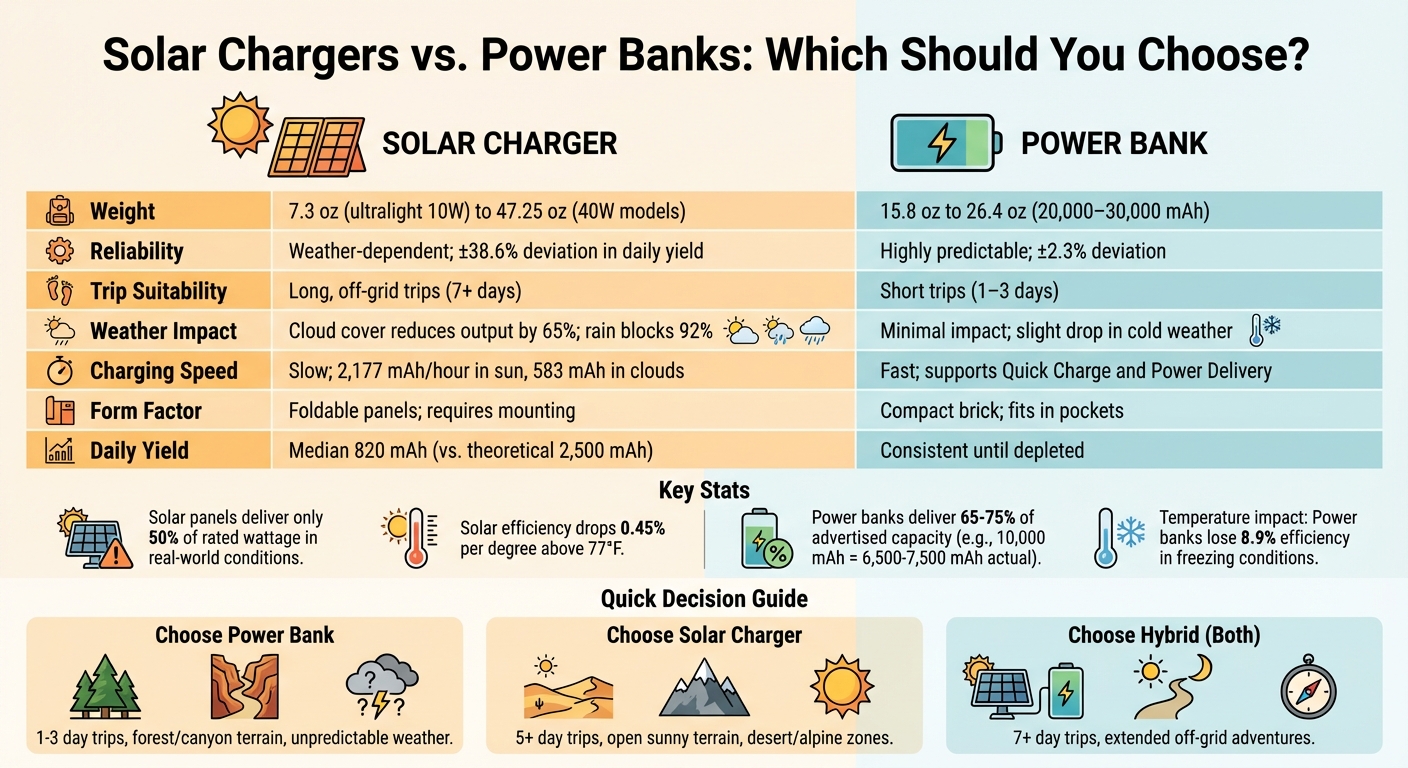
Understanding how solar chargers and power banks perform in different conditions is essential for making an informed decision. Here’s a breakdown of their performance across critical factors:
| Factor | Solar Charger | Power Bank |
|---|---|---|
| Weight | 7.3 oz (ultralight 10W) to 47.25 oz (40W models) | 15.8 oz to 26.4 oz (20,000–30,000 mAh) |
| Reliability | Weather-dependent; ±38.6% deviation in daily yield | Highly predictable; ±2.3% deviation |
| Trip Suitability | Long, off-grid trips (7+ days) | Short trips (1–3 days) |
| Weather Impact | Cloud cover reduces output by 65%; rain blocks 92% | Minimal impact; slight drop in cold weather |
| Charging Speed | Slow; 2,177 mAh/hour in sun, 583 mAh in clouds | Fast; supports Quick Charge and Power Delivery |
| Form Factor | Foldable panels; requires mounting | Compact brick; fits in pockets |
| Daily Yield | Median 820 mAh (vs. theoretical 2,500 mAh) | Consistent until depleted |
This comparison highlights how each option stacks up, depending on your trip length and conditions.
What the Comparison Shows
The table makes it clear: power banks are the go-to choice for short trips, offering consistent and convenient performance without worrying about sunlight or weather. For weekend hikes or three-day excursions, a power bank is reliable and hassle-free. But on longer journeys - those lasting a week or more - a drained power bank becomes dead weight. That’s where solar chargers come into play, especially for off-grid adventures.
Field testing confirms that power banks deliver steady results in the short term, while solar chargers falter in poor weather. This makes solar chargers better suited as an auxiliary energy source rather than your primary one.
"Solar backpacks excel as emergency top-up tools - not primary energy sources. Their real value lies in extending margin, not replacing planning." - Dr. Lena Torres, Renewable Energy Engineer, National Renewable Energy Laboratory
Temperature also plays a role in performance. Solar panel efficiency drops by 0.45% for every degree above 77°F. On the flip side, lithium power banks slow down at 41°F and may experience voltage issues in freezing conditions. A hybrid solution - combining a 20,000–25,000 mAh power bank with a 7W–10W detachable solar panel - offers a balanced approach for long-distance hikers.
When to Use Solar Chargers vs. Power Banks
Choosing between a solar charger and a power bank depends on factors like trip length, weather conditions, and how much weight you’re willing to carry. Each has its strengths, and understanding when to use one over the other can make a big difference in your outdoor adventures.
Power Banks for Short Trips and Compact Packing
For trips lasting 1–3 days, a power bank is usually the smarter choice. These devices are simple, dependable, and unaffected by weather. A 10,000 mAh power bank typically provides about 7,000 mAh of usable energy due to conversion losses, which is enough to recharge most smartphones twice. Power banks shine in environments where solar panels falter - such as dense forests, deep canyons, or areas with unpredictable weather, like the Pacific Northwest. Adventure travel writer Cameron Martindell sums it up well:
"If you are hiking under a deep forest canopy or through a shadowy canyon, there is not much point in strapping a solar charger to your pack."
Make sure all your devices and power banks are fully charged before you head out.
Solar Chargers for Longer, Off-Grid Adventures
For trips lasting more than 4 days, solar chargers become a practical solution. Unlike a drained power bank, a solar panel keeps generating power as long as it has access to sunlight. This is especially useful in open landscapes like deserts, alpine zones, or sunny regions in the western U.S.. Review editor Sam Schild emphasizes this point:
"If you are without power for four or more days, a panel will likely serve you better than a battery."
To get the most out of your solar charger, angle it 30° toward the sun using trekking poles or rocks, and focus on charging between 11 a.m. and 3 p.m. when sunlight is strongest. Keep in mind, though, that solar panels lose 0.45% efficiency for every degree above 77°F, and winter conditions can limit daily output to just 12–18 watt-hours - barely enough for a single smartphone charge.
Using Both for Greater Versatility
For extended trips where neither option alone is sufficient, combining a power bank with a solar charger offers the best of both worlds. For journeys longer than 5 days, pairing a 20,000–25,000 mAh power bank with a 7W–10W detachable solar panel provides both reliable stored power and renewable energy. Field tests show this hybrid approach can extend power availability by 42%. One strategy is to charge a power bank at camp using solar energy while keeping another power bank ready for immediate use. To protect your devices, always charge them through the power bank rather than directly from the solar panel, which can cause voltage spikes. As Dr. Lena Cho from the National Renewable Energy Laboratory explains:
"The real advantage of solar isn't longevity - it's operational independence when infrastructure fails. Choose solar not for battery health, but for mission-critical autonomy."
Finding Portable Power Solutions at Electrical Trader

Electrical Trader offers a variety of portable power options tailored to meet the needs of backpackers. From high-capacity power banks to solar chargers, the platform provides products that balance performance and portability. Each product lists specifications in mAh, Wh, and ounces, making it easier to plan your load for outdoor adventures.
Take the SOARAISE 48,000mAh power bank as an example. Priced at $116.99, it delivers approximately 177.6 Wh of energy - perfect for multiple device charges on extended trips. If durability is a top priority, the 38,800mAh waterproof solar charger ($119.99) might be your pick. With an IP66 waterproof rating and rugged housing that can withstand drops from up to 3.6 meters, it’s built to handle tough conditions. For those venturing far off-grid, the SunJack 40W Foldable Solar Panel paired with a 100W power bank ($209.99) offers a 94.7 Wh capacity. Its ETFE construction, with 95% UV permeability, outperforms standard PET panels, which only achieve 80%.
For backpackers aiming to minimize weight, the Powertraveller Tactical Extreme is a standout. Weighing just 10.2 ounces, it provides 44.4 Wh of power and features MPPT technology, ensuring stable charging even under cloudy skies. This is particularly useful, as cloud cover can cut solar output by up to 65%.
Keep in mind that airline regulations restrict power banks to a maximum of 100 Wh for carry-on luggage. To figure out the Wh rating of a power bank, use this formula: (mAh × 3.7V) ÷ 1,000. For instance, a 25,600mAh power bank translates to 94.7 Wh, keeping it within airline limits.
For added convenience, look for models with built-in kickstands or carabiners. These features allow for passive charging while on the move, helping you stay powered up without slowing down. Whether you’re planning a weekend hike or a week-long trek, Electrical Trader’s selection ensures your power needs are covered.
Conclusion
To wrap things up, here’s a quick recap for backpackers deciding between power banks and solar chargers.
Power banks are a dependable choice for shorter trips (1–4 days), offering consistent power regardless of weather. However, once drained, they’re no longer useful. On the other hand, solar chargers are great for longer, off-grid adventures (5+ days) since they provide renewable energy. That said, their performance heavily depends on sunlight conditions and can drop significantly in poor weather.
For shorter outings, a power bank with a capacity of 10,000–20,000 mAh is a reliable and compact option. For multi-day treks or extended hikes, a hybrid approach is best. Pair a 20,000–25,000 mAh power bank with a 7W–10W solar panel. Use the solar panel during peak sun hours (11 a.m.–3 p.m.) to recharge the power bank or your devices directly. This combination strikes the balance discussed throughout the article.
"If your backpacking trip is short, stick with power banks. If you're going for a longer off-grid trek, or carrying multiple devices, add a solar charger to your kit." - Some Bold Adventure
Before setting out, fully charge your devices and activate power-saving modes to extend battery life.
Ultimately, your choice should align with your trip length, weather expectations, and power needs. Find the setup that matches your adventure, and check out Electrical Trader’s range of products to stay powered up without unnecessary bulk.
FAQs
How big a power bank do I need for my trip?
The size of the power bank you should bring depends on what devices you’re using and how long you’ll be away. For most backpacking adventures, a power bank with 10,000-20,000 mAh offers a good mix of portability and capacity. A 10,000 mAh power bank is usually enough to keep smartphones and smaller gadgets powered. However, if you need to charge multiple devices or plan to stay off-grid for several days, you might want to go for something larger, like 20,000 mAh or more.
What solar panel wattage is enough for backpacking?
For backpacking, a solar panel with a capacity of 10 to 20 watts usually covers most energy needs, depending on what devices you plan to charge and the size of your battery. A 20-watt foldable panel strikes a good balance between portability and charging speed, making it ideal for those who need to power multiple devices. On the other hand, 10-watt panels are more compact and work well for smaller power banks, though they take longer to recharge. Sticking to this wattage range ensures you have a lightweight, efficient solution for your outdoor trips.
Can I safely charge a phone directly from a solar panel?
Yes, but it depends on the setup and conditions. Charging your phone directly with a solar panel can be unreliable because solar panels often generate inconsistent power due to changes in sunlight. Additionally, many solar panels lack built-in voltage regulation, which could potentially damage your device. A safer approach is to charge an external battery pack with the solar panel first. Once the battery pack is charged, you can use it to power your phone, ensuring a stable and safe charging process.