

UPS and Solar: Powering Data Centers Together
Data centers demand constant uptime, and power disruptions can cost businesses over $500,000 per incident. To address this, Uninterruptible Power Supply (UPS) systems provide immediate backup during outages. But as energy costs and carbon reduction pressures rise, integrating solar energy with UPS systems is emerging as a cleaner, cost-effective alternative.
- Standard UPS systems offer reliable short-term backup but depend on the grid and require frequent battery replacements every 3–5 years. They cost $25,000–$100,000+ and have an ROI of about 8 years. However, they contribute significantly to energy consumption and emissions.
- UPS-solar hybrids combine solar panels and batteries, reducing reliance on grid power. They provide longer backup (hours to days), last 10–15 years, and offer faster ROI (~4 years). They also qualify for tax credits and significantly lower emissions.
Key Comparison:
| Feature | Standard UPS | UPS-Solar Hybrid |
|---|---|---|
| Initial Cost | $25,000–$100,000+ | $10,000–$50,000+ |
| ROI Period | ~8 years | ~4 years |
| Battery Lifespan | 3–5 years | 10–15 years |
| Backup Duration | Minutes | Hours to Days |
| Carbon Emissions | High | Low |
For immediate, low-maintenance backup, standard UPS systems work well. But if you’re looking to cut costs and emissions while increasing reliability, UPS-solar hybrids are the better long-term choice.
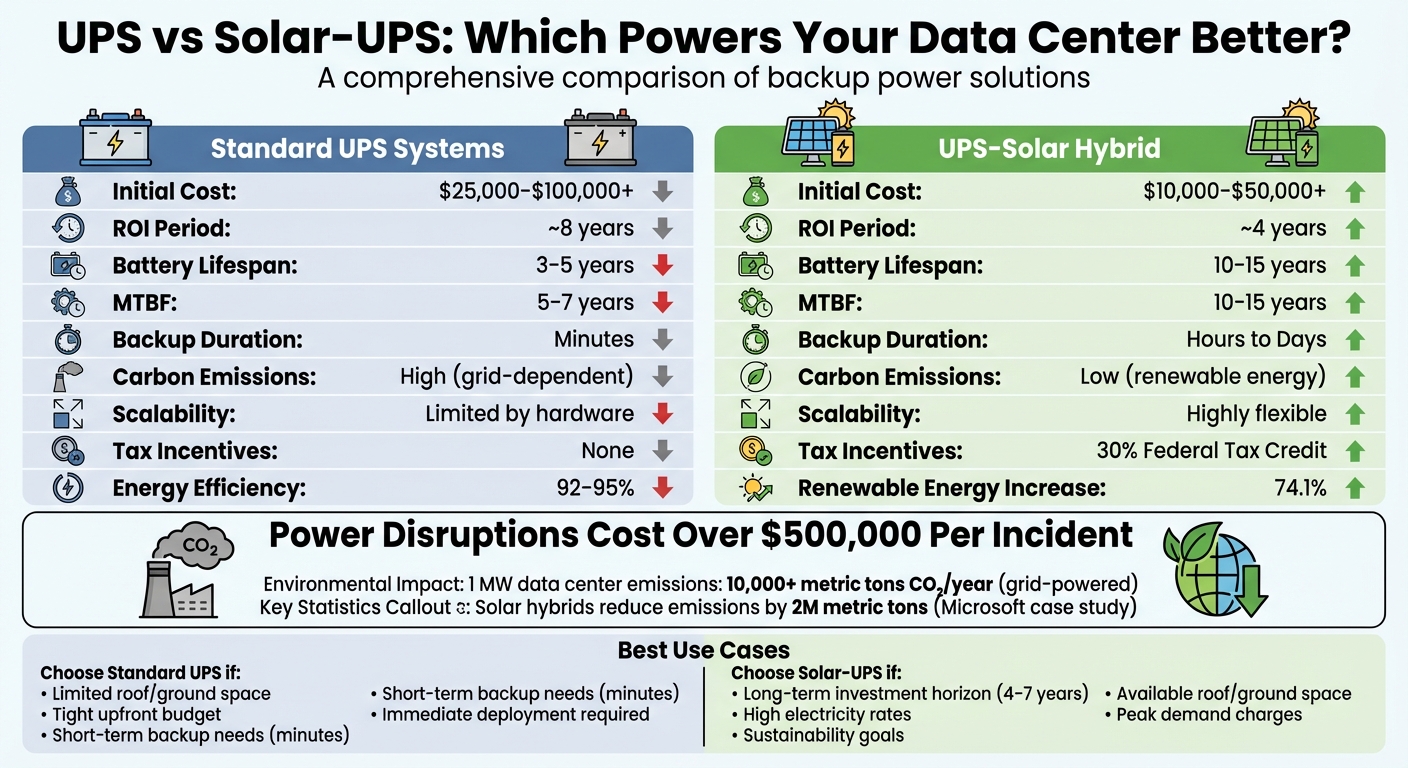
Standard UPS vs Solar-UPS Hybrid Systems Comparison for Data Centers
This Home Data Centre is Powered by Solar!
sbb-itb-501186b
1. Standard UPS Systems
Standard UPS systems play a crucial role in safeguarding data centers, acting as a bridge between the utility grid and essential IT equipment. They kick in immediately during power outages, switching to battery power to ensure uninterrupted operation. These systems also stabilize incoming electricity, protecting against voltage fluctuations.
Reliability
These systems are built to deliver near-perfect uptime - 99.999% - which is essential for operations that can't afford downtime. They achieve this through rapid battery transitions, providing power for the few seconds or minutes it takes for backup generators to activate. To strengthen reliability further, many facilities use 2N or parallel configurations. This means if one UPS module fails, a redundant one automatically takes over the load.
In July 2022, Microsoft adopted Eaton's EnergyAware grid-interactive UPS technology at its Dublin campus. By joining Enel X's virtual power plant, these systems now provide fast-frequency support to Ireland's grid operator, EirGrid, helping reduce carbon emissions by about two million metric tons over several years.
Cost Efficiency
The costs of UPS systems vary widely. Small business models are priced between $200 and $2,000, while enterprise-grade systems can exceed $25,000. Installation costs range from $500 to $10,000, with maintenance adding $200 to $5,000 annually. Battery replacements, required every 3–5 years, are another expense to consider.
UPS systems also contribute to energy consumption. Losses in electrical distribution, including those from UPS systems, can account for 10% to 12% of a data center's total energy use. Efficiency drops sharply when the load falls below 50% and even more so under 30%. Modular UPS designs are becoming more popular, as they let operators add capacity in small increments (10–50 kVA), ensuring systems run closer to their optimal load levels.
"Replacing the old UPS systems was probably our biggest challenge on the path towards a more efficient facility... But it also provided one of the biggest payoffs in terms of efficiency."
– Dom Lovino, Manager of Data Center Operations, Exelon Corp
For example, in 2021, Exelon Corp's Joliet, IL Data Center upgraded from two 1,000 kVA Piller UPS systems to four smaller 750 kVA modules configured as two 2N systems. This change allowed the facility to operate at higher load factors, cutting its Power Usage Effectiveness (PUE) from 1.96 to 1.146 while increasing computing capacity fivefold - without raising energy consumption.
ENERGY STAR-certified UPS models also offer significant savings, reducing energy losses by 30% to 55% compared to older models. For instance, improving UPS efficiency from 90% to 95% in a 15,000-square-foot data center can save around $90,000 annually (based on $0.12 per kWh). A 1,000 kVA ENERGY STAR-certified UPS could save approximately $18,000 each year in energy costs.
Environmental Impact
Traditional UPS systems rely heavily on grid electricity, much of which is generated from fossil fuels like coal and oil. Keeping batteries charged and managing heat dissipation adds to their overall carbon footprint.
Modern UPS models, however, are more efficient, achieving 92% to 95% efficiency compared to older systems that often fall below 90%. Using eco or bypass modes - where utility power bypasses the rectifier and inverter under stable conditions - can cut energy costs by 2% to 8%.
Another shift is the move from Valve-Regulated Lead-Acid (VRLA) batteries to lithium-ion batteries. While lead-acid batteries need replacement every 3–5 years, lithium-ion batteries last 10–15 years. Lead-acid batteries are highly recyclable, with up to 99% of the lead recoverable. However, lithium-ion batteries present unique challenges due to the mining of cobalt and nickel.
Scalability
Modular UPS designs have revolutionized how data centers scale their power systems. Instead of installing oversized systems that run inefficiently at low loads, operators can add capacity as needed, maintaining better efficiency.
Grid-interactive UPS systems take scalability a step further by enabling data centers to use stored energy for purposes like peak shaving and grid stabilization. These systems can even generate revenue by providing frequency response services to utility companies.
While these systems excel in reliability and scalability, integrating renewable energy sources could further enhance their efficiency and environmental benefits.
2. UPS-Solar Combinations
Pairing UPS systems with solar energy transforms backup power from a recurring expense into a functional asset. These hybrid setups harness solar panels to generate electricity during daylight hours, storing any surplus energy in batteries. During outages or peak demand periods, the UPS taps into this stored energy. Integration happens in two ways: Solar UPS units come equipped with built-in charge controllers for direct solar panel connectivity, while regular UPS systems require external controllers and inverters to work with solar energy .
Reliability
Hybrid systems offer an impressive lifespan, with an MTBF (Mean Time Between Failures) of 10–15 years, compared to the 5–7 years typical of standard UPS setups. Their micro-grid capability ensures uninterrupted solar power production during outages by isolating inverters, allowing batteries to recharge daily and providing extended backup power.
To handle solar's variability, these systems utilize buffered energy management. For instance, when clouds reduce solar output or during sudden demand surges, the UPS seamlessly switches to stored battery power . Advanced software tools like REDUX optimize battery charging and discharging based on real-time grid conditions and renewable energy availability. This smooth coordination ensures continuous operation, reinforcing the system's reliability and laying the groundwork for financial advantages.
Cost Efficiency
Integrating solar with UPS systems delivers a faster ROI - about 4 years compared to 8 years for traditional UPS setups. Cost savings come from generating power during peak hours, avoiding expensive tariffs through peak shaving, and reducing demand charges by supplying stored energy during consumption spikes .
"With a fully-integrated solar+UPS solution, ROI actually enters the conversation, which is typically not the case with traditional UPS systems." – Yaron Binder, VP Product Management, SolarEdge
These systems also qualify for financial incentives like the 30% Federal Investment Tax Credit and MACRS accelerated depreciation, which are not available for standalone UPS solutions. Additionally, joint energy management strategies can boost renewable energy usage by 74.1% and extend battery lifespan by 10.6%.
Environmental Impact
By combining solar power with UPS systems, data centers can significantly cut their carbon emissions. For instance, a 1 MW data center can emit over 10,000 metric tons of CO₂ annually. Solar panels generate electricity without greenhouse gas emissions, reducing reliance on fossil fuel-based grid power and backup generators. Advanced energy delivery strategies can further enhance backup capacity by 16.5% while lowering emissions.
Solar panels are built to last, often backed by 25-year warranties, ensuring decades of clean energy production.
Scalability
Hybrid systems not only reduce emissions but also offer flexibility for future expansion. Operators can gradually add more solar panels and battery storage as needed. To account for seasonal changes and system inefficiencies, solar arrays should be sized at 125–150% of daily energy requirements. Battery banks should provide at least 24–48 hours of critical load support to handle extended outages or periods of low solar production.
This adaptable infrastructure can meet growing energy demands without requiring costly grid upgrades. For example, these systems can support high inrush power events, like peak computing loads, potentially eliminating the need for expensive infrastructure expansions. In many cases, adding extra batteries to an existing UPS system for solar storage is more economical than installing a separate standalone solution.
Advantages and Disadvantages
This section breaks down the trade-offs between standard UPS systems and UPS-solar hybrids to help guide investment decisions.
When selecting a backup power solution, there’s always a balance between upfront costs and long-term savings. Standard UPS systems have relatively low initial costs, typically ranging from $25,000 to over $100,000, but they come with higher ongoing expenses due to reliance on grid power and frequent battery replacements. On the other hand, solar-integrated systems start at around $10,000 and can exceed $50,000 for larger installations. However, these setups often pay off faster, thanks to lower utility bills and tax benefits like the 30% Federal Investment Tax Credit.
Reliability is another key factor. Standard UPS systems are designed for short-term backup, usually lasting just a few minutes, with a Mean Time Between Failures (MTBF) of 5–7 years. In contrast, UPS-solar hybrids extend reliability significantly, with an MTBF of 10–15 years. They can provide backup power for hours - or even days - by recharging batteries during outages through micro-grid operation.
| Feature | Standard UPS System | UPS-Solar Combination |
|---|---|---|
| Initial Cost | $25,000–$100,000+ | $10,000–$50,000+ |
| ROI Period | ~8 years | ~4 years |
| Battery Lifespan | 3–5 years | 10–15 years |
| MTBF | 5–7 years | 10–15 years |
| Environmental Impact | High (grid-dependent) | Low (renewable energy) |
| Scalability | Limited by hardware | Highly flexible |
From an environmental perspective, solar-integrated systems have a clear edge. For example, a 1 MW data center relying on grid power emits over 10,000 metric tons of CO₂ annually. Solar hybrids not only cut these emissions but also extend battery life by 10.6% and increase green energy usage by 74.1%. The batteries themselves are another factor: traditional VRLA batteries require disposal every few years, while lithium-ion batteries in solar setups last 10–15 years.
"Solar Hybrid systems are a better option than UPS systems for critical processes in terms of cost, reliability, and sustainability." – jvenergyconsultant
Scalability is where solar hybrids shine. Standard UPS systems are often limited by physical constraints like rack space, cooling capacity, and grid connection size. Solar setups, however, can grow incrementally by adding panels and batteries, which are typically sized at 125–150% of daily energy needs to account for seasonal variations. This flexibility lets data centers expand without costly infrastructure upgrades. That said, solar arrays do require substantial roof or ground space - a limitation for some facilities.
These comparisons highlight how data centers can weigh immediate costs against long-term benefits like sustainability and resilience.
Conclusion
Standard UPS systems and solar-integrated setups cater to different needs, offering distinct advantages based on operational goals and priorities.
Standard UPS systems provide a straightforward and dependable backup solution with relatively low upfront costs - typically between $25,000 and $100,000 for larger setups. These systems are ideal for facilities with limited roof space, tight budgets, or backup requirements that span minutes rather than hours. However, they come with ongoing expenses, such as grid power usage and battery replacements every 3–5 years.
On the other hand, UPS-solar combinations are designed for long-term efficiency and cost savings. They not only reduce operating expenses through methods like peak shaving but also offer a faster return on investment compared to traditional systems. These systems are especially advantageous for facilities with high electricity rates, significant peak demand charges, or organizations focused on reducing their carbon footprint. Their ability to evolve from a backup solution into a revenue-generating asset highlights their growing appeal.
Modern solar-UPS systems can participate in demand-response programs or sell excess energy back to utilities, creating additional income while maintaining backup power. However, they do require significant space - either on rooftops or the ground - and involve more complex installation processes, including engineering and permitting. For data centers equipped with the necessary space and a long-term investment outlook (approximately 4–7 years), the benefits are substantial. These include extended battery lifespans (10–15 years), tax incentives like the 30% Federal Investment Tax Credit, and improved green energy utilization, which can increase by up to 74.1% .
For those seeking immediate, low-maintenance backup power, standard UPS systems are the go-to option. But for organizations prioritizing sustainability, cost efficiency, and energy independence over the next decade, solar integration offers clear advantages. Selecting the right system ensures data centers remain both resilient and forward-thinking.
FAQs
How do I size solar panels and batteries for my data center UPS?
To properly size solar panels and batteries for your data center's UPS system, begin by assessing the total power demand in kilowatts (kW) or megawatts (MW) and deciding how long you need the backup to last. To calculate energy requirements, multiply the power demand by the desired runtime in hours.
When it comes to solar panels, take into account local solar irradiance data and the efficiency of the panels you plan to use. For batteries, ensure they can store enough energy (measured in kilowatt-hours or kWh) to meet your needs. Pay close attention to voltage and amp-hour ratings to ensure proper sizing and compatibility with your system.
Will a solar-UPS hybrid work during a multi-day grid outage?
A solar-UPS hybrid system offers dependable backup power during prolonged grid outages, provided it includes sufficient solar generation and battery storage. The system's effectiveness hinges on its design and the batteries' ability to store enough energy to cover power needs for several days.
What permits and incentives apply to adding solar to an existing UPS?
Integrating solar power with an existing UPS system often involves navigating permits and incentives. Key steps typically include securing interconnection agreements and ensuring compliance with local electrical codes, like the NEC 120% rule. However, the exact requirements and potential benefits can differ depending on where you are. To make the most of available programs and meet regulations, it’s crucial to review your local guidelines and incentives thoroughly.