How to Size Main Service for Residential Properties
Sizing your home’s electrical service is about safety and efficiency. It ensures your system can handle current and future electrical demands without risks like overloaded circuits or fire hazards. Here’s a quick breakdown:
- Why it matters: Undersized services cause breaker trips, voltage drops, and overheating. Modern homes with EV chargers, heat pumps, and other high-demand devices often exceed the NEC’s 100A minimum requirement.
- How to check your current service size: Look at your main breaker or panel labels for the amperage rating (e.g., 100A, 150A, 200A). If unclear, check the meter base or conduit size.
- How to calculate your load: List all major appliances, note their wattage, and apply NEC guidelines. Use the Optional Method for homes with 100A+ services to avoid oversizing. Continuous loads (like EV chargers) require extra capacity.
- When to upgrade: If your total load exceeds 80% of your service capacity, it’s time for an upgrade. For example, a 200A service should handle no more than 160A of continuous load.
- Get professional help: Licensed electricians ensure calculations meet NEC standards, avoiding costly mistakes or failed inspections.
Upgrading your service isn’t just about meeting today’s needs - it’s about preparing for tomorrow’s demands. Always consult a professional for accurate load calculations and safe installations.
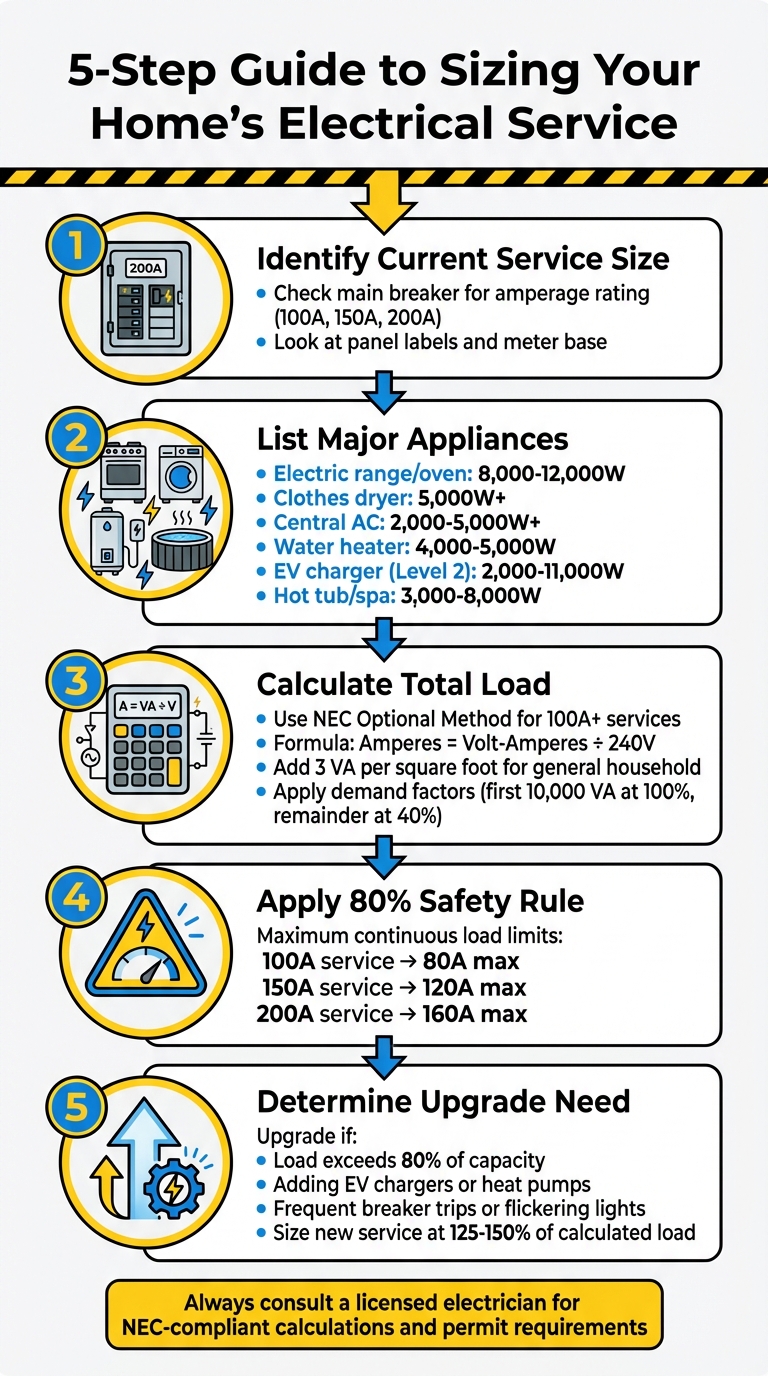
5-Step Guide to Sizing Residential Electrical Service
NEC Dwelling Service Calculation Example
How to Identify Your Current Electrical Service Size
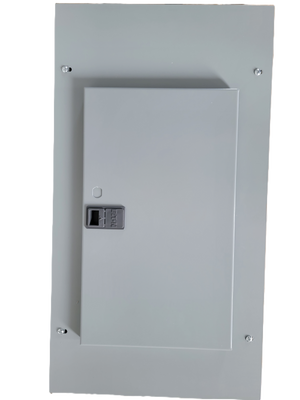
Before figuring out your electrical needs, you first need to know your current service size. This information is located in your main service panel - that gray metal box usually found in your garage, basement, or utility room. Inside the panel, you'll see the main breaker, which is the largest switch controlling all the power in your home.
Check the Main Breaker
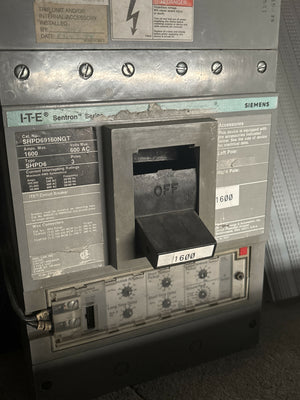
To determine the size of your service, take a look at the main breaker. It’s usually located at the very top or bottom of the two rows of smaller branch breakers. The amperage rating (like 100, 125, 150, or 200) is typically stamped on the toggle handle or the face of the breaker itself.
"The current rating is clearly marked on the breaker. That's the panel's capacity." - Chris Deziel, Author and Home Improvement Expert, Family Handyman
Safety tip: Make sure the area around the panel is dry before opening it. If the markings are hard to see, use a flashlight. If you don’t find the main breaker inside the panel, check near your electric meter for a main disconnect switch.
Review Electrical Panel and Meter Base Labels
If the markings on the breaker are faded or unclear, look for the manufacturer’s nameplate on the panel or the meter base. These labels usually list the maximum amperage rating, along with the manufacturer’s name and the model number.
The shape of the meter base can also give you some clues. A square metal base often indicates a 100-amp service, while a rectangular base extending below the glass dome suggests 150-amp or 200-amp service. Additionally, the size of the conduit pipe entering your home can provide hints: a 1¼-inch conduit typically supports 100 amps, while a 2-inch conduit is usually rated for 150 amps or more.
Important: Only the rating of the main panel matters when determining your service size.
Once you’ve identified your current service size, you can move on to listing and calculating the power needs of your major appliances.
List All Major Appliance Loads
Once you’ve determined your current service size, it’s time to take inventory of your home’s major appliances. This step is crucial for calculating your total electrical load and figuring out if your existing service can meet your energy requirements.
Identify High-Wattage Appliances
Start by listing all the high-power appliances in your home. Residential electrical loads generally fall into a few main categories: general lighting and receptacles, small appliance circuits, laundry circuits, and specific high-wattage fixed appliances.
Some of the largest power consumers include:
- Electric range/oven: 8,000W–12,000W
- Electric clothes dryer: At least 5,000W
- Central air conditioner: 2,000W–5,000W+
- Electric water heater: 4,000W–5,000W
- HVAC systems
- Level 2 EV chargers: 2,000W–11,000W
- Hot tubs or spas: 3,000W–8,000W
- Electric space heaters: 1,500W–6,000W+
Also, account for fixed appliances such as dishwashers, microwaves, and sump pumps. If you have four or more of these "fastened-in-place" appliances, the National Electrical Code (NEC) allows you to apply a 75% demand factor to their combined load, which can lower your calculated service size.
Pay close attention to continuous loads - appliances that run for three hours or more, like EV chargers or space heaters - since these require additional capacity due to their prolonged energy use. Additionally, consider noncoincident loads, such as heating and air conditioning systems, which rarely operate at the same time. In such cases, you typically factor in only the larger load when calculating your total demand.
Find Appliance Power Ratings
The most reliable way to determine your load is by checking the power ratings on each appliance’s nameplate. These ratings are usually located on the appliance’s door, back, or near the power cord.
If the nameplate lists amperage instead of wattage, you can calculate the wattage by multiplying the amperage by the operating voltage (120V for standard appliances and 240V for larger ones). For example, a 40-amp EV charger operating at 240V draws 9,600 watts (40 × 240).
If the nameplate isn’t accessible, such as with built-in dishwashers, consult the owner’s manual or manufacturer’s specifications. You can also use a plug-in electricity usage monitor to measure the actual wattage of 120V devices. Keep in mind that the NEC requires minimum values for certain loads, regardless of the nameplate rating. For instance, electric clothes dryers must be calculated at a minimum of 5,000W unless the nameplate specifies a higher rating.
With all the power ratings recorded, you’re ready to calculate your home’s total electrical load.
Calculate Total Electrical Load
Once you've listed all your appliances, the next step is to figure out the total electrical load for your home. The National Electrical Code (NEC) provides two ways to do this: the Standard Method (NEC Article 220, Part III) and the Optional Method (NEC 220.82). For homes with a 100-amp service or larger, electricians often lean toward the Optional Method since it's simpler and usually results in a smaller service size requirement.
Calculate Amperage from Wattage
To find out the size of the service you need, you’ll need to convert the total wattage (or volt-amperes) into amperage. Use this formula: Amperes = Volt-Amperes ÷ Volts. For most single-family homes, divide by 240 volts, which is the standard system voltage.
Here’s an example: if you have a total of 34,160 VA, divide it by 240 volts. The result is 142A. According to the NEC, you can round down any fractions below 0.50. This number gives you the minimum amperage your home’s electrical service should handle.
Add General Household Load
Beyond your major appliances, you also need to account for the general electrical use throughout your home. The NEC sets a baseline of 3 VA per square foot for general lighting and standard 15A and 20A outlets. To calculate this, use the total square footage of your home’s exterior dimensions, excluding areas like open porches, garages, or unfinished spaces.
Next, add fixed values for specific circuits:
- 1,500 VA for each of the two required small-appliance circuits (covering the kitchen, dining room, and pantry areas).
- 1,500 VA for the laundry circuit.
These values ensure your home’s electrical system can handle everyday activities without issues.
The NEC also recognizes that not all devices and appliances run at the same time. To account for this, demand factors are applied to reduce the calculated load. Under the Optional Method, the first 10,000 VA of your general load is calculated at 100%, while any load above that is reduced to 40%. This adjustment reflects typical usage patterns and avoids oversizing the service. For example, a home that might need 198A under the Standard Method could require only 142A using the Optional Method.
Accurately calculating your electrical load is essential for both safety and compliance with NEC standards. Once you’ve determined the total load, compare it to your current service size to see if an upgrade is needed.
sbb-itb-501186b
Compare Load to Service Size and Plan Upgrades
To determine if your current electrical service can handle the demand, compare your calculated load to the service capacity. This step ensures your system operates safely and efficiently, and helps you decide if an upgrade is necessary.
Apply the 80% NEC Safety Rule
The 80% rule is a key safety standard outlined in NEC 220.87, designed to prevent overloading your electrical system. If your calculated load exceeds 80% of your service capacity, it’s time to consider an upgrade. This rule accounts for continuous loads - those running for three hours or more - which require a 125% calculation, effectively capping the usable capacity at 80% of the breaker’s rating.
Here’s a quick breakdown:
- 100-amp service: Limit continuous load to 80 amps.
- 150-amp service: Stay at or below 120 amps.
- 200-amp service: Do not exceed 160 amps.
For example, a newly built home with a 200-amp service experienced a peak demand of 185 amps - 92.5% of its capacity. This left only 15 amps of spare room, causing repeated breaker trips and voltage drops. To resolve the issue, the homeowners upgraded to a 400-amp service, which cost them $18,000.
"If the calculated load exceeds 80% of your service capacity, consider upgrading per NEC 220.87." - EleCalculator
Determine When Service Upgrades Are Needed
Beyond the 80% rule, specific situations often signal the need for an upgrade. A common example is adding Level 2 EV chargers, which typically draw 7.2 kW to 19.2 kW (30 to 80 amps at 240 volts) and are classified as continuous loads. For instance, a 40-amp EV charger adds 9,600 VA to your total load, which can easily push a 100-amp or even 150-amp service over the safe threshold.
Other upgrade triggers include:
- Switching to all-electric systems like heat pumps, electric water heaters, or induction ranges.
- Home expansions that increase load demand.
- Installing high-demand equipment such as hot tubs or workshop tools.
- Warning signs like frequent breaker trips, flickering lights, or a hot-to-the-touch panel.
When planning an upgrade, aim to size your new service at 125%-150% of your calculated load. This ensures you have enough capacity for future additions, such as battery storage or additional EV chargers.
When to Hire a Licensed Electrician
While basic load estimates can give you a general idea of your home’s electrical needs, professional calculations are essential for meeting permit requirements and adhering to electrical codes. The complexity of NEC Article 220 makes these calculations a challenge, even for seasoned professionals. As Randy Hunter, Master Electrician and Consultant, puts it, "during certification testing it is usually one of the most dreaded". This highlights why relying on a professional is crucial before pursuing any service upgrades.
DIY Estimates vs. Professional Load Calculations
DIY load estimates often miss key factors like voltage drop, temperature effects, and conductor bundling, which can lead to serious issues, including system failures or fire risks. Local Authorities Having Jurisdiction (AHJ) require official load calculations from licensed professionals to approve permits for upgrades or new installations.
Mistakes in these calculations can be expensive. For instance, a contractor working on a 4,500-square-foot custom home failed inspection when a 200-amp service was deemed insufficient after calculations showed a 220-amp requirement. A professional recalculated using the Optional Method, reducing the need to 180 amps. This adjustment saved the homeowner $3,500 and avoided a two-week project delay. Such examples emphasize the financial and safety risks tied to improper assessments.
Licensed electricians are well-versed in both the Standard Method (NEC 220.40) and the Optional Method (NEC 220.82), which can sometimes result in more cost-effective service sizes for homes. Christel Hunter, Vice President of Standards at Cerro Wire, explains:
"To accurately calculate the service size for residential installations, the designer and installer must be familiar with many requirements in the National Electrical Code. The requirements are not necessarily straightforward".
By ensuring compliance with permits and prioritizing safety, professional evaluations are a vital step in any electrical upgrade.
How to Select a Qualified Electrician
When hiring, seek out a Master Electrician or a licensed contractor with expertise in NEC Article 220 calculations. For homes with electrical needs exceeding 400 amps or custom installations, you might require a Professional Engineer (PE) for advanced load analysis and utility coordination. Confirm that the electrician is licensed to pull permits in your area and understands local code amendments, as some jurisdictions use the International Residential Code (IRC) Chapter 36 instead of the NEC.
Ask about the calculation method they will use - opting for the Optional Method can often eliminate unnecessary upgrades for homes with services of 100 amps or more. Request documented load calculation worksheets that detail demand factors for lighting, appliances, and HVAC systems. These documents will be necessary for permit applications and future inspections. Additionally, ensure the electrician is experienced in integrating modern continuous loads like Level 2 EV chargers, heat pumps, and solar PV systems into the overall demand calculations.
Conclusion
Getting the right size for your home's electrical service isn't just about plugging in numbers - it's about precision and safety. To do it right, follow the National Electrical Code (NEC) guidelines for load calculations. Start by determining your total residential load using NEC-approved methods, then apply the proper demand factors to find a service size that's efficient and cost-effective.
Keep the NEC's 80% rule in mind. If your load exceeds 80% of your service capacity - or if continuous loads like EV chargers, calculated at 125% of their rating, come close to this threshold - it’s time to consider upgrading. This step can help you avoid voltage drops and potential system failures.
Accurate load calculations are also essential for permits and staying code-compliant. Harold De Loach, a Master Electrician, explains:
"If we did not apply demand factors to our service calculations, we would waste money, material, and manpower installing grossly oversized electrical services".
A licensed electrician, well-versed in NEC Article 220, can ensure your calculations meet local codes and consider modern additions like heat pumps and solar panels.
To future-proof your setup, plan for a 20–30% safety margin for potential expansions. Whether you're upgrading an existing system or designing one for new construction, accurate sizing safeguards your investment and prioritizes safety. Always verify your final numbers with a licensed professional to ensure compliance and long-term reliability.
FAQs
How do I know if my home's electrical service needs an upgrade?
To figure out if your home's electrical system needs an upgrade, start by evaluating your current power usage. Common warning signs include frequent breaker trips, flickering lights, or overheating wires. These issues often indicate that your system is struggling to keep up. Also, if you're planning to add high-energy appliances like an electric vehicle charger or a central air conditioning unit, your existing setup might not be enough to handle the extra load.
Getting a professional load calculation is a smart move. This process determines whether your electrical system's ampacity - the maximum current it can safely manage - matches your household's power needs. If your demand is higher than the system's capacity, upgrading isn't just about convenience. It’s about boosting safety, avoiding outages, and ensuring your home can handle future energy demands.
What should I consider when calculating the electrical load for my home?
To figure out your home's electrical load, start with the general lighting and receptacle loads, which are usually calculated based on your home's square footage. Then, include the appliance loads for things like kitchen gadgets, laundry machines, and other fixed appliances. These are often adjusted with demand factors to reflect typical usage patterns.
Make sure to also account for the load from HVAC systems, as heating and cooling equipment can have a major impact on total demand. Pay attention to whether these systems run at the same time or alternate. Additionally, think about the size and layout of your home, the number of circuits, and any plans for future upgrades. This helps ensure your electrical system can handle both current and potential future needs safely.
By considering all these factors, you can determine the right main service size for your home, ensuring your electrical system is reliable and safe.
Why should you hire a licensed electrician for electrical service upgrades?
When it comes to electrical service upgrades, hiring a licensed electrician isn't just a good idea - it’s a must. This ensures the work is done safely and meets local electrical codes, reducing the risk of serious dangers like electrical fires, shock hazards, or potential damage to your home.
Licensed electricians bring specialized training and experience to the table. They can accurately assess your electrical system, tackle complex upgrades, and ensure everything runs smoothly and reliably. Choosing a professional means you can relax, knowing the job is handled correctly the first time.