Silicon Steel vs. Amorphous Metal: Core Durability
Choosing the right transformer core material - silicon steel or amorphous metal - depends on your operational needs. Silicon steel offers durability, mechanical strength, and consistent performance under high-stress conditions, making it ideal for industrial environments with frequent load changes or vibrations. Amorphous metal, while more efficient with up to 70–80% lower no-load losses, is brittle and less suited for high-vibration settings, thriving instead in applications with steady, continuous loads.
Key Takeaways:
- Silicon Steel: Tough, reliable, and better for dynamic loads; higher no-load losses but easier to maintain.
- Amorphous Metal: Energy-efficient and great for light, continuous loads; fragile and requires careful handling.
Quick Comparison:
| Feature | Silicon Steel | Amorphous Metal |
|---|---|---|
| Durability | High; withstands vibration | Low; brittle under stress |
| No-Load Losses | Higher | 70–80% lower |
| Thermal Stability | Good, but generates more heat | Stable but brittle after annealing |
| Cost | Lower upfront | 20–40% higher upfront |
| Noise Levels | Lower | 3–8 dB higher |
| Best Use Case | Industrial, variable loads | Continuous, light loads |
For heavy industrial use, silicon steel remains the practical choice. For efficiency-focused operations like data centers, amorphous cores may provide long-term savings despite higher initial costs.
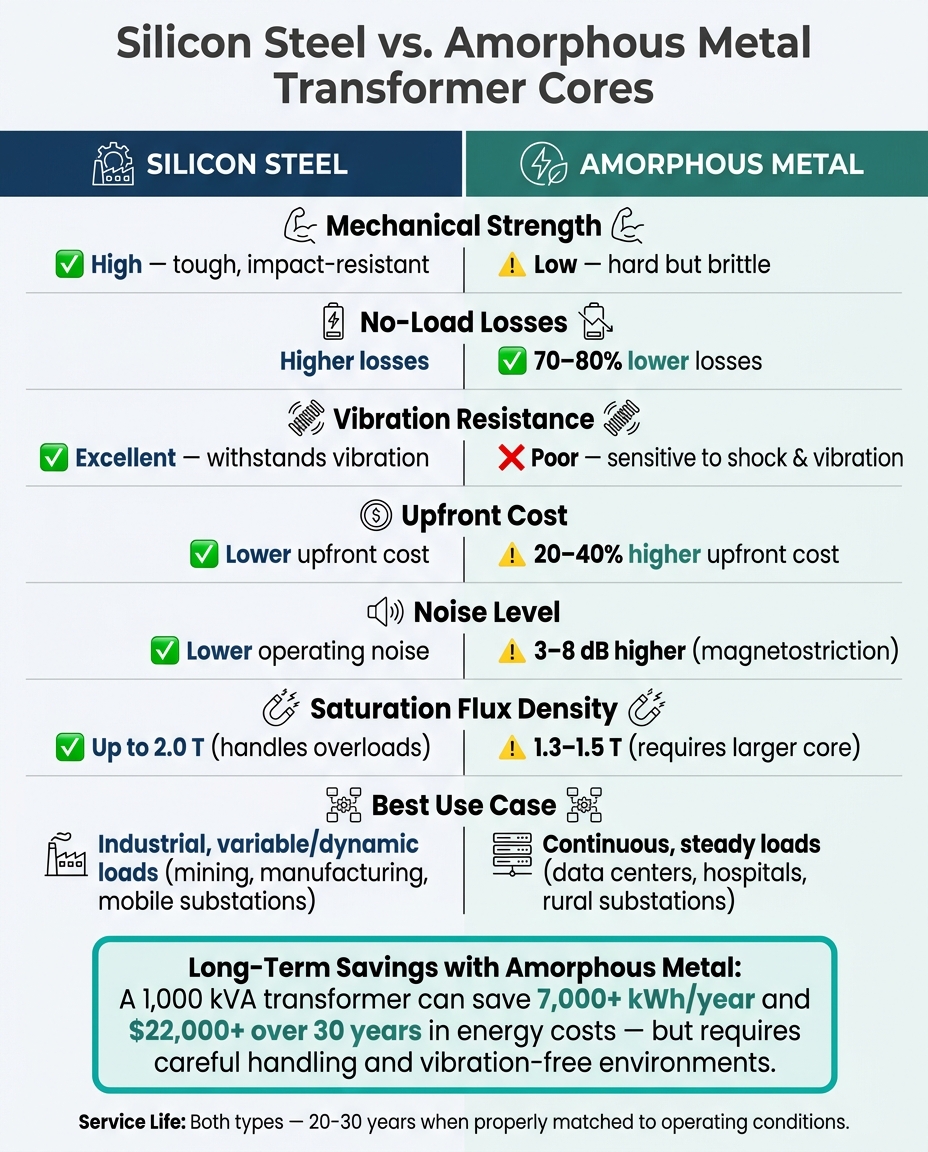
Silicon Steel vs. Amorphous Metal Transformer Cores: Key Differences
How Do Transformer Core Materials Work? - Electrical Engineering Essentials
Silicon Steel Cores: Durability and Performance
Silicon steel forms the backbone of transformer cores, thanks to its blend of mechanical strength, thermal stability, and reliable magnetic properties that endure over lengthy service cycles.
Mechanical Durability of Silicon Steel Cores
One of the standout features of silicon steel cores is their laminated structure. These insulated, tightly stacked laminations reduce eddy currents and create a sturdy assembly capable of withstanding vibrations, shocks, and handling stresses.
As Hitachi researcher Chie Kobayashi explains:
"Silicon steel sheets employed in large-capacity machines have high magnetic flux density and mechanical strength."
This durability is especially important in industrial environments, where transformer cores face challenges like vibrations from adjacent machinery, short-circuit shocks, and physical strain during assembly. Silicon steel handles these stresses effectively. Its saturation flux density of up to 2.0 T - approximately 20% higher than amorphous metal - enables it to endure overload conditions without saturating. This not only protects the core itself but also safeguards the surrounding insulation.
Beyond its mechanical resilience, silicon steel's thermal characteristics are equally critical for its performance over time.
Thermal Performance and Aging in Silicon Steel
Silicon steel's thermal properties offer both advantages and challenges. Its low coefficient of thermal expansion ensures that the laminations remain aligned during repeated heating and cooling cycles, which helps prevent mechanical creep and insulation degradation over time. As noted by Sheraxin Electrical Steel:
"Its [silicon steel] low thermal expansion and good conductivity maintain core integrity under fluctuating temperatures."
However, there’s a trade-off. Silicon steel generates more heat than amorphous metals during operation, which can impose additional thermal stress on insulation. With a moderate electrical resistivity (45–50 μΩ·cm), the material is more prone to eddy current formation, accelerating thermal stress. This means that in continuous-duty industrial settings, effective thermal management is essential to prevent premature insulation aging.
Magnetic Aging and Long-Term Stability
The crystalline structure of silicon steel provides a clear edge in maintaining long-term magnetic stability. Modern Cold Rolled Grain Oriented (CRGO) silicon steel undergoes controlled annealing and domain refinement processes. These techniques align magnetic domains and reduce coercivity, ensuring consistent loss characteristics over decades of use.
Another advantage is reduced operational noise. Silicon steel cores produce 2–5 dB less audible noise compared to amorphous metal cores, thanks to lower magnetostriction. This feature is especially valuable in settings like indoor substations or mixed-use industrial buildings, where noise levels are a concern. While silicon steel cores have higher no-load losses than amorphous alternatives, their predictable magnetic performance simplifies long-term maintenance planning and ensures reliable operation throughout their lifespan.
Amorphous Metal Cores: Strengths and Limitations
Amorphous metal cores, often referred to as "metallic glass", have a distinct non-crystalline structure that sets them apart from conventional materials like silicon steel. This structure offers an edge in efficiency by significantly reducing no-load losses, but it also comes with challenges in durability and handling.
Mechanical Properties of Amorphous Metal Cores
One of the key drawbacks of amorphous cores is their brittleness. These cores are made from ribbons about 25 µm thick, which can fracture easily under stress. Unlike silicon steel, which has a sturdy laminated structure capable of withstanding vibrations and assembly forces, amorphous cores lack inherent mechanical strength and need external support systems to maintain their integrity.
As Chie Kobayashi from Hitachi, Ltd. explains:
"Because mechanical strength of a standalone core is low, a separate structure is needed to support its weight."
To address this, transformer designs often incorporate beam structures, support frames, or epoxy coatings to prevent deformation caused by the core’s own weight or compressive stress. However, these additional measures come at a cost - manufacturing expenses for amorphous core transformers are typically 20%–35% higher than those for silicon steel designs. In a 30-MVA hybrid-core prototype, compressive stress on the amorphous core increased iron losses by 32% compared to a stress-free state. This brittleness also affects long-term durability, making careful handling and robust design critical for industrial applications. Additionally, these mechanical limitations can influence the thermal performance of the core, as discussed below.
Thermal Behavior and Stability
Amorphous cores require annealing at temperatures between 320°C and 380°C to relieve internal stresses, but this process also makes the material more brittle.
"Annealing turns the amorphous material into a brittle form, which makes it more complicated for further processing." - Jolanta Nieroda, ABB Corporate Technology Center
Despite this, amorphous metal has a low coefficient of thermal expansion (around 4.3 × 10⁻⁶/°C), which helps maintain dimensional stability during temperature fluctuations. However, the material’s crystallization temperature of approximately 489°C and a Curie temperature near 364°C set strict limits on operating conditions. Exceeding these thresholds risks losing the amorphous structure and its associated benefits.
Magnetic Performance Over Time
Amorphous cores stand out for their ability to reduce no-load losses by minimizing resistance to magnetic field reversals. This efficiency remains stable over decades, with field data showing reliable operation for more than 25 years.
"Amorphous steel (technically a metallic glass, not steel) can reduce core losses by 70–80% compared to conventional silicon steel." - FluxCo
For instance, in a 1,000 kVA transformer with an average load of 35%, this reduction can save over 7,000 kWh annually, translating to more than $22,000 in energy savings over 30 years. However, amorphous cores have a lower saturation induction (1.3–1.5 T) compared to silicon steel (1.6–1.8 T), which often requires a larger core cross-section to achieve the same power rating. This limitation becomes particularly noticeable under high-frequency or heavy industrial loads, where vibration or prolonged stress can erode the efficiency gains over time.
sbb-itb-501186b
Silicon Steel vs. Amorphous Metal: Durability Compared
Now that we've examined each core type individually, comparing them side by side helps clarify the trade-offs - especially for industrial buyers looking to match the right core material to specific operating conditions. The table below highlights the key durability factors, setting the stage for how load demands and environmental conditions influence overall performance.
Durability Factors: Comparison Table
| Durability Factor | Silicon Steel Core | Amorphous Metal Core |
|---|---|---|
| Mechanical Strength | High; tough and impact-resistant | Low; hard but brittle |
| Vibration Resistance | Excellent; withstands vibration | Poor; sensitive to shock and vibration |
| Overload Capacity | Strong; handles fluctuating industrial loads | Moderate; best for stable, continuous loads |
| Corrosion Resistance | Moderate; standard protection required | Low; highly susceptible to humidity |
| Noise Level | Lower operating noise | 3–8 dB higher due to magnetostriction |
| Service Life | 20–30 years | 20–30 years (if protected from stress) |
| Maintenance Complexity | Standard; mature technology | Higher; core fragility complicates repairs |
How Industrial Load Profiles Affect Core Durability
The durability of these cores also depends heavily on the type of industrial load they encounter.
Silicon steel cores excel in environments with frequent load changes, mechanical vibrations, and high-stress conditions. These qualities make them a go-to choice for industries like manufacturing and mining, where equipment faces constant switching and overloads. As ZTELEC GROUP explains:
"Silicon steel transformers still dominate many industrial applications due to their mature technology, cost control advantages, and strong overload capability."
Amorphous cores, by contrast, are better suited for applications with steady, predictable loads. Their ultra-thin 0.025 mm ribbons - about one-tenth the thickness of silicon steel laminations - are highly efficient but prone to magnetostriction, which increases audible noise by 3–8 dB and can cause mechanical fatigue under prolonged vibration. Additionally, amorphous transformers consume 30%–50% more no-load current, making them less ideal for environments with frequent load fluctuations. While data centers and hospitals with stable energy demands may find these characteristics manageable, heavy industrial sites with variable loads could face durability challenges.
Maintenance Needs and Environmental Conditions
Maintenance and environmental exposure further highlight the differences between silicon steel and amorphous metal cores.
For silicon steel cores, maintenance is straightforward thanks to well-established procedures and the availability of replacement parts. Amorphous cores, on the other hand, are more fragile due to their wound structure. Repairs often necessitate complete replacement, adding complexity and cost.
Environmental factors also play a critical role. Tests on Metglas 2605HB1M ribbons at 120°F (49°C) and 45% relative humidity revealed that untreated ribbons began corroding within 15 days, with significant degradation by 30 days. Applying a silane-based hybrid binder (TEOS/BTSE) proved effective in preventing corrosion while also reducing no-load losses and noise. Silicon steel, with its thicker laminations and advanced coatings, is far less vulnerable to humidity-related damage in most industrial settings.
In environments prone to dust, humidity, or high vibrations, silicon steel tends to be the more reliable option. While amorphous cores can perform well under such conditions, they require proper coatings, isolation mounts, and careful installation to ensure durability.
Conclusion: Picking the Right Core for Industrial Use
Choosing the right core material for industrial transformers involves balancing technical performance with operational demands. The decision is shaped by factors like the environment, load requirements, and long-term costs, as outlined below.
Key Factors That Drive Core Material Selection
When selecting a core material, three factors stand out: operating environment, load profile, and total cost of ownership (TCO). For example, a transformer working at over 70% capacity in a high-vibration industrial setting will have vastly different needs compared to one running continuously at lighter loads in a data center or rural substation. Both silicon steel and amorphous cores can deliver long service lives if matched to the right environment, as explained earlier.
TCO is particularly important. While amorphous cores come with a 20%–40% higher upfront cost compared to silicon steel, their ability to cut no-load losses by 60%–80% can lead to substantial savings over time. For a 1,000 kVA transformer, these savings could exceed $20,000 during its lifespan. This makes a thorough TCO analysis essential when deciding on the core material.
When to Choose Silicon Steel vs. Amorphous Metal
The choice between silicon steel and amorphous metal ultimately depends on the specific operating conditions.
- Silicon steel is ideal for environments with mechanical stress, such as vibration, shock, or frequent load changes. It performs well in dynamic industrial settings like mobile substations, mining sites, or backup systems that cycle on and off often.
-
Amorphous metal is better suited for transformers that remain energized continuously at lower loads, especially when energy efficiency or reducing carbon emissions is a priority. However, as Powerstar points out:
"Amorphous metal is brittle and has to be treated with care. It is susceptible to mechanical stress so cannot be sited where there might be vibrations, as this can cause small fragments of amorphous metals to break off... and degrade the performance of the transformer."
For high-voltage applications above 22 kV, hybrid-core designs may offer the best of both worlds. Hitachi’s 30-MVA hybrid-core prototype, for instance, combines amorphous cores with silicon steel to achieve a 62% reduction in iron loss while maintaining the structural integrity needed to handle mechanical stress.
Sourcing Durable Transformers Through Electrical Trader
Once you've assessed your technical and operational needs, the next step is sourcing the right transformer. The key is to match the core material to your actual requirements, rather than simply opting for the most efficient model on paper. Electrical Trader offers a range of new and used transformers, including 3-phase and substation units, allowing you to compare options easily.
When evaluating transformers, ask suppliers about the core type, impedance rating (typically 2%–6%), and cooling class (e.g., ONAN or ONAF). If you’re considering amorphous units, ensure they meet current IEC 60076 or IEEE C57 standards and are designed to comply with the upcoming DOE 2027 efficiency mandates.
FAQs
How do I calculate payback for an amorphous-core transformer?
To figure out payback, apply the Total Cost of Ownership (TCO) method. Start by adding the initial purchase price to the present value of energy losses throughout the transformer's lifespan. Then, compare this TCO to that of a silicon steel alternative. This comparison helps you see how energy savings can balance out the higher upfront cost. Key elements to consider are electricity rates, the capacity factor, and the price gap between the two technologies.
What site conditions can crack or damage an amorphous core?
Amorphous cores have a notable downside: they are mechanically fragile and prone to damage from physical stress. Placing them in environments with constant vibrations isn't a good idea, as this can lead to permanent damage. Additionally, they don't handle electrical stresses well. Issues like short circuits, sudden heavy loads, or overloads can negatively impact their performance. Their rectangular shape also makes them less capable of withstanding mechanical forces from these stresses when compared to more traditional core designs.
When does a hybrid core make more sense than either option alone?
Silicon steel and amorphous metal cores serve very different purposes due to their unique properties. Silicon steel stands out for its durability and affordability, making it a go-to choice for heavy-duty industrial applications. On the other hand, amorphous metal is prized for its efficiency in low-load, continuous systems, though it is more fragile.
Because these materials are optimized for entirely different conditions and require distinct handling approaches, combining them into a hybrid core isn’t common. The decision between the two usually boils down to what matters more: durability or energy efficiency over time.