

How Real-Time Data Reduces Generator Downtime
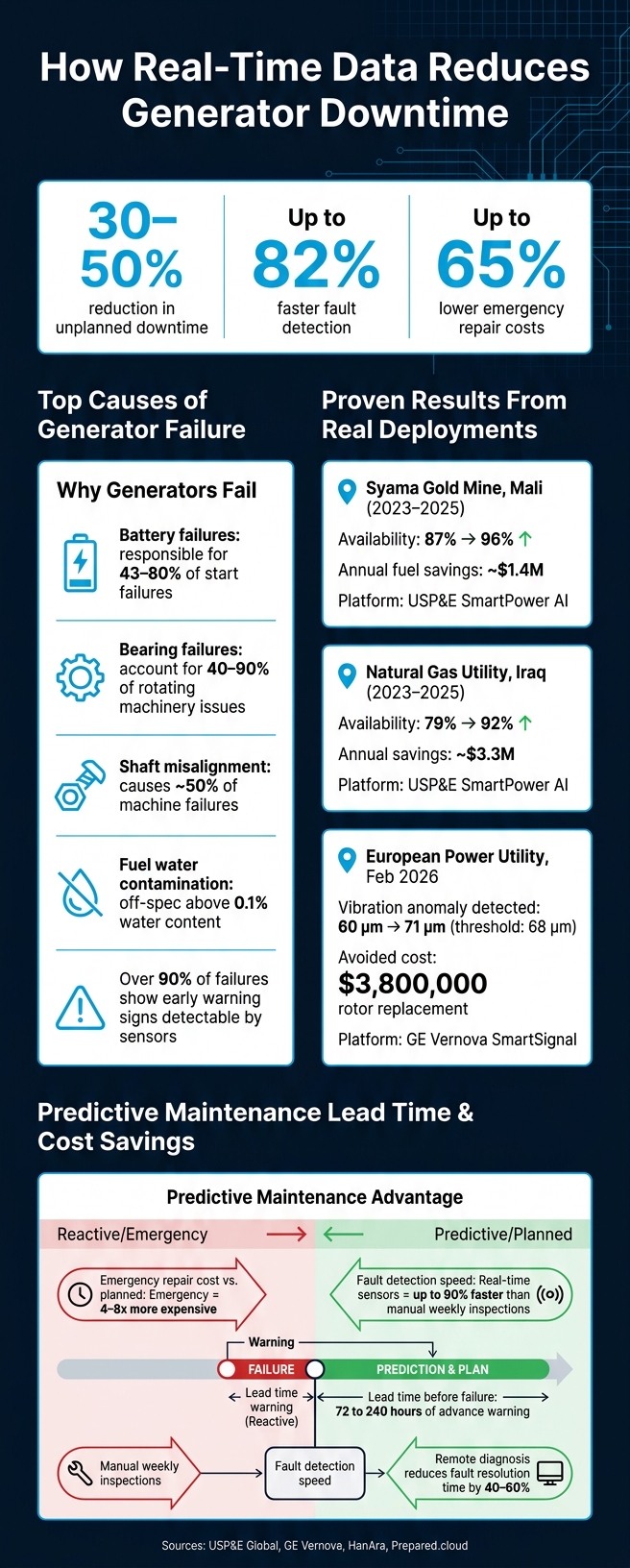
Real-time data analytics is changing how generators are maintained, reducing unplanned downtime by 30–50% and cutting fault detection times by up to 82%. Here's why it matters:
- Cost Savings: Emergency repairs can cost 4–8x more than planned maintenance. Real-time monitoring helps avoid these expenses.
- Early Problem Detection: Subtle changes like a 6°F oil temperature increase or slight vibration shifts are flagged before failures occur.
- Reduced Downtime: Over 90% of failures show early signs that real-time data can detect, preventing costly disruptions.
- Streamlined Maintenance: Maintenance is scheduled based on actual conditions, avoiding unnecessary checks and preventing missed issues.
- Fleet Management: Centralized dashboards simplify oversight of multiple generators, even across different brands or sites.
Real-time monitoring uses sensors, IoT gateways, and AI-driven analytics to predict issues, improve efficiency, and lower repair costs. Whether managing a single unit or a large fleet, this approach ensures generators stay reliable and operational when needed most.
Real-Time Generator Monitoring: Key Stats & Cost Impact
Common Causes of Generator Downtime
Frequent Technical Failures in Generators
Generators often fail due to recurring technical issues, with battery system failures being the most common. These failures, caused by silent issues like sulfation and corrosion, are responsible for 43% to 80% of generator start failures. A generator might seem fine during routine checks but fail to start when needed.
"The #1 cause of generator failure is a dead starting battery." - Taylor, Root Cause Analysis Expert
Diesel fuel, another critical component, degrades over time due to oxidation, water contamination, and microbial growth. If water content exceeds 0.1%, the fuel becomes off-spec, potentially damaging the engine. Additionally, running diesel engines below 30% load can lead to wet stacking - unburned fuel accumulating in the exhaust system. Other issues, such as cooling system leaks, belt failures, and mechanical problems like bearing wear or shaft misalignment, also contribute to unplanned outages. For example, bearing failures account for 40% to 90% of all rotating machinery issues, while misalignment causes about 50% of machine failures.
Here’s a quick breakdown of common failures by system:
| System | Common Failure Modes |
|---|---|
| Starting | Sulfation, dead batteries, loose connections |
| Fuel | Microbial growth, water ingress, wet stacking |
| Cooling | Leaks, belt failure, block heater failure |
| Mechanical | Bearing wear, shaft misalignment |
| Electrical | ATS malfunction, sensor failure, control board errors |
How Monitoring Gaps Allow Problems to Grow
Traditional monitoring methods often fall short because they rely on fixed alarm thresholds. These alarms only trigger after a problem has escalated, even though warning signs like declining battery voltage or reduced cooling flow may have been present for days or weeks.
Manual inspections also have limitations. For instance, a technician might record battery voltage but miss related issues like a slower cranking speed - two indicators that together could signal an impending failure. Standby generators are particularly vulnerable. Problems like fuel oxidation or coolant leaks can quietly worsen during long idle periods, only becoming evident during an emergency.
"If your telemetry cannot survive a routine outage, it will not help during a real one." - Marcus Hale, Senior Operations Content Strategist, Prepared.cloud
These gaps highlight the need for real-time data analytics to catch problems early and reduce downtime.
Difficulties in Managing Multiple Generators
Managing a fleet of generators across multiple sites adds another layer of complexity. Often, site engineers lack a unified system to monitor all units. This can result in a fault on one generator going unnoticed while attention is directed elsewhere.
Mixed fleets complicate things further. Different data protocols and compliance requirements - like the EPA's 100-hour annual cap on non-emergency generator use - make centralized management challenging. Alarm fatigue also plays a role, as operators can become overwhelmed by numerous unprioritized alerts, potentially missing critical warnings that could prevent a major failure.
"The root cause of avoidable operational losses in frontier markets is consistent across geographies: Reactive maintenance culture: faults are addressed after failure, not before." - Will Gruver, CEO, USP&E Global
These challenges underscore the importance of centralized dashboards and real-time analytics for effective generator management.
sbb-itb-501186b
How Real-Time Data Analytics Addresses Generator Downtime
Technologies That Make Real-Time Monitoring Possible
Real-time generator monitoring relies on a network of sensors feeding data into a central analytics platform. These sensors include accelerometers for vibration, RTDs and thermocouples for temperature, ultrasonic sensors for fuel levels, and current/voltage transducers for electrical output. Data is transmitted via industrial IoT gateways using protocols like RS485 Modbus, CAN bus, or Ethernet, and then sent to cloud platforms over 4G LTE or satellite links. Advanced platforms utilize AI and machine learning to establish performance benchmarks and detect even the slightest deviations.
"Early detection can help customers reduce risk, avoid unnecessary damage, and make maintenance decisions on their own terms." - Jacqueline Vinyard, Director of Product Marketing, GE Vernova
This steady stream of accurate data forms the backbone of predictive maintenance, which is explored next.
How Predictive Maintenance Works in Practice
With predictive maintenance, systems provide a lead time of 72 to 240 hours, allowing for scheduled maintenance and minimizing emergency repair costs by up to 65%. Unplanned downtime is also reduced by 30% to 50%.
"A model that predicts 'something might fail' is not actionable. A model that predicts 'starter current draw is rising while cranking speed is falling' is useful because it tells technicians what to inspect." - Marcus Hale, Senior Operations Content Strategist
Specificity in detection is key. For example, in April 2026, GE Vernova's SmartSignal software identified a 6°F increase in lube oil supply temperature at an aeroderivative power plant - 157°F compared to the alarm threshold of 160°F. This early warning allowed the operator to clean a fouled oil cooler during a planned maintenance window, avoiding an estimated $50,000 in production losses and repair expenses.
These predictive capabilities integrate seamlessly with centralized fleet management, covered in the next section.
Managing Generator Fleets From a Single Dashboard
For operations managing multiple generators across various locations, centralized dashboards offer a unified view that manual methods simply can't match. By consolidating data from mixed fleets - regardless of manufacturer or protocol - into common health metrics, these dashboards enable consistent performance evaluations across all units.
USP&E Global's SmartPower AI platform illustrates this concept on a large scale. Between 2023 and 2025, it was deployed at a 30 MW diesel power station at the Syama Gold Mine in Mali, boosting availability from 87% to 96% and saving about $1.4 million annually in fuel costs. Another deployment at a 75 MW natural gas utility plant in Iraq during the same period increased availability from 79% to 92%, resulting in yearly savings of approximately $3.3 million through AI-driven load optimization.
Centralized dashboards also use tiered alert systems to combat alarm fatigue and ensure maintenance efforts are focused. Alerts are categorized by severity, with automated responses tailored to each level:
| Alert Level | Trigger | Automated Response |
|---|---|---|
| Level 1: Advisory | Parameter within 5% of threshold | Dashboard flag; daily report |
| Level 2: Warning | Parameter breach or trending anomaly | Automated SMS/email to site engineer |
| Level 3: Critical | Multiple sensor breach or rapid deviation | Immediate escalation to NOC and site team |
| Level 4: Shutdown | Safety limit exceeded or major fault | Controlled auto-shutdown; emergency dispatch |
This structured approach ensures the right information reaches the right people, streamlining operations and reducing downtime.
What Real-Time Data Delivers for Generator Operations
Catching Problems Before They Cause Failures
Real-time monitoring gives operators the ability to spot issues before they escalate into full-blown failures. Unlike traditional fixed-threshold alarms that only activate after a parameter crosses a danger point, predictive analytics monitor trends to identify gradual shifts that signal potential problems.
Take February 2026, for example. A European power utility using GE Vernova's SmartSignal detected a slight vibration increase on a generator bearing - rising from 60 µm to 71 µm, just above the 68 µm threshold. This small but critical change revealed loosened distance pieces in the rotor end winding. Addressing the issue early allowed for a targeted repair during a scheduled outage instead of a costly rotor replacement, saving an estimated $3,800,000.
Maintenance Schedules Based on Actual Conditions
Condition-based maintenance, powered by real-time data, shifts service schedules from being calendar-driven to performance-driven. This approach ensures maintenance is aligned with the actual needs of each generator, avoiding two common pitfalls: performing unnecessary maintenance on equipment that’s still in good condition and missing issues that require immediate attention.
By relying on real-time metrics like oil pressure, vibration patterns, or coolant temperature trends, maintenance is carried out only when it’s genuinely needed. This approach also reduces unnecessary technician visits, as service teams are dispatched only when data confirms an issue. For operators managing large fleets, this translates into substantial savings in labor and parts costs over time.
Faster Diagnosis and Shorter Repair Times
When generators go down, the financial impact can be immediate and severe, particularly in industries like mining or data centers. Real-time data logs significantly speed up the diagnostic process. Instead of piecing together incomplete records after a failure, technicians can arrive armed with a detailed timeline of changes, pinpointing what went wrong and when.
For example, real-time sensor feeds can identify faults up to 90% faster than manual weekly inspections. Additionally, remote-first diagnosis - where Network Operations Center (NOC) teams begin their analysis as on-site teams respond - can reduce total fault resolution time by 40% to 60%. In one instance from January 2026, HanAra's HanPHI software detected a drop in stator cooling water flow - 234.8 l/min compared to the expected 256.3 l/min - 91 hours before an emergency shutdown could occur. This advance notice allowed operators to derate output and plan a repair for a vibration-induced crack in the generator header, avoiding an unplanned outage entirely.
Real-time data also streamlines parts management. AI-driven advance procurement systems can order replacement components before a failure occurs, cutting emergency parts costs by approximately 20%. This proactive approach reduces one of the most unpredictable expenses in generator operations, ensuring smoother repairs and better uptime management.
Diesel Generator Monitoring System | IBMS | Xenius Solution by Radius Synergies
How to Set Up Real-Time Data Analytics for Your Generators
If you're aiming to minimize generator downtime, setting up real-time analytics is the way to go. Here's how you can get started with a monitoring system that keeps everything running smoothly.
Selecting and Installing Monitoring Equipment
Start by figuring out which generators need the most attention. Break your fleet into categories: high-priority units (like those in data centers) and lower-priority ones. This "tiered" approach helps you decide where to focus your resources first.
Next, choose the right hardware. You have three main options:
- OEM-integrated platforms such as Cummins PowerCommand.
- Controller-native platforms like Deep Sea DSEControl or ComAp, which are ideal for mixed-brand fleets.
- Third-party IoT retrofit kits, which work well for older units.
For older generators, you'll need gateways that can convert Modbus RTU or analog signals into formats compatible with modern systems. Regardless of the hardware you pick, make sure it monitors critical signals like oil pressure, coolant temperature, battery voltage, fuel levels, alternator output, and exhaust temperature.
Connectivity is another key factor. While cellular (4G/5G) usually works, remote or underground sites might need a dual-path setup, like using Starlink with SMS as a backup. During installation, always verify sensor data by comparing it to manual readings.
"The goal is not just to see a warning light, but to understand the chain of signals that caused it." - Marcus Hale, Senior Operations Content Strategist
Here’s a quick look at typical costs:
- Controller upgrades: $800 to $2,500 per unit (Deep Sea or ComAp)
- Telemetry gateways: $300 to $800
- IoT sensor retrofit kits: $200 to $600
- Annual cloud platform fees: $200 to $600 per unit
Considering that predictive maintenance can cut downtime by 30% to 50% and extend equipment life by 20% to 40%, these investments often pay for themselves quickly.
Once your monitoring equipment is ready, the next step is sourcing the right components.
Sourcing Components Through Electrical Trader

After choosing your hardware, streamline the process of acquiring components by using a centralized platform like Electrical Trader. They offer a wide selection of new and used electrical equipment, including tools and parts suited for real-time monitoring systems.
When sourcing components, focus on those that support standardized communication protocols like Modbus TCP/RTU, MQTT, and SNMP. This ensures seamless integration with analytics platforms without needing custom software. For older generators, look for universal input enclosures or retrofit kits to bring them into your modern data setup. Additionally, opt for utility-grade hardware with NEMA 4X weatherproof enclosures, which are built to operate even during power outages.
These choices not only simplify integration but also help establish a secure and reliable network for your generators.
Data Security and Compliance for Critical Industries
Connecting generators to a network comes with cybersecurity challenges, especially in industries like healthcare, utilities, and data centers. Start by changing all default factory passwords immediately after installation and isolating generator controllers on a dedicated VLAN.
For secure data transmission, make sure your equipment includes TLS encryption, VPN access, and certificate-based authentication. In regulated industries, compliance with standards like NERC CIP (utilities) or IEC 62443 (industrial control systems) is mandatory. Components should also meet U.S. standards such as NFPA 110, UL 2200, and NEC Article 700, which are critical for standby power systems in essential facilities.
"A connected generator is a network asset, not just a power asset." - chenwen, Shandong Huali Electromechanical
Skipping security during the initial setup is a costly mistake. It's far better to build robust security measures into your system from the start than to retrofit them later.
Conclusion: What Real-Time Data Means for Generator Uptime
Real-time data analytics is transforming the way operators handle generator maintenance, shifting the focus from reacting to problems to preventing them. The results speak for themselves: 30–50% less unplanned downtime, up to 90% faster fault detection, and fuel cost savings of 8–15% through smarter load management. For U.S. operators managing critical infrastructure, these improvements translate into lower costs and fewer operational disruptions.
Metrics to Track When Measuring Results
To prove the value of real-time data analytics, tracking the right performance metrics is key. Some of the most telling indicators include total unplanned downtime hours, Mean Time to Repair (MTTR), system test success rates, and the ratio of predictive to reactive maintenance tasks. Financially, keep an eye on emergency spare parts spending and fuel consumption patterns - both should decline as predictive models become more effective. For example, AI-driven procurement can reduce emergency parts costs by approximately 20%, replacing the need for last-minute orders. As these metrics improve, the long-term advantages of real-time data become increasingly evident.
Building on Data Insights Over Time
The benefits of real-time monitoring grow the longer it’s in place. Early on, it helps catch obvious issues. Over time, the collected baseline data highlights subtle changes - like shifts in battery voltage, temperature fluctuations, or unusual vibrations - that manual checks might overlook. These trends in downtime and performance metrics underline the growing value of continuous data analysis.
Regularly review incidents to fine-tune alert thresholds. If your team is overwhelmed with minor alerts, adjust Advisory and Warning levels to focus on meaningful risks. Over time, integrate telemetry with your ticketing system so critical faults automatically trigger work orders, complete with asset history. This eliminates delays between detection and action, making real-time data not just a monitoring tool but the backbone of your entire maintenance strategy.
FAQs
What sensors should I monitor first to prevent generator downtime?
To keep generator downtime to a minimum, focus on monitoring key sensors that can identify common failure points early:
- Battery voltage: A low charge is a frequent culprit behind startup problems.
- Engine temperature: Keep an eye on this to avoid overheating.
- Oil pressure: Proper lubrication depends on maintaining adequate pressure.
- Fuel levels: Running out of fuel can lead to unexpected shutdowns.
- Vibration levels: Abnormal vibrations can signal mechanical issues, like worn bearings.
Electrical Trader provides tools and components designed to help with these essential maintenance tasks.
How much does real-time monitoring typically cost per generator in the U.S.?
Real-time monitoring costs for generators in the U.S. aren't explicitly outlined. However, the potential benefits are clear: it can cut maintenance expenses by 10%-40% and reduce downtime by up to 75%. While traditional scheduled maintenance typically costs between $300 and $1,000 per visit, these figures don’t account for the installation or subscription fees associated with real-time monitoring systems.
How do I connect older generators to a modern real-time analytics platform?
To link older generators with a real-time analytics platform, you'll need a hardware gateway or an IoT retrofit kit. These tools gather data from the generator and send it to the cloud. If the generator lacks a digital interface, the gateway converts signals from analog sensors or Modbus interfaces into a usable format. The process involves installing sensors, connecting them to the gateway, and setting it up to transmit data through cellular networks, Wi-Fi, or Ethernet. This allows for ongoing monitoring and predictive maintenance.