


Modbus Security: Encryption and Authentication
Modbus is widely used but lacks built-in security features. This makes systems vulnerable as industrial networks become more connected to IT and the internet. Here's what you need to know:
- Plain Modbus (RTU, ASCII, TCP): Easy to deploy but transmits data in cleartext, with no encryption, authentication, or message integrity. Suitable only for isolated, physically secure networks.
- Modbus/TCP with TLS: Adds encryption, authentication, and integrity checks using TLS 1.3, improving security. However, it requires modern devices and can increase complexity.
- Network Protections (VPNs, Firewalls): VPNs encrypt data, while firewalls isolate networks. These methods are ideal for legacy systems but don't secure traffic within trusted zones.
Quick Comparison
| Method | Encryption | Authentication | Integrity Checks | Best Use Case | Complexity |
|---|---|---|---|---|---|
| Plain Modbus | None | None | None | Air-gapped, secure environments | Low |
| Modbus/TCP with TLS | AES-GCM (TLS 1.3) | X.509 Certificates | HMAC, AEAD | Modern systems, critical networks | Medium |
| VPNs/Firewalls | AES-256 (VPNs) | Certificates/Keys | HMAC (VPNs) | Legacy systems, untrusted networks | Medium-High |
Key Takeaway: Plain Modbus is unsafe for connected networks. Use TLS for newer systems or network-level protections for older devices.
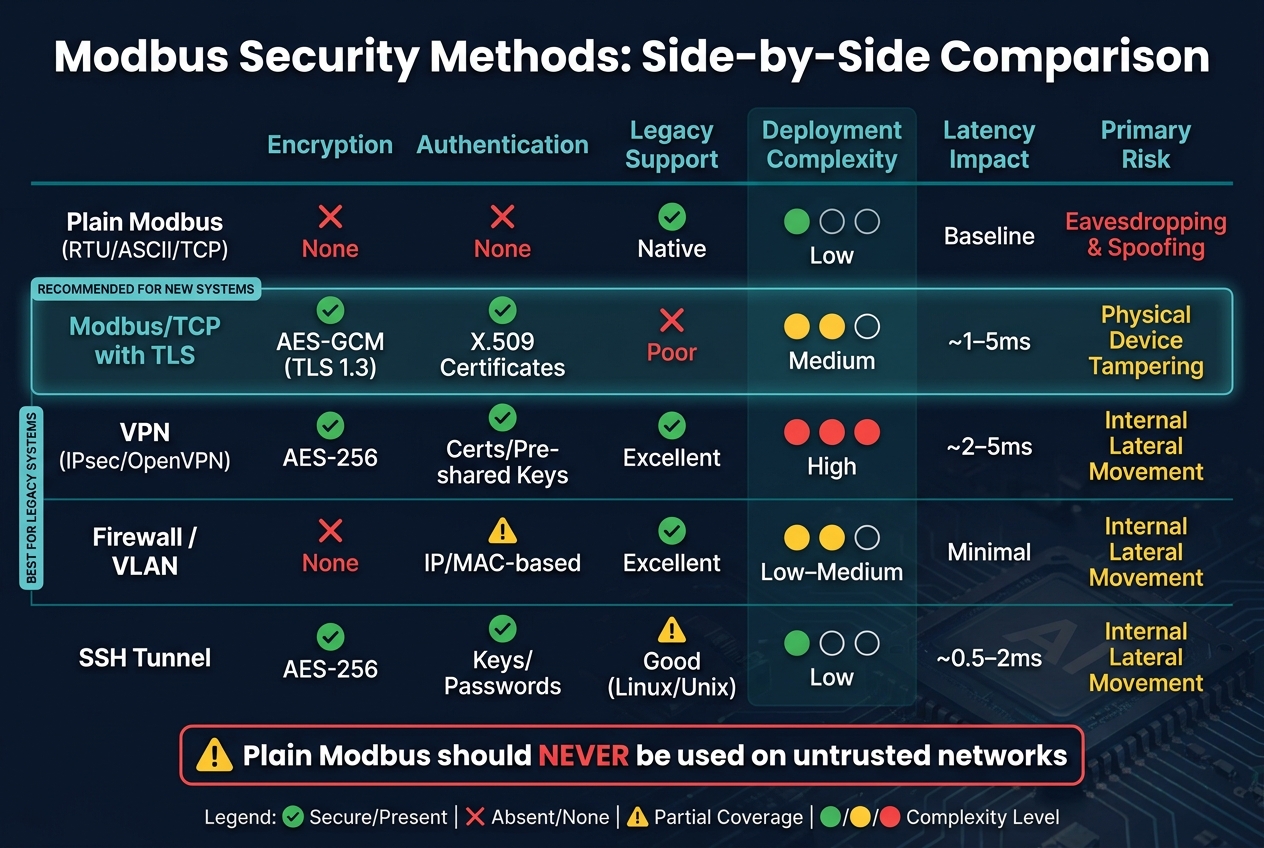
Modbus Security Methods Compared: Encryption, Authentication & Complexity
Secure ModBus (TCP/802)

sbb-itb-501186b
1. Plain Modbus Protocols (RTU, ASCII, TCP)
Modbus, known for its simplicity, comes with a major drawback: it lacks built-in security features, putting critical operations at risk. Whether you're dealing with Modbus RTU, ASCII, or TCP, all three versions share a common flaw - they transmit data in cleartext. This means every byte of information is exposed to anyone monitoring the network. As one industrial networking expert notes:
"Anyone with Wireshark and network access can inspect all register values in cleartext. Scripts can write to any register." - Trout Team
Let’s break down the vulnerabilities of plain Modbus implementations.
Encryption
Plain Modbus protocols do not include encryption. For example, Modbus TCP (which typically operates on port 502) is designed to be routable across networks, making it accessible far beyond the device level. On the other hand, Modbus RTU operates over serial communication, requiring physical access to the wiring. However, neither offers any protection against eavesdropping.
Authentication
Modbus TCP servers accept commands from any device that can reach them. Since there are no usernames, passwords, or certificates involved, any connected device can send read or write commands to any register, creating a significant security gap.
Integrity Protection
Modbus does not verify whether messages have been tampered with during transmission. This opens the door to man-in-the-middle (MitM) attacks, where attackers can intercept, modify, or even replay captured packets to cause unintended actions.
Deployment Complexity
One of the few advantages of plain Modbus is its ease of deployment. There’s no need to manage certificates, configure complex settings, or deal with security overhead. However, this simplicity becomes a liability when the protocol is exposed to broader networks, as it provides no defense against cyber threats.
Here’s a summary of the key security issues with plain Modbus:
| Security Feature | Plain Modbus (RTU/TCP) | Risk |
|---|---|---|
| Encryption | None (cleartext) | Data interception and eavesdropping |
| Authentication | None | Unauthorized command execution |
| Integrity Protection | None | Message manipulation via MitM |
| Session Management | None (stateless) | Replay attacks |
While plain Modbus might work in isolated, private networks with strict physical access controls, its vulnerabilities become glaringly obvious in more complex environments. This highlights the importance of adopting layered security measures, which will be explored further in later sections.
2. Modbus/TCP with TLS
To tackle the risks of cleartext communication and lack of authentication in standard Modbus/TCP, Modbus Security Protocol v2.1 introduces TLS encryption. This approach secures Modbus traffic by wrapping it in TLS, shifting encrypted data transmission to port 802 instead of the traditional port 502. This change makes it easier to pinpoint encrypted versus unencrypted connections within your network. Here's a closer look at how TLS improves encryption, authentication, and data integrity for Modbus.
Encryption
TLS 1.3 is the preferred option over TLS 1.2 due to its better performance and robust security features. With encryption powered by ciphers like AES-GCM, intercepted traffic becomes unreadable to unauthorized parties. The minimum recommended cipher suite is TLS_ECDHE_RSA_WITH_AES_128_GCM_SHA256. While TLS introduces a slight delay - typically 1–5ms per transaction - this latency is barely noticeable for polling cycles exceeding 100ms, especially if the hardware includes a crypto accelerator.
Authentication
TLS-based Modbus/TCP relies on X.509v3 certificates for mutual authentication, ensuring only authorized devices can communicate. Both client and server must validate each other’s certificates before any data exchange occurs, effectively blocking unauthorized access. Major industrial players like Schneider Electric, ABB, and Siemens are integrating this feature into their IIoT gateways and newer PLCs, making it increasingly accessible.
Integrity Protection
TLS ensures data integrity through built-in HMAC and AEAD mechanisms, such as AES-GCM. These features detect and reject any tampered packets, thwarting man-in-the-middle attacks. TLS also prevents replay attacks by using session keys to secure communication.
Deployment Complexity
Implementing TLS does introduce some challenges. Many libraries, such as libmodbus v3.1.6, don’t natively support TLS, requiring additional configuration with tools like OpenSSL, GnuTLS, or mbed TLS. Moreover, managing X.509 certificates for multiple field devices - including issuing, renewing, and revoking them - adds to the administrative workload. For devices that lack TLS capabilities, alternative network-level security measures may be necessary.
| Feature | Standard Modbus/TCP | Modbus Security (TLS) |
|---|---|---|
| Default Port | 502 | 802 |
| Encryption | None (plaintext) | TLS 1.2/1.3 (AES-GCM) |
| Authentication | None (IP-based only) | X.509v3 certificates |
| Integrity | None | HMAC / message integrity check |
| Replay Protection | No | Yes (via TLS session keys) |
| Latency Impact | Baseline | ~1–5ms increase |
3. Modbus with Network-Level Protections (VPN and Firewalls)
While TLS boosts device-level security, network-level protections like VPNs and firewalls offer a solid alternative when TLS isn’t feasible. For field devices without native TLS support, these tools secure Modbus traffic by wrapping it in additional layers of protection, helping to address protocol weaknesses.
"The goal is to make Modbus attacks difficult and detectable without requiring complete infrastructure replacement." - Cascadia OT Security
Encryption
VPNs, such as OpenVPN or IPsec, encrypt Modbus traffic using AES-256, creating a secure tunnel between devices or sites. This is especially critical when Modbus data travels across untrusted networks, like corporate WANs or remote connections. However, encryption adds a small latency - about 2–5ms per transaction. While this delay is manageable for most polling cycles, it’s worth testing in environments where timing is critical. For lighter encryption needs, SSH tunnels on Linux/Unix systems introduce only 0.5–2ms of overhead.
Firewalls, on the other hand, do not provide encryption. Their primary role is isolating networks rather than securing data itself.
Authentication
VPNs authenticate connections using X.509 certificates or pre-shared keys, ensuring only authorized users or sites can exchange Modbus traffic. Firewalls rely on IP and MAC address filtering for segmentation. However, these can be bypassed if internal access is compromised. Together, these measures strengthen Modbus security, even with the protocol’s inherent limitations.
One critical rule: never expose port 502 directly to the internet. Always place it behind a VPN and enforce two-factor authentication (2FA) for remote access.
Integrity Protection
VPNs use HMAC-based integrity checks to detect and discard tampered packets before they reach Modbus devices. Firewalls can take this further with deep packet inspection (DPI), filtering traffic based on specific Modbus function codes. For instance, Function Code 16 (write multiple registers) can be blocked for unauthorized sources while allowing read-only operations. However, once a device is inside the trusted network, these tools can’t verify whether Modbus commands themselves are legitimate.
Deployment Complexity
Firewalls are relatively straightforward, rated as Low–Medium complexity, and are often the first choice for segmenting internal OT networks. VPNs, however, are more complex, rated Medium–High complexity, since many PLCs and field devices lack the necessary compute power to act as VPN clients.
"Field devices require compute resources typically unavailable on PLCs and field devices. Protect Modbus segments at the network level using firewalls and VLANs; encrypt only when crossing untrusted boundaries." - Daniel Price, Industrial Networking Specialist
The best approach combines these methods: use firewalls and VLANs to isolate internal segments and deploy VPNs for connections across public or untrusted networks. This layered method works well alongside the TLS option discussed earlier.
| Solution | Encryption | Authentication | Latency Impact | Best For |
|---|---|---|---|---|
| VPN (OpenVPN/IPsec) | AES-256 | Certificates/Pre-shared keys | ~2–5ms | Site-to-site connections |
| Firewalls/VLANs | None | IP/MAC-based | Minimal | Internal segment isolation |
| SSH Tunnel | AES-256 | Keys/Passwords | ~0.5–2ms | Quick fixes for Linux/Unix |
Pros and Cons
Each method outlined earlier has its own set of benefits and limitations. Choosing the best option will depend on factors like your hardware setup, budget, and how much risk you're willing to accept.
Plain Modbus (RTU/ASCII/TCP) is straightforward to implement, especially in isolated environments. However, it sends data in cleartext, making it highly susceptible to eavesdropping and unauthorized access. This approach is only suitable for air-gapped systems where external access is physically impossible.
Modbus/TCP with TLS stands out as the most secure option for new systems. It offers end-to-end encryption, mutual authentication using X.509 certificates, and integrity checks through HMAC. That said, it does come with challenges - older devices often can't handle the TLS handshake efficiently, and library support (such as libmodbus) is limited, frequently requiring custom solutions like OpenSSL or mbed TLS wrappers. Additionally, it introduces a slight increase in latency per transaction.
"While secure Modbus improves confidentiality and integrity, it has downsides: it increases bandwidth consumption and processing requirements." - Wevolver
Network-level protections (VPNs and firewalls) are a practical solution for legacy systems. They act as a security layer without requiring changes to PLCs or other field devices. However, one drawback is that once traffic enters the trusted network segment, it’s no longer protected. This leaves systems vulnerable to internal threats or lateral movement if the network perimeter is breached.
Here’s a quick comparison of these approaches, highlighting their security features, compatibility with older systems, and potential risks:
| Approach | Encryption | Authentication | Legacy Support | Deployment Complexity | Primary Risk |
|---|---|---|---|---|---|
| Plain Modbus (RTU/TCP) | None | None | Native | Low | Eavesdropping & spoofing |
| Modbus/TCP with TLS | TLS 1.2+ (AES-128/256) | X.509 certificates | Poor | Medium | Physical device tampering |
| VPN (IPsec/OpenVPN) | AES-256 | Certificates/pre-shared keys | Excellent | High | Internal lateral movement |
| Firewall/VLAN | None | IP/MAC-based | Excellent | Low–Medium | Internal lateral movement |
| SSH Tunnel | AES-256 | Keys/passwords | Good (Linux/Unix) | Low | Internal lateral movement |
The next section will provide guidance on how to combine these approaches effectively based on your specific needs.
Conclusion
Securing Modbus effectively requires aligning the right tools with your specific needs. One key takeaway: plain Modbus should never be used on untrusted networks - a point emphasized throughout this discussion. If your devices are fully air-gapped, plain Modbus can be acceptable. However, the moment traffic leaves a controlled environment, a security layer becomes essential.
For many U.S. industrial facilities operating with older PLCs and field devices, network-level protections offer the most practical first step. This method avoids modifying device firmware or application code, which is a significant advantage when dealing with legacy hardware that can't handle the demands of TLS.
The best approach depends on your timeline and the criticality of your systems. In the short term, using SSH tunnels or VPNs for traffic crossing untrusted networks is a solid choice. For medium-term plans, consider wrapping your libmodbus socket layer with OpenSSL to achieve TLS 1.2+ security. Long-term strategies should focus on upgrading to modern IIoT gateways and PLCs that support the Modbus Security Protocol on Port 802. These devices can handle mutual X.509 certificate authentication without requiring custom solutions.
For high-criticality systems like water treatment plants, power grids, or manufacturing lines, compliance with frameworks such as NIST SP 800-82 and IEC 62443 is non-negotiable. As covered earlier, these frameworks advocate for a "zone and conduit" model. This involves segmenting Modbus devices onto dedicated VLANs, enforcing strict firewall rules at zone boundaries, and requiring multi-factor authentication for remote access to the control network.
Finally, while encryption does introduce some latency, it’s minimal and won't impact standard industrial polling cycles. This slight delay should never be a reason to avoid encryption where it’s truly necessary.
FAQs
How do I know if my Modbus devices support TLS on port 802?
To determine if your Modbus devices support TLS on port 802, check if they implement the Modbus Security protocol. This protocol operates on port 802 and includes support for TLS encryption and authentication methods, such as the use of X.509v3 certificates, as specified in the Modbus Security Protocol documentation.
What’s the simplest way to secure legacy Modbus without changing PLC firmware?
The simplest way to protect legacy Modbus systems without modifying PLC firmware is to use network isolation, VPNs, or encrypted tunnels such as TLS-wrapped Modbus or SSH. Since Modbus doesn't include built-in security, these approaches help secure communication effectively.
How should I manage X.509 certificates for Modbus in a plant network?
To handle X.509 certificates for Modbus, here's what you need to do:
- Generate Certificates: Create PEM-encoded X.509 certificates for each device. Make sure they're signed by a trusted Certificate Authority (CA) to establish authenticity.
- Install Certificates: Set up your devices with the certificates and private keys. These should be in either PKCS#1 or PKCS#8 format, depending on your system's requirements.
- Enable TLS: Use TLS to secure Modbus communication. This ensures encrypted sessions and allows for certificate verification, adding an extra layer of security.
- Manage the Lifecycle: Stay on top of certificate maintenance. Regularly renew, revoke, or replace certificates to keep your system secure and up to date.
Properly managing these steps helps ensure that your Modbus communication remains protected and trustworthy.