




Best Practices for IoT Cybersecurity in Industry
Industrial IoT (IIoT) systems are transforming industries like manufacturing and energy, but they come with serious cybersecurity risks. Legacy hardware, outdated protocols, and limited visibility make these systems vulnerable to attacks that can halt production, damage equipment, or even endanger lives.
Key takeaways for securing IIoT systems:
- Risk Assessment: Identify and classify devices, assess vulnerabilities, and document risks.
- Governance Policies: Enforce strict access controls, monitor vendor access, and aim for zero direct internet exposure.
- Network Segmentation: Use the Purdue Model to isolate systems and prevent lateral movement.
- Zero Trust: Authenticate every device and user, even within internal networks.
- Device Security: Implement secure boot, unique credentials, and over-the-air (OTA) updates.
- Procurement Standards: Choose devices that meet ISA/IEC 62443 standards and verify vendor security practices.
- Lifecycle Management: Secure devices from deployment to decommissioning, including legacy systems.
These strategies help mitigate risks, protect critical infrastructure, and ensure safe, uninterrupted operations in industrial environments.
Core Security Practices for Industrial IoT
Risk Assessment and Threat Modeling
Before rolling out any IoT devices in industrial settings, conducting a thorough risk assessment is essential. This step lays the groundwork for all other security measures. As noted in NIST SP 1800-10:
"An organization that is interested in protecting the integrity of a manufacturing system and information from destructive malware, insider threats, and unauthorized software should first conduct a risk assessment and determine the appropriate security capabilities required to mitigate those risks."
Frameworks like NIST CSF, MITRE ATT&CK for ICS, and IEC 62443 are invaluable for guiding these assessments. They help security teams identify and map potential threats to real-world industrial attack scenarios.
Start by using passive network discovery techniques - such as network taps or span ports - to identify IIoT/OT assets and their communication patterns without disrupting operations. Aim to inventory at least 90% of critical assets within 30 days. Once assets are identified, classify them based on factors like safety impact, operational importance, and their ability to receive patches. This classification will guide your choice of countermeasures: for patchable systems, consider deploying behavioral anomaly detection (BAD) and application allowlisting (AAL). For legacy systems that can’t be updated, focus on network-level isolation or virtual patching. Also, don’t forget to evaluate vendor access points and software update channels as part of this process.
Supply chain risks are another major concern. After mapping your assets, assess vulnerabilities tied to third-party vendors. Studies show that 29% of data breaches stem from third-party attack vectors, and 51% of smart factories cite vendors as their primary cybersecurity risk - often due to insecure default settings. Threat modeling should account for these risks by explicitly including vendor access points and OEM software update channels. Document all vulnerabilities, accepted risks, and mitigation measures in an OT/IIoT Risk Register. This will help track ongoing risks and technical debt.
Governance and Policies for IoT Security
The insights gained from risk assessments must translate into actionable governance policies to protect industrial systems. This requires breaking down silos between IT and OT teams, fostering collaboration on incident response plans and business continuity strategies.
Effective policies should be grounded in clear principles. For example, data minimalism ensures that systems only collect and transmit data essential to their function, reducing the attack surface. Vendor access should also be tightly controlled. All third-party connections must pass through a single, secure jump host featuring multi-factor authentication (MFA) and full session recording. Direct vendor access should be prohibited. A strong benchmark for governance is maintaining an Exposure Index of zero - meaning no OT/IIoT devices have direct internet access.
Here are some key performance indicators (KPIs) for governance policies:
| KPI Metric | Target Goal |
|---|---|
| Exposure Index | Zero devices with direct internet pathways |
| Asset Inventory Coverage | Over 90% of critical production line assets |
| Vendor Access Compliance | 100% of sessions routed through a secure jump host |
| Compensating Control Coverage | 100% of unpatched high-criticality assets |
One practical way to implement governance is through a structured 90-day resilience plan. This phased approach includes:
- Days 1–30: Focus on visibility by identifying assets and enforcing default-deny internet egress for all OT zones.
- Days 31–60: Strengthen data flows with TLS 1.3+ encryption and certificate-based authentication.
- Days 61–90: Conduct OT-specific tabletop exercises, simulating scenarios like a compromised vendor update.
This step-by-step plan ensures governance isn't just a static policy but a measurable and evolving security strategy.
sbb-itb-501186b
Industrial IoT Security Essentials (Key Risks and How to Mitigate Them)
Securing Industrial IoT Networks
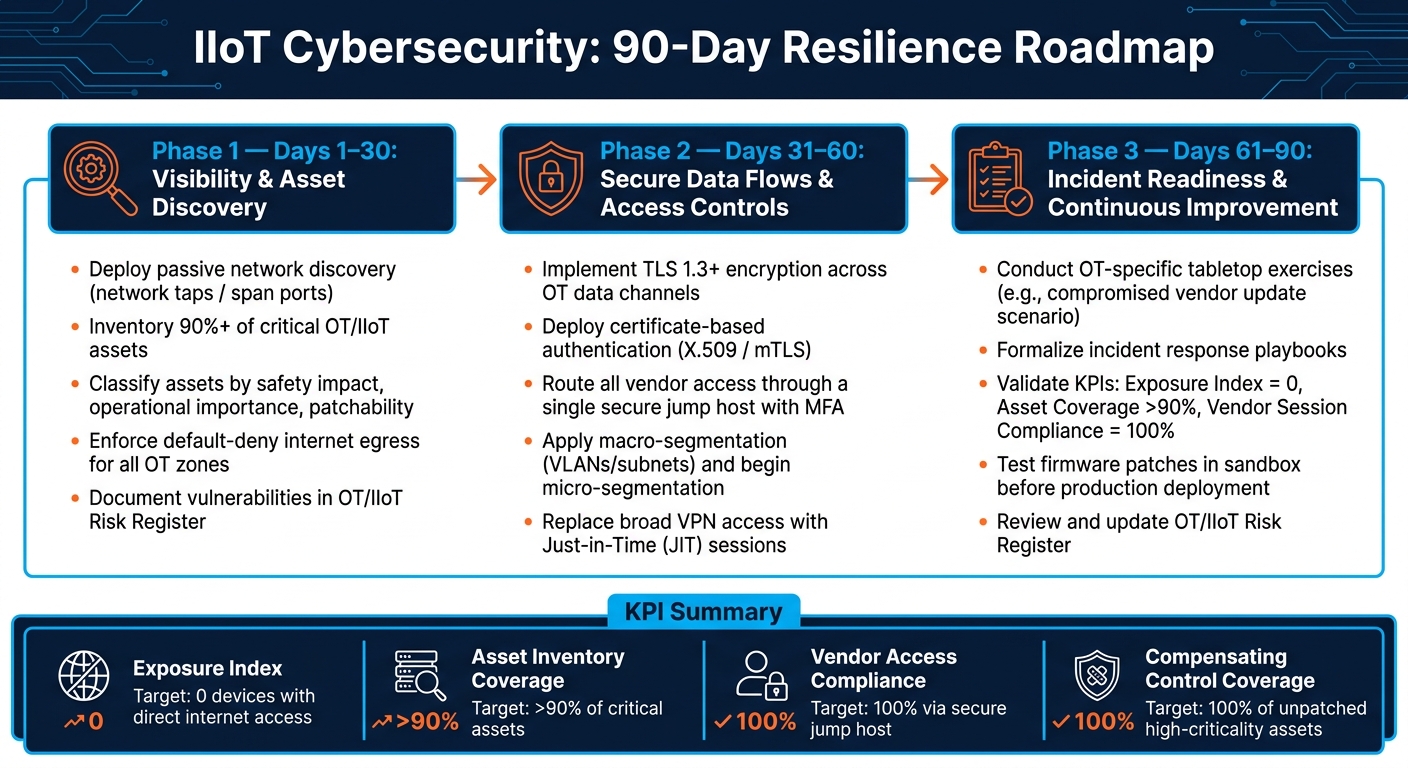
IIoT Cybersecurity 90-Day Resilience Plan
Network Segmentation and Traffic Control
Designing your network to contain breaches is a critical step in securing Industrial IoT systems. As Cisco's Industrial Automation Security Design Guide explains:
"The main goal for segmentation is to minimize the impact of any potential breach."
The Purdue Model is widely recognized as the foundation for industrial network architecture. It organizes networks into distinct levels, ranging from physical sensors at Level 0 to corporate enterprise systems at Level 5. However, many organizations overlook the importance of Level 3.5, the Industrial Demilitarized Zone (IDMZ). This intermediary layer is essential - it acts as a gatekeeper between operational technology (OT) and IT networks. All data exchanges between enterprise and plant-floor systems should pass through the IDMZ, ensuring no direct communication occurs.
| Purdue Level | Function | Typical Assets |
|---|---|---|
| Level 5 | Enterprise Network | Corporate IT, Internet Access |
| Level 4 | Business Logistics | ERP, Email, Office Apps |
| Level 3.5 | Industrial DMZ (IDMZ) | Firewalls, Proxy Servers, Jump Hosts |
| Level 3 | Site Operations | MES, Historians, Site SCADA |
| Level 2 | Area Control | HMI, SCADA Software |
| Level 1 | Basic Control | PLCs, Variable Frequency Drives |
| Level 0 | Process | Sensors, Actuators, Motors |
Start with macro-segmentation, which divides the network into functional zones using VLANs or subnets. Once you have better visibility into plant-floor operations, you can add micro-segmentation. This approach creates finer controls within each zone, limiting lateral movement between devices. Think of macro-segmentation as locking the building's main doors, while micro-segmentation is like securing each individual room inside.
For segments where data should only flow in one direction - such as sending OT data to IT for analysis - hardware solutions like data diodes (unidirectional gateways) provide a reliable safeguard.
Zero Trust for Industrial IoT
Segmentation is just the beginning. Access control needs to be airtight, especially since traditional OT security models assumed internal trust - a mindset that no longer works. The 2021 Colonial Pipeline attack highlighted the dangers of poor segmentation, where attackers moved laterally across systems, disrupting fuel operations for weeks.
Zero Trust turns this old model on its head.
"Zero trust assumes that threats exist both outside and inside your network." - John Filitz, Product Marketing Manager IIoT Cybersecurity, Cisco
Zero Trust requires every device and user to be authenticated explicitly, regardless of their location within the network. This approach is especially challenging in industrial environments, where older PLCs and controllers often lack modern security features like encryption or agent compatibility. As Frank DePaola, Chief Information Security Officer at Enpro, explains:
"In OT, Zero Trust focuses on controlling behavior around and between devices, not modifying the devices themselves."
For legacy devices that can't support 802.1X authentication, you can use MAC Authentication Bypass (MAB). This method pairs deterministic IP/MAC bindings with switchport profiling to verify device identities. Combine this with role-based access control (RBAC) and a strict deny-by-default policy at all zone boundaries. This setup minimizes the damage any compromised device could cause.
Secure Remote Access for Industrial Systems
Even with proper segmentation and Zero Trust policies, managing remote access remains critical. Remote connections are a common attack vector, so access should always be routed through controlled zones. For instance, all remote sessions should terminate in a dedicated Remote Access Zone within the OT DMZ. Direct connections to critical systems like HMIs or engineering workstations should never be allowed.
Replace broad VPN access with Just-in-Time (JIT) sessions. These sessions grant minimal, time-limited access to contractors or vendors. Each session should pass through a jump server, enforce multi-factor authentication (MFA), and log all activity for auditing purposes. As Secomea highlights:
"Zero Trust in OT isn't about starting from scratch – it's about taking measurable steps that reduce risk, increase control, and maintain uptime."
Before any remote device is allowed to connect, conduct a device posture check to ensure it meets your security requirements. Eliminate shared credentials entirely. Instead, assign unique, traceable identities to every user.
Device and Firmware Security
Device Authentication and Credential Management
Securing IoT devices goes beyond network policies - it starts with ensuring each device has a unique and secure identity. Avoid using shared credentials, as a single compromised key could put the entire system at risk.
A better solution is assigning each device an X.509 digital certificate. Unlike shared symmetric keys or passwords, this approach ensures every device has its own identity. When paired with mutual TLS (mTLS) - where both the device and server validate each other's certificates - it becomes nearly impossible for unauthorized devices to impersonate legitimate ones.
To protect cryptographic keys, store them in tamper-resistant hardware like a Trusted Platform Module (TPM) or Secure Element (SE). These components generate private keys directly on-chip and ensure they never leave the hardware, even under physical attack. For instance, the Microchip ATECC608, costing under $0.50 per unit, provides an affordable way to secure devices.
Additionally, eliminate factory-default passwords and hardcoded secrets before shipping devices. Weak credentials have led to massive breaches in the past, such as the compromise of 600,000 devices due to just 61 common username-password combinations.
Secure Boot and Configuration Hardening
Device authentication is just the first step. Ensuring that only trusted software runs on a device is equally critical. Secure boot achieves this by enforcing a chain of trust at every startup stage:
| Stage | Component | Security Action |
|---|---|---|
| 1 | Boot ROM | Verifies the bootloader signature using an immutable public key fused in silicon. |
| 2 | Bootloader | Validates the firmware image signature and checks rollback counters. |
| 3 | Firmware/RTOS | Confirms application integrity and initializes secure storage. |
| 4 | Application | Establishes encrypted connections (e.g., mTLS) to the backend. |
If any step in this process fails, the device halts its boot sequence. This layered approach highlights how vulnerabilities at lower levels, like hardware, can compromise the entire system.
Beyond secure boot, configuration hardening is necessary to minimize attack surfaces. For example, permanently disable debug interfaces like JTAG, UART, and SWD using eFUSEs before deployment. Similarly, lock down unused USB ports, disable insecure wireless protocols, and set flash protection bits to prevent unauthorized memory access. These measures ensure devices are locked down before leaving the factory.
Firmware Updates and Patch Management
Keeping firmware up to date is non-negotiable. Over-the-air (OTA) updates, combined with signed binaries and cryptographic hash verification, ensure updates are secure and free from tampering.
All firmware binaries should be signed using asymmetric cryptography, and their integrity verified using cryptographic hashes like SHA-256. This ensures the firmware remains unaltered during transit. Implementing A/B partitioning adds another layer of safety by testing updates in a secondary partition. If the update fails, the system can automatically revert to the previous version.
To prevent downgrade attacks, include monotonic version counters in update packages. These counters block attempts to roll back to older, vulnerable firmware versions. When prioritizing patches, focus on safety-critical and production-critical vulnerabilities rather than relying solely on CVSS scores.
For devices that cannot be updated - such as legacy PLCs - alternative measures like enhanced network segmentation, protocol whitelisting, and virtual patching through IDS/IPS rules can still reduce risks. These firmware practices, when combined with other security strategies, help address vulnerabilities effectively.
IoT Device Procurement and Lifecycle Management
Security-Aware Procurement of IoT Devices
Before purchasing IoT devices, ensure they comply with ISA/IEC 62443 standards. Specifically, commercial off-the-shelf (COTS) components should meet at least Security Level 2 (SL2). As noted by the ISA Global Cybersecurity Alliance:
"The ISASecure certification program asserts that commercial off-the-shelf (COTS) components should be manufactured to a minimum of security level 2 (SL2) as defined in the ISA/IEC 62443 series of standards."
When evaluating devices, focus on these key security features:
| Security Feature | What to Look For |
|---|---|
| Authentication | Unique identities, X.509 certificate support, multi-factor authentication (MFA) |
| Encryption | AES for data at rest; TLS 1.2+ or IPSec for data in transit |
| Integrity | Secure boot, signed firmware, hardware root of trust (TPM) |
| Updates | Secure over-the-air (OTA) patching, vendor-validated software supply chain |
| Network | VLAN support, VPN compatibility, secure industrial protocols (e.g., OPC UA) |
Demand comprehensive supply chain documentation from vendors to confirm the sourcing and testing of components. Considering that a single data breach in 2024 averaged $4.88 million in costs, taking these precautions is far more economical than dealing with the fallout of a security incident. For sourcing compliant electrical components and power distribution equipment tailored to secure industrial environments, Electrical Trader provides a wide selection of both new and used equipment across various voltage ranges.
Once devices with verified security credentials are in hand, it's crucial to establish a thorough lifecycle management plan.
Lifecycle Management and Secure Decommissioning
From the moment an IoT device is deployed to its eventual retirement, a structured security plan is essential. During onboarding, assign unique credentials to each device, replace all factory-default passwords immediately, and disable any unnecessary ports or services.
Ongoing monitoring is equally important. Use automated asset discovery and behavioral monitoring tools to maintain visibility and detect anomalies in real time. Before applying patches, test them in a sandbox environment to avoid disrupting production systems. A continuous security approach ensures that every stage - from deployment to decommissioning - strengthens the overall integrity of your industrial IoT setup.
When it's time to decommission a device, follow stringent protocols. This includes revoking all credentials and digital certificates, securely erasing data, and removing the device from asset inventories and management systems.
Connecting Legacy Systems to Modern Security Controls
After implementing strong procurement and lifecycle strategies, address the complexities of integrating legacy systems. Older industrial equipment, such as PLCs, RTUs, and SCADA systems, often lacks modern security features since they were designed in an era when internet connectivity wasn't a consideration. As SSH.com points out:
"Legacy OT systems were built without modern security features and rarely anticipated the need for internet connectivity, leaving them vulnerable to today's cyber threats."
One effective solution is protocol conversion. Secure gateways can translate insecure protocols like Modbus into encrypted alternatives such as OPC UA or MQTT with TLS, directly at the legacy device. Combine this with the Purdue Model for network segmentation, which isolates legacy equipment into cell zones (Levels 0–2) and separates them from enterprise networks using DMZs and managed switches.
For unpatchable or outdated devices, AWS advises: "If you are unable to protect insecure industrial assets, isolate or disconnect them from the network." If isolation isn't an option, deploy specialized firewalls designed for industrial control system (ICS) protocols, enforce strict allowlisting for permitted traffic, and use data diodes for highly sensitive areas. These diodes ensure that data flows outward only, physically blocking inbound threats from reaching critical systems.
Conclusion and Key Takeaways
Industrial IoT security is a complex, ongoing challenge that touches every layer of an operation. With cyber threats on the rise, the stakes have never been higher. For example, ransomware attacks targeting industrial operators jumped by 46% in early 2025, with a staggering 2,472 potential incidents reported in just the first quarter. As Tim McAllister from DigiCert put it:
"The rise of the Industrial Internet of Things (IIoT) is a double-edged sword: While technology is driving unparalleled efficiency and innovation, it also exposes industries to a new era of cyber threats."
A layered defense strategy remains essential. The journey starts with visibility. Without full oversight of operational technology (OT) environments, vulnerabilities can go unnoticed. Next, practices like segmentation can contain breaches, identity controls help verify users and devices, and timely patch management addresses exploitable weaknesses.
Security should begin at the procurement stage. Choosing devices from verified suppliers ensures you're starting with equipment that meets compliance standards. For example, platforms like Electrical Trader offer a variety of new and used electrical components, including breakers, transformers, and power generation tools, providing a trusted source for compliant hardware.
For those looking to strengthen their security posture, a structured 90-day plan can be a game-changer. Here's how to break it down:
- Days 1–30: Focus on passive network discovery and creating an asset inventory.
- Days 31–60: Work on securing data flows and refining messaging protocols.
- Days 61–90: Develop and formalize incident response playbooks.
FAQs
What should I do first if I can’t inventory all OT/IIoT assets?
If keeping track of all your OT/IIoT assets feels overwhelming, start small. Begin by creating a well-organized and regularly updated list of your systems, hardware, and software. From there, develop an OT taxonomy to group and prioritize these assets. This helps pinpoint which ones require immediate attention for security measures. Having a clear inventory and classification system is essential for managing risks effectively and establishing a solid cybersecurity foundation in industrial settings.
How can I apply Zero Trust to legacy PLCs that can’t run agents?
To bring Zero Trust principles to legacy PLCs that can't support agents, the focus should be on network segmentation, tight access controls, and session monitoring. Start by implementing micro-segmentation to isolate these devices within the network, limiting exposure to potential threats. Then, enforce identity-based access to ensure only authorized users or systems can interact with the PLCs. Adding just-in-time access further reduces risk by granting permissions only when absolutely necessary and for a limited time.
Since legacy PLCs often lack modern security features, visibility and continuous verification are key. A phased approach can help - begin with assessing current vulnerabilities, then gradually integrate these security measures. This way, you can strengthen defenses without disrupting operations.
What’s the safest way to handle vendor remote access into OT networks?
To keep things secure, it's best to use identity-based access controls, enforce time-limited session durations, and actively monitor access activities in real time. These steps help protect operational technology (OT) networks by reducing cybersecurity risks and ensuring vendors are held accountable for their access.





