SF6 vs air insulated dead tank breakers
If space is tight, SF6 usually wins. If space is available and you want to avoid SF6 reporting, leak tracking, and gas handling, air-insulated dead tank breakers are often the better pick.
I’d boil the decision down to five checks:
- Voltage: SF6 is still the common fit for higher transmission voltages, especially above 245 kV
- Footprint: SF6 uses less yard space; air-insulated units need more clearance and larger bays
- Maintenance: SF6 adds gas density checks, leak work, recovery steps, and fault cleanup rules
- Rules and reporting: In the U.S., owners above 17,820 lb of SF6 nameplate capacity must report emissions each year
- Long-term cost: Air-insulated units may start lower on unit price, but site layout can change the total job cost fast
Put simply, SF6 trades more compliance and service work for a smaller footprint and high-voltage fit. Air-insulated dead tank breakers trade a larger layout for simpler upkeep and no SF6 gas burden.
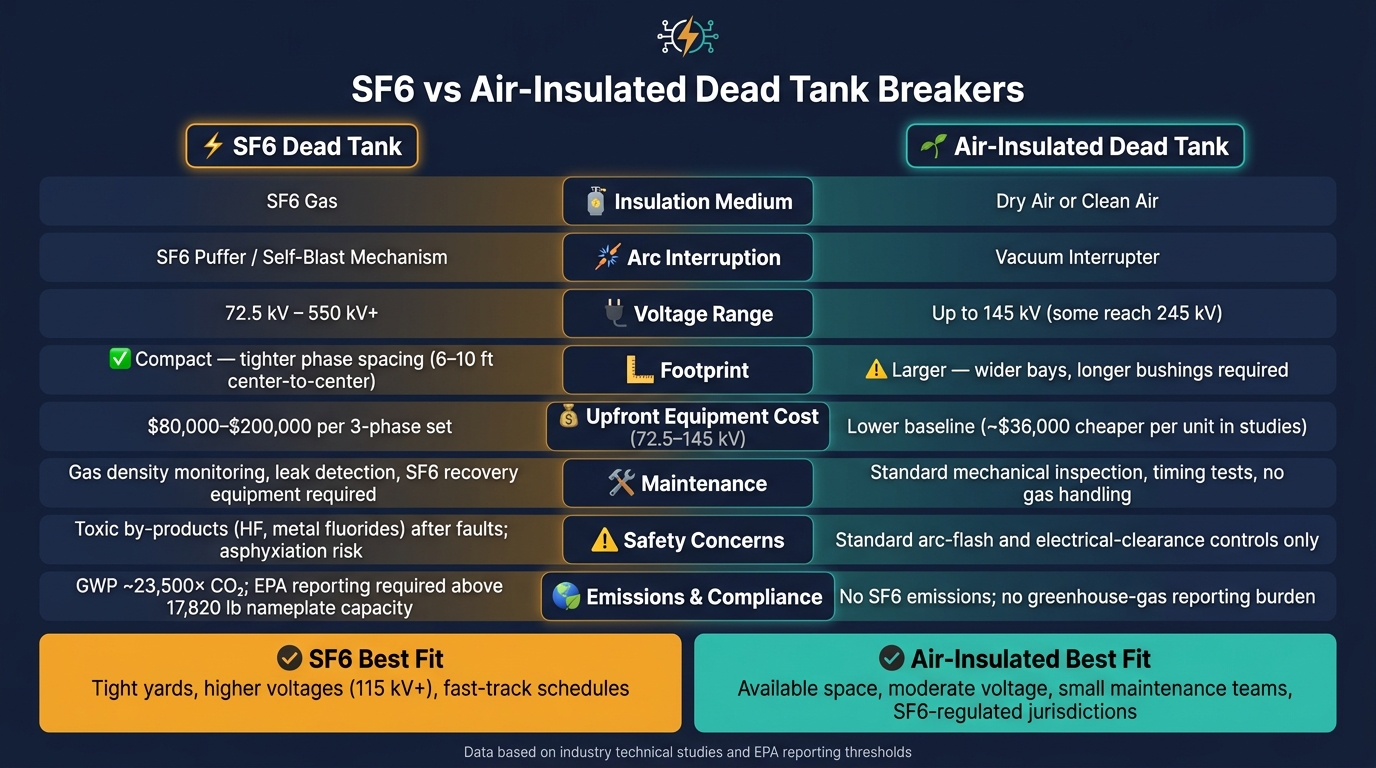
SF6 vs Air-Insulated Dead Tank Breakers: Side-by-Side Comparison
Types of Circuit Breakers | Air, Oil, Vacuum (VCB), and SF6 Explained
sbb-itb-501186b
Quick Comparison
| Check | SF6 dead tank | Air-insulated dead tank |
|---|---|---|
| Insulation medium | SF6 gas | Dry air or clean air |
| Arc interruption | SF6 mechanism | Vacuum interrupter |
| Typical voltage range | 72.5 kV to 550 kV+ | Usually up to 145 kV; some reach 245 kV |
| Footprint | Smaller | Larger |
| Maintenance | Gas monitoring, leak checks, recovery | Mechanical inspection, timing tests |
| Safety concerns | Fault by-products, confined-space gas risk | Standard high-voltage safety controls |
| Emissions/reporting | Higher burden | No SF6-specific burden |
| Best fit | Tight yards, higher voltage | Sites with room and smaller service teams |
One cost point stands out: SF6 breakers in the 72.5–145 kV range often run about $80,000 to $200,000 per three-phase set, while air-insulated designs can come in lower on unit price. But if your site is cramped, the extra land, steel, spacing, and bus work for air insulation can erase that gap.
So when I look at this choice, I don’t start with sticker price. I start with space, voltage, crew skills, compliance load, and 20- to 30-year cost.
Technical differences between SF6 and air insulated dead tank breakers
The main gaps come down to insulation strength, how faults are interrupted, physical size, maintenance work, and compliance. In plain terms, those points shape how much space you need, how much work crews take on, and what the equipment costs over time.
| Feature | SF6 Dead Tank | Air-Insulated Dead Tank (Dry Air or Clean Air, Vacuum Interrupter) |
|---|---|---|
| Insulation medium | Sulfur hexafluoride gas | Dry air or clean air mixtures |
| Arc-quenching method | SF6 puffer or self-blast mechanism | Vacuum interrupter |
| Typical voltage fit | 72.5 kV up to 550 kV and above | Typically up to 145 kV; some designs reach 245 kV |
| Short-circuit rating | 40–63 kA and above | Up to 40–63 kA at 72.5–145 kV |
| Footprint impact | Compact; tighter phase spacing | Larger tanks and longer bushings required |
| Maintenance focus | Gas monitoring, leak detection, SF6 recovery | Mechanical inspection, vacuum interrupter timing tests |
| Safety considerations | Toxic decomposition by-products after faults; asphyxiation risk in confined spaces | Standard high-voltage arc-flash and electrical-clearance controls |
| Environmental impact | SF6 has very high GWP and adds reporting/compliance burden | No greenhouse-gas emissions from the insulation medium |
Dielectric insulation and fault interruption performance
SF6 has dielectric strength of roughly 2.3 to 2.5 times that of air at the same pressure, about 89 kV/cm versus about 30 kV/cm at 1 bar. That extra strength lets manufacturers meet transmission-class requirements like 72.5 kV, 115 kV, 138 kV, and 230 kV with a more compact enclosure.
Air-insulated dead tank designs split the work between two parts. Dry air or clean air handles external insulation, while a vacuum interrupter clears the arc. Vacuum recovers dielectric strength very fast after interruption. But air has lower dielectric strength, so the breaker needs more clearance, larger tank diameters, and longer bushings to reach similar Basic Insulation Level (BIL) targets.
A 145 kV dry-air dead tank breaker can reach a lightning impulse withstand level of around 650 kV by using higher-pressure air compartments and properly sized insulators. Air-insulated vacuum dead tanks are on the market up to at least 145 kV / 40 kA / 3,150 A, and some product lines go to 245 kV / 4,000 A.
That’s the heart of it: if you need the highest voltages in a tight space, SF6 still has the edge.
Footprint, layout, and installation requirements
SF6’s stronger dielectric performance shows up right away in equipment size. At 115–145 kV, SF6 dead tanks can use phase spacing of roughly 6–10 ft center-to-center, which can keep a breaker-and-a-half or ring bus layout within a fraction of an acre. On a cramped site, that can make or break the project.
This matters most in urban infill substations, industrial plant yards, and brownfield upgrades. When the fence line is fixed and civil work gets expensive fast, every foot counts.
Air-insulated dead tanks need more room. Dry air provides about 56% of SF6’s dielectric withstand, so tank and insulator radial dimensions have to grow. In day-to-day layout terms, that means:
- Wider phase spacing
- Longer bushing profiles
- Larger bay footprints
- Wider yard layouts
For rural transmission yards or large greenfield solar and wind collector substations, that tradeoff is often manageable because land is available. In a tight urban yard, it often isn’t.
Air-insulated designs make more sense when site space and civil limits are less restrictive. On constrained sites, the space penalty is often the deciding factor.
Maintenance, safety, and emissions tradeoffs
SF6 dead tank breakers add a gas-handling layer on top of normal mechanical and electrical maintenance. Crews have to monitor gas density, run leak surveys, replace seals, and track annual leakage rates. If the breaker needs major overhaul or retirement, the SF6 has to be evacuated with special gas-handling equipment, and that adds recovery and reclamation cost.
After an internal fault, SF6 can break down into corrosive and toxic by-products, including HF and metal fluorides. That changes the maintenance job in a big way.
maintenance personnel need protective clothing, respirators, neutralizing agents, and strict disposal procedures before opening a faulted tank.
There’s also an asphyxiation risk if SF6 displaces air in confined spaces, so gas monitoring and ventilation controls are part of the work whenever crews handle the gas.
Air-insulated vacuum dead tanks avoid those SF6-only tasks. Maintenance centers on mechanical inspection, lubrication, contact wear checks, and vacuum interrupter timing tests. Some designs let operators refill the insulating air compartment without de-energizing the breaker.
The safety profile stays within normal high-voltage practice:
- Arc-flash protection
- Electrical-clearance control
It does not add the chemical hazard layer that comes with faulted SF6 equipment.
For smaller crews, that difference can matter more than the nameplate. It also feeds straight into total cost of ownership.
SF6 brings compliance work too, including federal reporting rules, and California is phasing out new SF6 gas-insulated equipment. Air insulation produces no greenhouse-gas emissions from the insulation medium, so that part of the compliance burden goes away.
Cost and total cost of ownership
For assets expected to stay in service for 20 to 30 years, the purchase price is only part of the story. Operating, maintenance, and compliance costs can end up outweighing the day-one check. That’s where the technical differences between these breaker types stop being abstract and start hitting the budget.
In practice, the biggest cost drivers are usually site size, crew capability, and SF6 compliance.
| Cost Factor | SF6 Dead Tank | Air-Insulated Dead Tank (Dry Air/Vacuum) |
|---|---|---|
| Capital equipment cost | Higher upfront cost | Lower baseline equipment cost |
| Land and civil cost | Lower footprint can reduce yard, grading, and structural steel needs | Larger phase spacing and taller structures increase civil scope |
| Maintenance labor | Requires SF6-trained crews and more specialized per-event work | Standard high-voltage skills; often handled by in-house teams |
| Gas handling equipment | Required: gas carts, leak detectors, vacuum pumps, analyzers | Not applicable |
| Compliance and reporting burden | Higher due to SF6 inventory tracking, leak programs, and emissions reporting | Minimal; no SF6-specific reporting obligations |
| Outage risk | Sealed internal insulation when gas density stays in range; pressure loss can lock out the breaker | No gas lockouts; more sensitive to yard contamination |
The widest price gap usually shows up at the start: equipment plus installation.
Upfront equipment and installation cost
At the 72.5–145 kV range, new SF6 dead tank breakers usually cost $80,000–$200,000 per three-phase set. At 245 kV, that climbs to $150,000–$300,000.
Air-insulated designs at similar ratings tend to come in lower on unit price. One technical study on 66 kV dead-tank breakers found that dry-air/vacuum units were about $36,000 cheaper per unit than similar SF6 designs, with installation savings of 5% to 10%.
That sounds simple on paper, but site conditions can flip the math.
On a tight site, SF6’s smaller footprint can cut yard area, grading, and steel needs. Air-insulated units often push cost into larger bays, more spacing, and more bus work. On a rural greenfield site with plenty of land, that tradeoff is often easy to live with. In an urban substation, though, the extra civil work for air-insulated equipment can eat up the lower equipment price in a hurry.
Installation adds another layer. It can run 40% to 70% of equipment cost. SF6 projects include gas filling and leak testing, and they may need specialty contractors beyond a utility’s normal field crew. Air-insulated breakers usually avoid that extra gas-work step, so standard substation contractors can handle most of the commissioning work.
Lifecycle cost drivers over 20 to 30 years
Over a 30-year life, SF6-specific costs build up in ways that don’t show on the first invoice.
Typical SF6 leak rates across breaker populations range from 0.2% to 2.5% of gas per year, and about 5% to 10% of breakers are leaking at any given time. Every leak can mean gas replacement, repair work, and paperwork. And because SF6 has a global warming potential of about 23,500 times that of CO₂, even small leaks can matter when carbon pricing or ESG accounting enters the picture.
For SF6 dead tank breakers, the main lifecycle cost items to model are:
- Compliance overhead: In the U.S., owners with SF6 nameplate capacity above 17,820 lb must report emissions to the EPA each year. That adds inventory tracking, data management, and annual filing labor.
- Gas handling and leak management: Gas replacement, leak repair, documentation, and the cost of specialized equipment spread across the fleet.
- End-of-life recovery: SF6 has to be evacuated with dedicated gas-handling equipment when the breaker is retired.
- Regulatory risk: Rule changes can force replacement earlier than the normal wear cycle would.
Air-Insulated Dead Tank (Dry Air/Vacuum) units don’t carry those SF6-specific reporting, gas-handling, or recovery costs.
For a 30-year asset plan, it helps to model two or three major maintenance cycles, assign labor and outage costs that match the site, and include 15- to 20-year refurbishment for both technologies. That’s often where the cost picture gets clearer, especially for sites with limited staffing or tighter operating conditions.
Matching breaker type to project conditions
Project conditions, not price alone, should drive the choice. The table below turns those tradeoffs into project-based picks.
| Project Condition | Better Fit | Why |
|---|---|---|
| Space-constrained urban substation | SF6 dead tank | Shorter clearances, tighter phase spacing, and a smaller overall breaker layout make retrofit design easier |
| Transmission-class utility yard (115 kV and up) | SF6 dead tank | Common in transmission-class yards where compactness and interruption margin matter |
| Strict SF6 jurisdiction | Air-insulated dead tank | Avoids SF6 inventory, reporting, and handling |
| Rural or suburban greenfield site | Air-insulated dead tank | More land can absorb the larger footprint, and compliance is simpler |
| Limited maintenance staff or no SF6 program | Air-insulated dead tank | Relies on standard substation mechanical and electrical maintenance instead of specialized gas handling |
| Tight outage window or fast-track schedule | SF6 dead tank | Factory-tested units shorten onsite commissioning |
| Budget-sensitive upgrade with available yard space | Air-insulated dead tank | Lower unit cost and fewer SF6 lifecycle compliance costs over a 20- to 30-year asset life |
| Extra-high-voltage application above 245 kV | SF6 dead tank | SF6 and advanced gas-mixture designs extend well beyond the range of dry-air/vacuum dead tank breakers |
Compact substations, utility yards, and regulated projects
Start with three things: yard space, voltage class, and the compliance load tied to SF6.
If the yard is too small to expand, SF6 is usually the better fit. At transmission voltages of 115 kV and above, SF6 dead tank breakers offer high dielectric strength, fast arc-quenching, and proven performance under severe fault conditions. That matters in utility yards where clearances are tight and fault-duty demands are high.
Air-insulated dead tank designs are available up to about 245 kV in some product lines, which makes them a fit for a growing share of sub-transmission work. Above that point, SF6 is still the more practical pick. And if you're working in a jurisdiction with strict SF6 rules, the decision can swing the other way fast, pushing the project toward air-insulated dead tank designs.
Limited maintenance teams and budget-sensitive upgrades
When space isn't the main issue, maintenance capability often settles the question.
If a utility or plant does not have an SF6 program in place, air-insulated dead tank breakers are simpler to live with day to day. They use standard substation inspection and testing practices, so crews can handle them without gas-specific procedures, inventory tracking, or special handling steps.
Cost also tends to follow the same pattern. When yard space is available, air-insulated designs usually come out ahead on lifecycle cost. When space is tight, though, SF6 can earn its higher upfront price by making the layout work.
Using Electrical Trader listings to compare available breaker options
Once you've settled on the right technology, move to the listings and compare units by rating and condition.
Use Electrical Trader listings to filter by:
- Voltage class
- kA rating
- Condition
- Manufacturer
Before you shortlist anything, verify the BIL, operation count, and test history. A listing may look right on paper, but those details tell you whether the breaker fits the job and the risk level you're willing to take.
Conclusion: How to choose between SF6 and air insulated dead tank breakers
The tradeoffs point to a pretty simple takeaway: pick the breaker that matches the site, the crew, and the compliance work that comes with it. In plain English, the decision comes down to space, voltage, maintenance, compliance, and lifecycle cost. The right fit depends on the full mix.
SF6 makes sense for tight yards and higher-voltage applications because it takes up less space. The flip side is extra compliance work and emissions-management effort, and both should be part of any TCO model.
Air-insulated dead tank breakers are usually a better fit when space is available and voltage needs are moderate. They avoid SF6 inventory tracking, gas handling procedures, and leak detection requirements altogether. That can make lifecycle costs easier to forecast, especially for utilities with small maintenance teams.
In day-to-day use, the choice usually comes down to four inputs:
- Space
- Voltage
- Maintenance
- Compliance
Use those four factors to break the tie. If maintenance capability is limited, air-insulated is the safer default.
FAQs
Which breaker type is better for a 230 kV project?
For a 230 kV project, SF6-insulated breakers are usually the standard pick. They offer the dielectric strength needed for high-voltage duty and are common in high-voltage substations because the design is reliable and compact.
By contrast, air-insulated technology is usually not practical at 230 kV. It needs a much larger footprint to keep the required insulation clearances in air.
How much extra space does an air-insulated dead tank breaker need?
Air-insulated dead tank breakers take up more space than gas-insulated ones. The reason is simple: air has lower dielectric strength, so the equipment needs larger insulation gaps.
The exact difference depends on the design and voltage class. But in many cases, gas-insulated switchgear can cut space needs by up to 90% compared with air-insulated systems.
That makes air-insulated breakers a better fit for sites with plenty of room.
When do SF6 reporting rules start to matter?
They matter now as oversight gets tighter. Owners should put SF6 reporting and compliance near the top of the list early, which can help cut long-term liability, especially as places like California move toward bans on SF6-insulated equipment, with major changes speeding up in January 2026.
SF6 has a global warming potential of about 24,300 times that of CO2. That means operators may need to deal with leak tracking, gas pressure reporting, and special disposal rules across a 30-year asset life.