Schneider Electric SF₆-Free Switchgear Overview
If you want the short answer: Schneider Electric AirSeT is the company’s SF₆-free medium-voltage switchgear line, built to cut SF₆ leak, handling, and end-of-life work while still covering retrofit, RMU, and primary distribution use cases.
I’d boil the article down like this: SF₆ has a global warming potential of about 24,300x CO₂, rules are getting tighter starting January 2026 in parts of the world, and U.S. owners need to think about what that means over a 30+ year asset life. AirSeT replaces SF₆ with pure air and uses vacuum interruption, with three main product lines for different jobs.
If I were screening this equipment, I’d focus on these points first:
- SM AirSeT: up to 24 kV, aimed at building and light industrial retrofits
- RM AirSeT: 12 kV/24 kV sealed RMU for utility and tight-space sites
- GM AirSeT: up to 36 kV for primary distribution and heavier-duty sites
- Digital monitoring: built-in sensing for temperature, humidity, pressure, and asset condition
- Maintenance shift: less gas-related work, more sensor-led checks
- Retrofit fit: check footprint, cable terminations, ratings, and U.S. orderability
- Lifecycle cost: compare day-one price against no SF₆ gas handling, no leak tracking, and less decommissioning work
AirSeT: SF₆ Free, Digitally Native Medium Voltage Equipment | Schneider Electric
sbb-itb-501186b
Quick Comparison
| Product | Main Use | Voltage | Best For | Main Check Before Buying |
|---|---|---|---|---|
| SM AirSeT | Secondary distribution | Up to 24 kV | Commercial buildings, hospitals, light industry | Retrofit fit with existing gear |
| RM AirSeT | Ring main unit | 12 kV/24 kV | Utility networks, compact substations, coastal sites | Sealed design, automation needs |
| GM AirSeT | Primary GIS | Up to 36 kV | Data centers, mining, oil & gas, renewables, heavy industry | Fault duty, current rating, site specs |
My takeaway: this is less about hype and more about planning. You’re comparing three things at once: ratings, fit, and cost over time. If the gear matches your U.S. project specs, AirSeT gives you an SF₆-free path without changing the basic job the switchgear has to do.
Schneider Electric SF₆-Free Portfolio and Core Specifications
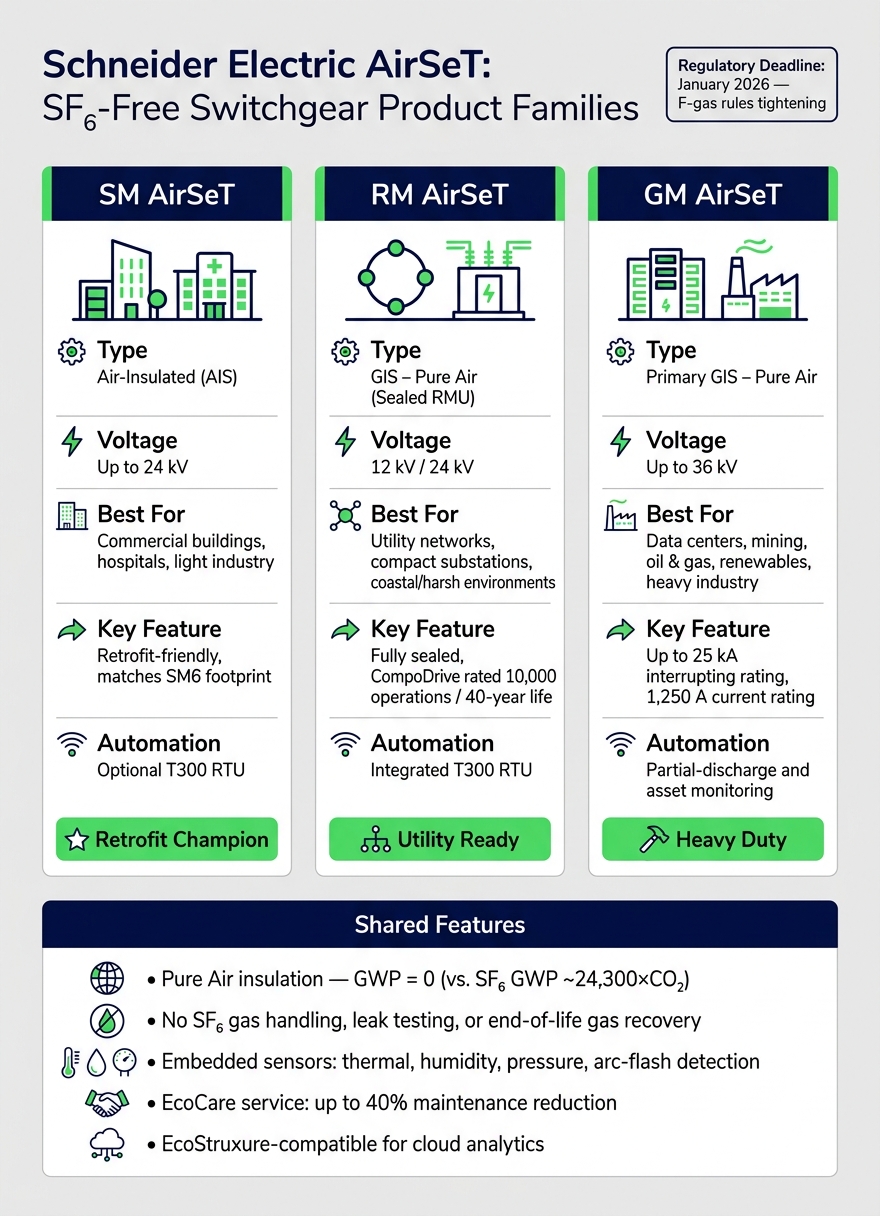
SF₆ vs. SF₆-Free Switchgear: AirSeT Product Comparison
SM AirSeT, RM AirSeT, and GM AirSeT
Schneider Electric’s AirSeT line has three product families, each aimed at a different part of the distribution network. The main differences come down to form factor, voltage class, and where the gear is meant to be used.
| Product | Type | Voltage Range | Best Fit |
|---|---|---|---|
| SM AirSeT | Air-Insulated (AIS) | Up to 24 kV | Commercial buildings, hospitals, light industry |
| RM AirSeT | Gas-Insulated RMU | 12 kV and 24 kV | Utilities, compact substations, coastal/harsh environments |
| GM AirSeT | Primary GIS | Up to 36 kV | Data centers, mining, oil & gas, heavy industry, renewables |
Taken together, the lineup gives buyers one SF₆-free platform that can cover retrofit projects, utility use cases, and primary distribution needs.
The SM AirSeT is built as a retrofit-friendly follow-on to Schneider Electric’s older SM6 range. It keeps the same footprint and three-position interface, which can make swap-outs much simpler in commercial and industrial buildings. That matters because retrofits often get messy fast when dimensions or connections change.
The RM AirSeT is fully sealed. That makes it a strong fit for compact utility applications and places where moisture or salt exposure is part of the job, like coastal sites.
The GM AirSeT is aimed at primary distribution and more demanding industrial settings. That includes data centers, mining, oil & gas, heavy industry, and renewables. The Performance variant is rated up to 25 kA interrupting rating and 1,250 A current rating.
Design Features That Affect Installation and Maintenance
Across the portfolio, one of the biggest day-to-day advantages is that the equipment comes factory-sealed. In plain terms, that means no on-site gas filling, no leak testing, and no special gas handling during installation.
Because AirSeT uses Pure Air instead of SF₆ or a proprietary gas blend, end-of-life handling is simpler too. It avoids gas recycling and recovery requirements at that stage. For teams thinking past first install, that can change the workload in a pretty direct way.
RM AirSeT also uses the CompoDrive mechanism, which is rated for 10,000 mechanical operations and a 40-year service life. AirSeT models are built with digital features from the start, including embedded sensors for temperature, humidity, and pressure monitoring. Schneider Electric says EcoCare can reduce maintenance by up to 40%.
U.S. Voltage Classes, Standards, and Sourcing Considerations
For U.S. buyers, it’s smart to check IEC 63360 compliance first, then confirm any IEEE and utility-specific requirements that apply to the project. That extra check matters because meeting one standard doesn’t always mean you’re covered on local utility specs.
For primary GIS in particular, buyers should verify voltage, current, and interrupting ratings before procurement. Those numbers shape the lifecycle tradeoffs discussed next.
Environmental and Day-to-Day Performance
Emissions, End-of-Life Handling, and Compliance Pressure
Beyond the emissions story, the big issue is simple: how does AirSeT hold up in day-to-day use?
On the emissions side, the case is clear. AirSeT uses pure air instead of SF₆, which removes a gas with a global warming potential of about 24,300 times that of CO₂. It also cuts out the F-gas compliance burden, and that matters more now because rules are getting tighter in both the U.S. and the EU, with changes starting in January 2026.
In practice, using pure air means operators no longer have to deal with SF₆ leak checks or pressure reporting. Over the life of the asset, that takes a chunk out of compliance work.
At end of life, the difference is just as direct. There’s no need for gas recovery, which can lower decommissioning cost and trim the logistics burden. Schneider Electric says its AirSeT technology has helped avoid about 2.5 million metric tons of CO₂e compared with SF₆-based options.
Reliability, Maintenance, and Service Expectations
AirSeT also changes the maintenance model. Instead of focusing on gas handling, it leans on condition-based monitoring. Embedded sensors keep watch on thermal, humidity, and partial discharge conditions, taking the place of periodic manual gas checks.
Pair AirSeT with Schneider Electric’s EcoCare service program, and maintenance needs can drop by as much as 40%. That doesn’t mean maintenance disappears. It means the work shifts away from routine gas-related tasks and toward sensor-led oversight.
SF₆ vs. SF₆-Free Switchgear: Key Tradeoffs
The table below sums up the differences that matter most for U.S. buyers weighing SF₆-based gear against Schneider Electric’s AirSeT line.
| Factor | SF₆-Based Switchgear | Schneider Electric AirSeT (SF₆-Free) |
|---|---|---|
| Global Warming Impact | GWP ~24,300 | GWP = 0 (pure air) |
| Leak Management | Requires monitoring | No specialized leak monitoring |
| Regulatory Burden | Ongoing reporting and leak tracking | No SF₆/F-gas burden |
| Maintenance Approach | Periodic gas pressure checks | Condition-based monitoring via digital sensors |
| End-of-Life Handling | Costly gas recovery and specialized decommissioning | No gas recovery needed at end of life |
| SF₆ decomposition byproducts | Possible during arc interruption | None |
| Operator Training | Standard | No extensive retraining; same three-position interface |
| Gas-management burden | Higher | Lower; no specialized gas supply chain |
Performance on paper is one thing. The bigger test is whether the digital features and use case line up with the job at hand.
Digital Functions, Applications, and Project Fit
Built-In Digital Features and Smart Grid Functions
AirSeT does more than cut maintenance work. Its digital layer also helps with remote switching and grid automation.
The switchgear comes with a built-in sensor set that includes wireless thermal, humidity, and optical sensors for condition monitoring and arc-flash detection. That gives operators a better view of equipment health, supports condition-based maintenance, and helps teams respond to faults faster.
On the automation side, the PowerLogic (Easergy) T300 RTU is integrated into RM AirSeT and offered as an option on SM AirSeT. It supports 24/7 remote monitoring, fault isolation, and automatic service restoration. Sensor data can also flow into Schneider Electric's EcoStruxure architecture for cloud-based analytics and predictive maintenance insight.
There’s also a safety angle here. Operators can switch locally or remotely through mobile apps and connected platforms, which helps keep them outside the arc-flash zone.
Use Cases in Utilities, Industry, Data Centers, and Campuses
The three AirSeT families serve different parts of the distribution network. They’re not meant to do the same job.
SM AirSeT fits retrofit-heavy commercial and industrial sites, including hospitals, airports, and data centers, where modularity and a compact footprint matter.
RM AirSeT is built for utility ring-main networks and tougher site conditions. Its sealed-tank GIS design works well in humid areas and coastal locations, and its CompoDrive mechanism is rated for 10,000 operations.
GM AirSeT targets primary distribution in large industrial buildings, critical infrastructure, data centers, and substations. It supports voltages up to 36 kV and adds partial-discharge and asset monitoring.
Those differences shape where each family fits in a network and what buyers should check before making a selection.
Application Comparison by Product Family
| Feature | SM AirSeT | RM AirSeT | GM AirSeT |
|---|---|---|---|
| Distribution Level | Secondary distribution | Utility distribution (RMU) | Primary distribution |
| Insulation Type | Air-insulated (AIS) | GIS - pure air | GIS - pure air |
| Voltage Range | Up to 24 kV | Up to 24 kV | Up to 36 kV |
| Automation Option | Optional T300 RTU | Integrated T300 RTU | Partial-discharge and asset monitoring |
| Key Digital Features | Thermal, environmental, arc flash sensors | Thermal, environmental, remote control | Thermal, environmental, partial discharge |
| Design Focus | Modularity and retrofit flexibility | Compactness and grid resilience | High power density and reliability |
These role differences set up the procurement checks in the next section.
Procurement, Retrofit Planning, and Final Takeaways
What U.S. Buyers Should Verify Before Purchase
Once you've looked at performance and digital features, the purchase decision gets pretty practical: ratings, fit, and cost over time.
Before you move ahead with any AirSeT product, verify the exact U.S. model, voltage class, current rating, and interrupting duty your site needs. You’ll also want to confirm U.S. orderability, expected lead times, and whether the cable terminations line up with your current setup. On top of that, make sure the product family fits your site's temperature, humidity, and enclosure conditions.
Cost needs a longer view than the sticker price. SF₆-free equipment removes gas handling, leak testing, and end-of-life recovery from the equation. SM AirSeT is designed for a 40-year service life, and Schneider Electric's EcoCare service plan can cut maintenance needs by up to 40%. Over the life of the asset, that can help make up for a higher day-one cost.
Retrofit Strategy, Mixed Fleets, and Equipment Resale Channels
For retrofit work, the big question is simple: Will the new gear drop into the old setup without a major redesign? That’s where fit matters.
SM AirSeT matches the physical dimensions of legacy SM6 units, and GM AirSeT remains nearly identical in layout to its SF₆ predecessors. In plain terms, many facilities can replace equipment without reworking the full substation layout.
Mixed fleets can also work well during a phased transition. Motorized operation and familiar three-position interfaces help keep retraining needs low. And EcoStruxure monitoring gives teams one way to track both older and newer assets during the changeover.
If your organization is retiring SF₆ equipment in stages, resale can help clear space and recover part of the spend. Electrical Trader provides a marketplace for buying and selling surplus power distribution equipment during modernization.
Key Points for Decision-Makers
For most buyers, the checklist is pretty clear:
- Verify ratings
- Confirm retrofit fit
- Compare lifecycle cost
The case for buying is fairly direct. SF₆-free switchgear cuts environmental burden while keeping the day-to-day usefulness operators need in existing networks: lower emissions, simpler operation, and less regulatory risk as compliance timelines get tighter on both sides of the Atlantic.
FAQs
Which AirSeT model fits my project?
Choose based on your distribution setup and where the gear will be installed:
- GM AirSeT: for primary distribution, industrial buildings, and critical infrastructure
- RM AirSeT: for secondary distribution and ring main unit needs, especially in harsh conditions
- SM AirSeT: for secondary power distribution in industrial and commercial buildings
Across the lineup, all models use pure air instead of SF₆ and include digital monitoring.
Will AirSeT work in an existing switchgear lineup?
Yes. AirSeT is built as a drop-in replacement for existing switchgear, which helps cut down on facility changes.
For example, SM AirSeT uses the same footprint and the same connection point positions as the earlier SM6 model. That makes installation, replacement, or extension in existing electrical rooms much simpler. It also uses a familiar operating interface, which helps reduce disruption.
Is SF₆-free switchgear worth the higher upfront cost?
Yes. It’s often a smart spend when you look at the total cost of ownership, not just the sticker price.
The upfront price can be higher. But SF₆-free switchgear cuts out extra costs tied to SF₆ gas handling, recycling, and end-of-life treatment. It can also last longer and need less maintenance.
When you look at the full lifecycle, savings can reach 20% to 30%.