SF6-Free vs. SF6 Circuit Breakers: Environmental Impact
If I want the lower climate-impact option, I’d pick SF6-free in most cases. SF6 has a 100-year GWP of about 23,500 to 24,300 times CO2 and can stay in the air for more than 1,000 years. Even small leaks during use, service, and removal can add up over a breaker life of 30 to 40 years.
Here’s the short version:
- SF6 breakers are compact and proven, but leak risk exists from fill to disposal.
- Vacuum + dry air designs remove SF6 leak risk and make end-of-life work simpler.
- Lower-GWP gas blends cut climate impact a lot, but they still use fluorinated gas.
- For buyers, the main trade-off is space, voltage range, gas type, and disposal needs.
- For many sites, the choice affects Scope 1 emissions for decades.
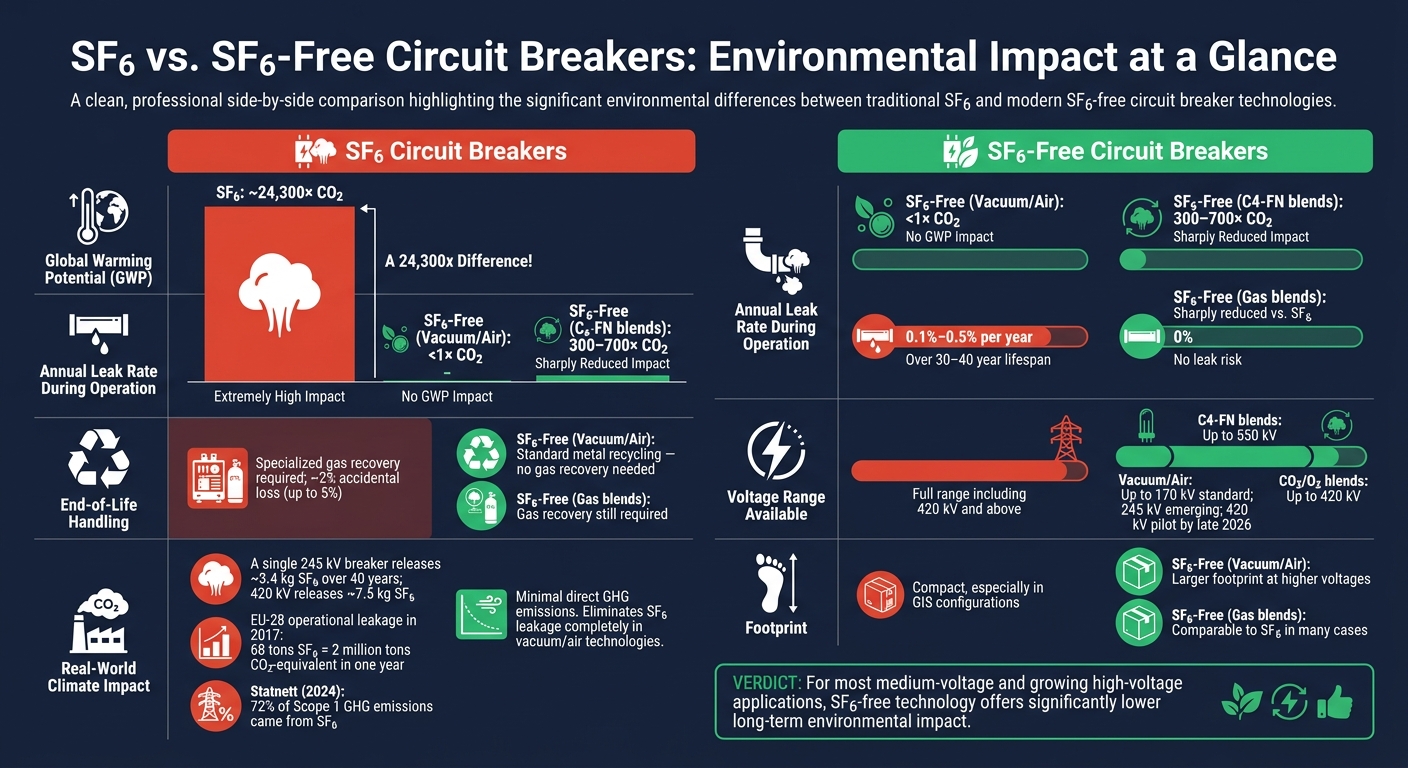
SF6 vs. SF6-Free Circuit Breakers: Environmental Impact Comparison
Alternatives of SF6 Gas | The End of SF6? Sustainable Alternatives for High-Voltage Power Systems
sbb-itb-501186b
Quick Comparison
| Criteria | SF6 Breakers | SF6-Free Breakers |
|---|---|---|
| Climate impact of gas | Very high | Very low with vacuum/air; much lower with blends |
| Leak risk | Yes, across the life cycle | None for vacuum/air; lower for blends |
| Footprint | Often smaller | Can be larger at higher voltages |
| End-of-life work | Gas recovery needed | Simpler for vacuum/air; gas recovery still needed for blends |
| Best fit | Tight spaces, legacy layouts, high-voltage use | Buyers focused on lower emissions and simpler disposal |
What I take from the article is simple: SF6 still works well technically, but its leak profile is hard to ignore. If you’re buying for the long term, it makes sense to check the gas type, voltage fit, service needs, PFAS status, and disposal steps before you commit.
Environmental Profile of SF6 Circuit Breakers
SF6 circuit breakers carry the heaviest emissions load in this comparison because releases can happen at every stage of the life cycle. For many utilities, SF6 leaks make up a big share of Scope 1 emissions.
Where SF6 Emissions Occur
The core problem isn’t one dramatic leak. It’s the steady drip of emissions from production all the way to retirement.
SF6 production adds about 122 kg of CO2e per kilogram produced. Initial filling losses average about 0.5% and can reach 1.6%. During service, leaks pass through seals and joints at 0.1%–0.5% per year. That may sound small at first glance, but over a 30- to 40-year service life, those yearly losses stack up. Retirement is the highest-loss stage: vacuum recovery typically loses around 2%, and in some cases reaches 5%.
Put simply, SF6 emissions show up during production, filling, operation, and retirement. The biggest losses come from operation over time and from gas recovery at end of life.
| Lifecycle Phase | Typical Emission Rate | Notes |
|---|---|---|
| Gas Manufacturing | 122 kg CO2-eq per kg SF6 | Embodied carbon before installation |
| Initial Filling | ~0.5% (range: 0.1%–1.6%) | Accidental release during commissioning |
| Annual Operation | 0.1%–0.5% per year | Cumulative over 30–40 years |
| End-of-Life Recovery | ~2.0% (up to 5.0%) | Losses during gas recovery |
Life-Cycle Impact and Regulatory Pressure
Over a full service life, these losses become hard to ignore. A single 245 kV SF6 circuit breaker is estimated to release an average of 3.4 kg of SF6 over its 40-year life cycle, while a 420 kV unit releases 7.5 kg. In 2017, operational leakage from electrical equipment across the EU-28 alone reached 68 tons of SF6. That equals 2 million tons of CO2-equivalent in just one year.
The main issue is cumulative leakage, not just one-time releases. That’s why regulation is pushing utilities to look at SF6 alternatives earlier in procurement. Buyers are now comparing SF6 and SF6-free options before a project locks in decades of emissions. With equipment staying in service for so long, the choice made at purchase can shape emissions for the next 30 to 40 years.
Environmental Profile of SF6-Free Circuit Breakers
SF6-free breakers cut emissions in one of two ways: they either remove SF6 completely or swap it for a gas with a much lower GWP. That split matters. Some designs get rid of fluorinated gas altogether. Others keep a gas-based setup but with far less climate impact than SF6.
Compared with SF6 breakers, these options cut or remove gas-related emissions. But there’s no perfect one-size-fits-all answer. The trade-off usually comes down to footprint, climate impact, and operating range.
Vacuum and Air-Insulated Breakers
Vacuum interrupters put out the arc inside a sealed vacuum chamber, so SF6 doesn’t play any role in interruption. For insulation, these systems usually use dry air, nitrogen, or oxygen - gases with a GWP of less than 1. That means no SF6 leak risk during service, and end-of-life handling is much simpler. Pure-air designs are already in commercial use.
Vacuum technology is also moving into higher voltages. It now reaches transmission-level ratings up to 170 kV, and pilot installations aimed at 420 kV are expected by late 2026. The catch is space. At higher voltages, air and vacuum setups often need more room than compact SF6 gas-insulated switchgear (GIS), which can be a problem in dense substations or urban sites.
When voltage needs or tight layouts rule out pure-air designs, lower-GWP gas blends become the fallback.
Alternative Gas Breakers With Lower GWP
For high-voltage use, lower-GWP gas blends tend to hold onto compact layouts better than air-only systems. One common choice is fluoronitrile (C4-FN), often mixed with CO2 and O2. These blends have a GWP of about 300 to 700 - still much lower than SF6 from a gas-emissions standpoint. So yes, they cut emissions, but they don’t remove them.
C4-FN blends can get close to SF6-style compactness while sharply cutting gas-related climate impact. That’s a big deal in retrofit jobs where the available space is fixed. In late 2023, U.S. energy provider Eversource completed the first U.S. deployment of an SF6-free 420 kV dead tank breaker at a 345 kV substation in New England using C4-FN technology.
Not all blends behave the same in cold weather. C5-FK blends have tighter low-temperature limits, while C4-FN blends hold up better in colder conditions.
So the choice is pretty simple in theory, even if it gets messy in practice: environmental simplicity on one side, compact equipment on the other.
| Technology | Typical GWP | Voltage Range | Key Trade-off |
|---|---|---|---|
| Vacuum + dry air/N2 | < 1 | Up to 170 kV (standard); 245 kV (emerging) | Larger footprint at higher voltages |
| C4-FN blends | 300–700 | Up to 550 kV | PFAS classification; higher GWP than air |
| C5-FK blends | < 1 (pure) / ~1 (mix) | Up to 170 kV | Temperature limits above +41°F (+5°C) |
| CO2/O2 blends | < 1 | Up to 420 kV | Similar dimensions to SF6 |
(Sources:)
C4-FN may draw more PFAS-related scrutiny in the future. For buyers, the environmental decision usually comes down to this: zero-SF6 designs with more space needs or lower-GWP blends that fit older form factors.
SF6-Free vs. SF6 Circuit Breakers: Side-by-Side Comparison
The environmental gap comes down to three things: GWP, leak risk, and end-of-life handling. That’s where the contrast is easiest to see.
| Criteria | SF6 Circuit Breakers | SF6-Free Circuit Breakers |
|---|---|---|
| Global warming potential | ~24,300× CO2 | < 1 for vacuum/air; 300–750 for C4-FN blends |
| Leakage risk | Ongoing leak risk during service life; 0.1%–0.5% annual leakage typical | Eliminated for vacuum/air; sharply reduced for alternative gas designs |
| Life-cycle climate impact | Dominated by operational leakage and end-of-life recovery losses | Lower overall; more impact moves to manufacturing |
| End-of-life handling | Strict gas recovery required; ~2% accidental loss typical during decommissioning | Standard metal recycling for vacuum designs; gas recovery still needed for fluorinated alternatives |
GWP, Leakage Risk, and End-of-Life Handling: Key Differences
GWP is the biggest separator here. SF6 has roughly 24,300 times the warming impact of CO2. So even a small leak can carry an outsized climate cost.
Vacuum and air-based designs cut that figure to almost zero. C4-FN blends also bring it down sharply, with more than a 96% reduction versus SF6.
End-of-life handling is the other big issue. Retiring SF6 equipment calls for specialized recovery gear and careful procedures to prevent accidental releases. Those releases are modeled at about 2% of total gas volume during decommissioning. Vacuum equipment avoids that step, which makes disposal much more straightforward. In most cases, standard metal recycling applies.
Long-Term Trade-Offs for Utilities, Plants, and Commercial Facilities
For many operators, this isn’t just about engineering. It hits emissions reporting too.
In 2024, Norwegian transmission operator Statnett said that 72% of its direct Scope 1 greenhouse gas emissions came from SF6. That kind of concentration matters when a company is tracking Scope 1 totals or facing public reporting rules.
SF6-free equipment shifts more of the climate impact to manufacturing instead of day-to-day operation. For utilities, plants, and commercial sites with internal carbon goals, that can be easier to plan around and account for. It also changes the buying decision. Procurement teams can use the EPA's SF6 Alternatives Benefits Calculator to compare life-cycle greenhouse gas impacts.
Procurement Considerations and Conclusion
What to Check Before Buying or Replacing a Circuit Breaker
Once you’ve sorted out the environmental differences, procurement gets pretty practical: match the breaker to the job.
Start with the voltage class and interrupting rating. Vacuum technology is already well established for medium voltage and is now sold up to 145 kV. Above that point, C4-fluoronitrile (C4-FN) gas mixtures are among the main options, and SF6-free GIS is available up to 550 kV.
After that, check a few key points:
- Insulating medium - confirm whether the unit uses vacuum, clean air, or a fluorinated gas.
- PFAS status - verify whether the design includes fluorinated gases or PFAS-related parts.
- Service requirements - check whether gas recovery, leak inspections, or special handling are needed.
- Regulatory fit - make sure the breaker lines up with current rules and any local changes on the horizon.
- Lifecycle cost - compare purchase price, maintenance, and end-of-life costs.
Electrical Trader lists new and used circuit breakers across voltage classes, which gives buyers a way to compare SF6 and SF6-free options during asset planning.
Conclusion: Which Option Has the Lower Environmental Impact
Once technical fit and compliance are covered, the main issue is simple: which option leads to less long-term environmental impact.
SF6 circuit breakers have a long track record and are used on a large scale. But the environmental tradeoff is hard to ignore. SF6 has a GWP 24,300 times higher than CO2, there is leakage risk during the unit’s service life, and end-of-life handling brings added complexity because the gas must be recovered.
SF6-free options - especially vacuum and clean-air designs - remove most of those operating emissions and also avoid end-of-life gas recovery in many cases. For most medium-voltage uses, and more and more high-voltage ones, SF6-free technology is the better long-term environmental pick. The right choice for a given project still depends on voltage needs, available footprint, and budget, but both regulation and industry investment are moving in the same direction.
FAQs
How do I know if SF6-free fits my voltage needs?
Compare your project needs with what the market offers for each voltage class.
For medium-voltage applications up to 52 kV, SF6-free options are widely available and commercially mature. For high-voltage applications above 52 kV, availability is growing, with options up to 550 kV.
In every case, make sure the rated voltage, current, and interrupting capacity line up with your grid needs and local utility standards.
Are SF6-free breakers more expensive over time?
Not usually. SF6-free circuit breakers can cost 5% to 20% more upfront than SF6-filled models, but the long-term math often looks better.
Here’s why: SF6-based equipment can bring a steady stream of extra costs. That can include record-keeping, regulatory audits, gas weighing and refilling, staff training, and protective safety gear.
SF6-free breakers avoid much of that overhead. So while the purchase price may be higher at the start, total lifecycle costs are often lower over time.
Do lower-GWP gas blends still raise PFAS concerns?
Yes. Lower-GWP gas blends can still trigger PFAS concerns because many of them use fluorinated gases that are classified as PFAS, or closely tied to PFAS.
So while these blends cut global warming potential compared with SF6, they can still be viewed as high risk for a simple reason: they stick around in the environment for a long time.
If the main goal is to avoid forever chemicals altogether, vacuum-based technologies that use dry air, N2, or O2 are usually the only options that remove fluorinated gases from the equation entirely.