




Sustainable Insulation Materials for High Voltage Systems
The search for greener insulation in high-voltage systems is reshaping the power industry. Conventional materials like SF₆ gas and XLPE insulation are environmentally problematic, while new alternatives aim to meet performance needs and reduce ecological impact. Here's a quick look at the leading options:
- HFC-Based Gas Insulators: Temporary replacements for SF₆ with lower global warming potential but still environmentally impactful.
- Polyethylene Composites: Recyclable thermoplastics and nanocomposites that improve dielectric and thermal properties.
- Biodegradable Polymers: Plant-based solutions offering strong electrical performance and reduced waste.
- Nanocomposites: High-performance materials with enhanced breakdown strength and heat management, though costly.
Each option balances performance, cost, and ecological concerns differently, making material choice critical for modern power systems.
DEIS YP Monthly Webinar: Sustainable Insulation for Power Cables by Detlef Wald
sbb-itb-501186b
1. HFC-Based Gas Insulators (HFC-227ea and HFC-125)
Hydrofluorocarbons like HFC-227ea and HFC-125 have been considered as possible replacements for sulfur hexafluoride (SF6), a gas notorious for its massive global warming potential (GWP) of 23,500 and an atmospheric lifetime stretching over 3,200 years. Initially regarded as greener options, these HFCs now highlight some critical environmental and performance challenges.
Dielectric Strength
When it comes to dielectric performance, the data for HFC-227ea and HFC-125 is still sparse, especially under high-voltage conditions and regarding their dissociation products. For context, traditional materials like porcelain offer a dielectric strength of 4–10 kV/mm and maintain stability around 60 kV/cm. This lack of comprehensive testing for HFCs leaves some uncertainty about their reliability in demanding applications.
Environmental Impact
While once marketed as eco-friendlier alternatives, HFCs are now seen as less viable due to their considerable global warming impact. For instance, fluoronitrile-based mixtures (C4-FN) have emerged as far cleaner options, reducing GWP by over 99% compared to SF6. The electrical industry is increasingly focused on "sustainable substitution" to align with global net-zero goals, making HFCs more of a temporary fix than a permanent solution.
Cost Efficiency
The economic appeal of HFCs often lies in their ability to save space. In high-voltage setups, where every square meter can cost around $100,000, compact gas-insulated switchgear offers significant cost advantages, particularly in urban and offshore settings. However, the limited data on HFC performance and the growing shift toward ultra-low GWP alternatives cast doubt on their long-term cost-effectiveness. Utilities must weigh these uncertainties carefully as they plan infrastructure that could last decades.
"When we manage to reduce a high-voltage installation to half of the space, we have made big bucks." - Prof. Peter Vaessen, Head of High Voltage Technologies Group, TU Delft
Ultimately, HFCs appear to be a stepping stone rather than a final answer, paving the way for the development of more sustainable insulation technologies.
2. Polyethylene and Advanced Polymer Composites
Polyethylene-based insulators, once primarily reliant on non-recyclable XLPE, are now shifting toward recyclable thermoplastics. This move addresses waste reduction while improving material performance. Let's explore how these innovations impact key properties.
Dielectric Strength
Through molecular engineering, advanced polymer composites achieve exceptional dielectric strength. By reducing polymer free volume and introducing traps, researchers can limit electron avalanches, which are a primary cause of electrical breakdowns. For example, polypropylene-based nanocomposites are being developed for HVDC cable insulation. These materials use interfacial deep traps to suppress space charge accumulation, a common issue leading to high-voltage breakdowns. Inorganic fillers like ZnO or SiC are added to these nanocomposites to enhance the polymer-nanoparticle interface, resulting in better breakdown strength compared to traditional polymers.
Thermal Stability
Improving dielectric properties is only part of the equation - thermal stability is equally important. Branched low-density polyethylene (LDPE) begins to lose stability at around 212°F (100°C). This limitation led to the adoption of cross-linking, as XLPE can withstand higher temperatures and maintain its structure under thermal stress. While linear high-density polyethylene (HDPE) offers a higher melting point than LDPE, its use in high-voltage systems is still under development. To address these challenges, advanced composites are being designed with improved thermal conductivity. This helps dissipate heat more effectively, avoiding localized hot spots that could lead to electrical failure.
Environmental Impact
The production of traditional XLPE involves energy-intensive processes like degassing and requires specialized facilities for catenary cross-linking. Thermoplastic polyethylene materials, on the other hand, eliminate these steps, making them more energy-efficient and recyclable. Another promising development is self-healing polymers, which use microcapsules or superparamagnetic nanoparticles to autonomously repair electrical damage. This innovation could significantly extend the lifespan of insulation materials and reduce waste.
Cost Efficiency
Polymer composites not only enhance performance but also offer economic advantages over their lifecycle. Producing XLPE involves costly cross-linking facilities and lengthy degassing processes, especially for large cables. In contrast, thermoplastic alternatives boast quicker manufacturing cycles and lower energy requirements. The real financial benefit lies in their recyclability. Thermoplastics support a circular economy, allowing utilities to recover value from decommissioned cables instead of discarding them. While nanocomposites may have higher initial costs due to specialized fillers, they can reduce system size and improve reliability - key considerations for long-term infrastructure planning.
3. Biodegradable Polymer Solutions
Bio-based polymers are emerging as a strong contender in the quest for sustainable alternatives, offering both electrical and environmental advantages. Derived from plants, these polymers provide insulation that competes with petroleum-based materials, addressing ecological concerns while meeting the high demands of modern electrical and thermal applications.
Dielectric Strength
Bio-based epoxy resins have shown impressive electrical performance, thanks to advancements in molecular engineering. For instance, in December 2024, researchers at the Ningbo Institute of Materials Technology and Engineering (Chinese Academy of Sciences) created a bio-based electrotechnical epoxy resin (DGEMT) using magnolol, a compound extracted from magnolia bark. The resulting Al₂O₃/DGEMT composites achieved an AC breakdown strength of 35.5 kV/mm - 15.6% higher than traditional petroleum-based Al₂O₃/DGEBA composites. Additionally, these materials exhibited a dielectric loss (tanδ) of 0.0046, marking a 20.7% reduction compared to conventional options. Beyond electrical performance, these materials also meet high thermal standards, as explored in the next section.
Thermal Stability
Effective heat management is essential for ensuring the reliability of high-voltage systems. The magnolol-based DGEMT resin incorporates double crosslinked points (allyl and phenolic hydroxyl groups), which help maintain structural stability and consistent breakdown strength even at elevated temperatures. Furthermore, the Al₂O₃/DGEMT composite boasts a thermal conductivity of 1.19 W·m⁻¹·K⁻¹, a 52.6% improvement over conventional materials.
Environmental Impact
The shift to bio-based polymers contributes to carbon neutrality goals in power grid construction. Unlike petroleum-derived resins, magnolol-based materials are sourced from renewable plant resources, reducing the ecological impact of high-voltage infrastructure. These materials support eco-friendly practices across their entire lifecycle, from production to disposal, aligning with the industry’s growing focus on sustainability. While challenges remain - such as establishing global standards and proving long-term reliability under extreme conditions - current data confirms the readiness of these materials for use in environmentally friendly power equipment.
Cost Efficiency
Although bio-based polymers may have higher initial costs, their enhanced performance offers significant value. The 15.6% boost in dielectric strength and the 52.6% increase in thermal conductivity enable more compact designs and could extend the lifespan of equipment. Additionally, these materials share similar mechanical and processing properties with traditional DGEBA resins, allowing manufacturers to use existing production setups without major investments. As production scales up and renewable feedstock supply chains grow, these sustainable alternatives are expected to become more cost-effective, paving the way for future advancements in nanocomposites and carbon-based materials.
4. Nanocomposite and Carbon-Based Materials
Nanocomposites improve insulation by incorporating nanoscale fillers that enhance electrical properties. Building on developments in polymer composites and biodegradable materials, nanocomposites combine excellent dielectric and thermal performance with improved recyclability. These materials introduce "trap sites" at the interface between the polymer matrix and nanoparticles, which help reduce space charge buildup and block high-energy electron transport. Even small amounts of fillers can lead to significant improvements.
Dielectric Strength
The dielectric performance of nanocomposites depends on the type and concentration of nanofillers. Aluminum oxide (Al₂O₃) stands out as a cost-effective and efficient filler. For example, adding just 1.0 wt.% of functionalized α-Al₂O₃ to crosslinked polyethylene (XLPE) increases DC breakdown strength from 220 kV/mm to 320 kV/mm - a remarkable 45% improvement. Similarly, introducing 0.1 wt.% of nanohexagonal boron nitride (h-BN) enhances DC breakdown strength by 39%.
Carbon-based materials, such as graphene oxide, also show promise, but their dispersion must be carefully controlled. If the filler concentration exceeds 1.0–2.0 wt.%, agglomeration can occur, forming conductive paths that reduce dielectric strength. Alongside these dielectric enhancements, managing heat is equally important.
Thermal Stability
Nanocomposites also offer superior thermal management. While standard XLPE operates at 194°F (90°C), adding nanofillers like Al₂O₃ and boron nitride improves thermal conductivity, allowing better heat dissipation. These enhanced materials can maintain their properties at temperatures as high as 266°F (130°C) for up to 36 hours, while minimizing shrinkage under thermal stress. Carbon-based fillers like carbon nanotubes (CNTs) and graphene are particularly effective at dissipating localized heat, helping to prevent thermal runaway, which could lead to insulation failure. Additionally, their chemical stability provides an advantage over metal-based nanoparticles.
Environmental Impact
Nanocomposites contribute significantly to decarbonization by supporting high-voltage direct current (HVDC) transmission. HVDC systems efficiently connect renewable energy sources, such as offshore wind farms and desert solar arrays, to the grid. Unlike crosslinked XLPE, nanocomposites using recyclable thermoplastic matrices address recycling challenges. Research is increasingly focusing on recyclable thermoplastic polymers that avoid crosslinking byproducts while maintaining excellent mechanical and thermal properties. Some advanced nanocomposites even include self-healing features, such as superparamagnetic nanoparticles or microcapsules, which autonomously repair electrical damage. This capability can extend service life and reduce material waste.
Cost Efficiency
The performance and environmental benefits of nanocomposites also lead to cost savings. Al₂O₃ is particularly popular due to its low cost, high electrical resistivity, and thermal conductivity. Improved insulation performance reduces power loss during long-distance transmission, enhancing grid efficiency. While precise dispersion of nanofillers can increase initial costs, the substantial gains in breakdown strength and thermal management make this investment worthwhile. Even at low concentrations, these materials deliver impressive results, offering a strong balance between performance and cost.
Advantages and Disadvantages
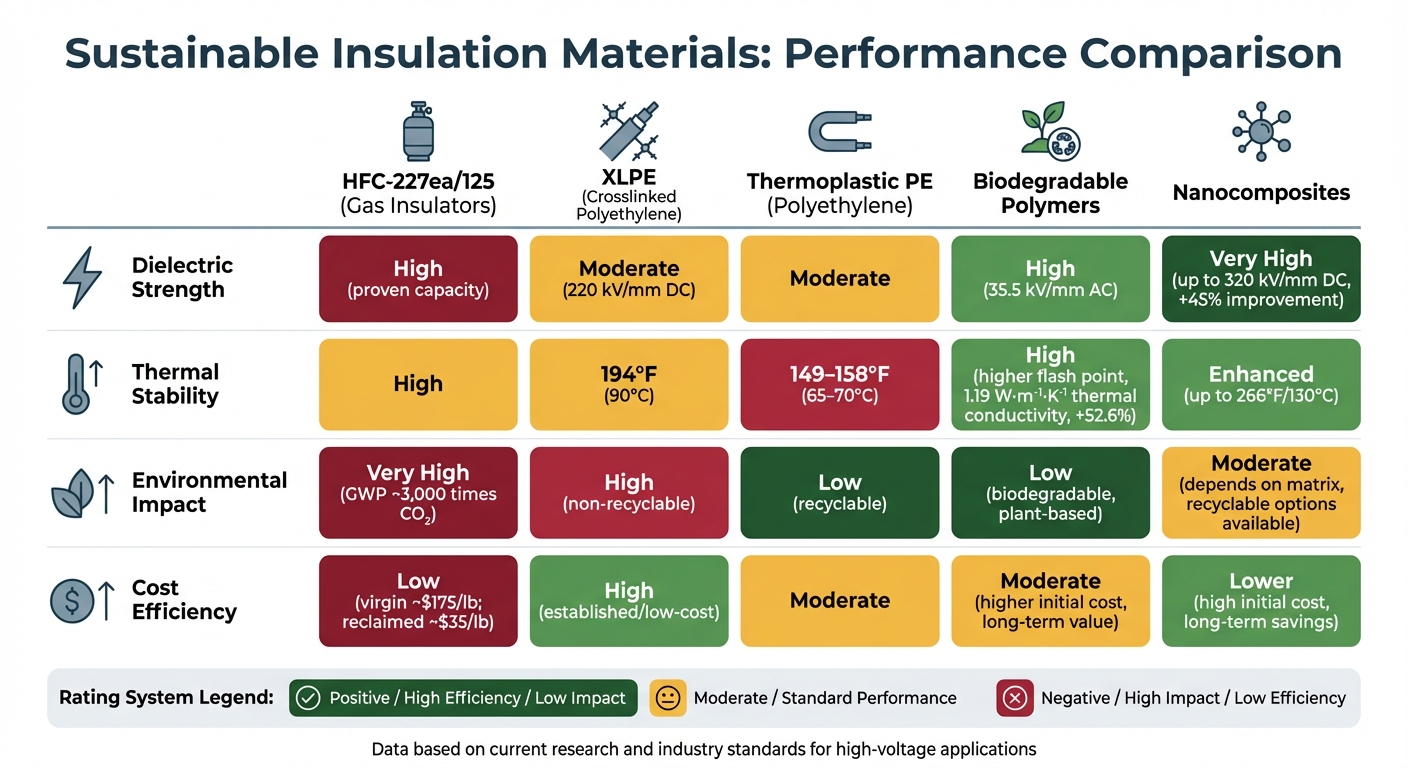
Comparison of Sustainable Insulation Materials for High Voltage Systems
When it comes to sustainable insulation materials, each option has its own strengths and weaknesses. These trade-offs are crucial for engineers and facility managers to consider when designing high-voltage systems. Balancing performance benefits with environmental impact is key to making informed decisions. Below is a breakdown of the main trade-offs for each material category.
HFC-Based Gas Insulators, such as HFC-227ea and HFC-125, deliver reliable performance but come with a heavy environmental cost. For example, HFC-227ea has a Global Warming Potential (GWP) that is 3,000 times higher than CO₂. Adding to this, the EPA plans to cut HFC production by 85% by 2036, which has already driven virgin HFC prices to around $175/lb, with reclaimed HFC remaining at approximately $35/lb. The European Commission highlights that:
"HFOs are considered more climate-friendly than HFCs due to their significantly lower Global Warming Potential and faster atmospheric breakdown."
Polyethylene and Advanced Polymer Composites come with their own set of challenges. Cross-linked polyethylene (XLPE) performs reliably at temperatures up to 194°F (90°C) but is non-recyclable. On the other hand, thermoplastic alternatives, which can be recycled, operate at lower temperatures of 149–158°F (65–70°C).
Biodegradable Polymer Solutions focus on sustainability by offering biodegradable options. For instance, natural ester fluids, derived from sources like corn or coconut oil, have been safely used in transformers for over 30 years. These materials are designed to break down naturally, reducing soil contamination risks. However, they may not yet match the durability of conventional insulators under extreme electrical stress.
Nanocomposites stand out for their impressive performance improvements. They can boost DC breakdown strength by 45% - for example, adding 1.0 wt.% α-Al₂O₃ to XLPE increases its strength from 220 kV/mm to 320 kV/mm. Nanocomposites also enhance thermal management, but the precise dispersion of nanoparticles drives up initial costs.
| Material | Dielectric Strength | Thermal Stability | Environmental Impact | Cost Efficiency |
|---|---|---|---|---|
| HFC-227ea/125 | High (proven capacity) | High | Very High (GWP ~3,000) | Low (virgin ~$175/lb; reclaimed ~$35/lb) |
| XLPE | Moderate (220 kV/mm DC) | 194°F (90°C) | High (non-recyclable) | High (established/low-cost) |
| Thermoplastic PE | Moderate | 149–158°F (65–70°C) | Low (recyclable) | Moderate |
| Biodegradable Polymers | High | High (higher flash point) | Low (biodegradable) | Moderate |
| Nanocomposites | Very High (up to 320 kV/mm DC) | Enhanced | Moderate (depends on matrix) | Lower (high initial cost) |
This comparison provides a clear view of the trade-offs, helping engineers choose the most suitable material for their specific high-voltage applications.
Conclusion
Sustainable insulation materials bring specific advantages to various high-voltage applications, making them a smart choice for modern electrical systems.
When choosing insulation, it's crucial to align the material with your specific high-voltage needs. For cable applications, recyclable polypropylene (PP) outperforms traditional XLPE in temperature resistance for both AC and DC cables. As Jinliang He and Yao Zhou from IEEE emphasized:
"Traditional crosslinking polyethylene (XLPE) insulation cannot meet the requirement of environmental protection and sustainable development."
In gas-insulated switchgear, replacing SF₆ with C₄F₇N mixed with CO₂ or air can significantly lower Global Warming Potential without compromising dielectric strength.
For transformer retrofilling, utility operators should explore natural vegetable oil esters. These biodegradable and non-toxic fluids have been safely used for over three decades. They not only offer a greener alternative to mineral oils but also provide higher flash points, enhancing fire safety. Meanwhile, silicone rubber is an excellent choice for high-voltage hardware, delivering better dielectric breakdown performance compared to XLPE or epoxy-based insulators.
For top-tier performance, nanocomposites are worth considering. By incorporating nanoparticles like MgO or ZnO, these materials improve breakdown strength and thermal management while reducing space charge accumulation - key for long-term reliability in HVDC systems. Although the upfront costs may be higher, the increased durability and potential self-healing properties can extend the service life of high-voltage equipment.
FAQs
Which insulation option is best for HVDC cables versus transformers or GIS?
For HVDC cables, polymeric insulation materials are often the go-to choice. Why? They combine flexibility, excellent electrical properties, and the capacity to endure high electrical stresses. On top of that, they provide solid thermal performance and are straightforward to install.
When it comes to transformers and gas-insulated switchgear (GIS), solid insulation systems are typically used. These systems often rely on mineral or synthetic oil paired with paper or pressboard. Meanwhile, there’s growing interest in sustainable alternatives, such as eco-friendly polymers, to minimize environmental impact.
What causes nanocomposites to fail when filler concentration is too high?
When too much filler is added to nanocomposites, it can cause several problems. Excessive filler concentration often leads to aggregation and defects within the material, which can weaken its structure. This can also result in a drop in dielectric breakdown strength, making the material less effective at withstanding electrical stress. On top of that, high levels of filler can actually reduce thermal conductivity, which can negatively impact both the performance and reliability of the nanocomposite.
How do U.S. HFC phase-down rules affect long-term equipment choices?
The U.S. HFC phase-down rules, enforced by the EPA, aim to cut down greenhouse gases with a global warming potential (GWP) of 700 or lower. These rules push manufacturers to use alternative refrigerants and insulation materials for long-term equipment. As a result, the design and selection of insulation systems are being shaped to meet these environmental standards.





