How Regulatory Compliance Impacts Maintenance Costs
Ignoring maintenance compliance can cost millions. Facilities that follow standards like NFPA 70B and OSHA 29 CFR 1910.269 reduce costs, improve safety, and avoid penalties. Here's why it matters:
- Planned vs. Emergency Costs: Emergency repairs cost 2–3x more than scheduled maintenance. Transformer failures can reach $7 million.
- Compliance Benefits: Routine checks, like IR scans and oil sampling, detect issues early, saving money and extending equipment life.
- Non-Compliance Risks: Unplanned outages last up to 18 weeks, with fines up to $1M/day under NERC PRC-005.
- Insurance Impact: Non-compliance may void claims, while compliance lowers premiums.
- Cost Control: Compliance enables planned spending, avoiding surprise expenses.
Bottom line: Compliance isn't just a legal box to check - it protects budgets, ensures reliability, and minimizes downtime.
1. Regulatory Compliance Maintenance
Maintaining regulatory compliance in electrical systems is no longer just a recommendation - it’s now a formal and enforceable responsibility. Standards like NFPA 70B have shifted from being merely advisory to becoming mandatory, which means facilities must budget for electrical maintenance as a necessary operational expense.
Cost Categories
Compliance comes with a variety of costs that need to be accounted for. These include routine expenses like inspections, IR thermography scans, torque checks, and advanced electrical testing. Additionally, there are indirect costs such as personnel training and implementing a Maintenance Management System (MMS) to ensure records are always ready for audits.
Maintenance Strategies
Modern compliance strategies have evolved significantly. Relying solely on fixed schedules is no longer enough. Approaches like Condition-Based Maintenance (CBM) use actual equipment conditions to guide interventions, cutting down on unnecessary downtime and labor costs. For example, transformers over 10 MVA benefit from oil sampling every six months and monitoring for a 20% monthly increase in dissolved fault gases, which can detect issues 6 to 18 months in advance. Another approach, Reliability-Centered Maintenance (RCM), focuses on prioritizing assets based on their importance to the network and the risks associated with unplanned outages.
| Strategy | Basis | Cost Impact | Compliance Level |
|---|---|---|---|
| Time-Based (TBM) | Fixed intervals | Moderate (fixed) | Meets minimum statutory requirements |
| Condition-Based (CBM) | Measurable deterioration | Lower (targeted interventions) | High (addresses actual risk) |
| Predictive (CMMS-Driven) | Real-time data & trends | Lowest (prevents 3x failure costs) | Highest (audit-ready documentation) |
These strategies not only improve maintenance efficiency but also provide better financial stability over time.
Long-Term Financial Impact
One of the biggest financial benefits of compliance is the ability to plan ahead. Regular inspections and early problem detection allow facilities to replace equipment during planned budget cycles, referred to as "planned CapEx", instead of being hit with unexpected capital expenses. On the flip side, non-compliance can lead to sudden and extremely high costs. For instance, replacing a power transformer unexpectedly can cost $4.2 million, and forced outages can last anywhere from 4 to 18 weeks. Beyond the financial strain, non-compliance also exposes facilities to penalties under standards like NERC PRC-005-6, which can reach up to $1 million per day per violation.
"Effective regulation fosters efficient investment, supports innovation, preserves reliability, and minimizes tariff impacts while ensuring long-term system resilience and sustainability." - eCIGRE
Equipment Sourcing
The equipment you choose upfront plays a big role in long-term maintenance costs. Decisions like selecting between Oil-Impregnated Paper (OIP) and Resin-Impregnated Paper (RIP) bushings, or choosing porcelain versus composite housing, can influence how often maintenance is needed and how severe failures might be. For facilities looking to source high-voltage components, platforms like Electrical Trader provide access to a variety of replacement or refurbished equipment, including transformers and circuit breakers. This helps support planned replacement strategies without the delays often associated with new orders. Thoughtful equipment sourcing aligns with compliance-driven maintenance, helping to control costs and avoid surprises down the line.
Next, we’ll dive into the financial and operational risks that arise when facilities neglect these compliance strategies.
sbb-itb-501186b
2. Non-Compliant Maintenance
Unlike proactive strategies, non-compliant maintenance focuses less on planned expenses and more on reacting to unexpected costs.
Cost Categories
At first glance, non-compliant maintenance may seem cost-effective. It eliminates recurring expenses like infrared scanning, insulation resistance testing, breaker injection testing, and the administrative burden of adhering to standards like NFPA 70B. Additionally, it avoids costs related to specialized personnel training and Maintenance Management System implementation.
But here's the catch: these "savings" are short-lived. When emergencies arise, materials often need to be sourced quickly, leading to premium pricing. As CTI Electric puts it:
"The most significant financial risks are often the ones that don't appear anywhere... production losses can dwarf repair expenses."
In other words, what looks like savings upfront can snowball into much larger expenses down the line.
Long-Term Financial Impact
Non-compliance doesn't just increase repair costs - it accelerates equipment wear and tear, leading to unplanned capital expenditures. Instead of replacing aging assets on a predictable schedule, facilities are caught off guard by sudden failures. Emergency repairs, which typically cost 2 to 3 times more than planned maintenance, also result in extended downtime and operational disruptions.
For example, an unexpected transformer failure can lead to staggering replacement costs and prolonged outages, with the average forced outage lasting 12 weeks. The financial hit doesn’t stop there. Insurance claims may be denied if inspections were skipped, and violations of NERC PRC-005 can incur penalties as high as $400,000. To top it off, 83% of protection relay failures are only discovered during actual faults, not during routine testing.
Equipment Sourcing
When maintenance is reactive, sourcing equipment becomes a logistical nightmare. Unexpected failures force organizations to procure materials urgently. High-voltage assets like transformers and switchgear often have long lead times, making emergency replacements both costly and challenging.
In these situations, companies may pay inflated prices or settle for non-certified or poorly documented equipment just to resume operations. This approach creates fragmented inventories with inconsistent standards, making future maintenance even more expensive and complicated. Over time, this patchwork system undermines operational efficiency and drives up costs, turning non-compliance into a long-term liability.
Pros and Cons
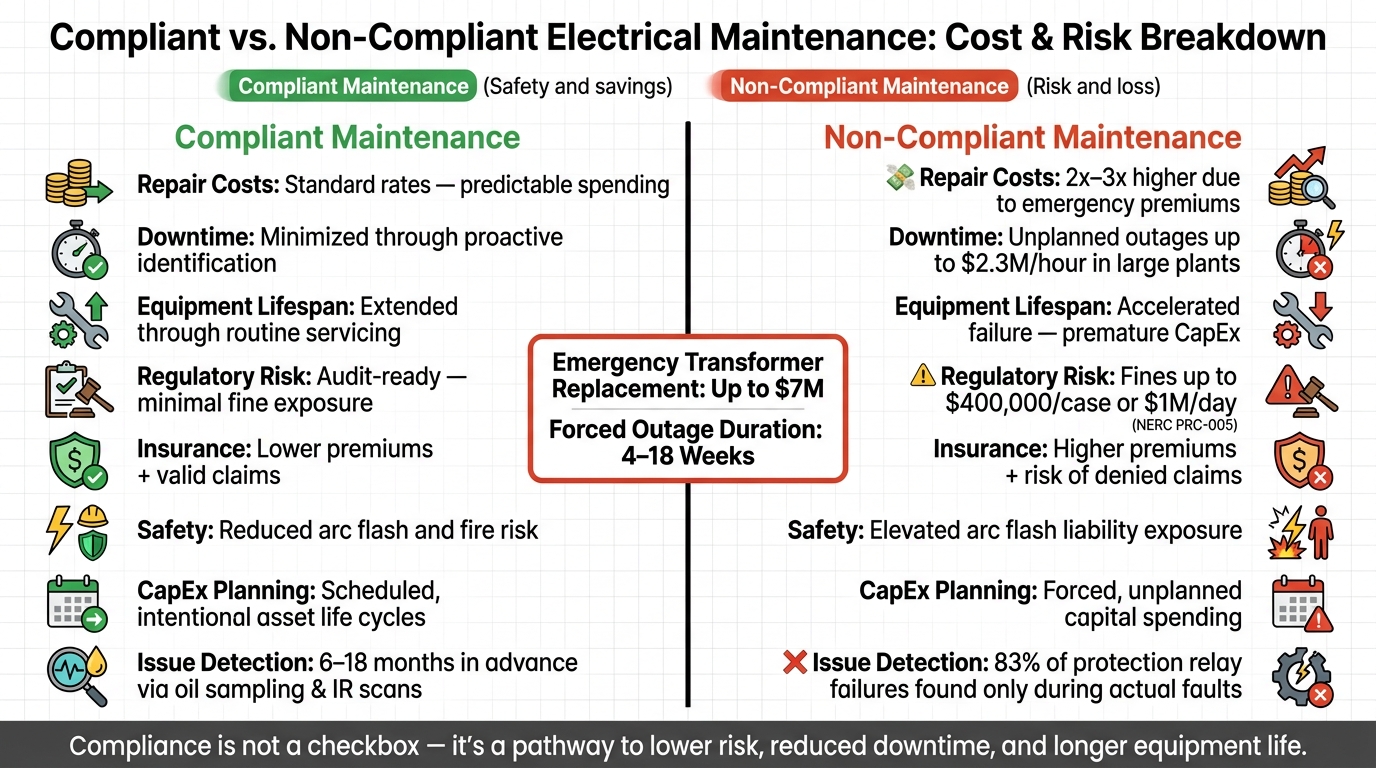
Compliant vs. Non-Compliant Maintenance: Cost & Risk Breakdown
The table below highlights the financial and operational trade-offs between compliant and non-compliant maintenance. It summarizes the cost factors and risks discussed earlier, offering a clear comparison of the two approaches.
| Factor | Compliant Maintenance | Non-Compliant Maintenance |
|---|---|---|
| Labor Rates | Standard planned O&M rates | Emergency service premiums |
| Parts & Materials | Planned procurement at market rates | Rushed delivery at premium prices |
| Repair Costs | Standard rates; predictable spending | 2x–3x higher due to emergency premiums |
| Equipment Lifespan | Extended through routine servicing | Accelerated failure; premature CapEx |
| Downtime Risk | Minimized through proactive identification | Unplanned outages up to $2.3M/hour in large plants |
| Regulatory Risk | Audit-ready; minimal fine exposure - unrecorded tasks carry the same legal weight as unperformed ones under NERC PRC-005 | Fines up to $400,000 per case or $1M/day |
| Insurance | Lower premiums; valid claims | Higher premiums; risk of denied claims |
| Safety | Reduced arc flash and fire risk | Elevated liability exposure |
| CapEx Planning | Scheduled, intentional asset life cycles | Forced, unplanned capital spending |
This comparison brings into focus the long-term benefits of compliant maintenance versus the risks and costs of non-compliance.
By sticking to compliance, businesses gain predictability in their expenses. Labor and parts are managed at standard rates, and equipment replacements are planned rather than rushed. On the flip side, non-compliance may save money in the short term but often leads to steep long-term costs, including higher repair premiums, regulatory fines, and safety liabilities.
Seth Heeter, President of Access, puts it succinctly:
"NFPA 70B compliance is not simply a checkbox. It is a pathway to lower risk, reduced downtime, improved safety, and longer equipment life."
Conclusion
Regulatory compliance goes beyond being a legal requirement - it’s also a smart financial move. Following standards like NFPA 70B and NERC PRC-005 may involve higher upfront costs for routine testing, training, and thorough record-keeping. However, these expenses pale in comparison to the financial impact of unplanned failures.
Consider the risks: emergency transformer replacements, repair premiums that can double or triple standard costs, and NERC PRC-005 penalties that can climb to $1 million per day. These are not hypothetical scenarios - they’re real-world outcomes of neglecting proper maintenance. Proactive care ensures both operational reliability and financial stability.
For U.S. organizations, the path forward is clear. Develop a written Electrical Maintenance Program, use a CMMS to streamline documentation, and align O&M budgets with long-term capital planning. Treating maintenance as a part of risk management can prevent small, manageable costs from ballooning into major financial setbacks.
If you’re in the market for replacement components or need to adjust your maintenance strategy, Electrical Trader offers a wide selection of new and used high voltage equipment. From transformers to breakers, their inventory supports both planned maintenance schedules and urgent replacement needs.
FAQs
What maintenance records do audits typically require?
To ensure compliance during an audit, it's essential to keep a well-organized, time-stamped record of your maintenance program. These records should include:
- Who performed the work: Clearly document the name of the individual or team responsible.
- Equipment details: Include specifics like the serial number or other identifying information.
- Date of the activity: Record when the work or inspection took place.
- Inspection results or actions taken: Provide detailed notes on findings and any steps completed.
Additionally, auditors will require documentation showing corrective actions for any unresolved issues. You'll also need to provide evidence that all required testing was conducted within the specified timeframes.
How do I choose between time-based and condition-based maintenance?
To choose between time-based and condition-based maintenance, begin by performing an equipment condition assessment following the 2023 NFPA 70B standard. This involves evaluating key factors such as the equipment's physical condition, its importance to operations, and the environment in which it operates.
Time-based maintenance follows fixed schedules, offering simplicity and broad risk management. On the other hand, condition-based maintenance uses diagnostic data to respond to actual wear and tear, which can help lower costs by addressing issues only when necessary. Use the highest risk score from your assessment to determine the most suitable maintenance intervals.
When should I plan to replace a transformer instead of repair it?
Deciding whether to repair or replace a transformer comes down to factors like safety, reliability, and overall cost. You should consider replacing the transformer if it’s nearing 80% of its expected service life, shows significant signs of wear (such as overheating, unusual noises, or visible damage), or fails a Dissolved Gas Analysis due to issues like arcing or elevated furan levels. Replacement is also a smart choice if parts are no longer available or if the transformer no longer complies with safety codes or fault-current requirements.