Preventive Maintenance for Explosion-Proof Equipment
Explosion-proof equipment is critical for safety in high-risk industries like oil refineries and chemical plants. Proper maintenance ensures this equipment remains safe, functional, and compliant with safety standards. Here’s what you need to know:
- Why It Matters: Preventive maintenance prevents small faults (like a missing bolt or damaged seal) from escalating into major hazards. It also ensures compliance with safety standards like IEC 60079-17, IEC 60079-19, and NFPA 70B.
-
Key Maintenance Steps:
- Perform visual inspections for corrosion, damage, or loose components.
- Conduct functional tests to verify performance under hazardous conditions.
- Schedule annual detailed inspections for deeper evaluations, including partial disassembly.
- Inspect seals, enclosures, and connections to maintain certification and safety integrity.
- Compliance: Follow manufacturer guidelines, use certified parts, and maintain detailed records of all inspections and repairs.
- Training: Ensure maintenance is carried out by qualified personnel and keep certifications up to date.
Preventive maintenance isn’t optional - it’s a critical practice for safety, compliance, and uninterrupted operations.
Explosion Proof Electrical Equipment Safety
sbb-itb-501186b
Maintenance Standards for Hazardous Locations
Explosion-proof equipment requires strict adherence to specific standards. Ignoring these not only jeopardizes safety but also disrupts operations. Below are the key standards that guide maintenance practices both in the U.S. and globally.
Applicable Standards and Guidelines
| Standard | Scope |
|---|---|
| IEC 60079-17 | Inspection and maintenance of electrical installations in hazardous areas |
| IEC 60079-19 | Repair, overhaul, and reclamation of explosion-protected equipment |
| NFPA 70B | Electrical equipment maintenance focusing on reliability and safety |
IEC 60079-17 outlines requirements for routine inspections in hazardous areas, ensuring ongoing safety and functionality. When it comes to repairs, overhauls, or reclamations, IEC 60079-19 provides the necessary guidelines. Meanwhile, NFPA 70B addresses electrical maintenance issues that can lead to overheating, nuisance trips, or even injuries during electrical faults. These include concerns like loose connections and high-impedance ground faults. Together, these standards form the backbone of preventive maintenance strategies.
Meeting Compliance in Maintenance Practices
Adhering to these standards is critical to maintaining equipment certifications. The primary goal is to ensure all equipment remains in its certified condition - the state it was in when it received its safety rating. Unauthorized repairs or unapproved part substitutions can void this certification, rendering the equipment unsuitable for hazardous environments.
To avoid this, follow the manufacturer’s recommendations for maintenance intervals, approved parts, and procedures. Additionally, keep detailed records for each piece of equipment, including its location, condition, and a full log of any issues or repairs. These records are not just helpful - they’re essential for passing regulatory audits and ensuring ongoing compliance.
Inspection Types and Maintenance Intervals
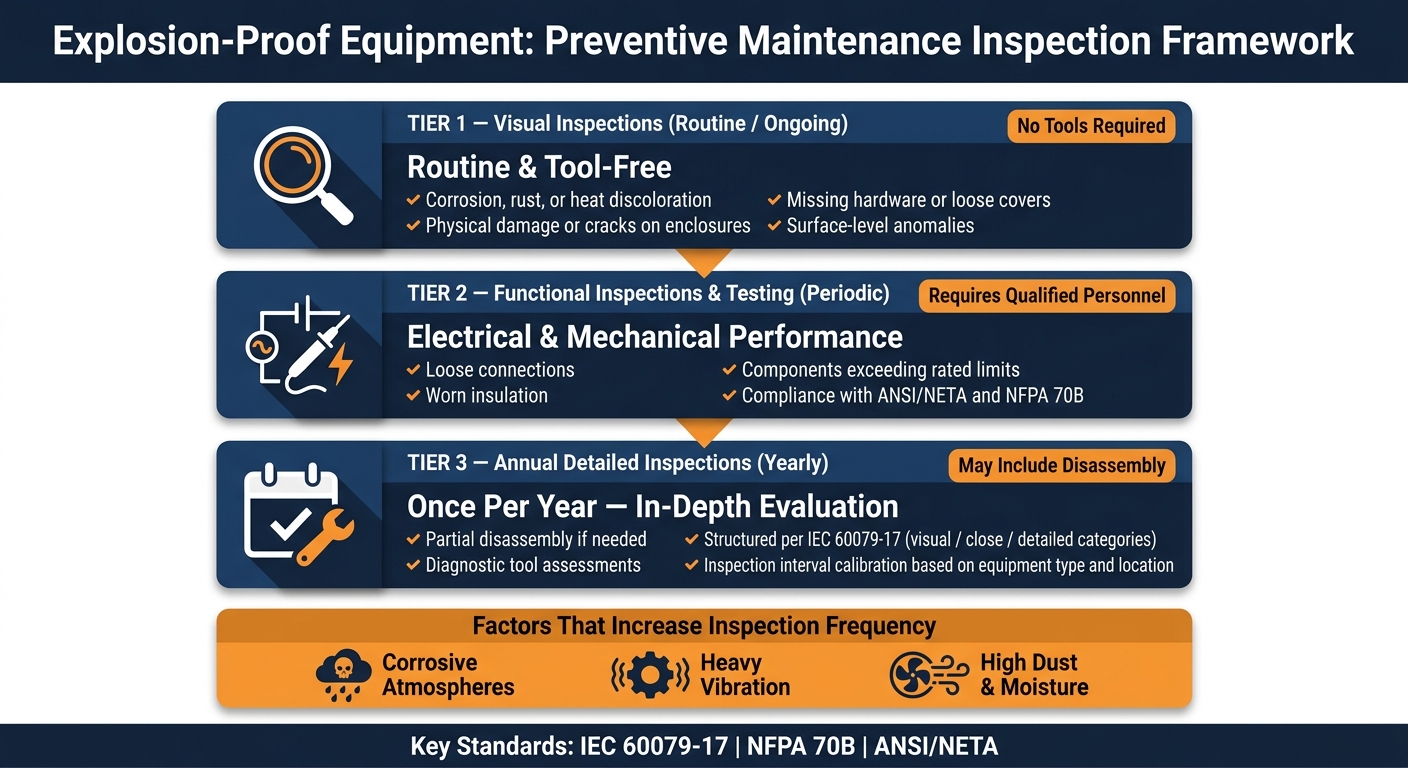
Explosion-Proof Equipment Preventive Maintenance: Inspection Types & Key Steps
How often explosion-proof equipment needs to be inspected depends on its design and the environment it operates in. Factors like corrosive atmospheres, heavy vibration, or high levels of dust and moisture can call for more frequent inspections.
Visual Inspections
Visual inspections are the simplest and quickest way to catch potential problems. These routine, tool-free checks are all about spotting surface-level issues like corrosion, physical damage, missing hardware, or anything else that looks off.
During these checks, ensure all covers are properly secured, look for signs of rust or heat discoloration, and check for cracks or impact damage on the enclosures. While these inspections are basic, they lay the groundwork for more in-depth evaluations of the equipment's functionality.
Functional Inspections and Testing
Visual inspections are only the beginning. Functional inspections go deeper, testing whether the equipment performs as it should, especially in hazardous conditions. These inspections cover both electrical and mechanical performance, following guidelines from standards like ANSI/NETA and NFPA 70B.
Ron Widup, Sr. Advisor, Technical Services at Shermco Industries, explains the approach:
"The condition of maintenance refers to the state of electrical equipment considering manufacturer instructions, industry standards, and its overall condition."
These tests can uncover hidden problems like loose connections, worn insulation, or components exceeding their rated limits - issues that wouldn’t be visible during a visual check. Regular functional testing ensures the equipment stays compliant with safety standards between more comprehensive annual reviews.
Annual Detailed Inspections
Once a year, a more thorough inspection is typically advised. These detailed inspections are designed to catch problems that routine checks might overlook. They may involve partial disassembly or the use of diagnostic tools to identify deeper issues.
Standards like IEC 60079-17 offer a structured approach to inspections - categorizing them as visual, close, or detailed - and provide guidelines for setting inspection intervals based on the equipment type and location classification. Keeping detailed logs of these inspections can also help refine future maintenance schedules by tracking the equipment's performance and identifying recurring issues.
Checking Seals, Enclosures, and Connections
The physical condition of seals, enclosures, and connections plays a crucial role in maintaining explosion-proof certification. Even minor damage in these areas can jeopardize the safety and certification of equipment, making regular checks essential in hazardous environments.
Inspecting Gaskets and Cable Glands
Seals and cable glands are some of the most common failure points in explosion-proof setups. In fact, cable glands are particularly vulnerable to issues during installation. For these to function correctly, they must match the cable type, be torqued to precise specifications, and maintain the enclosure's IP rating. For enclosures with a wall thickness under 6 mm, proper sealing requires both an internal locknut and an external IP washer to ensure the minimum IP54 rating necessary for Ex e (increased safety) enclosures.
"A perfectly certified Ex d enclosure becomes dangerous if a cable gland is installed incorrectly." - ExKnowledge
Unused cable entries are another frequent oversight. Leaving these open without sealing them with a certified blanking plug - not a standard plastic stopper - can compromise both the IP rating and the flame path's integrity. Additionally, gaskets must always be replaced with those specified by the manufacturer. Using a generic gasket invalidates the equipment's certification.
Once seals and cable glands are inspected, the next step is to assess the structural and connection integrity of the enclosures.
Checking Enclosure and Connection Integrity
After verifying seals and cable glands, it's essential to evaluate the overall condition of enclosures and connections. For Ex d (flameproof) enclosures, flame path surfaces demand particular attention. These surfaces are designed with precise gaps that cool escaping gases, preventing them from igniting the surrounding atmosphere. Any paint on these surfaces is a serious hazard - it fills the gap and stops the cooling process entirely. To maintain proper lubrication, only use non-hardening silicone grease as recommended by the manufacturer. The required minimum clearance for flame paths varies depending on the gas group:
| Gas Group | Minimum Clearance Requirement for Flame Paths |
|---|---|
| IIA | 10 mm |
| IIB | 30 mm |
| IIC | 40 mm |
Connections and fasteners also need to be thoroughly checked. Every bolt on a lid or gland plate must be accounted for, be of the correct type, and tightened to the manufacturer's specified torque.
"A missing bolt, for example, may compromise the protection of a flameproof enclosure and put the entire site at risk." - Arvind Kumar Singh, CSIR-Central Institute of Mining and Fuel Research
Earthing is another critical factor. All metallic parts must be securely bonded to the equipotential system, and for intrinsically safe (IS) zener barriers, earth resistance must stay below 1 Ω. Corroded earth connections or tags signal a problem that needs immediate attention. Additionally, terminal screws, including those on unused terminals, should be tightened regularly to prevent them from loosening due to vibration, which can lead to dangerous heating hazards.
Cleaning, Handling, and Repair Guidelines
Safe Cleaning Practices
Regular cleaning is crucial to prevent dust accumulation, which can cause surface temperatures to exceed safe levels as outlined in IEC 60079-31. Avoid any cleaning methods that might create static electricity; instead, follow the recommendations in IEC 60079-32-1. This means using cleaning agents that are confirmed to be compatible with the enclosure's materials - whether metallic or non-metallic - as specified in CSA C22.2 NO. 30:20. After cleaning, ensure all lid bolts, terminal screws, and gland plate bolts are fully tightened to maintain the enclosure's integrity.
Restrictions on Field Repairs and Part Substitutions
Strict rules govern repairs and part replacements to keep equipment certification intact. Unauthorized maintenance can quickly void compliance, which is why it's critical to stick to the boundaries set by IEC 60079-19 regarding what can be handled on-site versus what requires a specialized repair facility.
Always use certified parts approved by the manufacturer. Any unauthorized field modifications - like drilling additional cable entries - will invalidate certification and compromise safety . Since 2007, IEC 60079-14 has mandated that all replacement components, such as glands, stoppers, and thread adaptors, must meet IEC 60079-0 standards, far exceeding a basic IP rating check.
For tasks involving live equipment, only intrinsically safe (IS) circuits allow limited on-site actions, such as calibration adjustments or swapping plug-in components, and only if the documentation permits it. For non-IS equipment, ensure it is fully de-energized or verify the area is gas-free before starting any maintenance.
Documentation, Training, and Compliance Records
Keeping Maintenance Logs and Inspection Records
Good recordkeeping is at the heart of effective safety management. Every inspection, repair, and maintenance action should be documented in detail. This includes noting the equipment’s location, current status, any defects found, and the corrective actions taken. These records are essential for meeting standards like IEC 60079-17 and IEC 60079-19.
Failing to document even a single defect can jeopardize an area’s entire safety classification. Beyond safety concerns, agencies like OSHA will review these records during site audits to ensure your Electrical Maintenance Plan (EMP) is not only well-designed but also properly executed.
But there’s more to it than just compliance. Over time, consistent records provide a powerful tool: trend analysis. Ryan Roth, Global Product Manager at ABB Electrification Service, highlights this point:
"The ability to notice trends is important to assess when the next maintenance activity is needed or when equipment may need to be replaced. Good trending depends on good record keeping."
To make this process manageable, consider starting with a centralized equipment registry. This registry should track each asset throughout its lifecycle - from installation to every inspection and repair. Pair it with a standardized inspection checklist to ensure no details are overlooked.
And remember, the quality of maintenance depends on the qualifications of the personnel performing the work.
Worker Training and Certification Tracking
Maintaining accurate records of worker training and certifications is just as important as equipment logs. Standards like NFPA 70B and IEC 60079-17 require that maintenance in hazardous areas be performed by trained, competent individuals, with their qualifications documented and readily available for review.
This isn’t just about ticking boxes. Maintenance in hazardous locations demands a deep understanding - not just of the tools and equipment, but of how they interact with industrial processes and the surrounding environment. Ryan Roth emphasizes this point:
"Personnel who develop and implement the EMP must understand the electrical equipment, its value to the process that it powers and the impact of the environment on that electrical equipment and its respective process."
One major regulatory update to note: the 2023 revision of NFPA 70B has shifted the standard from being a recommended guideline to a mandatory requirement for electrical equipment maintenance. This change makes training and qualification tracking enforceable under U.S. regulations. Facilities must now ensure worker certifications remain up-to-date - this is no longer optional.
Key Takeaways for Preventive Maintenance
Explosion-proof equipment can only function safely if maintenance is carried out with precision and attention to detail. Even a small oversight - like a loose fastener, a worn-out gasket, or a cracked enclosure - can jeopardize the safety of an entire hazardous area. This highlights the critical need to follow maintenance protocols without fail.
Core standards such as IEC 60079-17, IEC 60079-19, and NFPA 70B are the backbone of inspections, repairs, and overhauls. Sticking to these guidelines is essential for building a strong preventive maintenance program.
Routine inspections are equally important. Regular visual checks, functional assessments, and detailed annual inspections help ensure that equipment remains in its certified "as-installed" condition, maintaining its safety certification throughout its operational life.
Finally, ongoing training and meticulous maintenance records are key to maintaining safety. Properly trained personnel and detailed logs not only safeguard workers and facilities but also ensure compliance during regulatory reviews, keeping the maintenance program reliable and effective every single day.
FAQs
How do I decide inspection frequency for my site conditions?
To figure out how often inspections should happen, take a close look at your site's specific risks, surroundings, and the condition of your equipment. Things like dust buildup, high moisture levels, or constant vibrations might mean you need to check things more often. Industry guidelines, like NFPA 70B, suggest focusing on risk and equipment condition rather than sticking to a rigid schedule. Quick visual checks can help spot obvious problems early, but more in-depth inspections should be tailored to your site's unique risks and operational demands to keep everything safe and running smoothly.
What maintenance actions can void explosion-proof certification?
Improper upkeep - like installing cable glands incorrectly or leaving out blanking plugs - can nullify explosion-proof certification. To maintain compliance and ensure safety, always follow the manufacturer's installation and maintenance guidelines to the letter.
What should hazardous-area maintenance records include?
Keeping detailed maintenance records for hazardous areas is crucial. These records should include the location and condition of all electrical equipment, any identified issues, and a clear account of any maintenance or repairs carried out. Accurate documentation not only ensures compliance with safety standards but also plays a key role in maintaining a safe environment in these high-risk areas.