NFPA 70B 2026 Updates: What to Know
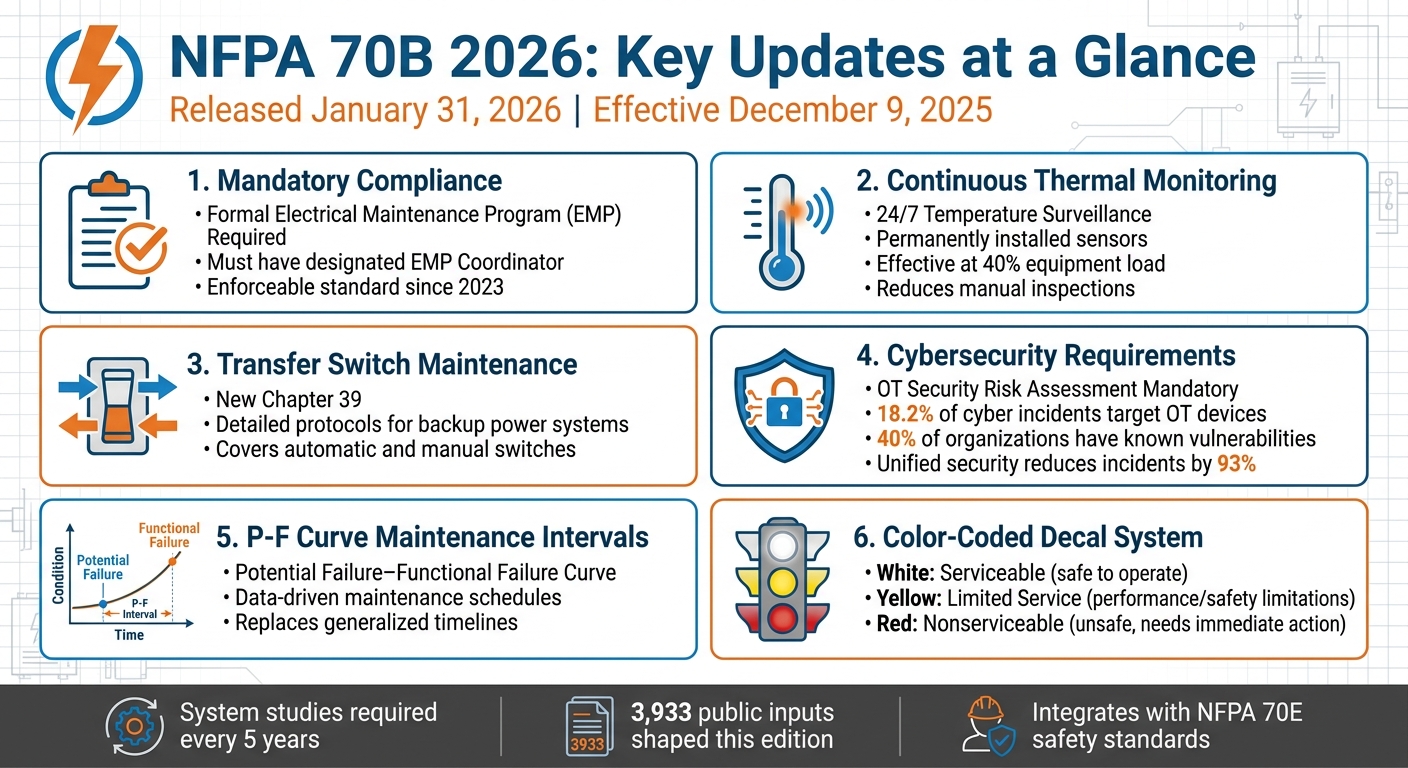
NFPA 70B, the standard for electrical equipment maintenance, has undergone key updates in its 2026 edition. Released on January 31, 2026, the changes reflect modern safety needs and technological advancements. Here's what you need to know:
- Mandatory Compliance: NFPA 70B, now enforceable since 2023, requires facilities to implement a formal Electrical Maintenance Program (EMP) overseen by an EMP Coordinator.
- Continuous Thermal Monitoring (CTM): New standards introduce 24/7 temperature surveillance using sensors, reducing manual inspections and improving safety.
- Transfer Switch Maintenance: A new chapter provides detailed protocols for maintaining backup power systems.
- Cybersecurity for Operational Technology (OT): Facilities must assess and secure OT systems to prevent cyberattacks.
- Structured Maintenance Intervals: Using the Potential Failure–Functional Failure (P–F) curve, the standard now prescribes scientifically informed maintenance schedules.
- Repair Timelines: Prompt action on equipment defects is now mandatory to avoid safety risks.
These updates aim to improve safety, reliability, and compliance across industrial electrical systems. Facilities must update their maintenance practices, ensure proper documentation, and source compliant tools and components to meet the new requirements.
NFPA 70B 2026 Key Updates and Requirements Overview
Key Changes in NFPA 70B 2026
Continuous Thermal Monitoring Requirements
The 2026 edition places greater emphasis on infrared thermography as a key diagnostic tool and introduces Continuous Thermal Monitoring (CTM) technology as a new standard for temperature surveillance. CTM uses permanently installed sensors to provide 24/7 real-time temperature data, eliminating the need for manual scans. This approach not only enhances safety by reducing human involvement in potentially hazardous areas but also ensures a continuous stream of data for thermography reports.
Unlike traditional manual scans that capture a single snapshot, CTM monitors equipment throughout its normal operating cycles. It remains effective even when equipment is running at just 40% of its designed load.
"Continuous Thermal Monitoring technology reduces the need for periodic inspections by implementing uninterrupted around-the-clock monitoring of mission-critical electrical infrastructure." - Exertherm
To meet compliance, thermography reports now require thermal and visible images, Delta T (ΔT) values for problematic areas, and recommended corrective actions for each issue. The updated standard also highlights the importance of comparing temperature readings between similar components under similar loads, as this can reveal issues like high resistance or overloading.
These advancements in thermal monitoring set the stage for more detailed maintenance guidelines, such as those outlined in the new chapter on transfer switches.
New Chapter on Transfer Switch Maintenance
The 2026 edition introduces Chapter 39, which establishes clear maintenance protocols for transfer switches. This addition is especially relevant for facilities with standby power systems, backup generators, or emergency power setups. By providing detailed guidance, the new chapter ensures consistent safety and reliability in maintaining these critical components.
As power systems grow more complex, transfer switches - both automatic and manual - play a vital role in maintaining operations during utility failures. Organizations should review their current maintenance procedures to align with these new requirements.
Cybersecurity Risk Assessment for Operational Technology
For the first time, the 2026 edition addresses cybersecurity within the context of Operational Technology (OT), treating it as an integral part of the Electrical Maintenance Program. Recent statistics reveal that 18.2% of cybersecurity incidents target OT devices, with many ransomware attacks exploiting vulnerabilities in controllers connected to the internet. Alarmingly, 40% of organizations report known vulnerabilities in these systems.
The guidelines require facilities to identify and secure internet-exposed assets, such as PLCs and HMIs, which are common targets for cyberattacks. Unified security solutions that span both IT and OT environments have been shown to reduce cyber incidents by 93%.
"This shift underscores that OT security is critical to prevent destructive attacks during major crises." - Christopher Wray, Director, FBI
The focus here extends beyond data protection to safeguarding industrial processes from physical damage or safety risks. Recommended measures include network segmentation at the cell or zone level, Deep Packet Inspection firewalls tailored for industrial protocols, and maintaining offline backups of controller configurations.
These cybersecurity updates align with the broader goal of creating a comprehensive and resilient maintenance framework.
Standardization of Terminology and Layout
To improve usability, the 2026 edition standardizes terminology and reorganizes chapter layouts. This ensures a more consistent framework for maintenance protocols. Inspection and testing tables across equipment-specific chapters now include additional details and clarifications, addressing feedback from the public during the development process.
A significant addition is the Potential Failure–Functional Failure (P–F) curve, which provides a structured method for determining maximum maintenance intervals based on data. This replaces generalized schedules with a more precise approach, focusing on when equipment begins to show signs of potential failure. Facilities are also required to establish specific timelines for repairs, which helps prevent maintenance backlogs and ensures timely resolution of defects.
sbb-itb-501186b
Impact on Industrial Electrical Maintenance Programs
Improved Preventative Maintenance Practices
The shift from a "Recommended Practice" to an enforceable "Standard" has brought a more structured approach to electrical maintenance. Facilities are now held accountable by Authorities Having Jurisdiction to comply with these updated requirements.
Electrical Condition Assessments (ECAs) now prioritize maintenance schedules based on factors like equipment condition, its importance to operations, and the environment it operates in. For example, equipment in harsh or demanding environments, or critical to production, gets more frequent attention. Meanwhile, components in controlled environments with less operational importance are serviced less often.
To simplify serviceability checks, a visual decal system has been introduced:
- White "Serviceable" decals: Indicate equipment that is well-maintained and reliable.
- Yellow "Limited Service" decals: Signal that performance or safety limitations exist.
- Red "Nonserviceable" decals: Warn that the equipment is unsafe and needs immediate repair or replacement.
Mandatory system studies - such as short-circuit analysis, coordination studies, and incident energy evaluations - are required every five years. These ensure electrical systems remain efficient and safe, especially as facilities adopt new technologies like microgrids or backup power sources.
"The need for these updates stems from a widespread misconception that correctly installed electrical equipment is inherently safe. In reality, even well-installed systems can become hazardous if not properly maintained."
– Miller Electric
These updates also bring additional documentation and staffing requirements, which facilities must address to stay compliant.
Compliance Challenges and Opportunities
While these maintenance improvements enhance operational reliability, they also come with new challenges. One major issue is the growing knowledge gap as experienced maintenance workers retire, leaving newer staff to manage increasingly complex systems.
Facilities are now required to implement a formal Electrical Maintenance Program (EMP) that includes nine specific elements. An EMP Coordinator must oversee its execution, ensuring consistency and accountability across the organization.
Another key change is the emphasis on manufacturer guidance. Although NFPA 70B offers default maintenance intervals, manufacturer instructions take precedence, introducing some flexibility. However, the standard also demands immediate action on nonconformance - any equipment deemed unserviceable must be repaired or replaced promptly to avoid safety risks or operational disruptions.
The integration of NFPA 70B with NFPA 70E has further tightened safety protocols. Proper maintenance is now a prerequisite for normal operation, meaning workers can no longer assume equipment is safe just because it appears correctly installed.
"Compliance with 70 and 70E, can be difficult if not impossible unless 70B is also considered as the standard to use while maintaining existing electrical equipment and systems."
– Mark Cook, Electrical Education Specialist, Faith Technologies Incorporated
The submission of 3,933 public inputs for the 2026 edition highlights the industry's dedication to refining and improving these standards.
How Electrical Trader Can Support Compliance

Sourcing Compliant Equipment
With the NFPA 70B 2026 updates, Electrical Trader plays a key role in helping professionals source equipment and maintenance tools that meet updated safety standards. To align with these requirements, replacement parts must adhere to NFPA 70B safety guidelines, which means using OEM (Original Equipment Manufacturer) or AHJ (Authority Having Jurisdiction)-approved components.
NFPA 70B specifies that replacement parts must be clearly identified and verified under applicable product standards. This ensures they meet the necessary safety benchmarks, whether they are OEM parts, engineered to NFPA standards, or approved by an AHJ. Electrical Trader’s marketplace offers certified electrical components, including breakers, transformers, switchgear, panelboards, and power distribution equipment. Additionally, the platform supports sourcing reconditioned equipment that complies with strict listing and labeling requirements.
Securing compliant components is just the first step. Proper diagnostic tools are equally important for conducting NFPA 70B inspections effectively.
Access to Maintenance Tools and Resources
Beyond sourcing compliant parts, maintaining a strong Electrical Maintenance Program requires specialized tools. NFPA 70B includes 54 sample inspection and testing forms in Annex E, providing a framework for thorough inspections. Electrical Trader complements this by offering access to diagnostic tools like infrared thermography devices and insulation testers, streamlining the maintenance process.
The 2026 update also introduces new maintenance requirements for transfer switches in Chapter 39. Electrical Trader’s marketplace addresses these updates by offering a centralized platform for sourcing both new and used components. Professionals can filter for safety-rated equipment that meets fault current ratings and proper listing standards, ensuring compliance and keeping equipment in "normal operation" as defined by the updated NFPA 70B guidelines. This makes it easier to stay ahead of the latest safety and maintenance requirements.
Conclusion
Summary of Major Updates
The 2026 edition of NFPA 70B, effective December 9, 2025, introduces significant advancements in electrical maintenance standards. Among the most impactful updates is the shift from periodic infrared inspections to continuous thermal monitoring, offering real-time insights into equipment health. A new chapter focuses on maintenance protocols for transfer switches, ensuring the reliability of critical backup power systems during outages. Additionally, the standard now requires cybersecurity risk assessments for operational technology (OT), addressing the increasing integration of digital control systems and microgrids in industrial settings. Together, these updates emphasize a more comprehensive approach to electrical safety and maintenance.
These changes build upon the 2023 shift from a "recommended practice" to a mandatory standard, further solidifying compliance requirements. The updates reflect extensive industry collaboration during their development.
Steps for Compliance
To align with the updated NFPA 70B standard, start by creating a documented Electrical Maintenance Program (EMP) and assigning an EMP Coordinator to oversee its implementation. Conduct Equipment Condition Assessments (ECAs) to establish maintenance intervals based on factors like equipment condition, criticality, and operating environment. Use a color-coded decal system to mark equipment status:
- White: Serviceable
- Yellow: Limited Service
- Red: Nonserviceable
Additionally, ensure system studies, such as short-circuit and incident energy analyses, are updated at least every five years. Mark Cook, Electrical Education Specialist at Faith Technologies Incorporated, highlights the importance of these efforts:
"Compliance with 70 and 70E, can be difficult if not impossible unless 70B is also considered as the standard to use while maintaining existing electrical equipment and systems".
Finally, leverage resources like Electrical Trader to source compliant components and diagnostic tools, ensuring both safety and operational reliability.
Is Your Electrical Maintenance Program Auditable? (NFPA 70B 2026 Update) w/ Steve Abbott
FAQs
Do I need continuous thermal monitoring, or are IR scans enough?
Continuous thermal monitoring (CTM) is gaining traction under the updated NFPA 70B standards because it identifies far more potential failures compared to periodic inspections. While infrared (IR) scans are effective at spotting hot spots, they can overlook transient or emerging problems. To meet these updated standards and improve safety, CTM should work alongside IR scans, providing a more dependable and proactive approach to electrical maintenance.
What should be in an Electrical Maintenance Program (EMP)?
An Electrical Maintenance Program (EMP) involves detailed procedures, schedules, and recordkeeping to keep electrical systems in top shape, aligning with the latest NFPA 70B standards. It should clearly define maintenance tasks, assign responsibilities to qualified personnel, and adhere to manufacturer-recommended practices.
The program must also include inspections, testing, and documentation to prioritize safety, detect potential hazards, and meet audit requirements. A proactive approach to maintenance helps prevent system failures and ensures the protection of personnel.
What OT cybersecurity steps does NFPA 70B 2026 expect?
The 2026 edition of NFPA 70B places a stronger focus on cybersecurity measures for operational technology (OT) systems. As these systems grow increasingly interconnected, the standard outlines critical steps to safeguard infrastructure, minimize vulnerabilities, and ensure alignment with broader OT objectives for 2026.