Ceramic vs. Polymer: High-Voltage Insulation Compared
Choosing the right insulation material for high-voltage systems boils down to understanding the strengths and limitations of ceramics and polymers. Here's a quick breakdown:
- Ceramics: Known for their durability, heat resistance (up to 3,800°F), and long lifespan (50+ years). They excel in harsh outdoor conditions but are heavy, brittle, and require regular cleaning in polluted areas.
- Polymers: Lightweight, flexible, and easier to install. They offer better contamination resistance and self-cleaning properties but have a shorter lifespan (20–30 years) and are prone to UV aging.
Quick Comparison:
| Feature | Ceramic Insulators | Polymer Insulators |
|---|---|---|
| Lifespan | 50+ years | 20–30 years |
| Heat Resistance | Up to 3,800°F | Up to 750°F (392°F for enhanced polymers) |
| Contamination Resistance | Limited (requires cleaning) | High (self-cleaning properties) |
| UV Resistance | Excellent | Moderate (degrades over time) |
| Weight | Heavy | Lightweight |
| Maintenance | High (regular washing) | Low (occasional checks) |
| Cost | Lower upfront cost | Higher upfront cost |
Ceramics are ideal for extreme heat and long-lasting outdoor use, while polymers suit modern systems requiring lighter, more flexible designs. The choice depends on your specific application and conditions.
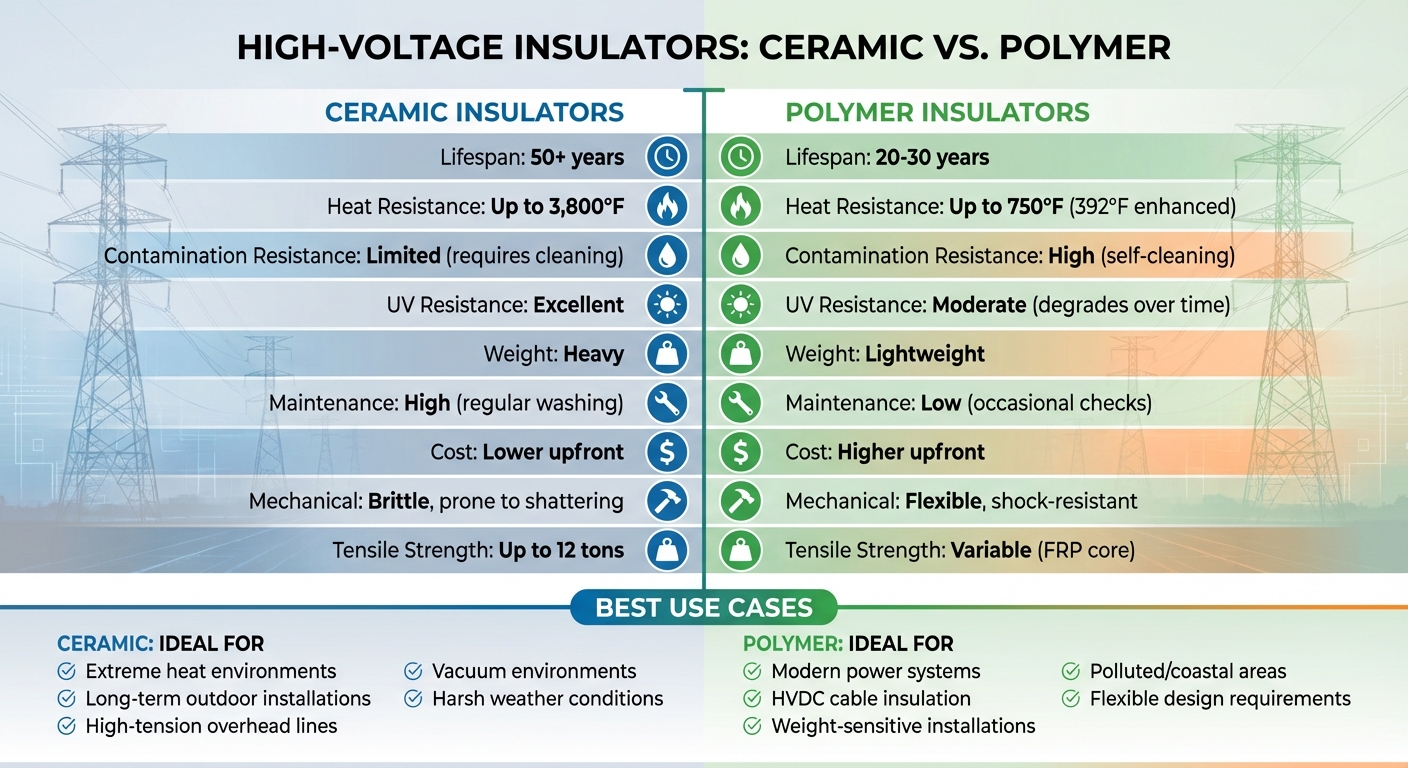
Ceramic vs Polymer High-Voltage Insulators Comparison Chart
Electrical Performance and Dielectric Strength
Dielectric Strength Ratings
Ceramic and polymer insulators handle electrical stress in distinct ways due to their material properties. In polymeric insulators, failure often occurs through bulk breakdown, where free electrons create a cascading effect that ultimately leads to failure. To counteract this, polymers are engineered at the molecular level, incorporating traps and advanced designs to mitigate these risks. On the other hand, alumina ceramics are more prone to surface flashover, especially in vacuum conditions. To improve their performance, ceramics often undergo surface treatments like chromium oxide film deposition, which helps enhance their resistance to flashover.
| Feature | Polymeric Insulation | Ceramic Insulation (Alumina) |
|---|---|---|
| Breakdown Mechanism | Electron avalanche / Bulk breakdown | Surface flashover (especially in vacuum) |
| Performance Enhancement | Molecular design, trap introduction, nano-composites | Surface film deposition, physical passivation |
| Design Flexibility | High; customizable through molecular engineering | Limited; constrained to specific structural forms |
These differences in handling electrical stress significantly influence the insulation resistance of each material under various conditions.
Insulation Resistance and Flashover Performance
The way polymer and ceramic insulators manage surface flashover further highlights their differences. Surface flashover, where an electrical discharge travels along the insulator's surface instead of through it, is influenced by environmental factors. In DC systems, polymeric insulators face challenges due to surface charge accumulation, which distorts the electric field and creates weak spots prone to failure. Outdoor environments, especially those with pollutants like salt spray or industrial residue, can worsen this issue.
Polymers, particularly those using silicone rubber (SiR) or RTV coatings, counteract these risks by leveraging their hydrophobic properties. These coatings repel water, preventing the formation of conductive films that could lead to flashover. Ceramic insulators, while traditionally less adaptable, often require similar coatings to match the pollution flashover resistance of polymers. This gives polymeric insulators a practical edge in high-risk environments like coastal or industrial areas.
sbb-itb-501186b
Temperature Resistance and Heat Management
Maximum Operating Temperature Limits
Ceramic insulators are engineered to handle extreme temperatures, reaching up to an impressive 3,800°F. This makes them ideal for demanding industrial and aerospace applications. On the other hand, standard polymer insulators are generally capped at around 750°F, restricting their use to more traditional power transmission and distribution systems. This stark contrast in thermal tolerance is a critical factor when deciding which material to use. However, advancements in polymer composites have extended their capabilities, with some now maintaining stable dielectric properties at temperatures up to 200°C (392°F).
Thermal Conductivity and Heat Dissipation
Temperature limits are only part of the story - effective heat dissipation is equally vital for ensuring insulator reliability. A material's thermal conductivity, measured in W/m·K, determines how well it can transfer heat and prevent localized overheating. Ceramics excel in this area, offering high thermal conductivity that efficiently channels heat away, even in environments with significant temperature swings. Polymers, in contrast, have lower thermal conductivity, which can lead to overheating risks. To address this challenge, researchers are working on solutions like adding nanostructured inorganic fillers and creating "phonon-engineered" materials. For example, ladderphane copolymers are being developed to boost the thermal performance of polymers, particularly in high-voltage DC systems.
Durability and Environmental Performance
Weathering and Contamination Resistance
Polymer insulators shine in polluted environments thanks to their natural water-repellent properties. Silicone rubber, in particular, stands out for its ability to repel water, which helps minimize leakage currents and lowers the risk of flashovers - even when coated with industrial dust or salt from coastal areas. One fascinating feature of silicone-based polymers is their "hydrophobicity transfer." This process allows silicone oils to migrate into contaminant layers on the surface, maintaining water repellence even under heavy pollution. On the other hand, ceramic insulators, being hydrophilic, rely on external cleaning to remove contaminants.
That said, ceramics have the upper hand in long-term weathering resistance. As inorganic materials, they are highly durable against UV radiation and chemical weathering. In contrast, polymers, being organic, can degrade under prolonged UV exposure, leading to surface tracking, erosion, and a gradual loss of hydrophobicity over the years. This aging process, often visible as surface "chalking", is a key limitation for polymer insulators in outdoor environments.
These differences in weathering and contamination resistance directly influence their lifespan and maintenance needs.
Lifespan and Maintenance Requirements
The environmental performance of these materials plays a big role in their reliability and upkeep over time. Ceramic insulators have a long history of durability, often lasting over 50 years. Their longevity is backed by decades of data and established theoretical models. Polymer insulators, however, typically last between 20 and 30 years before environmental aging requires replacement.
Maintenance needs present a trade-off. While ceramics are durable, they require regular high-pressure washing in polluted areas to remove contaminant buildup. Polymer insulators, by contrast, are often considered low-maintenance, needing only occasional checks on their hydrophobicity until they reach the end of their service life. A hybrid approach is also gaining popularity: applying Room Temperature Vulcanized (RTV) silicone rubber coatings to ceramic insulators. This combines the mechanical durability of ceramics with the contamination resistance of polymers.
The distinctions between these materials are summarized in the table below:
| Feature | Ceramic (Porcelain/Glass) | Polymer (Silicone/Composite) |
|---|---|---|
| Typical Lifespan | 50+ years | 20–30 years |
| UV Resistance | Excellent (Inorganic) | Moderate to Good (Ages over time) |
| Contamination Resistance | Limited (requires cleaning) | High (self-restoring) |
| Maintenance | High (Periodic washing) | Low (Self-cleaning properties) |
| Mechanical Stress | Brittle, prone to shattering | Flexible, shock-resistant |
Mechanical Properties and Installation
Strength and Flexibility Comparison
Ceramic and polymer insulators bring distinct mechanical traits to the table, making them suitable for different uses. Ceramic insulators, often made from porcelain shells, are known for their impressive tensile strength. Many ceramic string insulators can handle loads of up to 12 tons. However, ceramics have a downside - they’re brittle and don’t handle shear forces well. This is why ceramic post insulators in substations are typically used as stand-offs under compression, where lateral stress is minimal.
Polymer insulators, on the other hand, rely on a central core rod made of boron-free, corrosion-resistant ECR glass-fiber-reinforced plastic (FRP). This design helps prevent brittle fractures. Modern polymer insulators also use advanced materials like ladderphane copolymers and flexible cyclic-olefins to maintain their dielectric strength even under mechanical stress. Engineers can even tweak polymer materials at the molecular level by adding specialized electron traps. This customization allows polymer insulators to remain effective at temperatures as high as 392°F (200°C) while staying mechanically adaptable. These properties make polymers versatile, whether for composite crossarm insulators or integrated power equipment frameworks. These mechanical differences also play a key role in how these insulators are installed, as explained below.
Weight and Installation Complexity
The weight and design of these insulators significantly impact installation processes. Ceramic insulators, with their heavy porcelain shells and metal-capped disks, can be challenging to transport and install. Their use in string configurations for high-voltage applications further adds to their weight and complexity, often requiring specialized lifting equipment and larger crews.
Polymer insulators, in contrast, use lightweight FRP rods with silicone-based housings. This lighter design makes them easier and faster to install, cutting down on costs and labor. That said, polymer insulators are generally more suited for distribution systems with tower-to-tower spans under 500 feet, while ceramic strings remain the go-to choice for heavy-duty transmission lines that cover longer distances. The reduced weight of polymer insulators also simplifies maintenance and places less strain on supporting structures.
Polymer vs Porcelain Insulators: EEBootCamp Knowledge in Minutes
Cost Analysis and Lifecycle Economics
Understanding the costs involved is crucial when balancing performance with long-term reliability.
Initial Material Costs
Ceramic materials often come with lower initial costs compared to high-performance polymers. Polymers like polyurethane can experience price swings due to their connection to petroleum markets, whereas ceramic materials - made from mineral-based sources like recycled glass and rock - tend to have steadier pricing. Transportation costs can vary but may decrease with bulk purchases. While premium materials demand a higher upfront investment, they often provide better thermal efficiency and durability, which can prolong the lifespan of the equipment they protect. For example, polyurethane is among the most efficient insulation materials but is also one of the most expensive. Fiberglass, on the other hand, offers a more affordable option, though it sacrifices some efficiency.
Maintenance and Replacement Costs
Polymer insulators generally need less frequent cleaning in areas with heavy pollution. In contrast, ceramic insulators may require regular washing in industrial or coastal environments to avoid pollution flashover, potentially increasing labor costs. However, polymers are more prone to wear from UV exposure, humidity, and extreme temperatures, which can result in shorter replacement cycles. To address these vulnerabilities, coatings like Room Temperature Vulcanized (RTV) silicone rubber are often applied to extend the maintenance intervals. These ongoing maintenance costs, combined with energy efficiency factors, play a significant role in the overall expense of ownership.
Total Cost of Ownership
Beyond material and maintenance expenses, energy efficiency greatly influences the total cost of ownership by reducing heat and electrical losses in industrial systems. Ceramic insulators are known for their durability and resistance to chemical aging, while polymers often require additional measures, such as managing surface charge buildup, to prevent flashover. These added operational complexities can increase costs. A comprehensive cost analysis should consider factors like material availability, purchase volume, quality, transportation, labor expenses, delivery schedules, and energy savings. Opting for high-quality insulation can extend equipment life and reduce the need for replacements. For high-voltage environments, especially in harsh conditions, polymeric materials enhanced with protective coatings or fluorination treatments can help maintain insulation performance and minimize replacement frequency, ultimately lowering long-term ownership costs.
Conclusion: Selecting the Right Insulation Material
Choosing between ceramic and polymer insulation depends on your specific high-voltage application and the environment in which it will operate. By weighing factors like performance, durability, and cost, you can make an informed decision that aligns with your needs.
Ceramic insulators are the go-to choice for extreme heat environments and outdoor high-tension overhead lines. They shine in long-term exposure to UV rays and harsh weather conditions. With a hardness roughly four times that of stainless steel and natural resistance to contamination, ceramics are perfect for installations requiring minimal maintenance over decades.
On the other hand, polymer insulators are favored for modern power systems, including HVDC cable insulation and ultra-high voltage transmission, where weight reduction and flexibility are critical. However, polymers may need surface treatments to match the weathering resistance of ceramics in polluted settings.
For vacuum environments and high-temperature circuits, ceramics deliver superior performance. Meanwhile, advanced polymer materials, especially those enhanced with nanoparticles, offer unique benefits like self-healing capabilities for HVDC systems, automatically repairing electrical damage.
When it comes to long-term costs, ceramics often win in harsh outdoor conditions due to their durability and low maintenance needs. Polymers, however, can lower installation and transportation expenses thanks to their lighter weight. For sourcing high-voltage equipment and insulation components, Electrical Trader offers a range of new and used options to help balance performance with your budget.
FAQs
Which insulator type is safer in coastal or industrial pollution?
Polymer insulators are a safer choice for environments prone to coastal or industrial pollution. Their surface naturally resists pollution buildup and even cleans itself over time, which helps lower the chances of flashovers caused by contamination. On the other hand, ceramic insulators, while known for their durability, tend to collect more pollution and demand regular maintenance. This makes them less ideal for areas with high levels of pollution or salt deposits. In such challenging conditions, polymer insulators deliver more dependable performance.
How do I estimate total lifetime cost for ceramic vs. polymer?
When comparing the lifetime costs of ceramic and polymer insulation, it’s essential to look beyond just the purchase price. Ceramic insulators tend to have a higher upfront cost because they’re built to last. Their strength lies in their ability to withstand wear, corrosion, and extreme temperatures over time. On the other hand, polymer insulators are usually less expensive initially, but they might need more frequent repairs or replacements. To get a clear picture, you’ll need to weigh these upfront costs against ongoing maintenance and performance-related expenses.
When is an RTV silicone coating worth adding to ceramics?
RTV silicone coating offers an effective layer of protection for ceramic insulators in high-voltage systems, especially when dealing with contamination, pollution, or moisture. By reducing the risk of electrical tracking and flashovers, it boosts insulation performance and helps insulators last longer. This makes it a practical choice for harsh environments where dependable insulation is a must.