

Sector-Specific Calibration Guidelines Explained
Calibration ensures measurement tools perform accurately by comparing them to recognized standards. It’s crucial in industries like manufacturing, utilities, and power distribution to maintain safety and reliability. Poor calibration can lead to costly errors, regulatory violations, and safety risks. This article breaks down key calibration standards, such as ISO 9001 for manufacturing and NIST traceability for utilities, while offering actionable tips for compliance.
Key Takeaways:
- ISO 9001 Compliance: Requires tools to be maintained, traceable to SI units, and protected from damage. Calibration intervals depend on risk and usage.
- Utilities Standards: Instruments need higher precision due to environmental factors and live system operations. Calibration must align with NIST standards.
- Best Practices: Use detailed records, physical labels, and accredited labs. Adjust intervals based on risk, and recalibrate after incidents like drops or overloads.
- Emerging Trends: New standards mandate AI system calibration and electronic records for medical devices by 2026.
Proper calibration minimizes risks, ensures compliance, and protects infrastructure from failures.
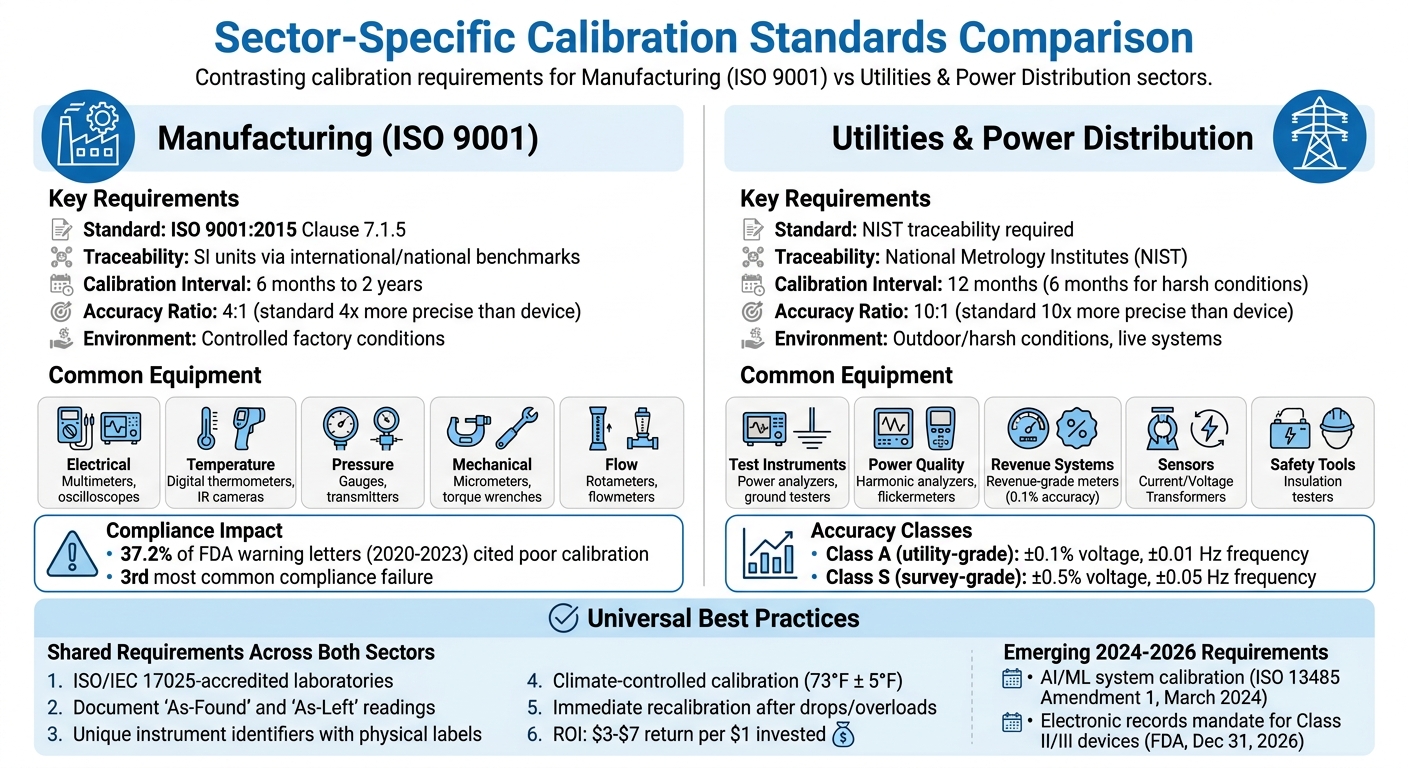
ISO 9001 vs Utility Calibration Standards Comparison Chart
ISO 9001 - Clause 7.1.5 Calibration in Your QMS - Part 2
sbb-itb-501186b
Calibration Standards for Manufacturing and Industrial Sectors
Manufacturing facilities depend heavily on precise measurements to ensure product quality and meet customer expectations. ISO 9001:2015 serves as a globally recognized standard, adopted by over one million organizations across 170+ countries, to manage calibration programs effectively. Within this framework, Clause 7.1.5 focuses on monitoring and measuring resources, requiring organizations to guarantee that their equipment delivers valid and reliable results. This means measurement tools must be suitable for their intended use, properly maintained, and traceable to recognized standards. When traceability is needed, equipment must be calibrated at specific intervals using standards linked to international or national benchmarks. This creates an unbroken chain of comparisons to the International System of Units (SI), forming the backbone of reliable calibration practices outlined in ISO 9001.
ISO 9001 Calibration Requirements
ISO 9001 outlines specific practices manufacturers must follow to maintain compliance. For instance, every measuring instrument should have a unique identifier, such as an asset tag or label, to clearly communicate its calibration status. Instruments must also be safeguarded from unauthorized adjustments, physical damage, or environmental factors. Organizations are required to keep detailed records of calibration results, including dates and any adjustments made. If a piece of equipment is found to be out of tolerance, manufacturers need to evaluate whether prior measurements were impacted and take corrective actions, which could even extend to product recalls.
Calibration intervals generally range from six months to two years and must use standards traceable to SI units. To ensure accuracy, calibration standards should be at least four times more precise than the device being tested.
| Equipment Category | Examples of Calibrated Equipment under ISO 9001 |
|---|---|
| Electrical | Multimeters, insulation testers, oscilloscopes, voltmeters, power supplies |
| Temperature | Digital thermometers, IR thermometers, thermal cameras, dry block calibrators |
| Pressure/Gas | Pressure gauges, vacuum gauges, barometers, transmitters |
| Mechanical | Micrometers, vernier calipers, torque wrenches, height gauges, feeler gauges |
| Flow | Rotameters, thermal mass flowmeters, turbine meters |
The financial implications of poor calibration can be severe. Between 2020 and 2023, 37.2% of FDA warning letters cited inadequate calibration, making it the third most common compliance failure in medical device manufacturing. Recalls stemming from such issues can cost millions, whereas maintaining a strong calibration program involves relatively low annual costs. As Michael Johnston, Software Product Manager at Fluke, puts it:
"Calibration is not just about accuracy. It is about demonstrating control."
Industrial Equipment Calibration Best Practices
Beyond ISO 9001 requirements, adopting additional best practices can significantly enhance calibration programs.
Start by creating a comprehensive master inventory. This should include each instrument’s serial number, location, calibration frequency, and upcoming due dates, enabling effective tracking of calibration schedules.
Physical labels are equally important. Add stickers to instruments that display both the "Date Calibrated" and the "Next Due Date" so technicians can quickly confirm whether a tool is ready for use. Equipment requiring recalibration should ideally be serviced within four weeks of its due date. If this timeline is missed, the tool should be taken out of service to avoid inaccurate measurements.
Calibration intervals should be determined based on risk rather than arbitrary timelines. Consider factors like manufacturer recommendations, usage frequency, and the criticality of the measurement to product quality. For example, high-risk equipment used in aerospace manufacturing may require calibration every three months, while stable, low-risk tools might only need annual checks. A great example comes from 2023, when a biomedical engineer in Durban, South Africa, reduced her lab’s electronic scale calibration from quarterly to biannually after analyzing 18 months of stability data. This adjustment saved $18,500 per year without triggering any audit issues.
Environmental conditions also play a major role in calibration accuracy. For instance, a semiconductor plant successfully reduced calibration failures from 41.3% to just 2% by controlling humidity levels. Shifts in temperature or humidity beyond ±9°F are often the leading causes of calibration failures.
If calibration services are outsourced, ISO 9001 requires that providers demonstrate their expertise. Partnering with ISO/IEC 17025-accredited laboratories ensures that calibration certificates include complete traceability to SI units and documented measurement uncertainty. Additionally, any software used for monitoring or measuring must be validated for its intended purpose and revalidated as needed. Notably, starting in March 2024, ISO standards (specifically ISO 13485 Amendment 1) will require calibration and validation of AI and machine learning systems used in measurement and quality control. Meanwhile, the FDA’s 2024 Calibration Modernization Initiative mandates that Class II and III device manufacturers transition to electronic records by December 31, 2026, phasing out paper logs entirely.
Calibration Standards for Utilities and Power Distribution Equipment
Utilities face distinct calibration challenges compared to manufacturing environments. Power distribution systems rely on instruments that measure voltage, current, harmonics, and transients - often operating in tough outdoor conditions. Factors like temperature changes, humidity, and electromagnetic interference can degrade accuracy. Unlike factory equipment, utility instruments must maintain precision while running in live systems. Even minor errors can lead to failures, safety hazards, or violations of regulations.
Traceability is critical in this field. Instruments must be traceable to SI units through accredited National Metrology Institutes like NIST. The calibration standard itself needs to be at least 10 times more accurate than the instrument being tested to avoid overlapping tolerances. Richard Hurst, Associate Editor at The Electricity Forum, highlights this principle:
"Calibration typically requires a standard that has at least 10 times the accuracy of the instrument under test."
Before calibration begins, instruments must stabilize in a climate-controlled environment at 73°F ± 5°F. This prevents thermal expansion from affecting high-precision measurements. For complex devices like Three-Phase Power Quality Analyzers, calibration involves multiple parameters, including voltage and current magnitudes, phase angles (120° separation), harmonics (up to the 50th or 100th frequency), flicker, and transients. It’s essential to document both "As-Found" and "As-Left" readings to confirm compliance.
Equipment That Requires Calibration
Utilities depend on a wide variety of calibrated instruments to ensure system reliability. These include:
- Test instruments: Multimeters, oscilloscopes, power analyzers, signal generators, ground testers, and megohmmeters.
- Power quality equipment: Portable and permanent monitors, flickermeters, and harmonic analyzers.
- Revenue and billing systems: Revenue-grade meters with 0.1% precision class accuracy.
- Sensors and transformers: Current Transformers (CTs), Voltage Transformers (VTs), and Rogowski coils.
- Safety and maintenance tools: Insulation-resistance testers and arc flash boundary measurement devices.
Class A power-quality instruments, used for utility-grade and contractual work, require voltage accuracy of ±0.1% of nominal voltage and frequency accuracy within ±0.01 Hz. Survey-grade Class S instruments, often used for troubleshooting, allow ±0.5% voltage accuracy and ±0.05 Hz frequency accuracy. For revenue metering, CTs and VTs must meet accuracy classes of 0.1, 0.2, or 0.5. Additionally, IEEE 519-2022 limits voltage Total Harmonic Distortion (THD) to 5.0% for bus voltages between 1–69 kV at the Point of Common Coupling.
Skipping calibration can have serious consequences. Techmaster Electronics warns:
"Inaccurate readings from an uncalibrated device are often more dangerous than no readings at all, as they provide a false sense of security while your infrastructure suffers from harmonic distortion or transient voltages."
How Often to Calibrate Utility Equipment
The industry standard recommends calibrating power distribution diagnostic tools every 12 months. However, for equipment used daily in harsh conditions or during critical audits, calibration intervals should be shortened to every 6 months. New equipment must arrive with a "Freshly Calibrated" certificate before being registered, as shipping and storage can impact accuracy.
Certain conditions demand immediate calibration. For instance, if an instrument is dropped (e.g., a current clamp) or experiences an electrical overload, it should be recalibrated - even if internal protection mechanisms weren’t triggered. For high-stakes projects, calibrate tools right before use, store them securely during operations, and recalibrate afterward to verify performance.
Field comparison checks do not replace formal calibration. Randy Hurst, Senior Editor at Electricity Today, explains:
"Many people do a field comparison check of two meters, and call them 'calibrated' if they give the same reading. This isn't calibration. It's simply a field check."
Before sending equipment for calibration, ensure firmware is updated, as updates can alter internal calibration constants. For current clamps, perform a "Zero" or "Null" calibration in the field to adjust for ambient magnetic interference. Proper storage is also key - modern Power Quality Analyzers should be stored with a battery charge between 40–60% to avoid internal voltage reference issues.
Professionals can procure pre-calibrated, compliant equipment from Electrical Trader to meet these strict standards. These meticulous procedures are essential for maintaining calibration compliance across the utility sector.
Compliance Strategies for Electrical Equipment Professionals
To meet calibration standards effectively, electrical professionals need well-structured compliance strategies. This involves setting up clear, documented calibration processes. A key requirement is NIST traceability - calibration certificates must include a traceability chain to the National Institute of Standards and Technology. Without proper documentation, calibration records might fail to meet regulatory requirements.
Another critical aspect is following the 10:1 accuracy rule, meaning the calibration standard must be at least 10 times more accurate than the instrument being tested. Instruments should be calibrated before starting critical projects and stored securely to prevent performance drift. These steps ensure both regulatory compliance and operational reliability.
How to Document Calibration Processes
Consistent documentation of both pre- and post-calibration states is essential. As Richard Hurst, Associate Editor at The Electricity Forum, points out:
"You'll get a report showing how far out of calibration the instrument was before, and how far out it is after."
If significant calibration errors are identified, a discrepancy review process must be documented. This involves rechecking all measurements taken with the instrument since its last successful calibration, starting with the most recent data. For industries like nuclear safety, the requirements are even stricter, often requiring all measurements since the previous calibration to be redone. Hurst adds:
"If the report shows gross calibration errors, you may need to go back to the work you did with that instrument and take new measurements until no errors are evident."
Keeping an event log is equally important. Any incidents, such as dropping a current clamp or exposing a digital multimeter to a voltage overload, should trigger immediate documentation and recalibration. Calibration intervals should also be recorded, whether based on manufacturer recommendations or project-specific needs.
| Calibration Frequency | Recommended Use Case |
|---|---|
| Before/After Critical Project | For precise measurements where reliability is crucial. |
| Monthly/Quarterly | When frequent critical measurements are necessary. |
| Annually | A practical option for mixed-use tools. |
| Biannually | For tools used less frequently in critical applications. |
| After an Event | Following incidents like drops, impacts, or overloads. |
Thorough documentation, combined with sourcing pre-calibrated instruments, forms the backbone of an effective compliance strategy.
Using Electrical Trader to Source Calibrated Equipment

Starting projects with instruments that are already calibrated reduces the risk of errors. Electrical Trader provides access to NIST-traceable equipment with documented calibration records, ensuring compliance from the outset and minimizing liability for professionals.
Pre-calibrated tools from Electrical Trader are designed to deliver precise measurements within strict tolerance limits, making them essential for safety-critical systems. The platform offers a variety of power distribution equipment, including breakers, transformers, and testing instruments, allowing professionals to acquire compliance-ready tools without delays. Additionally, calibration programs can deliver financial benefits, with a return of $3 to $7 for every $1 invested, thanks to reduced rework, fewer warranty claims, and improved safety outcomes.
When selecting equipment, verify that calibration is performed by an ISO/IEC 17025-accredited laboratory, and ensure the equipment includes detailed reports showing its "As-Found" and "As-Left" states. For critical projects, aligning calibration intervals with project timelines and securely storing instruments until deployment helps maintain measurement accuracy and reliability.
Conclusion
Adhering to sector-specific calibration guidelines does more than meet regulatory requirements - it actively prevents costly and potentially dangerous failures. When instruments provide inaccurate readings, the consequences can ripple across industries, risking safety, efficiency, and compliance. Calibration addresses these risks by countering "drift", the gradual loss of accuracy caused by wear and environmental factors. Even digital devices are not immune, as their precision can shift over time. Without a continuous chain of measurements linked to SI units, organizations face the risk of failing audits and undermining the trust that underpins international trade agreements.
Given these stakes, strong compliance strategies are essential. Modern methods prioritize data analysis over simply maintaining certificates. For instance, reviewing "as found" and "as left" data helps identify how drift may have impacted earlier production cycles. In industries like manufacturing or utilities - regulated by FERC, NERC, and EPA - comprehensive documentation not only ensures compliance but also simplifies the audit process.
Pre-calibrated tools and detailed records are critical safeguards for these industries. Electrical Trader supports this mission by offering NIST-traceable equipment with calibration records from ISO/IEC 17025-accredited labs, ensuring that organizations have compliance-ready tools they can rely on immediately.
FAQs
How do I choose the right calibration interval for each tool?
To figure out the right calibration interval for your tools, start by checking the manufacturer's guidelines in the tool's manual. Next, think about how often the tool is used, the conditions it operates in, and how critical its measurements are to your work. Industry standards, like ISO/IEC 17025, highlight the importance of maintaining measurement accuracy and accounting for potential drift over time. Finally, weigh the costs of calibration against your operational requirements to create a schedule that keeps your tools compliant and dependable under your specific circumstances.
What proof do I need for NIST traceability in an audit?
To show NIST traceability during an audit, you’ll need to provide documentation such as calibration certificates or reports. These documents should verify that your equipment has been calibrated following recognized procedures and aligns with NIST standards. This helps confirm that your measurements are both accurate and compliant.
When should I recalibrate a meter after a drop or overload?
If your meter has been dropped, overloaded, or shows signs of measurement drift, zero instability, or physical damage, it's time to recalibrate. Recalibration ensures your readings remain accurate and reliable. Plus, it's a critical step in maintaining safety, especially if the equipment has experienced any mishandling or impact.