




How to Ensure Compliance with ISO/IEC 17025
ISO/IEC 17025 is the global standard for testing and calibration labs, focusing on technical accuracy and valid results traceable to SI units. Compliance ensures labs meet quality benchmarks, gain international recognition, and build trust in their results. Here's how to achieve and maintain it:
- Understand the Standard: ISO/IEC 17025 emphasizes impartiality, metrological traceability, and measurement uncertainty.
- Gap Analysis: Compare current practices against the standard to identify deficiencies.
- Build a Quality Management System (QMS): Document policies, procedures, and records that meet ISO requirements.
- Train Staff: Ensure personnel are skilled in technical tasks, uncertainty evaluation, and equipment use.
- Audit Regularly: Conduct internal audits and management reviews to fix issues and improve processes.
- Prepare for Accreditation: Organize documentation and address gaps before assessments.
Compliance is an ongoing process requiring regular reviews, updates, and adherence to the latest requirements, including digital data handling by 2028. This ensures accurate, traceable results and global acceptance of your lab's work.
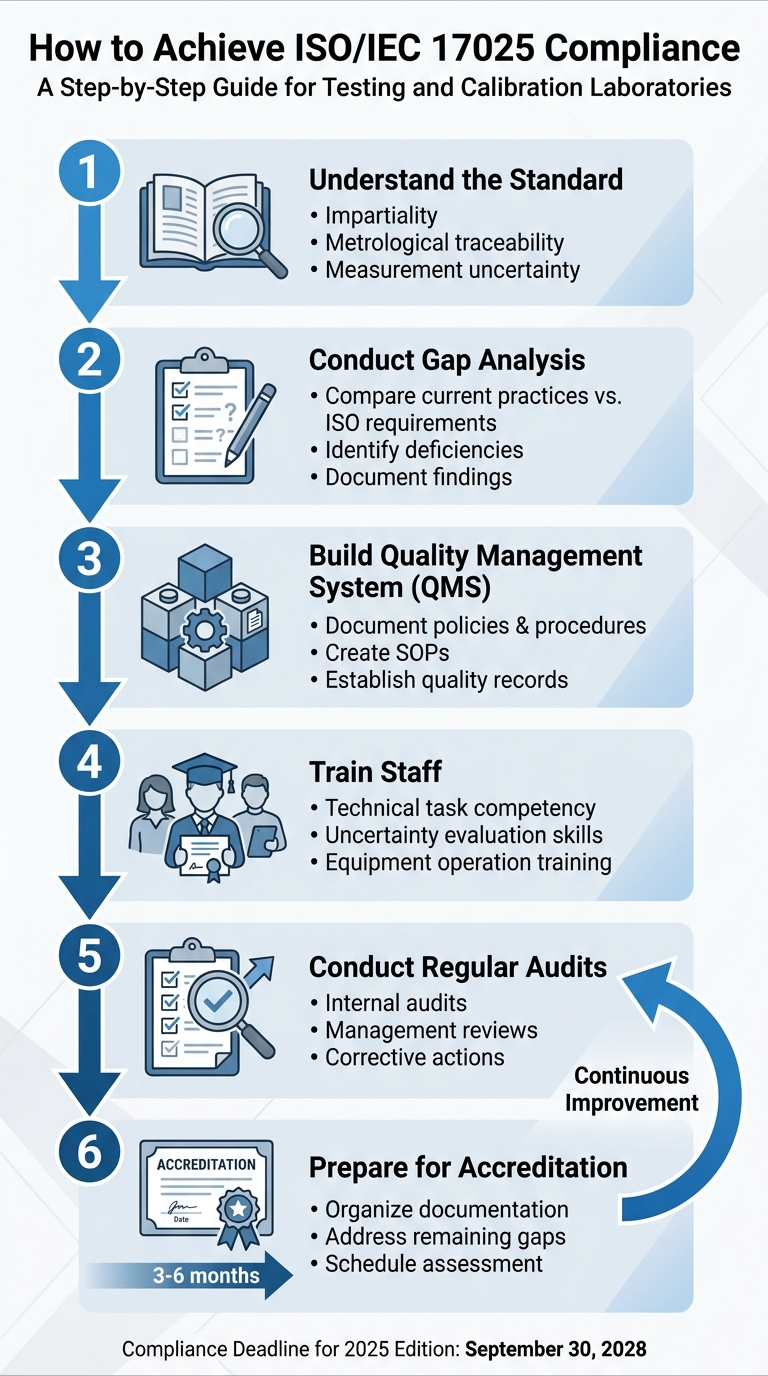
6-Step Process to Achieve ISO/IEC 17025 Compliance for Testing and Calibration Labs
Understanding ISO/IEC 17025 Requirements
General, Structural, and Resource Requirements
ISO/IEC 17025 organizes its requirements into two primary areas. The first focuses on general, structural, and resource needs, which form the backbone of technical competence.
Clause 4 emphasizes impartiality and confidentiality. Laboratories must regularly evaluate risks to impartiality and maintain a legally defined structure with a documented scope (Clauses 4 and 5). This ensures that commercial or financial pressures never interfere with the quality of results.
Clause 6 zeroes in on resources. Personnel need specialized technical training to handle complex measurements like voltage, current, and resistance. Additionally, facilities must regulate environmental factors - such as temperature, humidity, and electromagnetic interference (EMI) - that directly impact measurement accuracy. Calibration activities should pause if environmental conditions exceed acceptable thresholds.
All equipment must have unique identification, be calibrated, and maintain traceability to SI units via an unbroken calibration chain connected to a National Metrology Institute, such as NIST. According to ILAC P10 Policy, "Metrological traceability pertains to reference quantity values of measurement standards and results, not the organization providing the results". This distinction is critical, as measurement traceability consistently ranks among the top 10 deficiencies cited during ISO/IEC 17025 audits.
| Clause | Requirement Category | Application to Electrical Calibration |
|---|---|---|
| 6.2 | Personnel | Expertise in electrical safety and precision measurement techniques |
| 6.3 | Facilities | Control over EMI and maintaining stable temperature conditions |
| 6.4 | Equipment | Use of precision multimeters and calibrators with verified calibration status |
| 6.5 | Metrological Traceability | Continuous traceability to SI units for Voltage (V), Current (A), and Resistance (Ω) |
With these resource standards in place, the next section delves into the process and management system requirements that ensure technical validity.
Process and Management System Requirements
Clause 7 outlines the process requirements necessary to uphold technical validity. Labs must validate calibration methods tailored to the specific applications of each electrical device. Addressing measurement uncertainty (Clause 7.6) is crucial - labs must identify all significant contributors to uncertainty, especially for high-precision electrical components where even minor deviations can have a big impact. If equipment is found to be out-of-tolerance (OOT), Clause 7.10 mandates an analysis to assess whether previously reported results remain reliable.
Clause 8 defines management system requirements. A key element is risk-based thinking (Clause 8.5), which encourages labs to shift from a reactive approach to a proactive one by identifying risks - like equipment drift or environmental changes - before they compromise results. Regular internal audits (Clause 8.8) and management reviews (Clause 8.9) help ensure the system remains effective over time.
The 2025 edition of ISO/IEC 17025, released on September 27, 2025, introduced new requirements for handling digital calibration data, electronic signatures, and software validation. Laboratories must comply with these updates by September 30, 2028.
sbb-itb-501186b
Steps to Achieve Compliance
Conducting a Gap Analysis
The first step toward ISO/IEC 17025 compliance is conducting a gap analysis. This process compares your lab's current operations to the standard's requirements, helping you pinpoint areas where you fall short.
Start by reviewing the ISO/IEC 17025 requirements for Scope, Resource, Process, and Management System. Then assess your existing practices, including documentation, training programs, equipment calibration records, and proficiency testing results. This comparison will help you uncover specific deficiencies - ranging from minor documentation issues to major non-conformities that could compromise measurement accuracy.
Document your findings in a table that outlines the requirements, your current state, identified gaps, and planned corrective actions. For instance, if Clause 4 requires documented procedures to ensure impartiality, but your quality manual doesn’t address organizational structure, note this gap and plan to revise the policy. Prioritize addressing gaps that pose the highest risk to measurement reliability. Engage your team in this process to capture the realities of daily operations, rather than relying solely on written procedures. Conduct an internal review roughly 30 days before any official assessment to catch and resolve critical issues early.
Once you’ve identified the gaps, the next step is to create a robust Quality Management System (QMS) to address them.
Developing and Implementing a Quality Management System (QMS)
Building a QMS requires commitment from senior management and a well-organized documentation framework. Each element of the QMS supports the technical accuracy demanded by ISO/IEC 17025. Your QMS should include a quality policy with SMART objectives (Specific, Measurable, Achievable, Relevant, and Time-bound), standard operating procedures (SOPs) for technical tasks, work instructions, and quality records such as calibration certificates and audit reports.
Clause 8.5 emphasizes risk-based thinking. Identify potential risks - like equipment drift, environmental fluctuations, or threats to impartiality - and outline actions to mitigate them before they impact results. Use controlled templates for calibration certificates to ensure consistency. These templates should include a unique number, instrument identification, method reference, uncertainty statement, traceability details, and a decision rule for conformity assessments.
Consider transitioning to an electronic QMS (eQMS) to simplify document control, training record management, and corrective action tracking. Regular internal audits and management reviews are essential to ensure the QMS operates effectively and supports continuous improvement.
Staff Training and Competency Assurance
ISO/IEC 17025 places a strong emphasis on staff competence, which is defined as the ability to achieve intended results. Your lab must document the competence requirements for every role that influences results, from operating reference standards to calculating measurement uncertainty and approving reports. Maintaining consistent competency verification is critical to upholding the precision outlined in Clause 6.
Implement a tiered competency system to track staff development. For example:
- Level 1: Trainees
- Level 2: Supervised personnel
- Level 3: Independent experts.
Verify staff competency using various methods, such as observing technicians during calibrations, administering written exams, reviewing proficiency testing results, and analyzing statistical data on repeatability and reproducibility. As calibration expert Edwin explains, "Competence is the core requirement for personnel to allow the execution of important laboratory activities. It is also one of the reasons why customers pay for our service".
Maintain a competency matrix to track training completion, certification expiration dates, and authorized tasks for each team member. Incorporate on-site observations during internal audits to confirm that technicians follow documented procedures during real calibrations. Only grant formal authorization after verifying competency, and remember that skills need ongoing monitoring and reassessment to stay current.
Strong training programs not only enhance the integrity of your QMS but also help ensure your lab remains compliant with ISO/IEC 17025.
📌 ISO 17025 Accreditation: Step-by-Step Guide to Get Certified
Maintaining Compliance Through Regular Reviews
Staying compliant with ISO/IEC 17025 isn't a one-and-done deal. It requires consistent effort through internal audits and management reviews. These regular check-ins help labs adapt to changing conditions, aging equipment, and shifts in personnel. By catching potential problems early, you can protect both your measurement accuracy and your accreditation.
Performing Internal Audits
Internal audits are essential for ensuring your lab stays aligned with ISO/IEC 17025 requirements. These audits cover everything from management tasks like document control and risk management to technical processes such as calibration and uncertainty calculations.
The success of an internal audit hinges on the right mindset and skilled auditors. ISO 17025 expert Tracey Evans puts it well: "Management should encourage an open, fair, collaborative effort between technical auditors and auditees. The technical auditors must clearly communicate with auditees that gaps will be identified together in order to drive improvement, not to find 'fault' and cast blame". That means your auditors need to understand the specific technical processes they're reviewing - someone auditing pressure calibrations, for instance, must know the methods, equipment, and traceability involved.
To cover all bases, use three main types of audits:
- Witnessing: Observe a technician performing a live calibration to confirm real-time compliance.
- Vertical audits: Follow a single reported result from start to finish, tracing it through sample registration, testing, and final reporting.
- Horizontal audits: Examine specific ISO clauses, like equipment maintenance or staff competency, across all your testing methods.
An effective audit program typically includes at least one horizontal audit, one witnessing session, and one vertical audit annually. Start preparing 30 days in advance by defining the audit’s scope, freezing document versions, and assigning responsibilities for specific clauses. Standardized checklists from accreditation bodies can help ensure you don’t miss critical areas like metrological traceability, measurement uncertainty, or environmental controls. To stay ahead, aim to conduct internal audits 2–3 weeks before external assessments so you have time to address any major issues.
Beyond the technical side, management reviews play a vital role in evaluating whether your lab’s overall system is on track to meet its goals.
Conducting Management Reviews
Management reviews are more than just routine check-ins - they’re a chance to step back and assess whether your quality system supports your lab’s broader objectives. As Tracey Evans explains, "Management review is neither an audit nor a report-back discussion. It is not about reporting measurements, but evaluating to what extent the management system fulfills its functions and goals. Management review is a strategic planning opportunity".
Schedule at least one management review each year, ideally timed with your financial year or accreditation cycle to ensure resources are available for any necessary upgrades. Clause 8.9 outlines mandatory discussion points, including:
- Status of previous review actions
- Results from internal and external audits
- Changes in work volume or scope
- Feedback from customers and staff
- Risk assessments and result validity
For calibration labs, it’s also important to analyze trends in Out-of-Tolerance (OOT) events, evaluate the effectiveness of calibration intervals, and review any updates to uncertainty budgets or measurement methods. Use four key criteria to guide your review:
- Suitability: Are the right processes in place?
- Adequacy: Are all requirements being met?
- Effectiveness: Is the system delivering the desired results?
- Efficiency: Are resources being used wisely?
Document everything - decisions, resource needs, and action plans - in a Management Review Record. Use dashboards or graphs to present data in a clear, visual format that highlights lab performance. Most importantly, share the results and new objectives with your team to ensure everyone stays aligned and motivated. Each review should lead to actionable goals that improve your lab’s operations moving forward.
Preparation for ISO/IEC 17025 Accreditation
After building your quality management system and completing internal audits, the final hurdle is the formal accreditation assessment. This is your chance to show an external assessor that your lab operates effectively and produces reliable results. The entire process, from application to accreditation, typically takes 3 to 6 months. With over 114,600 laboratories accredited worldwide under the ILAC Mutual Recognition Arrangement as of March 2025, the standards for technical competence are well-established.
Key Documents and Records for Accreditation
This step is all about showcasing the quality management system you’ve worked so hard to develop. Assessors will require thorough evidence that your lab meets all ISO/IEC 17025 requirements. Start by organizing your management system documentation, which includes your quality policy, objectives, and procedures for managing documents and records. Although the 2017 version of the standard no longer mandates a formal Quality Manual, many labs still use one to demonstrate process alignment.
Your technical records are critical. Clause 7.5 of the standard requires you to maintain detailed records covering calibration work, equipment maintenance, and personnel qualifications. This includes an equipment master list with calibration schedules, maintenance logs, and traceability to SI units. For personnel, maintain competency matrices, training logs, task authorizations, and job descriptions for all technical staff.
Don’t forget your process documentation. This should include validated test methods, work instructions, sampling procedures, and measurement uncertainty budgets, all of which should be easily accessible. Additionally, quality assurance records - such as proficiency testing results, inter-laboratory comparisons, and internal audit reports with corrective actions - must be up-to-date and well-organized. If your lab is transitioning to ISO/IEC 17025:2025 (with a deadline of September 30, 2028), you’ll also need to document digital data integrity, electronic signatures, and software validation.
Pay special attention to your calibration certificates. As LabCalibrate emphasizes:
"If an auditor must guess what a result means, your certificate format is too weak".
Each certificate should include a unique ID, traceability statement, measurement uncertainty, decision rule for conformity, and an authorized signatory. Missing any of these elements is a common issue during assessments. Once your documents are in order, stick to a well-planned timeline to ensure a smooth accreditation process.
Tips for a Successful Accreditation Assessment
A structured approach can make all the difference. Begin with a countdown strategy to stay on track:
- Thirty days before the audit: Freeze all document versions to avoid last-minute edits that could lead to "document control drift." Assign staff members as "clause owners" responsible for specific sections of the standard. Create a central evidence index that maps each audit question to a specific record and its responsible person. This index will serve as your guide during the assessment.
- Fifteen days out: Focus on internal audits, especially in areas where you’ve identified weaknesses. Verify that all traceability records are current, and conduct mock interviews with staff. Lab Manager Jeanné Mensingh highlights the importance of this step:
"The best planning tool for an accreditation assessment is an internal audit, but it is rarely given the attention needed to improve the laboratory's compliance".
Role-playing exercises can help technicians practice explaining their work and locating records under pressure - skills that build confidence and reduce stress on the big day.
- Seven days before the visit: Finalize your evidence pack and ensure all records can be retrieved quickly. Auditors will assess how efficiently you can access specific job files or equipment logs. Slow retrieval can signal disorganization and raise concerns. Conduct a final management briefing to address any remaining risks and prepare leadership to discuss strategic planning and resource allocation.
During the assessment, treat the process as an opportunity for improvement. Answer questions clearly, demonstrate processes when requested, and don’t hesitate to say, "I don’t know, but I can find out" if you’re unsure about something. If non-conformities are identified, address them with a detailed root cause analysis and a plan to verify effectiveness. Simply logging an action without tackling the root issue won’t suffice. As SIMCO reminds us:
"Calibration under ISO/IEC 17025 is a technical control, not an administrative task. A current certificate alone does not demonstrate compliance or result validity".
Be prepared to explain not only what your lab does but also why your methods ensure accurate and traceable measurements.
Conclusion
Achieving ISO/IEC 17025 compliance is all about demonstrating that your lab produces technically sound and traceable results. The journey starts with a gap analysis to pinpoint areas for improvement, followed by creating a quality management system that incorporates traceability, uncertainty evaluation, and staff expertise. As Michael Johnston from Fluke aptly states:
"ISO/IEC 17025 proves not only that you can measure accurately but that you can prove it."
But compliance offers more than just passing an audit. Accreditation ensures your calibration certificates are recognized globally through the ILAC Mutual Recognition Arrangement. This not only strengthens your competitive edge but also builds customer confidence by showing your measurements are reliable and your processes consistent.
Keep in mind, compliance isn’t a one-and-done effort - it’s a continuous process. Regular internal audits, management reviews, and tracking uncertainty trends help your system adapt to changing demands. With new requirements like digital data integrity and software validation taking effect by September 30, 2028, staying vigilant is more important than ever. Think of the standard as a living framework that grows alongside your lab’s operations.
For electrical calibration labs, staying compliant ensures the accuracy of critical measurements - whether for power distribution equipment, circuit breakers, or transformers. This precision supports everything from product launches to safety certifications. By embedding compliance into your daily routines, you’ll minimize rework, improve efficiency, and solidify your lab's reputation in the electrical industry.
Make these practices part of your everyday operations to ensure ongoing compliance and long-term success.
FAQs
What’s the fastest way to run an ISO/IEC 17025 gap analysis?
To efficiently conduct an ISO/IEC 17025 gap analysis, begin by examining the latest 17025:2017 standard to clearly outline your compliance objectives. Evaluate your current system by reviewing documentation and engaging with staff to pinpoint areas that need improvement. Leverage a gap analysis checklist or tool to concentrate on key aspects such as documentation, procedures, and required evidence. Once gaps are identified, prioritize tasks and develop a focused action plan to address shortcomings and progress toward compliance.
How do I prove SI traceability for my lab’s calibration results?
To establish SI traceability, it's essential to connect your measurements to the International System of Units (SI) through a continuous chain of calibrations, each with documented uncertainties. This involves using calibration standards that are directly tied to SI units and keeping thorough records that detail the calibration history, the standards utilized, and the associated uncertainties. Adhering to ISO/IEC 17025 guidelines and consulting NIST's policies on metrological traceability can further ensure your compliance with these requirements.
What do labs need to change for the ISO/IEC 17025:2025 digital data rules by 09/30/2028?
Calibration labs need to adjust their workflows to meet the ISO/IEC 17025:2025 digital data requirements by September 30, 2028. These updates emphasize handling digital calibration data, validating measurement software, and adopting secure electronic signatures. To align with the new standards, labs must focus on traceability, data integrity, and security. This means revising how records are kept, ensuring software is properly verified, and updating procedures for managing digital measurement systems.





