




Calibration Compliance: Role of ANAB and IAS
In the electrical industry, calibration compliance ensures safety and reliability. Two key accreditation bodies, ANAB and IAS, play critical roles in verifying calibration labs meet ISO/IEC 17025 standards. Here's a quick breakdown of their approaches:
- ANAB: Focuses on technical expertise, with over 700 accredited labs globally. Offers detailed documentation, pre-assessments, and a structured accreditation process.
- IAS: Known for quick service and flexibility, catering to labs with tight deadlines. Emphasizes strict measurement reporting and specialized requirements, such as those for defense contractors.
Both organizations ensure traceability to national standards (e.g., NIST) and global recognition through ILAC agreements. Your choice depends on your specific needs - ANAB for detailed technical support, or IAS for faster turnaround times and accessibility.
1. ANAB
Accreditation Standards
ANAB evaluates laboratories using ISO/IEC 17025, focusing on both technical expertise and quality management systems. To address specific calibration needs, ANAB supplements this standard with additional documents. For example, AR 2250 applies to testing labs, while TR 2501 outlines equipment requirements for tools like scales and balances. For forensic calibration, AR 3125 incorporates essential ILAC policies related to proficiency testing and measurement uncertainty.
One key distinction of ANAB is its status as a signatory of the ILAC Mutual Recognition Arrangement (MRA). This designation ensures that calibration data from ANAB-accredited labs is automatically recognized in about 80 countries where ANAB operates. For electrical manufacturers working across borders, this eliminates the need for repetitive testing, streamlining global operations.
Scope of Calibration
ANAB provides each accredited lab with a Scope of Accreditation, detailing the specific parameters, measurement ranges, and uncertainties they are qualified to test. For electrical testing, this might include voltage, current, and resistance measurements, each with clearly defined uncertainty limits. To ensure accuracy, labs must demonstrate traceability to SI units through national metrology institutes.
Accredited labs are also required to participate in proficiency testing annually, with a four-year plan that covers all accredited activities. This process helps maintain consistent calibration capabilities over time. By adhering to this rigorous framework, labs can ensure their calibration practices remain reliable and well-documented.
Impact on Electrical Industry
A well-defined accreditation scope ensures labs can meet the precise needs of the electrical industry. For this reason, many companies in the sector prioritize ANAB accreditation when selecting calibration providers. With over 700 ANAB-accredited labs worldwide, manufacturers can access a trusted network of service providers. As ANAB explains:
"The goal of ANAB calibration laboratory accreditation program is to provide 3rd party assurance of the quality of calibration laboratories with the objective of promoting confidence in calibration through accreditation by assuring compliance with international standard ISO/IEC 17025."
For example, Electrical Trader (https://electricaltrader.com) benefits from ANAB's extensive network to ensure accurate calibration for components like breakers and transformers. Businesses sourcing equipment through platforms like this can verify that suppliers rely on ANAB-accredited labs, ensuring power distribution equipment meets exact specifications.
Documentation Requirements
ANAB places a strong emphasis on thorough record-keeping. Accredited labs must maintain a quality manual that outlines policies and operational procedures, including guidelines for calibration intervals. Each type of calibration must have a documented procedure, and labs are required to keep detailed records of measurement uncertainties for all equipment.
To support traceability, ANAB offers Form FM 2807, which helps labs track the calibration chain from working equipment back to reference standards. For proficiency testing, labs need to document a plan covering the current year and the next three years, including records of participation and any investigations into unsatisfactory results. These documentation standards ensure that calibration data is defensible during audits or regulatory reviews.
sbb-itb-501186b
2. IAS
Accreditation Standards
IAS accredits calibration laboratories based on ISO/IEC 17025, supplemented by its own Accreditation Criteria for Calibration Laboratories (AC204), which introduces additional requirements. As a member of both the ILAC Mutual Recognition Arrangement (MRA) and the Asia Pacific Accreditation Cooperation (APAC), IAS ensures that calibration certificates issued by its accredited labs are accepted worldwide. This global recognition provides a solid foundation of trust for electrical suppliers and manufacturers. IAS policies also align with ILAC P14 regarding measurement uncertainty and refer to key resources like the BIPM SI Brochure and NIST Special Publication 811 for proper unit representation.
Scope of Calibration
IAS takes a firm stance against flexible scopes in calibration laboratories, requiring labs to report only their verified measurement capabilities. Standard Calibrations, Inc. highlights this approach, stating:
"IAS's prohibition of flexible scopes gives our customers the confidence that best measurement capability (best achievable accuracy) is not overstated."
Additionally, IAS-accredited labs can meet specific U.S. Navy standards, such as OPNAVINST 3960.16B, to qualify as official Calibration Service Providers. These labs must also demonstrate traceability to NIST for critical calibration activities.
Impact on Electrical Industry
IAS will celebrate 50 years of accreditation expertise in 2025, a milestone that reflects its longstanding reputation for reliability. This reputation has made IAS a preferred choice for defense contractors and specialized facilities. For example, IAS-accredited labs are routinely reviewed by the Defense Contract Management Agency (DCMA) and companies like BAE Systems. For electrical equipment suppliers, IAS accreditation ensures that products like breakers, transformers, and power distribution systems meet precise performance standards. This rigorous approach not only guarantees accuracy but also supports the detailed documentation necessary for calibration compliance.
Documentation Requirements
IAS enforces strict documentation standards to ensure consistent calibration practices. Key policy guides include IAS/CL/014, which addresses calibration, traceability, and measurement uncertainty in line with ISO/IEC 17025:2017. For labs conducting offsite calibrations, IAS/TL-CL/026 outlines mandatory policies, while IAS/TL-CL/031 specifies proficiency testing requirements to validate claimed Calibration and Measurement Capabilities. IAS also provides guidance on evaluating calibration uncertainty, ensuring compliance with statistical standards. The organization emphasizes that accreditation reflects technical competence, distinguishing it from general management system certifications.
| Document Code | Purpose | Alignment |
|---|---|---|
| AC204 | Core assessment criteria for calibration labs | ISO/IEC 17025 |
| IAS/CL/014 | Calibration, traceability, and measurement uncertainty | ISO/IEC 17025:2017 / Z540 |
| IAS/CL/022 | Scope representation guidelines | ILAC P14 / NIST SP 811 |
| IAS/TL-CL/031 | Proficiency testing requirements | ISO/IEC 17025:2017 |
| IAS/TL-CL/026 | Offsite calibration policy | ISO/IEC 17025:2017 |
ANAB Webinar: In House Calibrations for Testing Laboratories
Pros and Cons
ANAB vs IAS Calibration Accreditation Comparison
When it comes to calibration standards, ANAB and IAS each bring distinct strengths to the table, offering different benefits that can influence the choices of electrical equipment suppliers and testing facilities.
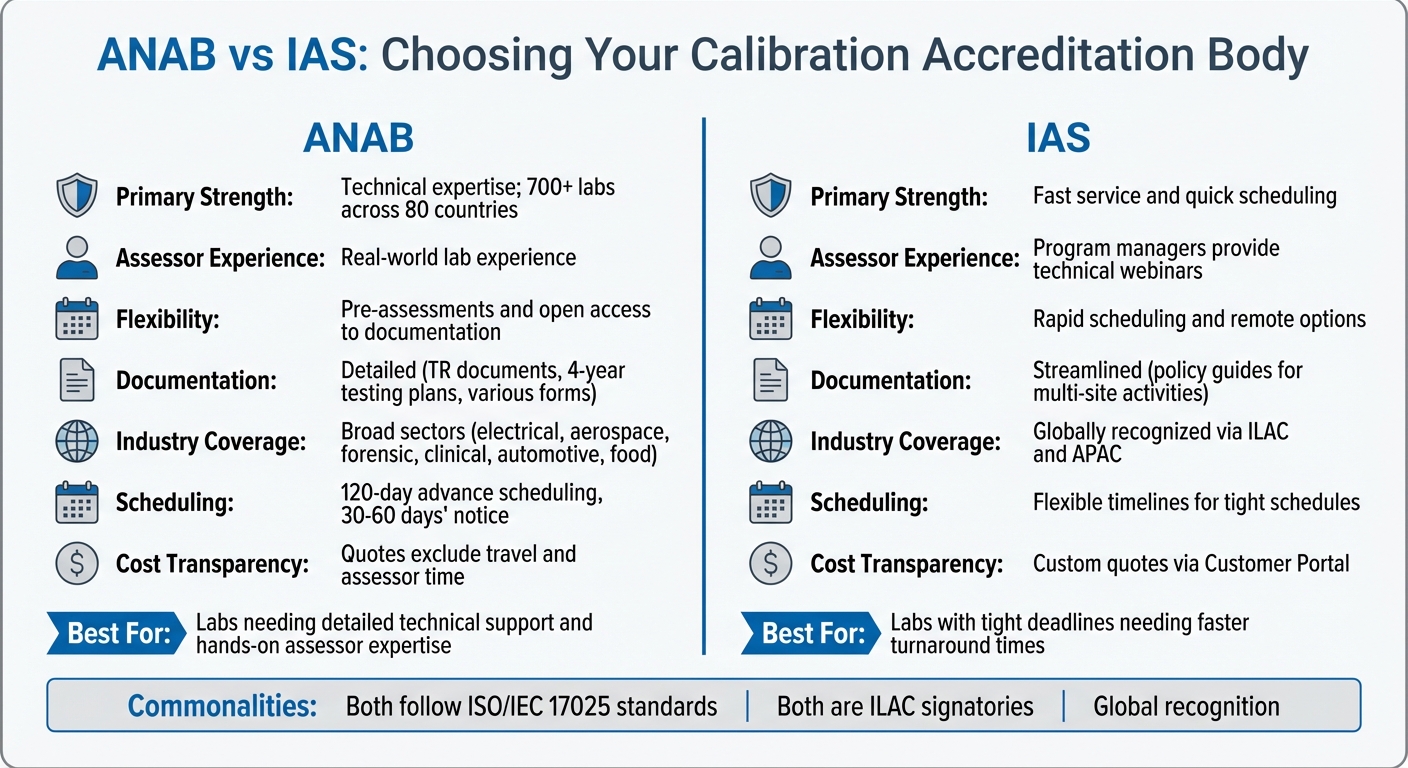
ANAB is known for its technical expertise and its position as the largest multi-disciplinary accreditation body in the Western Hemisphere. With over 700 calibration laboratories accredited across nearly 80 countries, it has established a reputation for reliability in calibrating critical electrical components. One standout feature is the hands-on experience of its assessors. Jeremy Kraft, Senior Manager of Metrology at Alcami, highlights that ANAB assessors all have real-world laboratory experience. This practical knowledge ensures that assessments align closely with actual laboratory operations. ANAB also supports laboratories through preparatory evaluations and provides open access to non-restricted documents, such as assessment checklists, before formal audits begin.
IAS, on the other hand, emphasizes speed and accessibility. It is particularly appealing to laboratories working under tight deadlines, thanks to its ability to schedule assessments quickly. IAS also offers educational resources, including webinars on topics like measurement uncertainty and risk-based thinking, which help laboratories maintain compliance.
The differences between the two organizations extend to documentation and cost transparency. ANAB requires annual proficiency testing within a four-year plan covering the entire accreditation scope. It also provides detailed guidance through Technical Requirements documents like TR 2501. In contrast, IAS offers a more streamlined approach with policy guides such as IAS/TL-CL/031, which address multi-site and off-site activities.
When it comes to costs, ANAB provides quotes that exclude travel and assessor time, while IAS delivers custom pricing through its Customer Portal, though specific details are not publicly itemized. Scheduling practices also vary: ANAB typically plans assessments 120 days in advance, with 30 to 60 days' notice before the visit, whereas IAS is known for accommodating shorter timelines.
| Factor | ANAB | IAS |
|---|---|---|
| Primary Strength | Technical expertise; accredits 700+ labs across 80 countries | Fast service and quick scheduling |
| Assessor Experience | Assessors with real-world lab experience | Program managers provide technical webinars |
| Flexibility | Pre-assessments and open access to documentation | Rapid scheduling and remote options |
| Documentation | Detailed: TR documents, four-year testing plans, and various forms | Streamlined: policy guides for multi-site activities |
| Industry Coverage | Broad sectors: electrical, aerospace, forensic, clinical, automotive, food | Recognized globally via ILAC and APAC |
| Scheduling | 120-day advance scheduling, 30–60 days' notice | Flexible timelines for tight schedules |
| Cost Transparency | Quotes exclude travel and assessor time | Custom quotes via Customer Portal |
Conclusion
Both ANAB and IAS follow ISO/IEC 17025 standards and are ILAC signatories, which ensures their calibration data is recognized worldwide. The key difference between them lies in their approach to service and focus areas.
If you're looking for assessors with hands-on lab experience and detailed technical insights, ANAB might be the better choice. Jeremy Kraft, Sr. Manager of Metrology at Alcami, highlights the importance of peer-level expertise during complex audits. ANAB also offers preliminary assessments, which can be incredibly helpful for new labs to address potential issues before pursuing formal accreditation.
On the other hand, IAS stands out for its quick and personalized service, making it a strong option for labs that need faster turnaround times and expedited assessments.
It's crucial to ensure that your choice aligns with any regulatory or contractual requirements. For instance, certain U.S. federal contracts or industry clients may require accreditation from a specific body or traceability to NIST standards.
Ultimately, your decision should reflect your operational needs. For businesses like electrical equipment traders on platforms such as Electrical Trader (https://electricaltrader.com), verified accreditation is essential to ensure the reliability of products like power distribution equipment, breakers, and transformers. Whether you opt for ANAB or IAS, maintaining accreditation through regular proficiency testing, internal audits, and thorough documentation is key to ensuring accurate measurements and compliance.
FAQs
How do I choose between ANAB and IAS for my calibration lab?
When weighing your options between ANAB and IAS, it's essential to look at their recognition, scope, and acceptance across industries. ANAB stands out as the largest accreditation body in the U.S., with a reputation for upholding stringent ISO/IEC 17025 standards. It is particularly well-regarded in sectors like aerospace and automotive. While IAS is also acknowledged, ANAB's widespread acceptance often makes it the go-to choice for calibration labs aiming to establish global credibility.
What should I look for on a lab’s ISO/IEC 17025 Scope of Accreditation?
When evaluating a lab, check its measurement parameters, calibration methods, and scope of accreditation. These elements demonstrate the lab’s ability to meet ISO/IEC 17025 standards. They also confirm traceability, technical expertise, and adherence to global guidelines. Pay close attention to how well the lab aligns with your specific calibration requirements.
How can I verify NIST traceability on a calibration certificate?
To confirm NIST traceability on a calibration certificate, check for a specific statement that mentions the calibration is traceable to NIST standards. This indicates that the calibration was performed using primary reference standards recognized by NIST.





