




Thermal Conductivity Standards for Electrical Components
Thermal management is critical for the performance and safety of electrical components. Poor heat dissipation can lead to reduced durability, electrical failures, and safety risks. Industry standards like ASTM E3088-25 and ISO 22007-2 provide precise methods for measuring thermal conductivity, ensuring materials meet performance requirements. For example, FR4 is cost-effective but less efficient in heat dissipation, while ceramics like Alumina and Aluminum Nitride offer superior thermal performance for high-power applications. Testing methods, including steady-state and transient techniques, ensure compliance with these standards, helping engineers select reliable materials for transformers, PCBs, and more.
Key Takeaways:
- Thermal conductivity directly impacts the lifespan and reliability of electrical systems.
- Standards like ASTM E3088-25 (2025) and ISO 22007-2 (2022) guide testing for materials like plastics, metals, and ceramics.
- Materials like FR4 (0.25–0.5 W/m·K) are affordable but less effective than ceramics like AlN (170–180 W/m·K).
- Proper testing, using methods like Transient Plane Source (TPS), ensures compliance and material performance.
Understanding and following these standards is essential for sourcing and designing components that handle heat effectively.
📘Thermal Conductivity Explained | Definition | Applications | Measurement | k vs T Trends
sbb-itb-501186b
Standards for Measuring Thermal Conductivity
When it comes to evaluating thermal conductivity in electrical components, three key standards stand out. These methods ensure precise and consistent measurements, forming the basis for engineers to assess material performance effectively.
ASTM E3088-25: Hot Disc Method
Introduced in November 2025 after years of refinement, ASTM E3088-25 uses the transient plane source method with a double-spiral configuration. This standard covers thermal conductivity values ranging from 0.05 W/(m·K) to 500 W/(m·K) and operates across temperatures from 200 K to 600 K. It is versatile, enabling measurements for metals, ceramics, polymers, and composites in a single test.
The standard outlines three specific test methods:
- Method A: For isotropic solid bulk materials.
- Method B: For anisotropic materials like layered circuit boards, which have directional properties.
- Method C: For thin materials with conductivity above 5 W/(m·K).
One of its standout features is that it’s an absolute method, eliminating the need for repeated calibrations against reference samples. This makes it highly efficient and reliable for a wide range of applications.
ISO 22007-2: Transient Plane Source Method
ISO 22007-2:2022, available for approximately $153 USD, is another widely-used standard. While it primarily focuses on plastics, it’s also applicable to various electrical insulation materials. It measures thermal conductivity in the range of 0.010 W/(m·K) to 500 W/(m·K) and handles temperatures from 50 K to 1,000 K.
One of its key advantages is the speed of testing - just a few seconds - which minimizes errors from thermal convection. This is especially important for evaluating liquid or gel-based thermal interface materials used in power electronics. The sensor, made of a continuous double spiral of nickel foil encased in polyimide layers, ensures electrical insulation and mechanical stability during testing.
Here’s a quick comparison of ISO 22007-2 and ASTM E3088-25:
| Feature | ISO 22007-2:2022 | ASTM E3088-25 |
|---|---|---|
| Primary Material | Plastics | All Solids |
| Conductivity Range | 0.010 to 500 W/m·K | 0.05 to 500 W/m·K |
| Temperature Range | 50 K to 1,000 K | 200 K to 600 K |
| Published | Edition 3, 2022 | November 2025 |
NIST Standard Reference Materials
NIST-certified materials, such as austenitic stainless steel and electrolytic iron, play a crucial role in validating thermal conductivity measurements. These Standard Reference Materials (SRMs) ensure traceability and long-term stability, particularly for materials with conductivities between 0.2 and 200 W/(m·K).
Even though transient methods like the Transient Plane Source are considered absolute, SRMs remain indispensable for international standardization. They provide a benchmark for comparison, ensuring that results are reliable and consistent across different laboratories. SRMs are especially valuable in comparative techniques, where they serve as the known reference for measuring unknown materials across a wide range of temperatures.
Accurate measurement standards are the backbone of selecting components that meet strict thermal performance and safety requirements. Up next, we’ll dive into how common electrical materials perform in thermal assessments.
Thermal Conductivity of Common Electrical Materials
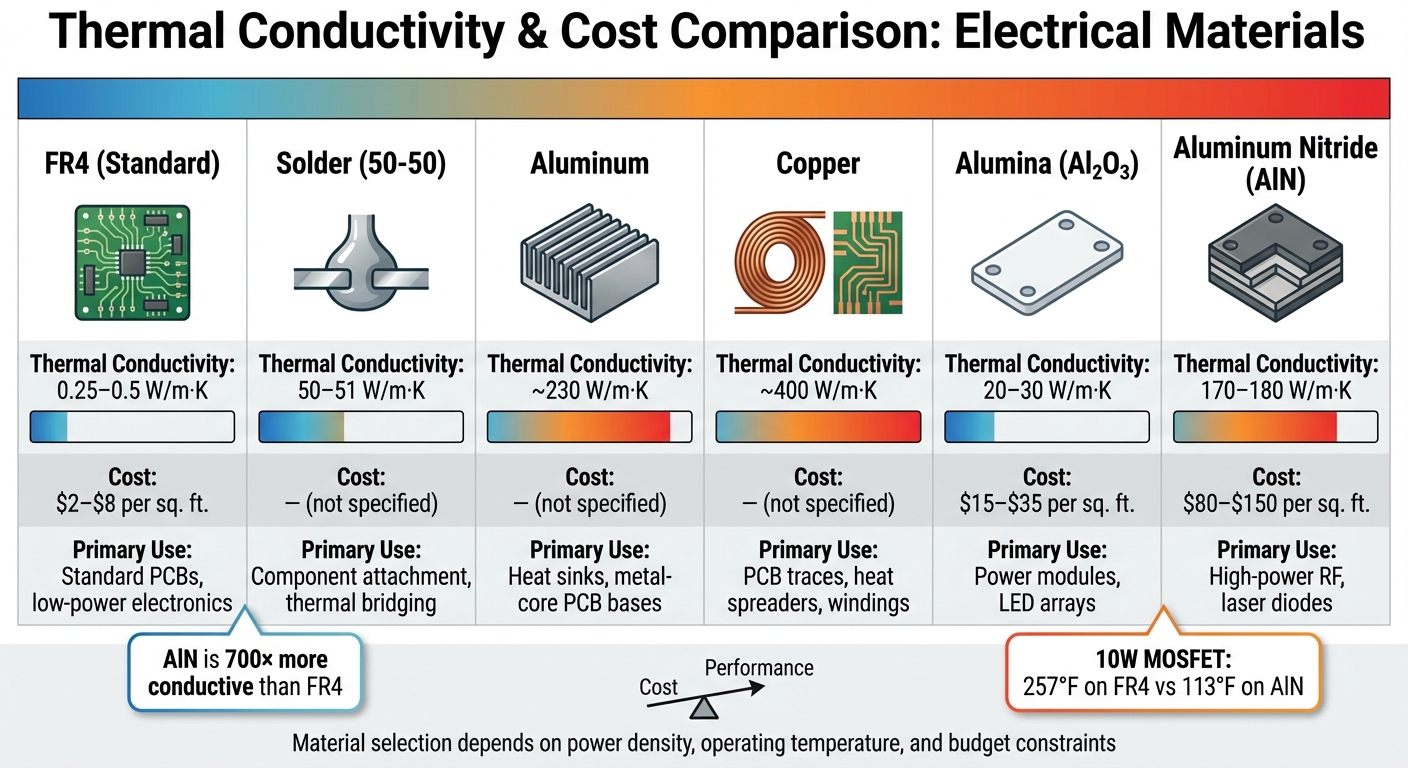
Thermal Conductivity Comparison of Common Electrical Materials
Material selection plays a crucial role in the thermal performance of electrical systems. Thermal conductivity values can vary widely, from 0.25–0.5 W/m·K for FR4 to about 400 W/m·K for copper. These differences directly influence the lifespan, performance, and reliability of electronic components.
FR4 vs. Ceramics: Performance Comparison
FR4 dominates the electronics industry, making up roughly 90% of the market due to its low cost (around $2–$8 per square foot). This material, made from fiberglass and epoxy resin, has a thermal conductivity of 0.25–0.5 W/m·K. However, its insulating nature and anisotropic properties - where heat flows more easily in the plane of the PCB than through its thickness - can lead to localized overheating in high-power components. As Will Li from MOKO Technology explains:
"FR4 is anisotropic, meaning it has different thermal conductivity values in different directions. The thermal conductivity is higher in the plane of the PCB (in-plane) than through the thickness (out-of-plane)."
For applications requiring better heat dissipation, ceramic substrates offer a substantial upgrade. Alumina (aluminum oxide) provides 20–30 W/m·K, while Aluminum Nitride (AlN) significantly outperforms with 170–180 W/m·K - nearly 700 times higher than FR4's lower limit. For instance, under identical conditions, a 10W power MOSFET reached 257°F on FR4 but only 113°F on Aluminum Nitride.
Ceramic materials are more expensive, with alumina costing $15–$35 and aluminum nitride ranging from $80–$150 per square foot. However, their superior thermal performance makes them indispensable for high-power applications like high-power LEDs, automotive electronics, and RF assemblies. These applications often push FR4 close to its thermal limit of 302°F (150°C), while ceramics can handle continuous operation in environments between 572°F (300°C) and 1,112°F (600°C). Additionally, alumina ceramic PCBs can extend the lifespan of LEDs by approximately 30%.
For low-power systems operating in cooler environments (below 110°F), FR4 is sufficient. However, as power density increases, ceramics become essential to prevent overheating and extend component life.
Solders and Metals in Electrical Applications
Metals and solders also play a critical role in heat management. Copper, with its thermal conductivity of about 400 W/m·K, is widely used for PCB traces, transformer windings, and heat spreaders. Increasing copper thickness (e.g., 2 oz or more) further enhances heat distribution across the board.
Aluminum, while less conductive than copper at approximately 230 W/m·K, is a lighter option often used for heat sinks and the bases of metal-core PCBs. However, it requires a dielectric layer to avoid electrical shorts.
Solder serves as a thermal bridge between components and the PCB. A standard 50-50 lead-tin solder has a thermal conductivity of about 50–51 W/m·K. While this is better than FR4, it’s still much lower than copper, making the quality of solder joints critical for effective heat transfer.
| Material | Thermal Conductivity (W/m·K) | Primary Application | Cost per sq. ft. |
|---|---|---|---|
| FR4 (Standard) | 0.25 – 0.5 | Standard PCBs, low-power electronics | $2 – $8 |
| Alumina (Al₂O₃) | 20 – 30 | Power modules, LED arrays | $15 – $35 |
| Aluminum Nitride (AlN) | 170 – 180 | High-power RF, laser diodes | $80 – $150 |
| Copper | ~400 | PCB traces, heat spreaders, windings | - |
| Aluminum | ~230 | Heat sinks, metal-core PCB bases | - |
| Solder (50-50) | 50 – 51 | Component attachment, thermal bridging | - |
As power density in devices like inverters, motor drives, and high-current breakers continues to rise, switching to ceramic substrates or metal-core PCBs becomes increasingly important to prevent thermal failures.
Testing Methods and Equipment for Compliance
Once you've selected your materials, the next step is to ensure they meet industry standards through proper testing. Testing methods generally fall into two categories: steady-state and transient. Each has its own strengths, depending on the type of material and the time available for testing.
Steady-State and Transient Testing Methods
Steady-state methods, such as the Guarded Hot Plate and Heat Flow Meter, involve applying a constant heat source until the temperature stabilizes. These methods are known for their precision, achieving accuracy within ±2%. They are particularly effective for bulk insulation materials or thicker electrical components where full-thickness measurements are required. However, these tests often demand large sample sizes (typically 6″ x 6″ slabs or larger) and meticulous preparation to minimize heat loss through radiation and convection.
On the other hand, transient methods - like TPS (Transient Plane Source), MTPS (Modified Transient Plane Source), and THW (Transient Hot Wire) - use a brief heat pulse and monitor the temperature response. These methods deliver results quickly, often within seconds to minutes, making them ideal for testing smaller samples, as well as powders, liquids, and pastes. Landen MacDonald from C-Therm Technologies explains:
Transient methods offer a powerful approach to measuring thermal conductivity by analyzing a sample's response to a heat pulse.
For thin or less stable materials, ASTM D5470 is often used to measure thermal impedance. When testing rigid components, applying thermal grease between contact surfaces can significantly reduce interfacial resistance and improve the accuracy of the measurements.
These testing methods are crucial for selecting the right equipment to ensure compliance with industry standards.
Thermal Testing Equipment
Specialized equipment complements these testing methods, making compliance verification more efficient. The C-Therm Trident system is a standout example, offering a modular platform that supports multiple transient sensors in one device. It includes MTPS for one-sided plug-and-play testing, TLS (a needle sensor) for powders and pastes, and TPS for double-sided testing of isotropic or anisotropic solids. This versatility ensures accurate thermal testing for a wide range of materials, which is essential for validating components used in high-power electrical systems.
Calibration is another critical factor in certification testing. For instance, ASTM C518 mandates that testing equipment be calibrated with specimens traceable to national standards laboratories within 24 hours before or after a certification test. Heat Flow Meter systems are particularly valued for their simplicity and speed, often achieving repeatability better than ±1%.
Understanding these testing protocols is essential when sourcing materials for electrical components like transformers, breakers, or power distribution systems. Proper testing ensures that the materials meet their thermal performance claims, providing confidence before they are integrated into high-power systems.
How Standards Affect Component Sourcing
Effects on Component Design and Performance
Thermal conductivity standards play a big role in how electrical components perform and last over time. For systems like transformers, motors, or printed circuit boards, standards such as NEMA and IEC 60085 define the maximum operating temperatures insulation materials can handle. Going beyond these limits can speed up insulation aging and lead to failure.
Localized hot spots need special attention. Designers should use a thermal profile that considers ambient temperatures (about 104°F), internal heat rise, and the duration of exposure to guide material choices. For example, every time the temperature at a hot spot exceeds its rated limit by 18°F, the insulation's lifespan can be cut in half.
ASTM D5470 divides materials into three types: Type I (viscous liquids or pastes), Type II (viscoelastic solids like gels or rubbers), and Type III (elastic solids like ceramics or metals). These categories help guide decisions during the design process. For printed circuit boards, standard FR4 substrates provide thermal conductivity between 0.3 and 0.6 W/m·K, but ceramic materials can deliver 20 to 100 times higher conductivity - an edge in high-power applications.
Over-engineering isn't always the answer. For instance, while Class H materials can handle up to 356°F, they’re often heavier and more expensive than Class F materials, which are rated for 311°F. A more practical approach is to combine the ambient temperature with the expected heat rise and then choose the insulation class that fits the actual needs.
These design and performance considerations directly impact sourcing decisions, as discussed next.
Finding Compliant Materials on Electrical Trader
When sourcing components on Electrical Trader, it’s essential to ensure they meet the thermal standards mentioned earlier. Electrical Trader provides a wide range of new and used electrical components, making it easier to compare thermal specifications from various suppliers.
Jesse Galloway from ON Semiconductor highlights the importance of standards:
The primary purpose for adopting and following a standard is to impose a common set of testing conditions so that equivalent results will be measured when the same packages are tested by different labs.
For transformer applications, insulation materials must align with the required thermal class, especially for industrial motors or heavy-duty inverters that demand Class H ratings (356°F). Electrical Trader simplifies this process with categorized listings that let users filter components based on thermal needs. Buyers can also explore alternatives like aluminum-core or ceramic materials when standard FR4 substrates fall short in heat management.
In addition, Electrical Trader’s resource center offers detailed buying guides to help users make informed choices. Whether it’s comparing copper (thermal conductivity of 398 W/m·K) and aluminum (237 W/m·K) for heat sinks or evaluating dielectric liquids for high-voltage transformers, having access to standardized specifications ensures that components meet thermal compliance requirements.
Conclusion
Thermal conductivity standards play a key role in ensuring the reliability and longevity of electrical components. Standardized testing methods like ASTM C518, ISO 22007-2, and ASTM E3088-25 provide a consistent way to compare materials, helping manufacturers strike the right balance. Over-classifying materials can add unnecessary cost and weight, while under-classifying may result in premature aging or electrical failures.
Insulation classes, developed by organizations like NEMA and IEC, provide a structured framework for material selection based on operating temperatures. These classifications guide engineers in creating thermal profiles that address ambient conditions, internal heat generation, and localized hot spots. As noted in ASTM C1058:
Data and information at standard temperatures are necessary for valid comparison of thermal properties.
Accurate thermal measurements are essential for predicting heat flux and ensuring proper performance. Standards like ASTM D5470 categorize materials into Type I (viscous liquids), Type II (viscoelastic solids), and Type III (elastic solids), helping engineers choose the right testing apparatus for specific applications. This consistency not only supports robust designs but also leads to better procurement decisions.
On the sourcing side, platforms like Electrical Trader simplify procurement by offering categorized listings based on verified thermal specifications. Instead of relying on vague claims, buyers can compare materials using established performance metrics. For example, they can choose between copper heat sinks (398 W/m·K) and aluminum (237 W/m·K) or evaluate ceramic substrates with higher conductivity than standard FR4. The platform’s resource center further aids decision-making with detailed buying guides tailored to thermal compliance needs.
FAQs
Which thermal conductivity standard should I use for my material?
The right thermal conductivity standard depends on your material and how it will be used. For electrical insulation materials, ASTM D5470-17(2024) is a suitable choice. If you're working with solid homogeneous materials, ASTM E1225-13 is designed for a broad range of temperatures. For thermal insulation applications, ASTM C518-21 is commonly applied. Additionally, ASTM C1058-10(2023) can guide you in selecting appropriate evaluation temperatures. Be sure to pick the standard that aligns with your specific material and its intended purpose.
When should I choose FR4 vs alumina vs aluminum nitride?
When working with standard electronics that generate low heat, FR4 is a solid choice. It's affordable and can handle temperatures up to around 130°C, making it a practical option for many applications.
For devices requiring better thermal management, such as power electronics, consider alumina. With thermal conductivity ranging from 20 to 35 W/m·K, it performs well in moderate to high heat settings.
In extreme heat environments where top-tier thermal conductivity is essential, aluminum nitride stands out. Offering a thermal conductivity between 170 and 200 W/m·K, it’s ideal for demanding applications, though it comes with a higher price tag. Carefully weigh your priorities - performance, cost, and heat dissipation - when making your selection.
How do I validate thermal test results across different labs?
To ensure thermal test results are reliable, labs engage in inter-laboratory comparisons and equipment calibrations. This process involves multiple labs testing the same specimens using standardized techniques, such as the guarded hot-plate method, to verify consistency in measurements. Additionally, calibration plays a key role - labs use reference materials that are traceable to national standards to fine-tune their equipment. By routinely comparing results and calibrating tools, labs maintain accurate and dependable measurements across different facilities.





