Safety Standards for Mining Transformers
If a mining transformer misses MSHA rules, it can’t be treated as safe to install or move. In U.S. mines, the main checks are simple: proper grounding, fault-current limits, explosion-proof or flameproof enclosures where gas or dust may be present, locked and interlocked access covers, surface-mounted HV breakers for underground feeds, and clear inspection records.
Here’s the short version of what I’d want any buyer, electrician, or mine manager to know right away:
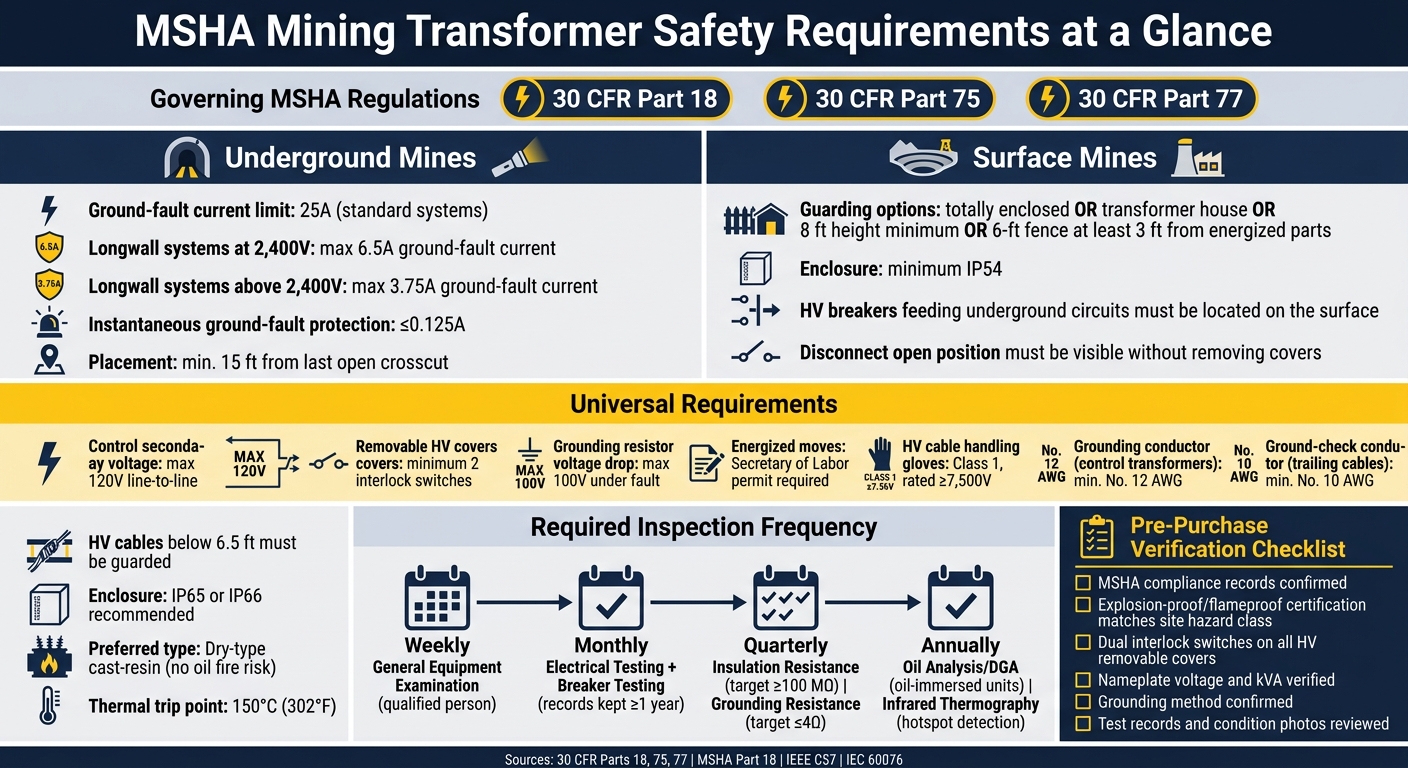
- MSHA is the main rule set for mine transformer safety under 30 CFR Parts 18, 75, and 77.
- Underground mine equipment faces tighter rules because methane, coal dust, moisture, tight spaces, and high fault current can turn a fault into a fire, blast, or shock event.
- Ground-fault limits matter a lot: some underground systems must limit ground-fault current to 25 amps, while some high-voltage longwall systems are limited to 6.5 amps at 2,400 V and 3.75 amps above 2,400 V.
- Control transformer secondary voltage is capped at 120 V line-to-line in the cases covered here.
- High-voltage removable covers need at least two interlocks so power shuts off when a cover is opened.
- High-voltage breakers feeding underground circuits belong on the surface, and workers must be able to verify the open position without removing covers.
- Portable power centers and transformers usually must be de-energized before a move unless a permit allows energized movement.
- Routine records are part of compliance, including examinations, testing, and proof that unsafe equipment was taken out of service.
A few physical checks also stand out. Surface units need guarding such as full enclosures, transformer houses, height separation, or fencing. Underground units must meet placement limits like 15 feet from the last open crosscut and 150 feet from pillar workings. In wet mine areas, buyers often look for IP65 or IP66 enclosures, and longwall thermal protection may trip at 150 °C (302 °F).
If I were boiling the full article down to one point, it would be this: mine transformer safety is not just about the transformer itself - it’s about the enclosure, grounding method, breaker location, interlocks, placement, testing, and paperwork all matching the mine site rules.
The article below walks through those rules, design points, installation checks, maintenance steps, and purchase reviews in plain language.
MSHA Mining Transformer Safety Requirements at a Glance
Regulatory Requirements for Mine Transformer Compliance
How MSHA Rules Apply to High-Voltage Transformers
Under 30 CFR Parts 75 and 77, MSHA lays out the rules for transformer design, guarding, grounding, testing, and energized work in mines. In plain English, these rules take broad mine safety risks and turn them into very specific requirements for high-voltage transformers.
On the design side, high-voltage parts must sit inside enclosures with internal grounded barriers or insulating partitions that separate high- and low-voltage circuits. That separation helps cut shock and arc risk. Each removable cover must also have at least two interlock switches that automatically de-energize the equipment when the cover comes off.
Control-power transformers with a high-voltage primary have their own added rule. They must include grounded electrostatic shielding between windings, and the secondary voltage cannot exceed 120 volts line-to-line.
There are also access limits. Enclosures must stay locked against unauthorized entry.
Grounding rules are just as strict. Grounding resistors must limit grounding-circuit voltage drop to 100 volts or less under fault conditions, which helps control fault energy in mine circuits. For high-voltage longwall systems, neutral grounding resistors must limit ground-fault current to 6.5 amperes or less on systems at 2,400 volts, and 3.75 amperes on systems above 2,400 volts. High-voltage motor and shearer circuits must include instantaneous ground-fault protection set to 0.125 amperes or less.
MSHA also puts tight limits on energized moves. Moving a power center or portable transformer while it is energized requires a Secretary of Labor permit. That applies only when de-energizing would create a greater hazard during maintenance and relocation. And if workers handle energized high-voltage cables, they must wear Class 1 insulated gloves rated for at least 7,500 volts.
How NEC and State Mining Rules Affect Installations
NEC and state mining rules can add installation details, but MSHA sets the mine-specific baseline. For example, circuit breakers that protect high-voltage circuits entering underground areas must be located on the surface, not underground. Their open position must be visible without removing covers, and they must be lockable in the open position to support maintenance. High-voltage circuits supplying underground equipment must also use a resistor-grounded neutral at the source transformer.
Here’s the quick-reference version:
| Requirement Area | Governing Rule | Key Condition |
|---|---|---|
| Surface guarding | 30 CFR § 77.509 | Totally enclosed, enclosed in a transformer house, at least 8 feet above the ground, or surrounded by a 6-foot-high fence located at least 3 feet from energized parts |
| Underground breaker location | 30 CFR § 75.800 | Surface-only; no underground installation |
| Overcurrent/fault protection | 30 CFR § 75.800 | Undervoltage, grounded phase, short circuit, and overcurrent devices required |
| Disconnect visibility | MSHA requirements | Open position verifiable without removing covers |
| Monthly breaker testing | 30 CFR § 75.800-4 | Qualified person; records kept at a surface location for at least one year |
| Control secondary voltage | 30 CFR Parts 18/75 | Maximum 120 volts line-to-line |
sbb-itb-501186b
Design, Grounding, and Protection Standards
Which Design Standards Apply to Mining Transformers
Once MSHA rules are on the table, the next job is picking a transformer that can meet those rules in day-to-day mine use.
Mining transformers must comply with IEEE C57, IEC 60076, and MSHA Part 18 before installation. For high thermal loads, use Class F or Class H insulation. If the unit will run with a VFD, specify a K-factor rating to help limit harmonic-related overheating.
MSHA also sets minimum creepage distances for high-voltage terminals:
MSHA Minimum Creepage Distances for High-Voltage Terminals
| Phase-to-Phase Voltage | Points of Measure | Min. Creepage (in.) CTI ≥500 | Min. Creepage (in.) CTI <175 |
|---|---|---|---|
| 2,400V | Phase-to-Phase | 1.50 | 2.90 |
| 2,400V | Phase-to-Ground | 1.00 | 1.85 |
| 4,160V | Phase-to-Phase | 2.40 | 4.65 |
| 4,160V | Phase-to-Ground | 1.50 | 2.90 |
In methane- or dust-prone areas, use flameproof or increased-safety enclosures that match the site classification.
Grounding and Fault Protection Requirements for Mine Transformers
Insulation and enclosure design matter, but grounding and fault protection are what stand between a fault and a bad day underground.
Use a grounded electrostatic shield with at least No. 12 AWG grounding on control-voltage transformers. Ground-check conductors in high-voltage trailing cables must be at least No. 10 AWG for standard applications, or No. 16 AWG for center conductors. High-voltage mining equipment also needs circuit-interrupting devices that stop automatic re-closure after a fault.
| Protection Device | Primary Function | Key Mining Safety Requirement | Common Use Case |
|---|---|---|---|
| Faraday Shield | Prevents HV-to-LV voltage transfer | Min. No. 12 AWG grounding conductor | Control voltage transformers |
| Interlock Switch | Automatic de-energization on access | At least two switches per removable cover | HV motor-starter enclosures |
| Ground-Check Conductor | Monitors ground wire continuity | Min. No. 10 AWG (standard) | High-voltage trailing cables |
| Circuit-Interrupting Device | Fault isolation | Must prevent automatic re-closure | High-voltage power circuits |
| Grounded-Phase Indicator | Fault detection | Visible to operator; includes test circuit | Onboard ungrounded 3-phase circuits |
Track insulation resistance and grounding resistance during routine inspections. That simple check can catch trouble before it turns into downtime or a safety event.
Physical Safety Features That Improve Mine Transformer Performance
Meeting electrical rules is only part of the job. In a mine, enclosure strength, cooling, and corrosion resistance often decide how long a transformer keeps working.
Ingress protection should be at least IP54 for surface operations. For underground sites or high-moisture areas, IP65 or IP66 is often specified. That makes sense when underground humidity can exceed 85%. To deal with that moisture, some suppliers use epoxy zinc-rich primer coatings at least 80 μm thick to help resist corrosion.
Dry-type cast-resin transformers are often preferred underground because they remove the oil-leak and fire risk. The tradeoff is simple: they still need enough airflow to cool safely.
Mobile units, including power centers and portable substations, need vibration-dampening mounts and skid bases. Blasting, drilling, and frequent moves can punish weak equipment fast. Some higher-end units also include temperature controllers that adjust fan speed or trip the transformer if it overheats.
Installation, Maintenance, and Documentation Practices
How to Install Transformers Safely at Mine Sites
Once you’ve picked a compliant unit, the next step is just as important: installing it the right way. A transformer can meet the rules on paper and still become a problem if the layout is poor. Placement affects safety, access, cooling, and how easy the unit is to service later.
For surface transformers, leave the required clearances in place, keep access locked, and make sure there’s enough working space for service. Danger - High Voltage signs must be posted in clear view on all transformer enclosures. Substation areas also need to stay clear of nonessential combustible materials, refuse, and debris.
Underground transformers face tighter limits. They must be installed at least 15 feet from the last open crosscut and 150 feet from pillar workings. If high-voltage cables are installed less than 6.5 feet above the floor, they must be guarded anywhere people regularly work or pass. These placement and guarding rules should be checked before any mine transformer is energized.
Inspections, Testing, and Lockout Steps for Mine Transformers
Before any maintenance starts, the circuit must be de-energized, locked out, and tagged out. The person doing the work has to apply the lock and tag. If locking can’t be done, the installer or an authorized agent must open and tag the device. For high-voltage circuits, disconnecting devices must be built so workers can confirm the disconnection by visual observation.
Troubleshooting energized circuits calls for extra care. Workers must wear gloves rated for the maximum circuit voltage at all times. Dry insulating platforms or rubber mats should be used at exposed switchboards and stationary machinery.
The checks below help separate day-to-day transformer maintenance from broader site safety work.
| Inspection Item | Recommended Frequency | Regulatory or Standard Reference | Notes |
|---|---|---|---|
| General Equipment Examination | Weekly | W. Va. Code R. § 36-12-4.20 | Must be performed by a qualified person. |
| Electrical Testing | Monthly | W. Va. Code R. § 36-12-4.20 | Records must be kept and made available for audit. |
| Insulation Resistance | Quarterly | Industry best practice | Target: ≥100 MΩ. |
| Grounding Resistance | Quarterly | Industry best practice | Target: ≤4 Ω. |
| Oil Analysis / DGA | Annually | Industry best practice | Helpful for oil-immersed units. |
| Infrared Thermography | Annually | Industry best practice | Checks for hotspots and loose connections. |
For oil-immersed units, annual oil sampling and dissolved gas analysis can help spot internal faults before a failure happens. Annual infrared thermography is also useful for finding overheating at busbar connections and bushings.
Which Records Support Compliance and Safe Operation
Good records do more than fill a binder. They show what was inspected, what was tested, what went wrong, and what got fixed. Mine operators must keep records of weekly examinations and monthly tests for all electrical equipment. Those records must be readily available to authorized representatives of safety directors and to miners.
If power centers or portable transformers are moved while energized, operators must also keep a record of the qualified person’s examination completed before the move. That step matters because moving energized equipment changes the risk picture fast.
A complete documentation package should include:
- Test reports
- Inspection logs
- One-line diagrams
- Wiring diagrams
- Manufacturer manuals
For explosion-proof enclosures, MSHA-accepted QA procedure records are also required. Those records confirm that the physical parts match the approved engineering drawings. Any unsafe condition should be documented, and the equipment must be removed from service until the issue is corrected. These same records are also useful when reviewing replacement equipment and procurement submittals.
Selecting Compliant Mining Transformers and Key Takeaways
What to Check Before Buying a Mining Transformer
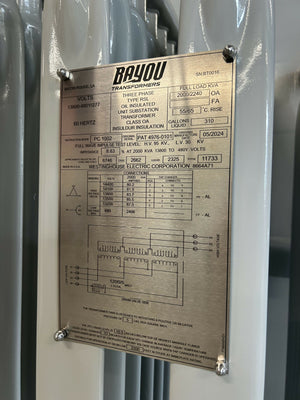
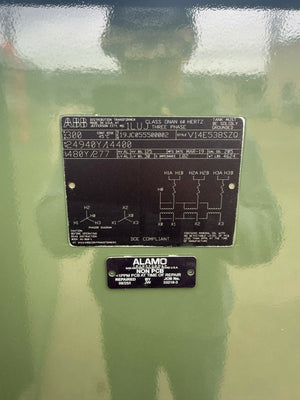
Once you've reviewed maintenance records and installation controls, the last step is simple: buy equipment that already fits the site's rules. Before you purchase a mining transformer, check the nameplate, certification, voltage, kVA, grounding, interlocks, and test records. If the transformer doesn't meet site requirements, you're taking on safety and compliance risk that could have been avoided.
Here are the main purchase-stage checks:
| Specification / Feature | Buyer Verification |
|---|---|
| Nameplate & Certification | Confirm MSHA compliance records and explosion-proof certification markings |
| Enclosure Rating | Verify flameproof or explosion-proof certification matches the site hazard classification |
You should also confirm that all removable covers on high-voltage compartments have dual interlock switches that automatically de-energize the unit when opened. For used units, ask for condition photos and test records before you move forward.
How Electrical Trader Can Support Equipment Sourcing
Use that same checklist when reviewing listed equipment. Electrical Trader is an online marketplace for new and used electrical equipment, including transformers and power distribution components. It can help you narrow down options, but the listing alone isn't enough. Review each candidate transformer carefully, then verify the nameplate data, enclosure condition, service history, and test records before purchase.
Conclusion: Core Safety Points to Review on Every Project
Before the unit reaches the site, do one last compliance check. Before installation, confirm MSHA compliance, grounding, interlocks, and complete test records. The paperwork, the equipment, and the installation all need to match before energization.
MSHA Part 46 - Working with Electricity at a Mine
FAQs
What makes a mining transformer MSHA-compliant?
A mining transformer is MSHA-compliant when it meets strict safety and design standards.
For control voltage transformers, that means grounded electrostatic shielding between the primary and secondary windings, and control voltages limited to 120 volts.
It also calls for enclosures that keep high- and low-voltage parts separate, along with proper interlocks, explosion-proof construction, and ground-fault protection for hazardous underground conditions.
When can a transformer be moved while energized?
Under federal mining regulations, power centers and portable transformers must be de-energized before they’re moved.
There’s one exception. They can be moved while still energized only if the Secretary determines that shutting off power would create an equivalent or greater hazard.
If that happens, a qualified person has to oversee the move. That person must:
- inspect the unit before it’s moved
- make sure it’s properly grounded
- make sure proper protection is in place
There’s also a strict rule for high-voltage cables. Energized high-voltage cables may be moved only by a qualified person who is wearing approved, tested insulated wireman’s gloves.
What records should we keep for compliance?
To stay compliant for high-voltage transformers in underground coal mines, operators need to keep a formal record of every required safety exam in a book approved by the Secretary.
It also makes sense to keep the supporting technical paperwork close at hand. That includes product design drawings, factory test reports, and operation manuals. These documents help back up safety certifications and day-to-day operating standards.